Now Reading: Larry Bell turns Madison Square Park into a public laboratory of light
- 01
Larry Bell turns Madison Square Park into a public laboratory of light

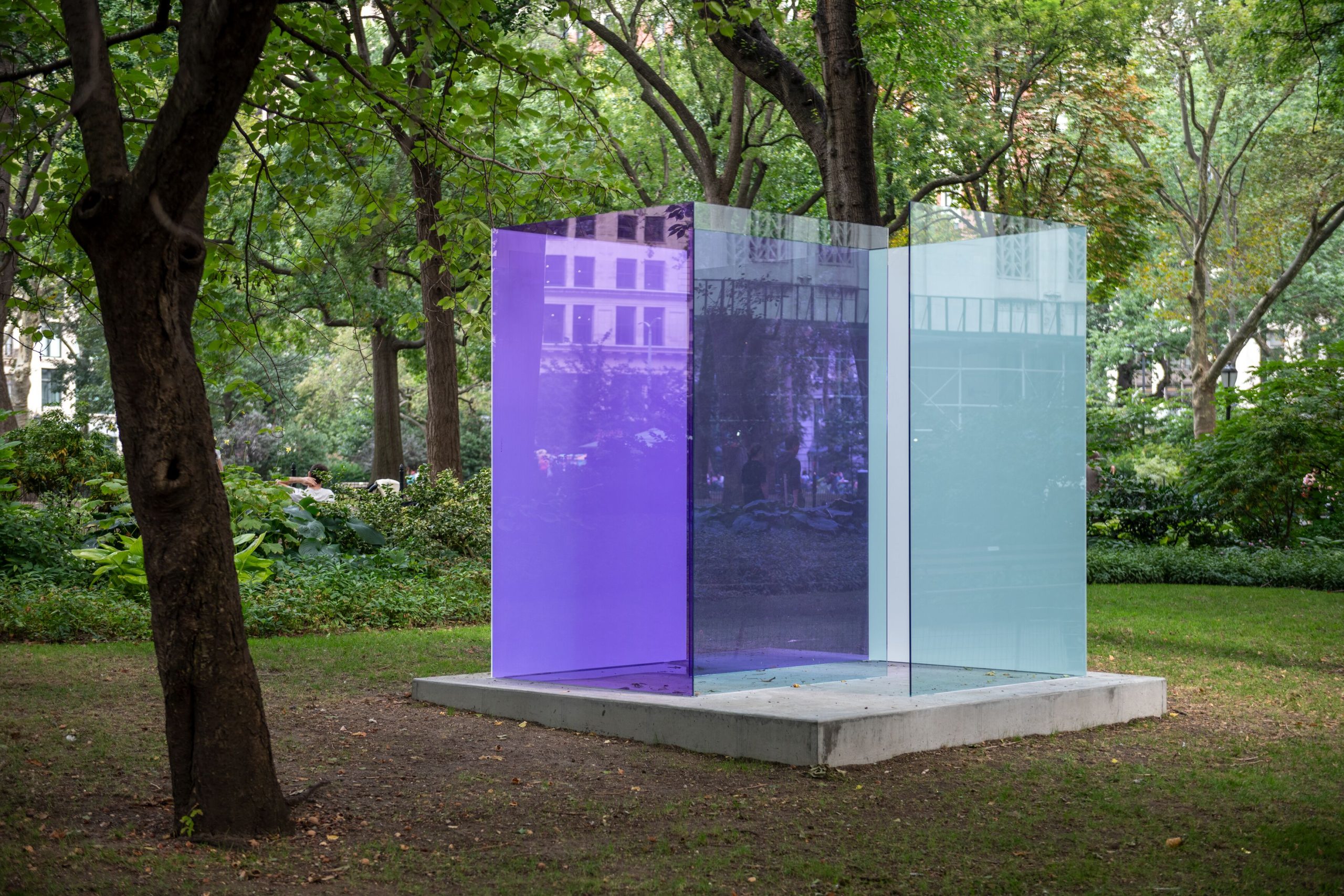

Six monumental glass works by Larry Bell spread across six lawns in Madison Square Park, shifting from colour-block to mirror-field as the sky changes and viewers move. In his largest outdoor project to date and first public commission in New York, Bell extends a decades-long inquiry into surface and perception, making the city itself an active collaborator.

ILLUMINATING SPACES: THE ENDURING VISION OF LARRY BELL
In the first months of 2026, Madison Square Park feels unusually alert to its own light. Winter strips the lawns back to their simplest state, sky, grass, architecture, moving bodies. Into that clarity, Larry Bell places six glass sculptures that do not so much decorate the park as recalibrate it. They stand across six lawns like instruments left out in the open, ready to register whatever the day brings. From one approach, they read as saturated presences, blues that cool toward violet, reds that drift toward purple. From another, they turn into mirror-fields, catching the surrounding towers, bare branches, and pedestrians so cleanly that the boundary between artwork and environment starts to feel negotiable.
The project is Improvisations in the Park (30 September 2025 to 29 March 2026), Bell’s largest outdoor installation to date and his first public commission in New York. Organized by the Madison Square Park Conservancy in collaboration with Hauser & Wirth, it brings together four of Bell’s glass cube sculptures and two newly made standing wall works, one six feet tall and one eight. Two of the cubes have never been exhibited before. The title’s reference to music is more than atmosphere. It names the underlying structure of Bell’s practice: an insistence that the work is never a single picture. It is a set of conditions that remain in motion, because the world remains in motion.
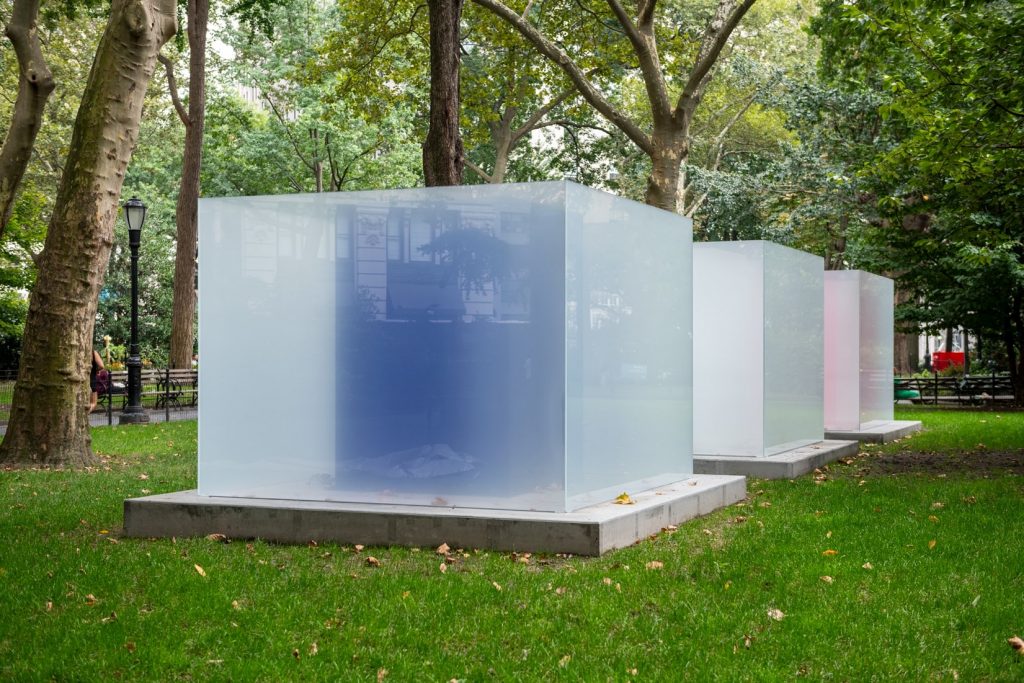
Bell’s surfaces are not theatrical. They do not “perform” in the obvious way that contemporary public art often does, engineered for the camera and for quick consumption. Instead, they do something quieter and more enduring. They make you notice how looking actually happens. A cube that appears almost opaque in one light can loosen into transparency in another. A panel that looks like a solid block of color can become a pale mirror as cloud passes overhead. The sculptures shift with weather and hour, but they also shift with you. Your angle, your distance, and the speed of your movement become part of the piece. In a city that trains attention to skim, Bell’s work rewards the opposite instinct. It invites you to slow down just enough to realize that perception is not passive. It is collaborative.
That collaboration is the main thread through nearly seven decades of Bell’s work. His art is often filed under the Light and Space rubric, alongside Southern California contemporaries who turned perception into subject matter. Yet Bell has long resisted tidy labels. “I do not believe there is a Light and Space movement,” he has said, arguing that “light is everywhere” and “space is everywhere.” The point is not contrarianism. It is clarity. Bell’s work is not about belonging to a category. It is about making visible the basic fact that everything we see arrives as light meeting a surface.
LOS ANGELES AS A TRAINING GROUND
Bell was born in Chicago on 6 December 1939 and moved to Los Angeles with his family in 1945, a shift that placed him inside a city built on bright atmospheres and manufactured skins. Postwar Southern California was a landscape of reflective materials and industrial processes, aircraft, cars, glass storefronts, anodized metal, and the soft, constant pressure of sunlight. Even the city’s myths, cinematic glamour, the promise of reinvention, are myths of surface. It is not hard to see why an artist formed there might develop a lifelong sensitivity to how a surface behaves, and to how that behavior shapes emotion as much as vision.
Bell studied at the Chouinard Art Institute from 1957 to 1959, in an environment where the boundaries between disciplines were already porous. His early ambitions moved through drawing, painting, and design, but what he began to seek could not be held by painting alone. Painting presumes a stable plane. Bell’s curiosity pulled him toward planes that were not stable, planes that could hold space, that could catch and return the world, that could tilt between revelation and concealment.
By the early 1960s, he was part of the artist community orbiting Ferus Gallery, the small Los Angeles space that helped the city claim its own gravity in American art. Ferus was less a style than an attitude. Artists there did not wait for permission from New York. They worked with what was around them, industrial materials, commercial fabrication, the city’s particular relationship to technology and illusion. Bell was young but quickly recognized. In 1962 he became the youngest artist to have a solo exhibition at Ferus, and his work already pointed away from gesture and toward construction.
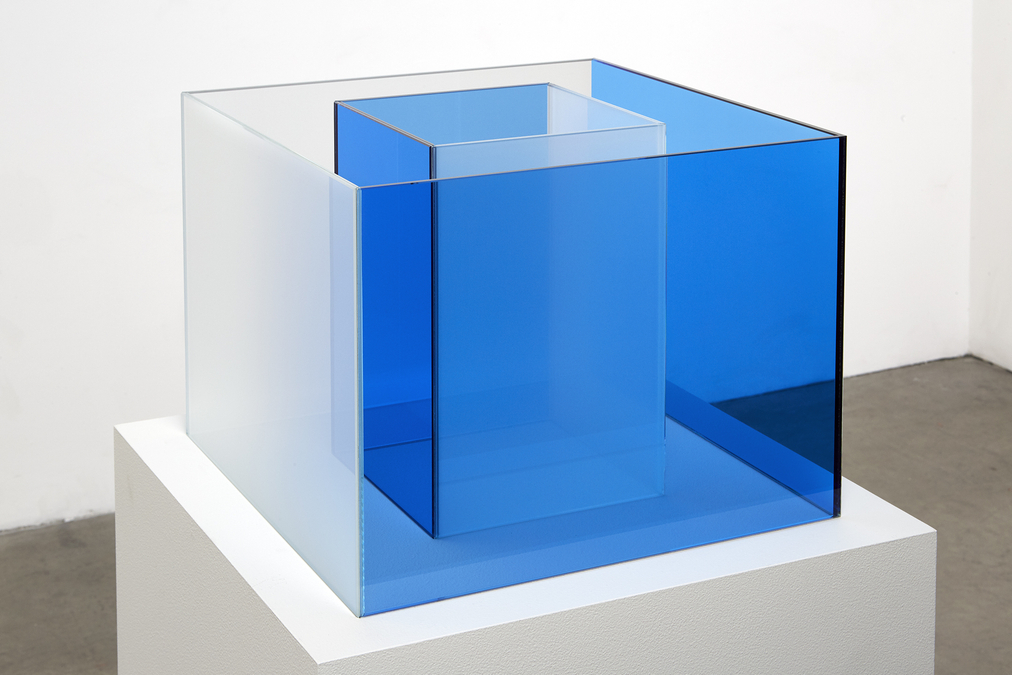
Those early constructions, often described as boxes, were significant not because they simply forecast the later cubes, but because they reveal Bell’s instinct for ambiguity. Using glass, mirrors, wood, metal, and other materials, he began to build objects that could not be comfortably read as either painting or sculpture. They were devices for producing a perceptual complication. Depth appeared where it should not. Reflection cancelled interior space, then suddenly exposed it again. The viewer’s movement activated the work. The object became less a thing to look at and more a situation to enter.
This is the quiet radicalism Bell brings to minimal form. He uses geometry not to declare certainty, but to stage uncertainty. A simple shape becomes a pressure test for the eye.
A PHILOSOPHY BUILT ON SURFACES
Bell’s mature work can look austere at first glance. Cubes and planar walls, glass and thin-film coatings, clean edges, controlled color. Yet the experience is rarely austere. It is often tender, even playful, because the work is not trying to dominate you. It is trying to make you present.
A second Bell statement captures this better than any theoretical frame: “Art is about feeling.” The line is simple, almost disarming, and it runs against the assumption that perceptual art is clinical. Bell’s light is never just an optical phenomenon. It is an emotional one. The work does not tell a story, but it produces a mood. A faint shift from blue to purple can make the air feel colder or warmer. A surface that briefly turns into a mirror can pull the park into the work and, for a moment, pull you into the park differently too.

This is where Bell diverges from the more doctrinaire edges of Minimalism. The cube, for Donald Judd, could be a proposition about objecthood, a statement that insists on its own literal presence. Bell’s cube is literal in form but not in effect. The surface keeps undoing the cube’s certainty. Sometimes it feels like a container of light. Sometimes it feels like a cut-out in the landscape. The cube stays the same, yet the experience is never the same.
Bell’s refusal to be boxed in by a movement label also marks a larger refusal: he will not reduce perception to a style. Light is not a “look.” Space is not a “topic.” They are the conditions of our lives. The work makes those conditions concrete, then returns them to you.

THE TECHNICAL LEAP THAT MADE IT POSSIBLE
The particular behavior of Bell’s glass is not incidental. It is the result of a technical pursuit that began in the 1960s and became foundational to his practice. Bell began working with thin-film deposition techniques, industrial processes adapted to the studio. By coating glass with extremely thin layers, often using inconel-based coatings and related materials, he could tune the way a surface reflects, absorbs, and transmits light. The result is not a stable tint, like stained glass, but a shifting threshold. Color can seem to sit on the surface, then move backward into depth. A plane can read as mirror from one position and as window from another.’

It is worth being precise about what this does to the viewer. Bell’s glass does not merely show you a scene. It reorganizes the scene. It sets up competing signals, transparency versus reflectivity, saturation versus clarity, and lets your body resolve them moment by moment. This is why photographs often feel like partial evidence rather than documentation. A camera records one condition. The work is made of conditions.
This technical mastery also explains Bell’s fidelity to simple forms. A cube gives the surface room to operate. It does not distract with expressive complexity. It sets the stage, then lets light do the speaking. Bell has described his cube as a kind of scaffold, a structure that allows the real subject, perception, to unfold.

In the late 1970s, Bell extended this language to works on paper, the vapor drawings, where related deposition processes produce shimmering gradients across a flat support. These works carry the same refusal of fixity. They change as you move, as if the drawing is unwilling to be pinned down into one image. In a smaller register, they reveal what the glass sculptures do at scale: surface is not a skin. It is an event.
TAOS, DISTANCE, AND THE DISCIPLINE OF IMPROVISATION
In 1973, Bell moved to Taos, New Mexico, while continuing to maintain a studio in Venice, California. The move is often described as a retreat, but it is better understood as an expansion of his vocabulary of light. Taos offers a different intensity. Desert light can be sharp and indifferent, less filtered than coastal atmosphere. Shadows feel carved. Colors behave differently. Time in the landscape is measured in wider units, not by traffic cycles but by weather and season.
Living between these two environments sharpened Bell’s sense of contingency. The work could no longer be imagined as a stable object in a neutral space. It was always going to be a negotiation with conditions. This is where the idea of improvisation becomes precise. Improvisation is not casualness. It is an attentive responsiveness backed by deep control.
Bell’s fabrication is exact. The edges are disciplined. The surfaces are the product of careful testing. And yet the experience remains open, because the work is designed to receive the world rather than replace it. It is a kind of generosity that feels rare in an era of spectacle. Bell’s sculptures do not compete with their surroundings. They invite the surroundings in.
MILESTONES, WITHOUT MYTH
Bell’s career has been marked by major exhibitions and institutional recognition, but his work does not rely on those markers for its authority. The core argument is consistent, and it has remained consistent because it is rooted in the fundamentals of perception.
In 1966, Bell was included in Primary Structures at the Jewish Museum in New York, a landmark exhibition often associated with the rise of Minimalist sculpture. The context is significant. Bell’s glass, with its shifting thresholds, entered a conversation dominated by solid industrial form. His cubes offered another kind of “primary” structure, one that questioned solidity rather than affirming it. They were not about mass. They were about atmosphere.
In 1970, Three Artists from Los Angeles at Tate brought attention to the distinct perceptual inquiries developing in Southern California. Bell’s work served as evidence that reduction in form could lead not to austerity, but to heightened sensation. The international reception mattered, but not as a stamp of approval. It widened the audience for a proposition that was already clear in the studio: perception can be treated as a serious subject, with serious consequences for how we understand experience.
Across subsequent decades, Bell developed the cube and wall forms into larger configurations and installations, sometimes modular, sometimes architectural in implication. He also moved into other materials. Bronze appears in bodies of work that draw on ancient mythic structures, yet even there the deeper interest remains the same: how form and surface shape the viewer’s sense of time and presence.
Recent museum surveys have returned to Bell not as a historical footnote, but as an artist whose work continues to clarify something essential. The exhibition Larry Bell: Improvisations at the Phoenix Art Museum (May 2024 to January 2025) and later at the San Antonio Museum of Art (August 2025 to January 2026) traced collages, sculptures, and works on paper across decades, emphasizing continuity rather than reinvention. Bell’s optical language has not aged into nostalgia because it does not depend on a period style. It depends on the physics and psychology of seeing.
Bell’s recognitions are part of this story, but they sit properly as context rather than climax. He received a Guggenheim Fellowship in 1970 and the New Mexico Governor’s Award for Excellence in the Arts in 1990. These are signals of esteem, but the work itself remains indifferent to prestige. It keeps returning to the simplest proposition: look again.
MADISON SQUARE PARK AS A CIVIC INSTRUMENT
What distinguishes Improvisations in the Park is not only scale, though the scale matters. It is also the shift in audience. In a museum, perceptual art can become a specialized encounter. You go looking for it, often with a sense of expectation. In a park, it becomes part of daily movement. It meets people at the pace of ordinary life, and it does not demand that they adjust. It simply offers a new possibility inside the familiar.
The installation’s distribution across six lawns creates subtle differences in framing. One work might catch more sky. Another might be edged by buildings. Another might hold the reflections of trees more insistently. Bell’s sculptures, placed this way, feel less like a single statement than a set of propositions. They demonstrate that the same material system can produce different perceptual results depending on context.

The two standing wall sculptures are particularly effective in this setting because they change the body’s relationship to the work. A cube holds space in a concentrated volume. A wall stands as a threshold, something you approach as you would approach architecture. It catches the city in broader slices. It includes your reflection at full height, then releases it again as you shift. In the park, that experience has a social dimension. You see other people reflected, layered into the work, and then you see them step out of it. The sculpture becomes a public surface in the oldest sense: a place where the city appears to itself.

Bell’s best moments often arrive without announcement. They are small, precise, and difficult to reproduce in language. A surface that seemed dark suddenly clears, revealing the park through a faint tint. A color gradient thickens as the sun drops, as if the glass has gained weight. A passerby slows, not because they have decided to look at art, but because something has made their vision hesitate.
Late in the afternoon, when the light is low and the park begins to cool, one cube can read almost like a calm block of color. Walk ten steps and it turns into a mirror that pulls a building’s vertical edge into its plane with unsettling clarity. Walk ten more and the edge slides away, replaced by the soft mesh of branches. Nothing about the object has changed. Everything about the world has changed, including your position in it. The work has simply made that change visible.
ENDURING, BECAUSE IT STAYS BASIC
It is tempting to claim that Bell’s work “anticipates” the digital age, that his shifting surfaces prefigure screens and augmented realities. There is some truth in the comparison, but it can also miss what makes his work distinctive. Bell does not simulate perception. He stages it. He uses real light and real materials to reveal that the world is already unstable, at least as far as sight is concerned.
This is why his work remains current. Not because it has adapted to new media, but because it refuses to let perception become automatic. In a culture that treats images as consumables, Bell’s surfaces ask for a different kind of engagement. They do not overwhelm you with content. They offer you a condition. They remind you that seeing is a relationship, and relationships require attention.

Madison Square Park, with its constant flow of people and its shifting urban light, is an unusually honest site for this reminder. Bell’s sculptures sit there without spectacle, receiving whatever the city offers: glare, shadow, cloud, the brief flare of sun between buildings. They do not impose an image on the park. They take the park seriously, and in doing so they make the park feel newly visible.
Near the southern paths, as the park lights begin to click on and the benches fill with people waiting out the last pale minutes of day, one of the standing walls holds a thin, wavering slice of the city. A couple passes and their reflections stitch briefly into the surface, then break apart. The lights from a nearby window appear as small, soft rectangles, then fade as the angle changes. For a moment, the panel reads like a darkened screen. Then a gust moves the branches above it, and the surface brightens, catching the last light as if it has been saved.
It is a modest moment, easy to miss. That is also the point. Bell has spent a lifetime insisting on a quiet but radical idea: light is not merely what reveals objects. It is what complicates them. His glass does not promise certainty. It offers attentiveness. It turns a public park, briefly and without fanfare, into a place where looking feels newly deliberate.

REFERENCES
- Madison Square Park Conservancy, Larry Bell: “Improvisations in the Park” (exhibition overview, dates, scope). (Madison Square Park Conservancy)
- Ocula, Larry Bell Talks Spontaneous Improvisation (source for the “Light and Space movement” quote and Bell’s framing). (Ocula)
- Phoenix Art Museum, Larry Bell: Improvisations (exhibition dates, curatorial framing). (Phoenix Art Museum)
- San Antonio Museum of Art, Larry Bell: Improvisations (exhibition dates; installation details). (South Australian Museum)
- LarryBell.com, Selected exhibitions PDF (Guggenheim Fellowship listed as 1970; exhibition history). (Larry Bell)
- Tate (Michael Compton), Three Artists from Los Angeles (1970 archival essay/context). (Tate)
- The Jewish Museum, The Jewish Museum Remembers Kynaston McShine (mentions Primary Structures with original 1966 dates). (stories.thejewishmuseum.org)
Photo Cover
Installation view of Larry Bell’s Improvisations in the Park at Madison Square Park, New York, 2025–2026, featuring vibrant glass cubes and standing walls that shift with light and viewer movement. Credit: Photo: Timothy Schenck. Courtesy the artist, Hauser & Wirth, and Anthony Meier, Mill Valley. Commissioned by Madison Square Park Conservancy.