Now Reading: Office building in Jaipur features perforated jaali screens and inclined terraces
-
01
Office building in Jaipur features perforated jaali screens and inclined terraces

Office building in Jaipur features perforated jaali screens and inclined terraces

URBAN INSERTION IN A DENSE COMMERCIAL CONTEXT
Situated along one of Jaipur’s busiest arterial roads, this office building introduces the first contemporary development within a neighborhood largely defined by older commercial structures. Rather than imposing an isolated architectural gesture, the project seeks to establish a dialogue between contemporary workplace requirements, the climatic realities of Rajasthan, and the region’s long-standing architectural traditions.

The building occupies a compact urban plot surrounded by high-density development and intense vehicular movement. In response, the design strategy focuses on creating an environment that is both flexible for commercial use and protected from the harsh climatic conditions characteristic of Jaipur’s hot and dry environment.


At ground level, the building opens toward the street with a restaurant and conference facility, introducing an active public interface that contributes to the urban life of the neighborhood. Above, the building transitions into a series of office floors designed to accommodate a variety of workspace scales.

FLEXIBLE PLANNING AND STRUCTURAL CLARITY
The internal organization is structured around a rational planning system that prioritizes flexibility. Service areas and the main circulation core are positioned along the southern edge of the building, allowing the remainder of each floor plate to remain unobstructed.

Structural columns are placed along the perimeter, ensuring that office spaces can be configured according to evolving tenant requirements. This arrangement enables a range of workspace formats, from smaller office suites on the lower floors to larger and more open office environments on the upper levels.


Such spatial adaptability reflects contemporary workplace needs, where companies increasingly seek environments capable of evolving over time without major structural alterations.
INCLINED VOLUMES AND OUTDOOR TERRACES
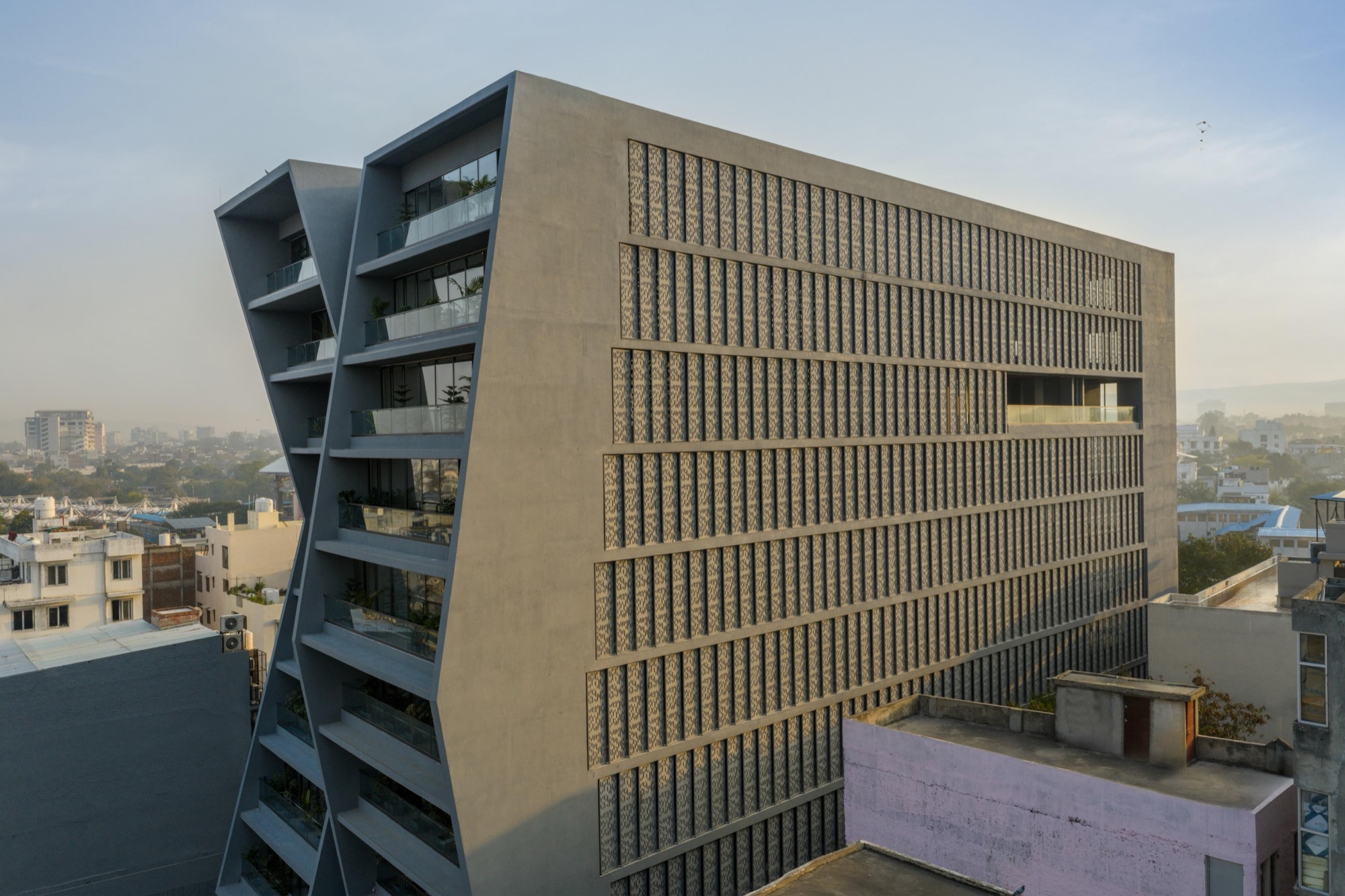
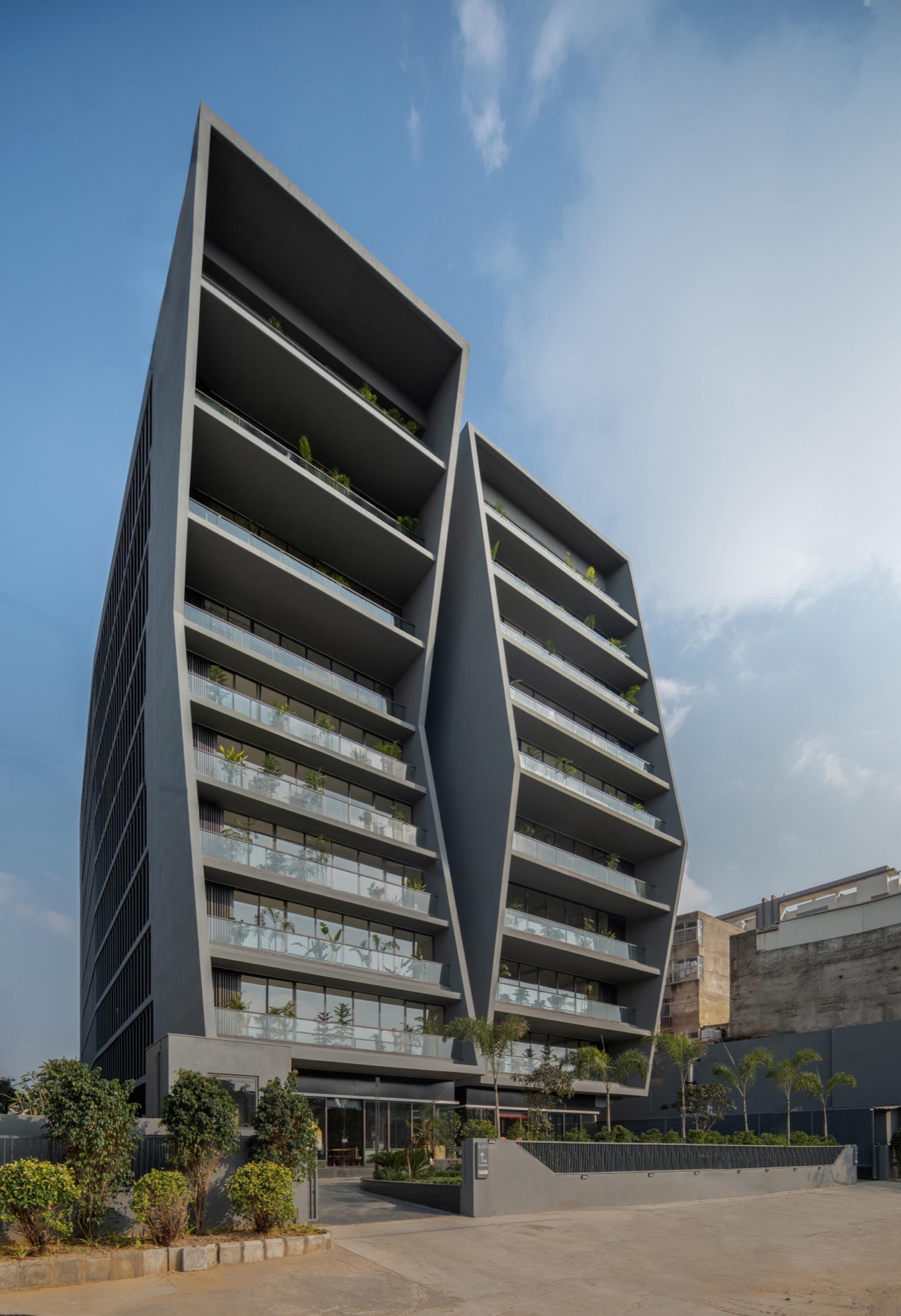
Facing the main road on the western side, the building adopts a distinctive volumetric strategy. The facade inclines both forward and backward, generating two vertically articulated masses with opposing angles.


This formal maneuver produces a series of sheltered outdoor decks at every level. These terraces not only extend the usable workspace outdoors but also provide visual relief within the dense urban fabric.
The opposing inclines also introduce subtle spatial separation between adjacent terraces, ensuring privacy for different office users while maintaining a cohesive architectural composition.

REINTERPRETING THE TRADITIONAL JAALI
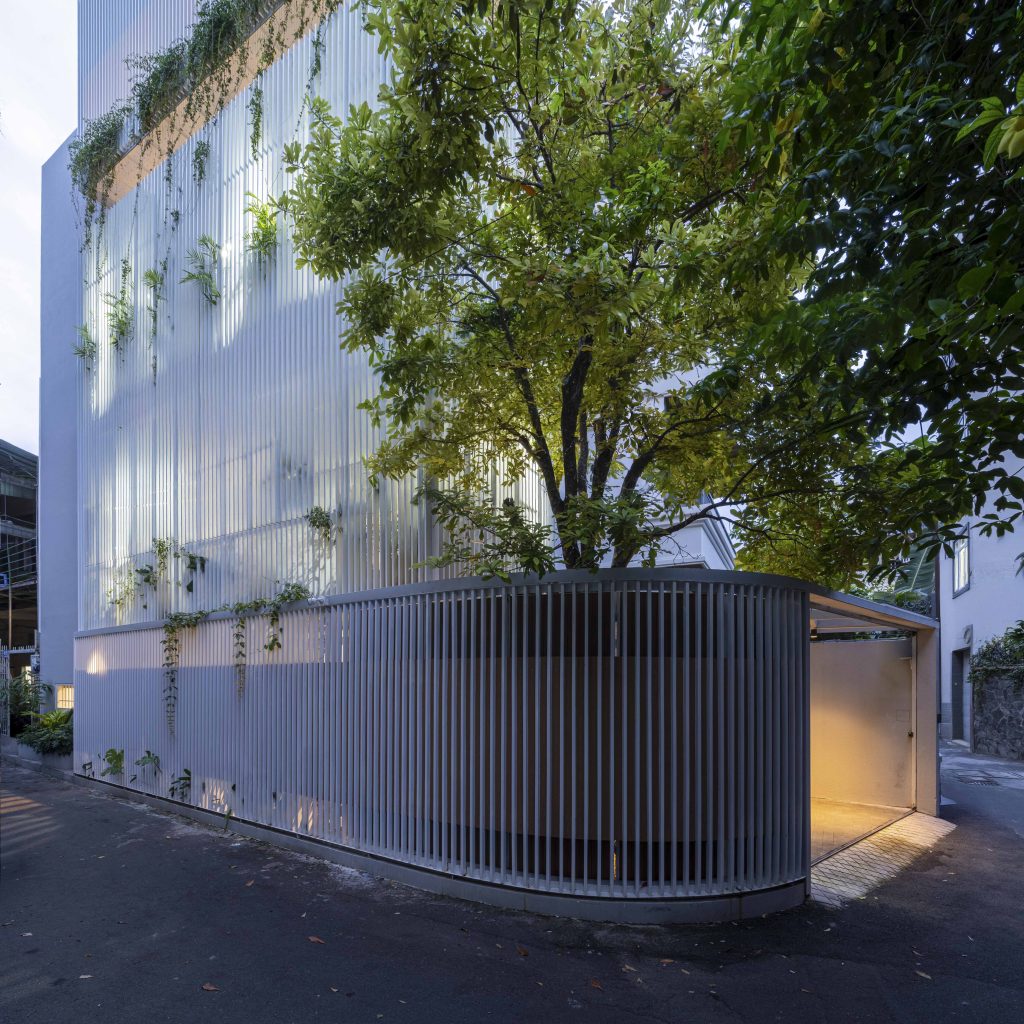
A defining feature of the project is the envelope that wraps the building’s lateral facades. Inspired by the traditional stone jaali screens widely found in Rajasthan’s historic architecture, the project reinterprets this element through contemporary materials and construction techniques.


Perforated screens fabricated from lightweight foam concrete form a secondary skin around the building. The material itself is composed primarily of recycled components, reducing environmental impact while providing effective thermal insulation.
Beyond their environmental performance, the screens act as a climatic filter. By mediating sunlight before it reaches the glazed facade, the jaali-inspired layer softens solar exposure and contributes to a cooler interior environment.


VEGETATION AS ACOUSTIC AND CLIMATIC BUFFER
Between the perforated screen envelope and the glazed facade, a continuous planter zone measuring approximately three feet in width runs along the building perimeter.
This planted buffer performs several functions simultaneously. It introduces a layer of vegetation that softens the architectural envelope, filters dust and noise from the busy roadway, and enhances the visual quality of the workspaces.

From inside the offices, occupants experience a green edge between interior and city, a subtle but meaningful intervention in an otherwise dense urban setting.


PASSIVE CLIMATE STRATEGIES AND ENVIRONMENTAL PERFORMANCE
Jaipur’s climate demands careful architectural responses to heat and solar exposure. The recessed terraces and perforated screens function as passive shading devices that reduce direct solar gain on the building envelope.
By minimizing heat infiltration, these elements significantly lower the demand for mechanical cooling. As a result, the building achieves improved energy efficiency and reduced operational carbon emissions over its lifecycle.

Material choices further reinforce the project’s environmental strategy. The structure combines an RCC frame with fly ash brick masonry, utilizing industrial by-products to reduce reliance on conventional clay bricks.
Additional sustainability measures include rainwater harvesting systems, water recycling infrastructure, and rooftop solar panels. Together, these strategies reduce the building’s environmental footprint while aligning with broader goals of responsible urban development.

CONTEMPORARY ARCHITECTURE ROOTED IN REGIONAL IDENTITY
In a rapidly evolving urban context like Jaipur, the challenge often lies in balancing modernization with cultural continuity. This office building addresses that challenge through an architecture that draws inspiration from local traditions without replicating them literally.
The reinterpretation of the jaali screen, the integration of passive climate responses, and the introduction of greenery within the building envelope collectively form an approach that is both contemporary and regionally grounded.
Rather than presenting a generic commercial structure, the project proposes a workplace architecture shaped by climate, context, and cultural memory. The result is a building that contributes a new architectural identity to the area while remaining deeply connected to the spatial intelligence of Rajasthan’s historic architecture.
Project Credit
Project name: Mahima Magnus Office
Location: Tonk Road, Jaipur, Rajasthan, India
Design firm: Sanjay Puri Architects / @sanjay_puri_architects
Plot Area: 2390.80 sqmt. /25,734 SQFT.
Built-up Area: 15646 sqmt./1,68,413 SQFT.
Date of completion: December 2025
Photo: Vinay Panjwani / @panjwani.vinay