Now Reading: Fragrance with Lotus flowers: A mist of timber lines choreographs Japanese dance in Tokyo
- 01
Fragrance with Lotus flowers: A mist of timber lines choreographs Japanese dance in Tokyo

Fragrance with Lotus flowers: A mist of timber lines choreographs Japanese dance in Tokyo

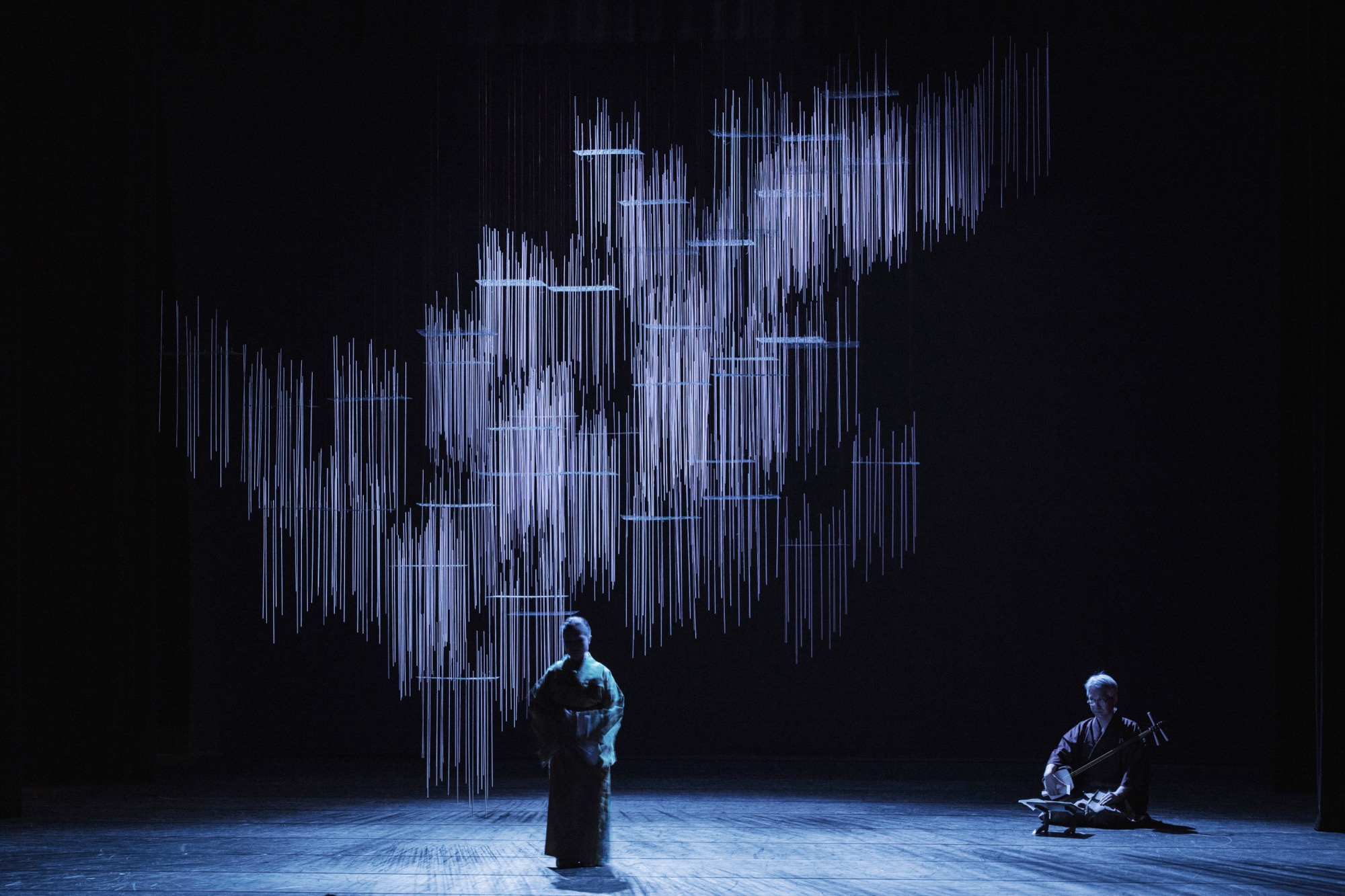
In Tokyo, studio Nakamura Kazunobu Design-works has created an installation that treats air as a material. Fragrance with Lotus Flowers, conceived as a spatial setting for Japanese dance.
Rather than framing performance with a conventional stage set, the project proposes an atmosphere. It translates the cultural image of lotus ponds in Japanese gardens, often wrapped in early-morning haze, into a three-dimensional field of “lines” that seems to condense light into a visible fragrance.


Lotus flowers hold sacred connotations in Japan, and the designers lean into the quiet drama of gardens at dawn, when blooms appear through mist. In this work, fog is not reproduced literally; it is reinterpreted as a condition of perception. A softly radiant ambiguity is used to evoke profundity, an atmosphere that feels ceremonial without relying on iconography.
The installation’s premise is simple and precise: build a space that does not compete with dance, but envelops it, letting movement emerge inside a luminous, shifting veil.


The “mist” is composed of more than 1,000 vertical elements made from 4mm-square timber. Each line reads as almost weightless, but together they accumulate into a hovering body that thickens and thins across the room, like a fog bank caught mid-rise.
Suspended from the ceiling on a delicate lattice assembled with slender metal rods (about 1mm in diameter), the components are placed individually with 3D modeling to calibrate density, height, and planar position. The goal is not a uniform curtain, but a gradation of transparency, so the installation can draw shadows, reveal depth, and make the presence of air legible.

Studio describes the work through a horticultural lens. The spacing between lines echoes how Japanese gardeners prune and thin branches to produce controlled sparseness and density. Here, that technique becomes an architectural tool: a way to “compose” atmosphere through micro-adjustments, creating depth not with walls, but with intervals.

The installation is ultimately a collaboration with light. Its effect depends on fragile illumination and the shadowy gradients it produces, aligning with the Japanese aesthetics discussed by Junichiro Tanizaki in In Praise of Shadows. The space is less about form-making than about the consequences of form: how an array of near-invisible elements can soften glare, catch brightness, and produce a shifting envelope around the performers.

As dancers move within the field, the mist-like volume changes character. It holds the light, diffuses it, and returns it as a gentle aura that frames the choreography without prescribing it.
Material choice reinforces the concept. The lines are made from Japanese cypress, traditionally regarded as a sacred tree, and sourced from scraps of thinned wood generated by forest maintenance. This approach positions the installation as a sustainable, reconfigurable system: the atmosphere can be scaled for different venues by adjusting the number of lines and their distribution, without changing the core language.
Project Credit
Name: Fragrance with Lotus Flowers
Location: Shibuya-ku, Tokyo, Japan,
Installation design: NAKAMURA KAZUNOBU DESIGN-WORKS / Kazunobu Nakamura, Egiku Hanayagi
Lighting design: Theaterbrain / Masao Igarashi,
Photo: Masaki Komatsu