Now Reading: Stable of 1930s farmhouse converted into apartment in Praz-Pury
- 01
Stable of 1930s farmhouse converted into apartment in Praz-Pury


In the rural landscape of Praz-Pury, a modest intervention reactivates the partially disused agricultural wing of a 1930s farmhouse. Typical of farmhouses in the canton of Fribourg, the original building brought domestic life and agricultural production under a single roof. Living quarters occupied one side, while the rural section accommodated livestock, fodder and storage. Rather than replacing this layered spatial logic, the project reinterprets it, allowing a new apartment to emerge from within the existing agricultural structure while preserving the building’s working character.

THE SPATIAL LOGIC OF THE FARMHOUSE
Farmhouses in this region were organised around a pragmatic yet robust spatial system. Two stables flanked a central passage known as the fourragère, a through space used to feed livestock. This corridor-like volume also benefited from greater height, enabling hay to be stored above the stables and ensuring efficient circulation within the farm.

The intervention draws directly from this typology. Instead of subdividing the agricultural interior into smaller domestic rooms, the project preserves the legibility of the original spatial order. The apartment occupies two structural bays on the ground floor. Living spaces are installed within the former fourragère, taking advantage of its generous height and its position as a transitional volume between interior zones. The bedrooms and bathroom are located within the first stable, while the second stable remains in use for the owner’s horses. Above, the roof space continues to function as hay storage, maintaining the building’s agricultural cycle.


ARCHITECTURE THROUGH CONTINUITY
The design strategy avoids nostalgic reconstruction or overt contrast. Instead, it operates through a careful logic of continuity, reinforcing the existing architectural character while making the intervention clearly legible.


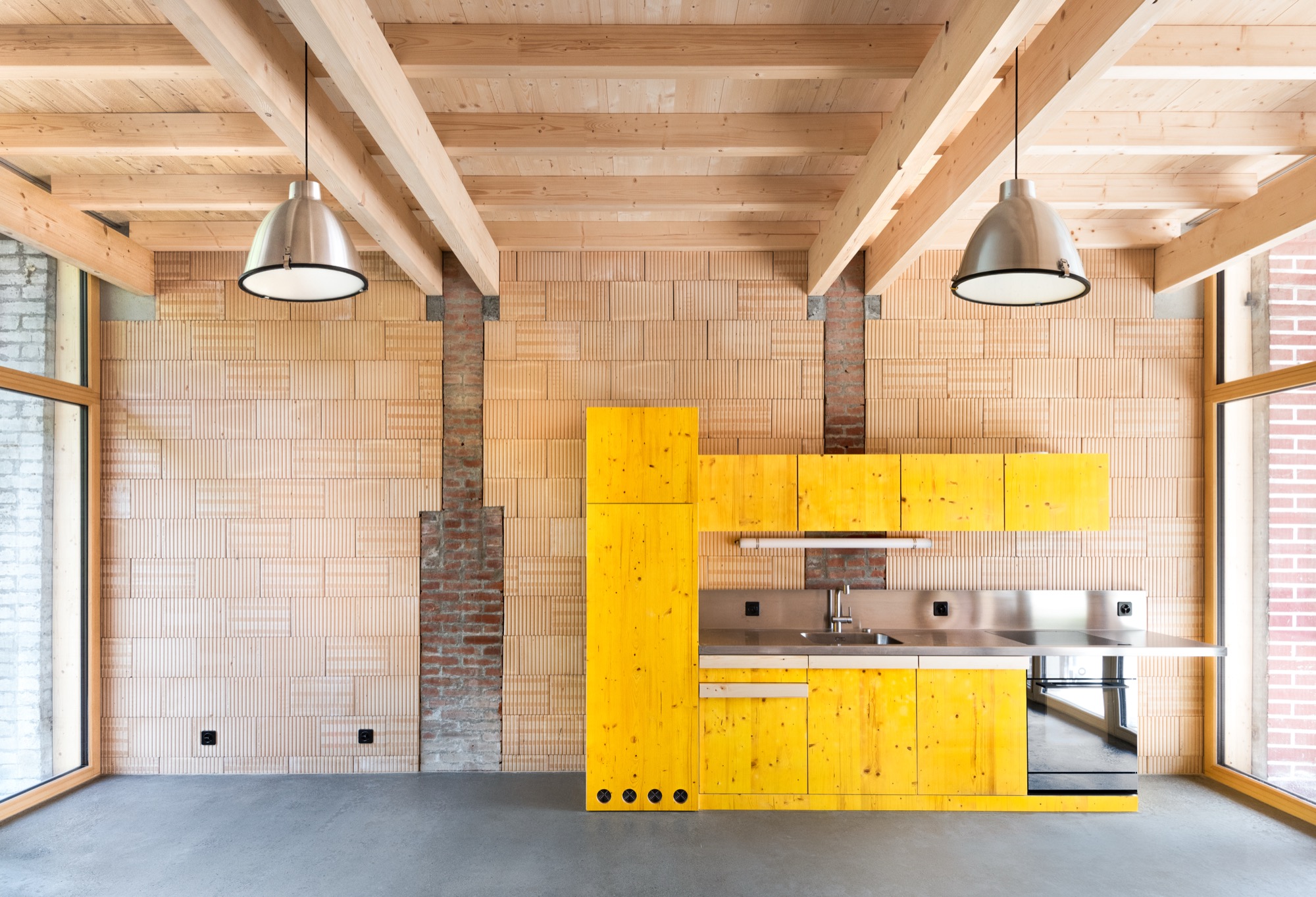
New interior walls are constructed in exposed terracotta brick, echoing the materiality of the original masonry. Their slightly different dimensions subtly distinguish contemporary additions from the historic fabric. This approach recalls the restoration philosophy of the German architect Hans Döllgast at Munich’s Alte Pinakothek, where new elements were integrated in a way that acknowledged the passage of time rather than concealing it.

Material choices further reinforce the continuity between past and present. The floor is finished in a raw trowelled screed that recalls the tactile character of traditional stable surfaces. In the kitchen, cabinetry constructed from formwork panels evokes the improvised constructions commonly found in agricultural outbuildings. Together, these elements create an atmosphere that remains rooted in the building’s rural memory while accommodating contemporary domestic life.


The resulting apartment does not attempt to domesticate the agricultural structure entirely. Instead, it inhabits it. By maintaining the functional coexistence of dwelling, livestock and storage, the project preserves the spatial intelligence of the original farmhouse. Architecture becomes a subtle act of continuity, allowing the rural building to evolve without erasing the traces of its working past.


Project Credit
Design firm: Bard Yersin architectes / @bard.yersin.architectes
Location: Praz-Pury, Switzerland
Year: 2025
Photo: Bard Yersin architectes