
Now Reading: Colección ES Headquarters: Art, Geometry, and Everyday Life in Santander
- 01
Colección ES Headquarters: Art, Geometry, and Everyday Life in Santander


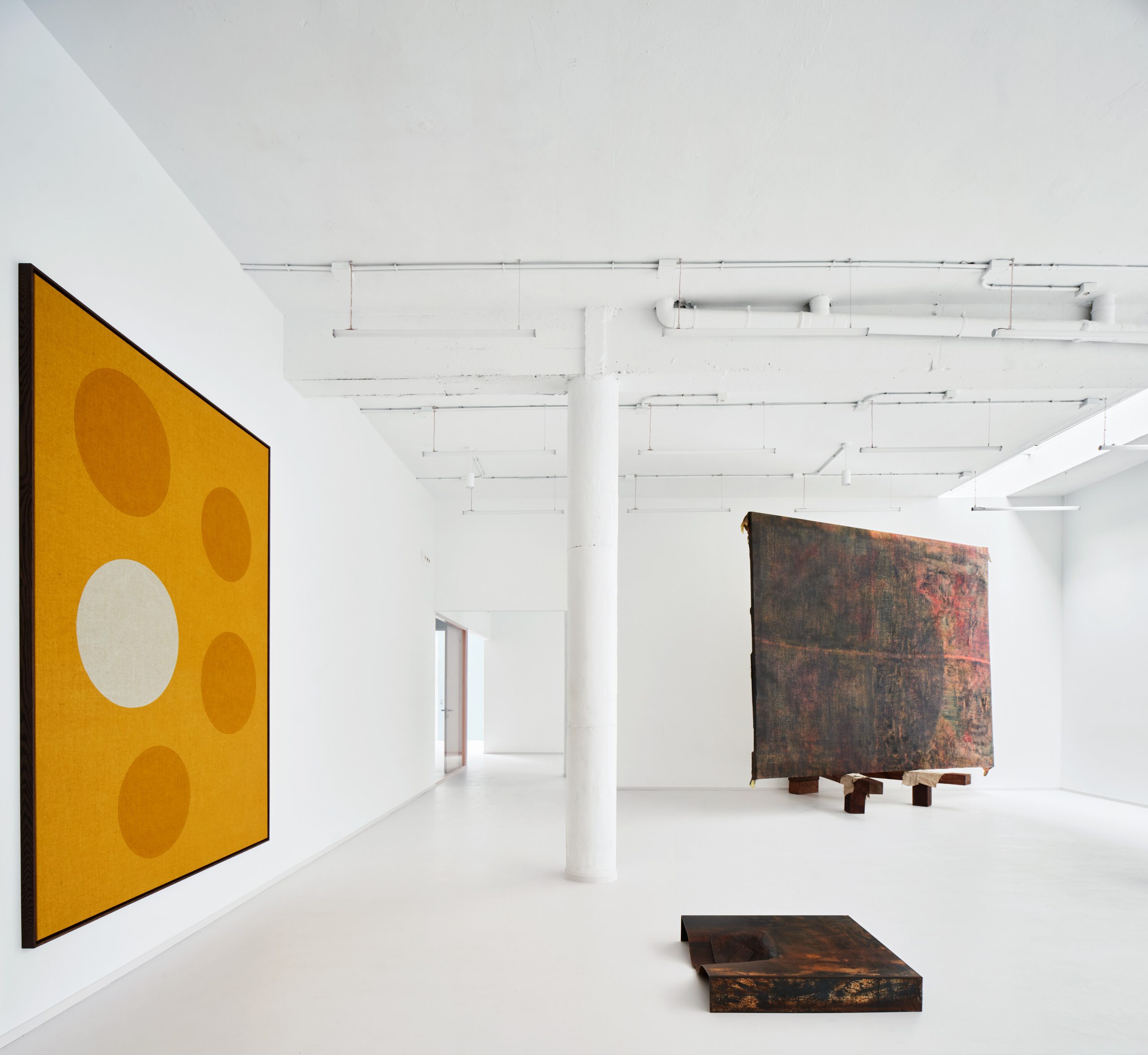
Located in the city of Santander in northern Spain, the Colección ES Headquarters occupies an approximately 600 square meter interior transformed into a hybrid space for art, work, and social life. Conceived as the home of a private contemporary art collection owned by a local businessman, the project extends beyond the logic of a conventional gallery. It functions simultaneously as an office, a place for meetings, and a setting for hosting friends and guests, with the collection remaining the constant point of reference throughout.
Rather than separating exhibition from everyday use, the architecture positions art as the organizing structure of daily activity. The space is designed to be lived in, worked in, and shared, with artworks present not as isolated objects but as active participants in the environment.

EXHIBITION, STORAGE, AND THE DOMESTIC LAYER
A large portion of the interior is dedicated to exhibition spaces, which coexist with the more private and functional areas required by the program. Storage for the collection, bathrooms, a kitchen with an adjacent dining area, and a workspace are all integrated into the overall layout. The office is oriented toward one of Santander’s characteristic inner courtyards, introducing natural light and a quiet domestic scale into the otherwise introspective interior.


These utilitarian zones are not hidden away. Instead, they remain visually connected to the exhibition areas, reinforcing the idea that art and everyday life occupy the same spatial continuum.


GLASS PARTITIONS AND FRAMED DAILY LIFE
Square glass partitions framed in pink act as the primary connective device throughout the project. Repeated consistently across the space, they maintain uninterrupted visual continuity between exhibition and service areas. Through these frames, artworks remain constantly visible, while daily activities such as cooking, working, or moving through the space appear as carefully composed scenes.


This strategy subtly transforms everyday moments into visual events. The architecture treats daily life as part of the collection, framed and observed much like the artworks themselves, without hierarchy or separation.


GEOMETRY AS CONCEPTUAL STRUCTURE
The spatial layout follows the logic of Cartesian axes, referencing the collector’s background in mathematics. This rational framework gives clarity to the plan and organizes circulation with precision and restraint. The square emerges as the fundamental module, structuring proportions, alignments, and transitions across the interior.

Alongside this mathematical order, the influence of Japanese architecture is present in the calm atmosphere and disciplined use of repetition. Shaped by the architects’ early professional experience in Tokyo, the project adopts a restrained spatial language where simplicity and order allow art to remain central.


MATERIAL CALM AND EMOTIONAL PRECISION
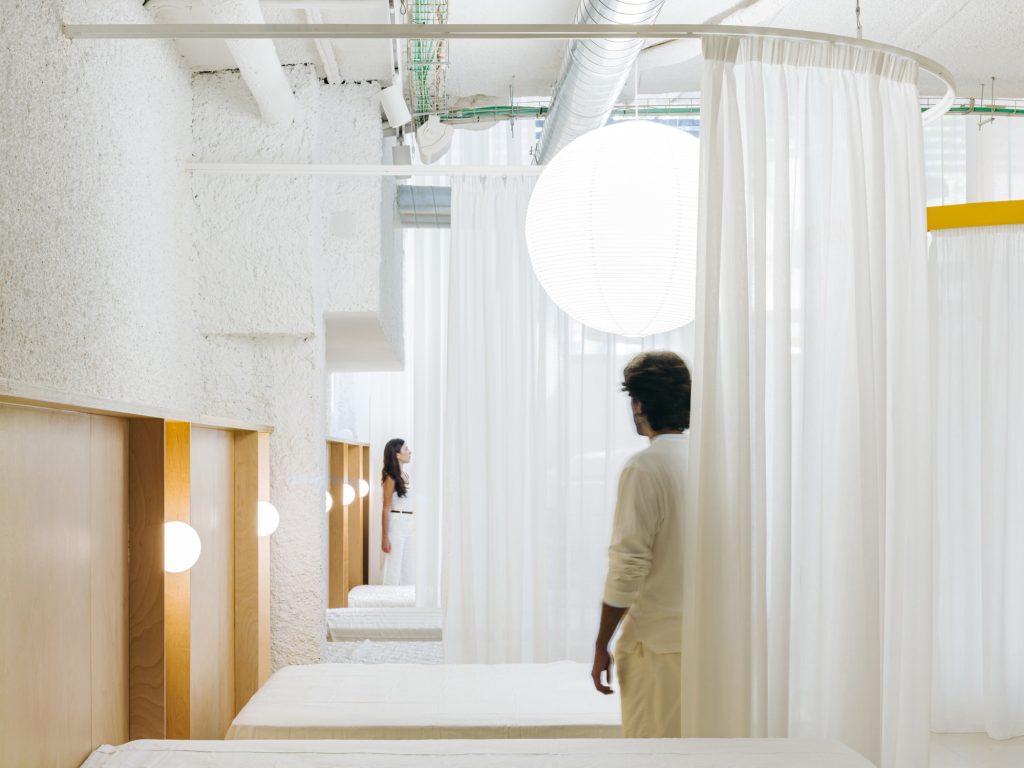
White surfaces dominate the interior, creating a neutral backdrop for the artworks while amplifying light and spatial clarity. This base is subtly softened through carefully chosen accents. Grey flooring grounds the space, pink frames introduce a graphic rhythm, light blue furnishings add a gentle chromatic counterpoint, and birch wood ceilings appear in smaller rooms to bring warmth and intimacy.
The palette reflects both a personal connection to Santander, where the architects spent their childhood, and the sensibility of a collector closely engaged with living artists. The result is an atmosphere that feels precise yet approachable, controlled yet quietly expressive.


A SPACE FOR ART AND HUMAN EXCHANGE
Colección ES Headquarters is conceived as a stage for both art and human connection. Architecture here does not seek to impress through form, but to support contemplation, work, and social interaction with equal care. Every decision contributes to an environment that is serene, structured, and purposeful.
The project demonstrates how a private collection can shape an architectural space that is neither purely domestic nor strictly institutional. Instead, it occupies a measured position in between, where art, geometry, and everyday life coexist in quiet balance.


Project Credit
Studio: Carbajo Hermanos / @carbajohermanos
Location: Santander, Spain
Year: 2024
Photo: José Hevia
More Photos


Carbajo Hermanos is a Madrid-based architecture studio focused on the design and construction of residential spaces and environments for art. Their work is characterized by clarity of form, precision in detail, and a restrained use of color to create calm, balanced atmospheres. In exhibition design, the studio adopts a discreet approach, allowing artworks to remain central while architecture acts as a supportive framework. Over the past decade, they have collaborated closely with institutions such as the Museo Reina Sofía, as well as with leading collectors, galleries, and cultural organizations in Spain.
Andrea Carbajo is an architect born in Santander, with a Master’s degree from the Tokyo Institute of Technology. Her background includes professional experience with Selgascano and research work at Atelier Bow-Wow under Yoshiharu Tsukamoto. She co-founded Carbajo Hermanos in 2014 and is based in Madrid.
Galo Carbajo, also born in Santander, is an architect with a Master’s degree in Craft and Product Design from the Istituto Europeo di Design. He has studied at the Architectural Association in London and collaborated with Sou Fujimoto Architects on international exhibition projects. He co-founded Carbajo Hermanos in 2014 and lives and works in Madrid.