Now Reading: Christian Kerez: Rewriting structure into space
- 01
Christian Kerez: Rewriting structure into space

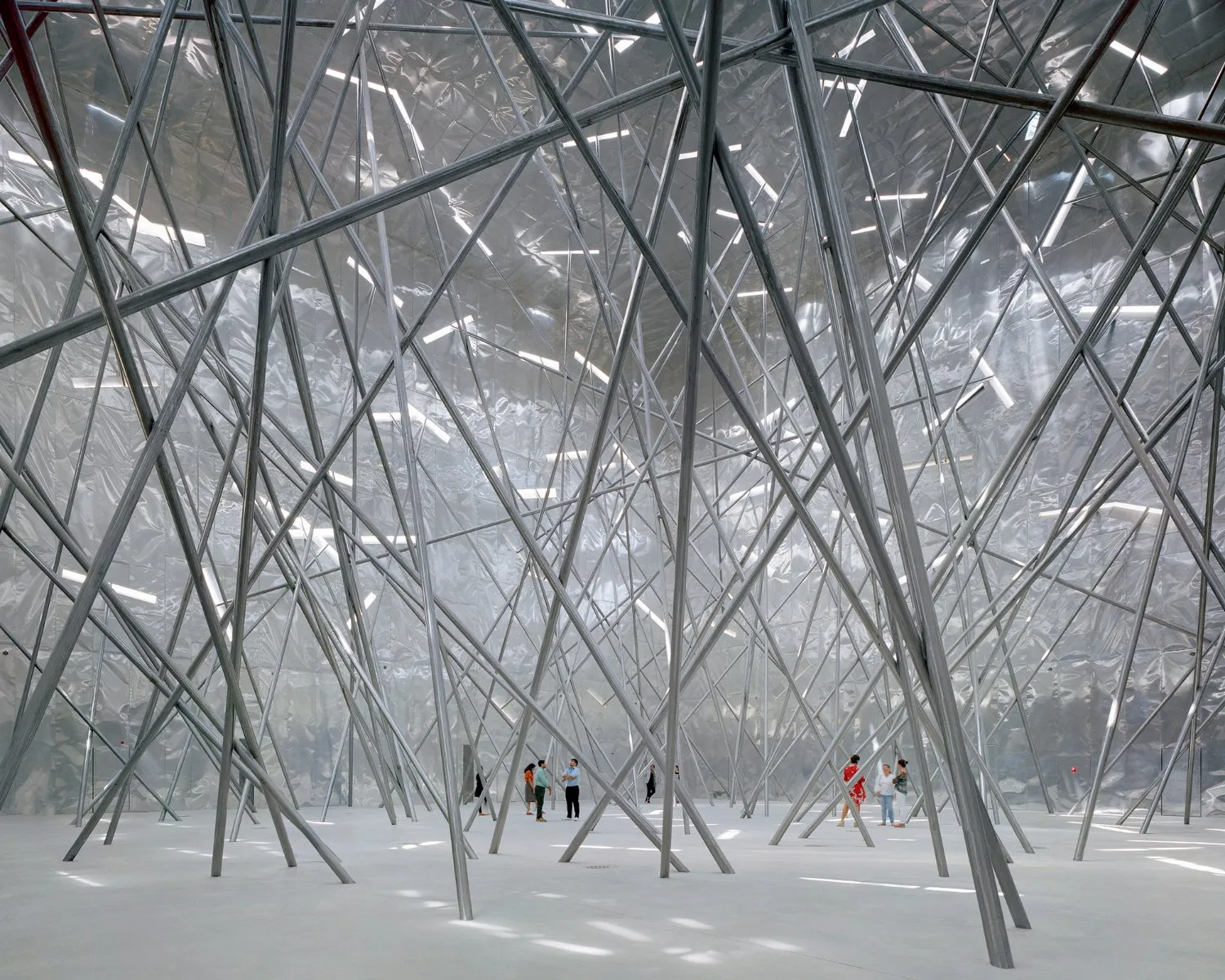

In the floodlit theatre of Expo 2020 Dubai, where national pavilions competed through oversized gestures and instant narratives, the Pavilion for the Kingdom of Bahrain arrived with a different kind of confidence. Designed by Swiss architect Christian Kerez and completed in 2021, it refused the familiar shorthand of cultural representation. There were no literal wind towers, no pearl metaphors, no scenographic folklore. Instead, the pavilion advanced a quieter claim: architecture can carry meaning through structure and perception, not illustration.

By Expo standards, the building’s main hall is compact, roughly a 900 square metre floorplate, yet its spatial impact is unexpectedly large. The volume rises to about 23 metres, with slender steel columns reaching roughly 24 metres. Inside, the room is staged by a thickened field of 126 steel members, each only 11 centimetres in diameter. They tilt, intersect, and link together at multiple points, like a structural weave that seems to have been drawn through the space rather than assembled into it.
At first glance, this reads as a provocation aimed at the most basic architectural assumption: that columns should be legible, vertical, and reassuring. Kerez does the opposite. Support becomes an active agent that rewrites how the hall is read. Inclined members compress sightlines and then release them. They form pockets of partial enclosure without building walls. They interrupt and choreograph movement without prescribing a route. The result is neither a neutral container nor a didactic installation, but an interior with grain, resistance, and surprise.
The experience begins immediately with light. The exterior is clad in reflective aluminium, and inside the shifting brightness is not an afterthought but a spatial material. Sunlight threads between inclined members and rebounds off the cladding, throwing patterns that slide across floors and bodies. At certain angles, the hall feels open and buoyant; a step later, the same room tightens as lines of steel gather in front of you. The eye keeps recalibrating. You look for a clear frame, and the building refuses to give you one for long.

That refusal has a bodily counterpart. The column thicket breaks up the room’s scale, quieting it. The height never disappears, but it stops behaving like a grand void. Instead, the hall becomes a series of near and far conditions, moments of compression and release. You pass close enough to a member that your shoulder instinctively angles away, then you slip into a gap where the structure thins and the space opens, letting you breathe and look up again. The pavilion makes proximity palpable. It turns the mundane fact of support into a choreography of micro-adjustments.

What gives the pavilion cultural charge is not a motif but a discipline of making. Bahrain is a small, densely inhabited nation with a long history of adaptation through networks, trade, and interconnection. Kerez does not depict that history. He offers an analogue. Constraint becomes an engine for invention, and the pavilion’s tight structural fabric becomes a form of generosity, producing countless readings as visitors move through it. Some observers compare the interlaced field to craft traditions of geometric precision; others see an echo of contemporary infrastructure. The pavilion never confirms any single interpretation. It stays deliberately open.
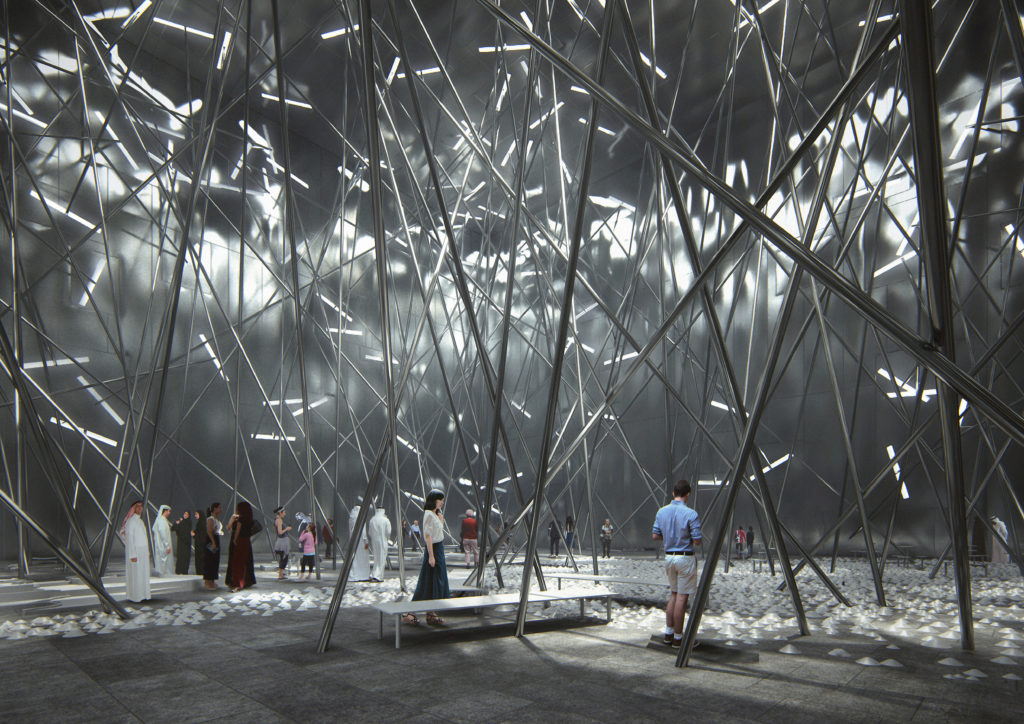
That openness extends beyond symbolism to the building’s intended afterlife. From the beginning, the pavilion was conceived to be dismantled at the end of the Expo and reassembled in Bahrain as a permanent structure. The logic is therefore not only spatial but logistical. The pavilion is both an event and an argument about continuity. In a world where temporary installations often exist to be photographed and forgotten, this one was designed with endurance in mind, as if the structure’s insistence on permanence could outlast the Expo’s glare.

The Bahrain pavilion is also an unusually clear entry point to Christian Kerez’s wider work. Born in 1962 in Maracaibo, Venezuela, to Swiss parents, and educated at ETH Zurich, Kerez has built a career on returning to fundamentals: space, gravity, perception, and the precise ways material and structure shape experience. Before founding his Zurich office in 1993, he worked as an architectural photographer, and that training still registers in his buildings’ awareness of viewpoint. They do not present a single, stable image. They change as you move, as edges align and then fall apart, as structure becomes legible through shifting distance.
Kerez’s academic life runs in parallel. At ETH Zurich he has treated the studio as a laboratory, moving from visiting professor to assistant professor and, later, full professor. The emphasis is consistent with the built work. Architecture begins with forces, spans, supports, and the body’s reading of space. Style arrives only as a consequence, never as a starting point.
Across his projects, structure often becomes the primary syntax. Columns, beams, slabs, and shells are not hidden behind finishes; they are exposed and pushed into three-dimensional configurations that blur the distinction between support and enclosure. A structural element might behave like a boundary one moment and like an invitation the next. The Bahrain pavilion takes this tendency and amplifies it until structure becomes not just visible but unavoidable, a condition you must negotiate.
A key moment in Kerez’s public profile came with his 2016 installation Incidental Space for the Swiss Pavilion at the Venice Architecture Biennale. Visitors entered an irregular, cavern-like interior formed by an ultra-thin concrete shell, only centimetres thick. The shape appeared almost accidental, like a geological formation, yet it was the product of advanced modelling and tightly controlled fabrication. Incidental Space posed a destabilising question: what is architectural space when it is freed from program and typology? Its power was not in narrative but in the intensity of perception. The room felt larger than its footprint, complex beyond its apparent means.

The term “incidental” is instructive. Kerez is drawn to emergent qualities that arise when structural logic is pursued with unusual rigor. The Bahrain pavilion operates in the same territory. Its inclined columns are not an aesthetic pattern applied to a neutral box. They are a spatial device born from the logic of support, multiplied, and then treated as an environment, a built atmosphere rather than a solved frame.
That line can be traced through earlier buildings. In the House with One Wall in Zurich-Witikon, completed in 2007, a single serpentine concrete element becomes the organising principle for a duplex. The gesture is economical, almost blunt, but it produces an intricate domestic landscape, with rooms connected and separated by the same continuous line. The “one wall” is not a metaphor. It is a structural decision that generates plan, section, and lived experience.

In the Leutschenbach School in Zurich, completed in 2009, Kerez takes a compact programme and turns it into a tower-like volume that reads as both pragmatic and luminous. Glazing and structure negotiate with each other rather than playing their typical roles of enclosure and frame. Daylight is not simply admitted; it is calibrated. Movement, learning spaces, and structural rhythm align to create a building that feels precise, almost infrastructural, yet unexpectedly open.

His earlier involvement in the Kunstmuseum Liechtenstein, completed in 2000 with Morger & Degelo, shows another facet of the same mindset: the museum as a container whose power comes from exactness, restraint, and the weight of material decisions. While the project sits comfortably within Swiss institutional minimalism, the deeper continuity lies in Kerez’s interest in what happens when architectural basics are pushed until they produce new perceptions, when they cease to be neutral and begin to act.
More recent work extends these principles into urban situations and infrastructural typologies. In Muharraq, Bahrain, Kerez has designed a series of car parks connected to the Pearl Path initiative. Here the challenge is not only to store vehicles but to make public space out of an unpopular typology. Instead of conventional ramps and stacked decks, the projects use continuous, sloping slabs and curved geometries to generate sequences that feel more like circulation landscapes than parking structures. Parking becomes promenade, a pragmatic programme turned into spatial continuity.
In Prague, the House Okamura, completed in 2024, explores aggregation through circular brick volumes that form rooms as autonomous yet overlapping spaces. Traditional material is used, but not nostalgically. Brick becomes a means to construct a new spatial order, one that feels both radical and buildable. It is another example of Kerez’s refusal to equate innovation with spectacle. The difference is embedded in geometry and structure, not in surface effect.
Kerez has spoken of changing architecture’s “genetic code,” a phrase that matters because it points away from cosmetic difference and toward elemental redefinition. His projects return to the same wager: that a column, a slab, a shell, if handled with enough precision, can do more than hold up a building. It can sharpen perception. It can produce a kind of wonder that is not imported from narrative, but generated by construction itself.
The Bahrain pavilion distils that ambition with unusual clarity. It transforms the basic necessity of support into an event. It makes a small footprint feel like a thick field of possibility. It operates without symbols and still carries cultural charge through a disciplined interconnection of parts. It refuses to tell you what to think, yet it gives you a structure that insists you keep looking, measuring your distance, reconsidering the room with every step.
There is a quiet ethics in that stance. The pavilion does not represent a nation through stereotypes or tourist-friendly cues. It offers a different kind of portrait: one built from constraint, precision, and the productive intelligence of compression. If it is reassembled in Manama as intended, it will stand as more than an Expo artefact. It will become a durable demonstration of an architectural position: that structure can be more than a means, and that limitation, taken seriously, can be a generous source of space.

Photo Cover
Panoramic exterior view capturing the pavilion’s compact form and cultural restraint in architectural context. Credit: Photo courtesy of Thisispaper Magazine