Now Reading: Barragán, read against a noisy eresent: Boundaries, time, and the domestic right to withdraw
- 01
Barragán, read against a noisy eresent: Boundaries, time, and the domestic right to withdraw

Barragán, read against a noisy eresent: Boundaries, time, and the domestic right to withdraw

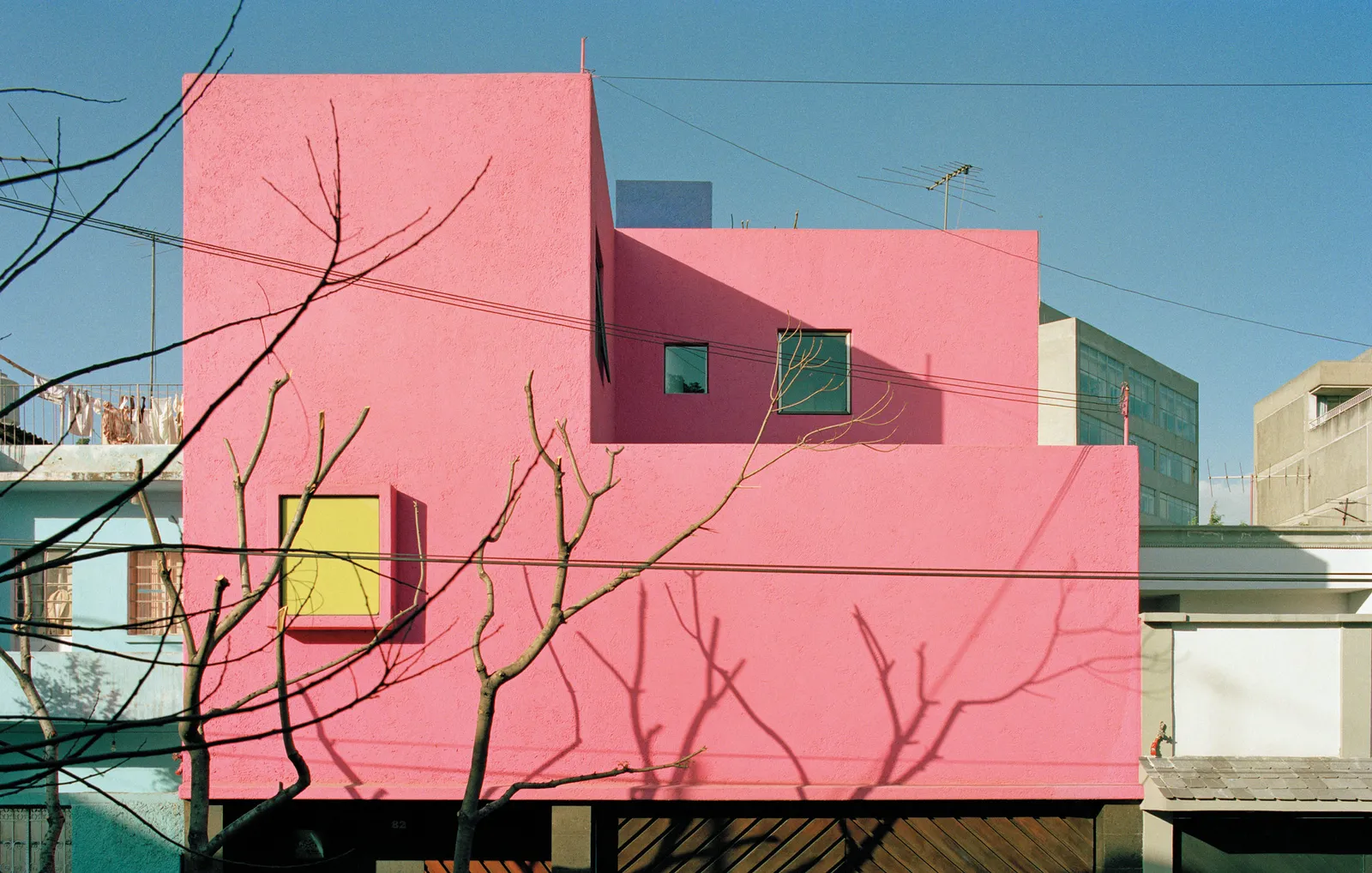
Most people meet Luis Barragán through color. Pink becomes the entry point, then the conversation stalls at palette. I prefer starting with a more ordinary and more demanding idea that runs through his work: the home is not obliged to be public. It can be built to protect interior life from the street, from the city, and from the pressure to remain visible.

Barragán described his architecture as autobiographical, grounded in memories of his father’s ranch and the rural world around Mazamitla, south of Guadalajara. Read as sentiment, that line can turn soft. Read as method, it becomes practical. His work returns to environmental facts he carried from childhood: red earth after rain, distance and shade, the sound of fountains in a plaza, the relief of enclosure, water as both image and measure of time. He did not rebuild the hacienda as a style. He extracted its spatial ethics and rebuilt those for modern life.
That extraction feels newly relevant now. Domestic space today is often asked to perform. It must look resolved in images before it has been lived in. It must explain itself instantly. It must remain transparent, open, shareable. Barragán does not offer an escape from modernity, but he does insist on a boundary. In his houses, the interior is allowed to stop acting like a public room.
TACUBAYA AND THE WALL AS A WORKING DECISION
Barragán’s own house in Tacubaya clarifies his priorities without much mediation. From the street the façade is restrained, almost withholding. In a working class neighborhood, that restraint also reads as a social choice. The building does not compete as an object. It does not advertise the life inside.
Inside, his sequence is disciplined. First, sever the interior from the street. Then choose openings with care. The wall is not there to dramatize privacy. It is there to make privacy reliable, so that light, view, and air can be admitted on the inhabitant’s terms.

The library shows the tactic with unusual precision. The window is set high, with the bottom of the sill about 1.5 meters above the floor. The pane is figured glass. Although the window faces the street, the street does not enter the room as image. Sunlight arrives bleached, turning into a white atmosphere rather than a view. The effect is not a mood. It is a working condition for attention.

A detail from this room also helps explain why Barragán’s “color” sits closer to labor than to taste. Sheila Hicks, who collaborated with him from the late nineteen fifties into the early sixties, recalled him spending long hours comparing color in this library. He would place silkscreen plates from Josef Albers’s boxed portfolios on the cantilevered stairs, testing them against paintings by his friend and collaborator Jesús Chucho Reyes Ferreira, moving from one hue theme to another across days. It is a slow practice, anchored in real surfaces and real light, and it produces decisions that cannot be replicated by copying a swatch.
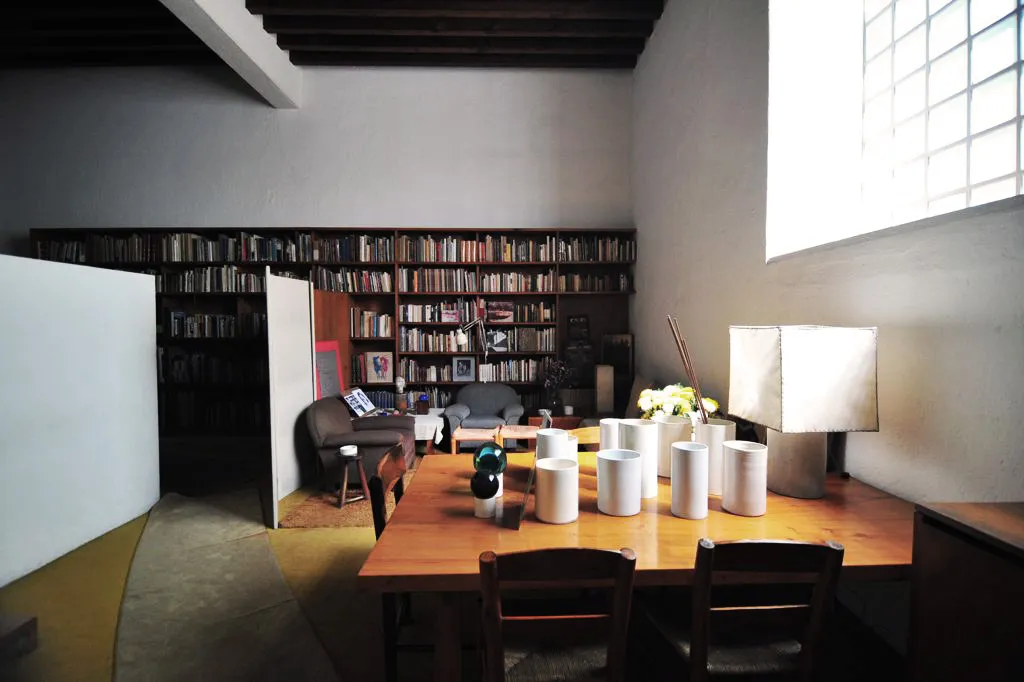
The house sets up contrast without theatrics. The library holds stillness. The living room, by contrast, opens to the garden through a full height glass wall. Afternoon light arrives filtered by vegetation, shifting across surfaces. One room concentrates, the other receives. The point is not openness versus enclosure. The point is control and sequencing, so domestic life can hold more than one psychological climate.
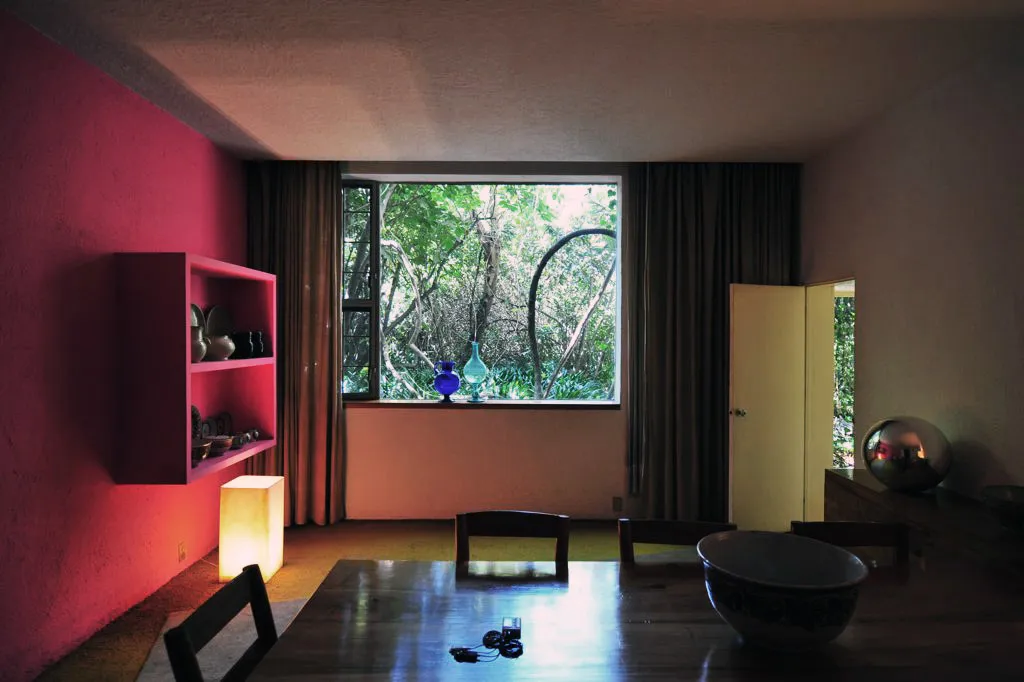
Barragán himself was explicit about what he resisted. In interviews he criticized oversized plate glass windows for stripping buildings of intimacy and atmosphere and pushing private life toward public display. The language is decades old, but the condition has sharpened. Exposure today is not only a matter of neighbors. It is cultural. Homes are routinely designed to be legible and shareable. Tacubaya reads as a refusal of that expectation.
EL PEDREGAL AND THE DIFFERENCE BETWEEN NATURE AND A SURFACE EFFECT
El Pedregal, developed between 1945 and 1950, begins with an inhospitable volcanic terrain. Barragán and his associates purchased the site and made it inhabitable through roads and utilities, stone walls built from extracted volcanic rock, pools, fountains, topsoil, and planting. Native flora and rock formations were preserved while flowering species such as bougainvillea and jacaranda were introduced. The project is often reduced to a landscape success story. More useful is the structural lesson. Nature in Barragán’s work is not a visual garnish. It reorganizes the plan, the view, the microclimate, and the tempo of movement.

The Prieto House, completed in 1950, shows how this becomes domestic enclosure. Barragán shifts away from the international style’s frame ideal and returns to walls as primary spatial organizers, using reinforced concrete to achieve large spans while maintaining the grounded presence associated with masonry. Around the house, volcanic stone walls establish a perimeter that changes the inhabitant’s relationship with the outside. The walls do not merely mark territory. They reduce exposure, and in doing so, they make intimacy possible.

Chucho Reyes’s influence matters here for reasons that go beyond color. Through him, Barragán began introducing small elements tied to local craft markets and everyday material culture, including unglazed jars once used for fermenting mescal, hand blown glass spheres, lampshades made from amate paper, and ornamental wooden fruit. These are not trophies of folk culture. Placed against walls and light, they operate like evidence that the local world has been allowed into a modern interior without being flattened into theme.
Read against the present, El Pedregal is also a warning. A building is not “green” because plants appear in photographs. If vegetation and water do not change the building’s environmental logic, they remain a surface effect. Barragán’s landscapes work because they function as structure, shaping shade, air, sound, and daily rhythm.
GÁLVEZ AND COLOR AS AN ALTERNATIVE LANDSCAPE
In the Gálvez House, Barragán makes a move that is frequently copied and rarely understood. Color becomes an alternative landscape for the inhabitant. Walls do not only enclose. They carry a distilled environmental identity, sometimes linked to the cultural familiarity of Mexican pink and to the bougainvillea that saturates streets and markets. But the key is not the hue. It is placement. Color is edited by white surfaces, activated by sunlight, softened by shadow, and held against greenery so the wall behaves less like a graphic gesture and more like weather.

The water patio adjoining the drawing room reinforces that method. Water is kept at floor level and given no program beyond perception. Shadows drift, ripples shift, sound becomes a low measure. This kind of space is difficult to justify through conventional efficiency, yet it addresses a condition many contemporary homes intensify. Plans get optimized until they cannot offer a pause. Barragán’s work makes room for an interval that does not exist to perform.
SAN CRISTÓBAL AND DELAYED REVELATION AS A DESIGN TOOL
San Cristóbal, completed in 1968, is often remembered as a long pink wall, water, and horses. The more consequential aspect is its choreography. The project includes a house, stables, fields, and a pool used to cool the hooves of horses returning from the adjoining field. Its scale allows walls and water to operate as spatial instruments rather than decorative accents.
From the gate, you do not receive the whole space. You receive a controlled first frame: balanced walls in white and red, water bursting from the red plane, a tree behind, and the larger pink wall holding the horizon. Only as you move closer do slits reveal the stables, and then the field opens. Barragán uses walls to restrict and then expand the field of vision. It is a technique for giving a place duration.

A practical adjustment in the project makes the point more sharply than any theory. A white wall projecting from the residence was originally shorter, then Barragán extended it by about five meters, likely to draw perspective inward and intensify the relationship among planes. Saito reports that clients often remembered him building walls, tearing them down, repainting, and rebuilding until proportion, position, and color aligned. You do not need to admire the delay to learn from the logic behind it. Some spatial decisions cannot be finalized in drawings alone. They require the body, real light, and the ability to calibrate on site.

In a contemporary delivery model built around certainty and speed, that lesson is uncomfortable. If we want spaces that outlast their first image cycle, we need to protect at least a small zone for calibration, and we need to be honest with clients about what cannot be solved on screen.
GILARDI AND THE CORRIDOR THAT CHANGES THE BODY
After San Cristóbal, Barragán largely withdrew for about a decade. The Gilardi House, designed for Francisco Gilardi, brought him back despite the small site, about 10 by 35 meters. The working method is revealing. Gilardi recalled Barragán sketching the plan on a paper napkin: a kitchen linked by a long corridor to a dining room in which a pool occupies a substantial portion of the space. Even during construction, walls were torn down and rebuilt. Only near the painting stage did the client fully grasp what the space would be.
The dining room with the indoor pool is instructive because it is controlled rather than extravagant. A red column reads as if suspended in water. Light arrives from above, slides along a blue wall, and falls into the pool. The water surface sits near floor level, and the room becomes a thin field of reflection and quiet.

Then comes the yellow corridor, often described as air tinted by golden light. Read practically, it is an environmental switch. It is long enough to change pace and attention. It prepares the body for the stillness of the pool room. Barragán’s color here is frequently mistaken for abundance. In fact it is selective. Large areas remain white, so the colored moments imprint themselves as afterimage rather than constant stimulus.
Saito also notes accounts that toward the end of his life Barragán kept a sheet of Mexican pink paper by his pillow, touching it or gazing at it. The detail is worth keeping in the right register. It is not a legend to polish his image. It is a small indicator that color, for him, functioned as a material of perception, something to test, to remember, to return to.

WHAT THIS READING CHANGES FOR PRACTICE NOW
Barragán’s relevance is not a call to borrow his palette. It is a call to name pressures we often treat as unavoidable.
The first pressure is domestic exposure. Many homes are designed as images before they are designed as habitats. Barragán’s work argues for privacy as a design responsibility, not an optional preference. The wall becomes a working decision, the element that makes chosen openness possible.
The second pressure is environmental theatrics. As climate stress increases, the temptation is to add visible greenery without changing the building’s logic. Barragán’s landscapes insist on something stricter. Nature must reorganize plan, shade, air, light, and time, or it remains decoration.
The third pressure is speed. Contemporary project culture punishes iteration. Yet Barragán’s repeated adjustments expose a gap between what can be solved in drawings and what must be solved in space. The lesson is not to romanticize delay. The lesson is to build a modest allowance for calibration, and to negotiate that allowance early.
Finally, there is the pressure of instant legibility. San Cristóbal argues for delayed revelation, for places that hold something back so they can keep giving. In an attention economy, that is not nostalgia. It is durability.
CLOSING, WITHOUT ROMANCE
Barragán is often described as poetic. I prefer saying he is strict. Strict about the boundary between street and interior. Strict about how light enters. Strict about where color speaks and where it stays quiet. Strict about the time it takes for a place to reveal itself.
In these houses, decisions about enclosure come before decisions about expression. The interior is secured first. Only then do light, water, and color do their work.