Now Reading: A window wants to be a room: Louis I. Kahn’s enduring demand on architecture
- 01
A window wants to be a room: Louis I. Kahn’s enduring demand on architecture

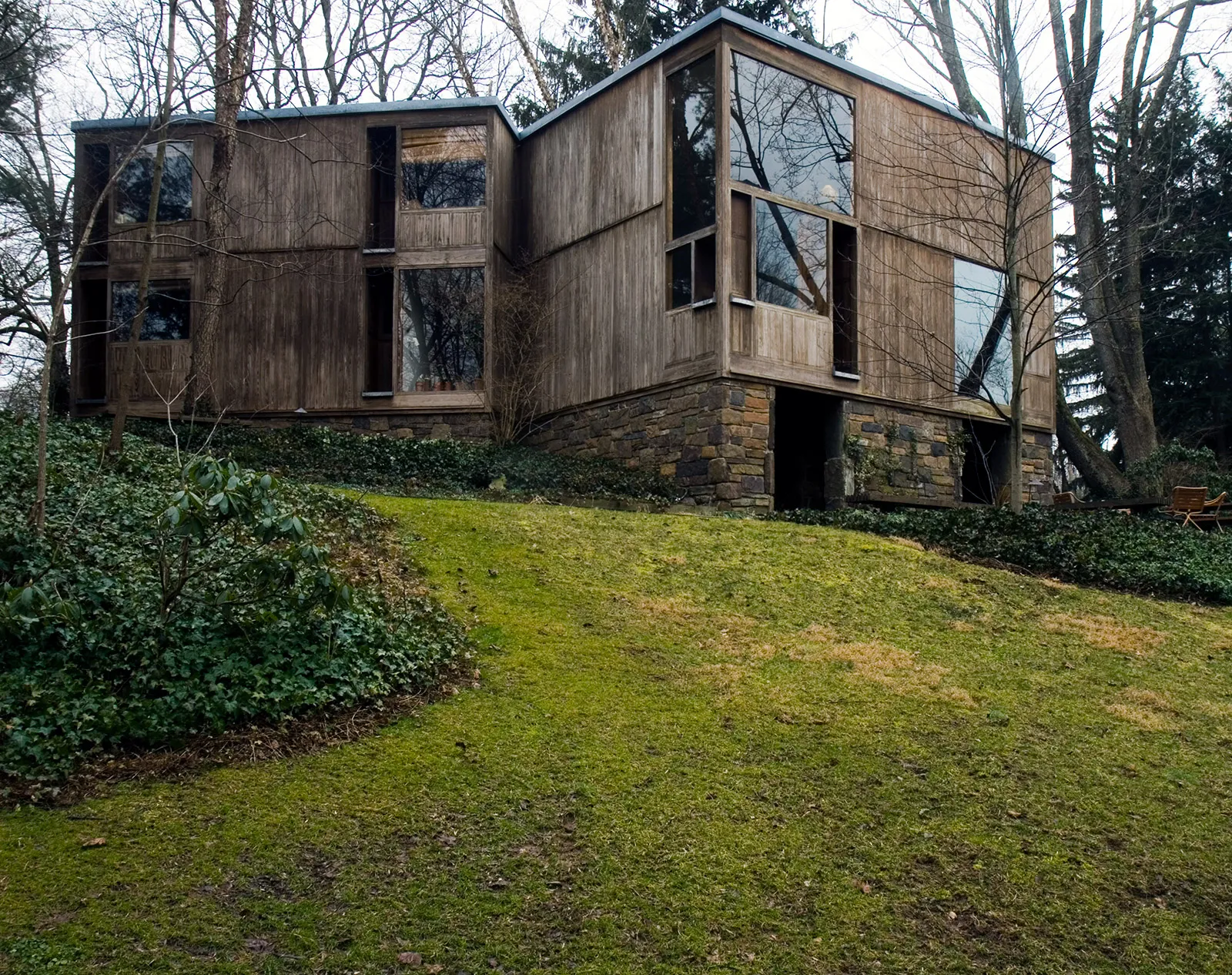

Kahn never treated the house as minor work. In the house he kept architecture close to its beginning, in the room he clarified its limits, and in the window he tested whether those limits could meet the world.
BEGINNINGS AT THE WINDOW
I tend to trust writers more when they give me a scene rather than a thesis. Accounts describe a moment in Kahn’s office at Walnut Street and Seventeenth Avenue, where house drawings lay open beside major work, including plans for East Pakistan.¹ Kahn would move between them with the same colored pencils, adjusting a city plan and then returning to a window corner for a modest residence. The point is not that Kahn was diligent. The point is that he treated the domestic commission as a place where architectural thinking stayed fully active.

Kahn’s question is plain, and it still stings a little. Why would an architect, already pulled toward large civic work, keep investing time and concentration in houses? The answer offered here cuts against the reflex that treats houses as either apprenticeship or lifestyle work.
For Kahn, “house” was not a category. It was a beginning.
THE HOUSE AS BEGINNING
Long ago, the house and the temple were not separate. Dwelling could carry prayer, and prayer implies communion with another, so the early “house” already held something communal within it. Over time, building types differentiated and became independent: shrine and chapel, then theater, market, library, school, government office. Yet when you search for the root, you are led back to the house.
There is an unavoidable risk in a claim that broad. Any story this compressed invites disagreement on historical specifics. I would rather name that risk than pretend it does not exist, because the value of the argument does not depend on proving a perfect genealogy. It depends on identifying what the house keeps visible.
The house is where architecture cannot hide behind institutional symbolism or program complexity. It must answer basic questions in ordinary language. What counts as belonging. What makes a threshold. What turns an interior into a place rather than a container. What kind of life a room assumes, permits, and quietly steers.

In 2026, those questions feel less like philosophy and more like pressure. Housing is crisis, market, and policy, and for many people it is a narrowing field of choice. Domestic space is also expected to absorb more roles than it can gracefully hold. Work spills into it. Screens colonize it. Performance requirements tighten, and budgets tighten in the same breath. Under that squeeze, housing easily becomes a delivery problem, an optimization problem, a spreadsheet problem.
And this is exactly where Kahn’s insistence begins to matter again. If the house is where architecture begins, then walking away from it as “small work” is not just a career trajectory. It is a way of losing contact with the beginning.
MAKING A ROOM
Kahn’s line – that architecture comes from the making of a room²—sounds like an aphorism until you watch how it unfolds. Room, here, is not a label you stamp onto a plan. It is an act of limitation. Architecture begins when human will applies clear boundaries to nebulous space, and those boundaries produce a room.
A sketch is sometimes described: a domed enclosure, a hearth, one person seated near it. The center of the room is “me.” The hearth is not just equipment. It marks belonging. The room allows me to be me.

Then what completes the picture. A second person appears, faintly drawn, facing “me.” The room is incomplete if “I” am alone. “You” must be present too. The room is not only shelter. It is a framework for relationship.
And then comes the final demand. The room, once enclosed, must open. Once opened, it must connect to the outside world. A complete room must allow the world to enter as visibility, scenery, wind, and light.
This sequence can sound almost old fashioned until you recognize how often we now do the opposite. We inherit openness as a default and call it freedom. We remove boundaries early, then spend the life of the building improvising them back in: curtains, screens, acoustic panels, furniture arrangements, device habits, rules about calls and quiet hours. The modern room becomes a space of constant negotiation. What Kahn proposes is stricter and, in practice, more generous. Limits chosen with intent, so the room can hold “me,” receive “you,” and still admit the world without being undone by it.
Kahn could not accept “universal space” as a general cure, and he dismissed the “free plan” as a contradiction when freedom is predeclared. His point is not to ban openness. It is to insist that freedom has to be earned through decisions, not granted through the absence of decisions.
THE WINDOW COMPLETES ALL
If a room must open, then the opening becomes decisive. This is where the reading becomes most concrete. The crucial element is the window.
The thickness of a window frame expresses the character of enclosure. The window determines how the opening confronts the outside world, how its shape and position connect inner and outer space, how it opens and closes, what kind of light the room seeks or rejects, what scenery it embraces or excludes, and what else it invites inside: wind, leaves, even the movement of small things.

Accounts describe Kahn’s behavior in final design stages and even on site: he concentrated his attention on window studies, producing drawings that range from quick sketches to near full size details.³ Each window, made this way, gives the room its finishing touch because it gives the room its particular light, and particular light makes a particular space.

Here is where I feel the distance between Kahn’s discipline and a lot of contemporary delivery. Today the window often arrives in one of two ways. Either it is a standardized unit introduced late, after the spatial ideas have already hardened, or it is a continuous glass field declared early as an image and then negotiated into compliance. If you have ever sat in a coordination meeting where the “window package” is decided as a procurement line item, you know how quickly an architectural edge can become a product boundary.
Performance modeling is real progress, and sometimes it saves a building. But performance data cannot replace intent at the edge.
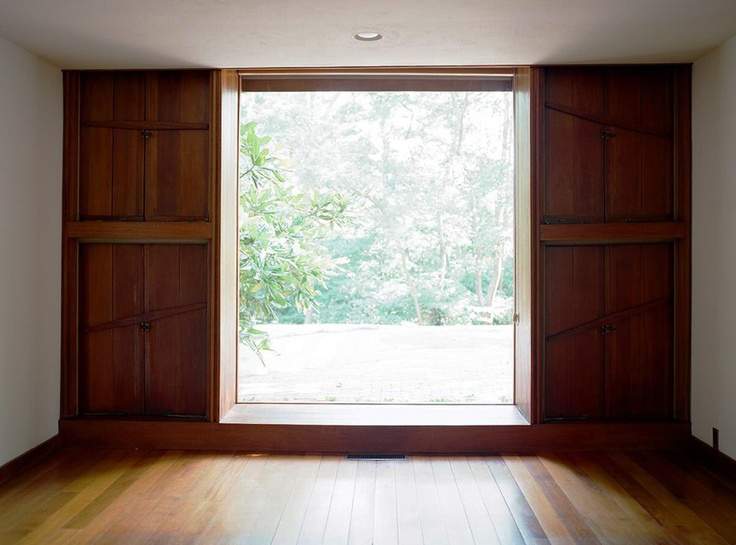
You can see the consequences in rooms that photograph well and live poorly. I have walked through interiors where the best view is technically available, yet the furniture keeps drifting away from the glass because the edge is unbearable. Glare flattens the space by noon. Blinds stay half drawn all year, turning the famous transparency into a permanent compromise. The air conditioning becomes the true boundary, humming away to maintain a comfort the section never learned to produce. The room “connects” to the outside in the brochure, and then spends its real life defending itself from the outside.
Kahn offers a different attitude, and it is not nostalgia for thick walls. It is a demand that the edge be designed as a place, thick enough in intention, and sometimes in section, to mediate between interior life and exterior reality. When that mediation succeeds, the window becomes inhabitable. It becomes a small room within the room.
Kahn’s line “Structure gives light, makes space” sits differently once you see the window this way. Structure is not only what holds up the building. It is what makes light legible. It turns daylight from a quantity into a character.
Then comes the line everyone quotes: “A window wants to be a room.” Kahn placed chairs and benches beside windows because he expected people to pause there, to read, to sit with the room’s light. A story that circulates about Venturi and Guild House, with Kahn questioning the television antenna and asking whether the elderly should be reading books,⁴ is revealing not because it is correct, but because it shows what Kahn assumed architecture could protect: attention.

That assumption is not a quaint preference. It is a design question in our moment. If domestic life is already saturated with devices, if attention is constantly split, then the window as an inhabitable edge becomes more than a view machine. It becomes one of the few architectural moves that can thicken time without enlarging floor area. A place where daylight has shape, where weather can be felt without becoming oppressive, where the room touches the world and does not dissolve into it.
The reading ends with distance. Kahn’s windows, it is suggested, look toward what is beyond human sight, and they open, ultimately, onto what can be described as a useful metaphor for “furthest love,” not a metaphysical conclusion.
I read this as a reminder that the window is where performance meets contemplation. It is the same aperture through which heat enters and horizon enters, through which glare can punish and time can deepen. A good window teaches a room how to live with scale: the scale of climate, and the scale of distance, and the scale of a day passing.
A HYBRID TAKEAWAY
This reading of Kahn can be taken as a design test. If you want to know what a practice believes, do not look first at the hero render. Look at how it makes rooms, and look at how it draws windows. Ask whether limits were chosen or merely inherited. Ask whether the room can hold “me,” receive “you,” and still admit the world as light, air, and time.
That, in the end, is what the house means in this reading. Not a small building. A small arena where architecture becomes measurable.

Notes
- Accounts of Kahn’s office practice, including his attention to domestic commissions alongside major civic projects, are described in Robert McCarter, Louis I. Kahn (Phaidon, 2005), particularly chapters on his Philadelphia studio and working methods.
- Kahn’s statement that “architecture comes from the making of a room” and related ideas about the room as origin are widely reproduced from his lectures; see especially Louis I. Kahn, Essential Texts, ed. Robert Twombly (W.W. Norton, 2003); and Alessandra Latour, ed., Louis I. Kahn: Writings, Lectures, Interviews (Rizzoli, 1991).
- Kahn’s intensive window studies and details are documented through his drawings in Richard Saul Wurman and Eugene Feldman, eds., The Notebooks and Drawings of Louis I. Kahn (originally published 1962; facsimile edition with Reader’s Guide, Designers & Books/Yale Center for British Art, 2022); and Alexandra Tyng, Beginnings: Louis I. Kahn’s Philosophy of Architecture (Wiley, 1984).
- The anecdote involving Robert Venturi’s Guild House and Kahn’s comment on the television antenna is recounted in various oral histories and secondary accounts; see Wendy Lesser, You Say to Brick: The Life of Louis Kahn (Farrar, Straus and Giroux, 2017) for contextual discussions of Kahn’s views on domestic architecture and attention.