
Now Reading: Architecture Uncomfortable Workshop: Freedom, Matter, and the Edges of Architecture
- 01
Architecture Uncomfortable Workshop: Freedom, Matter, and the Edges of Architecture

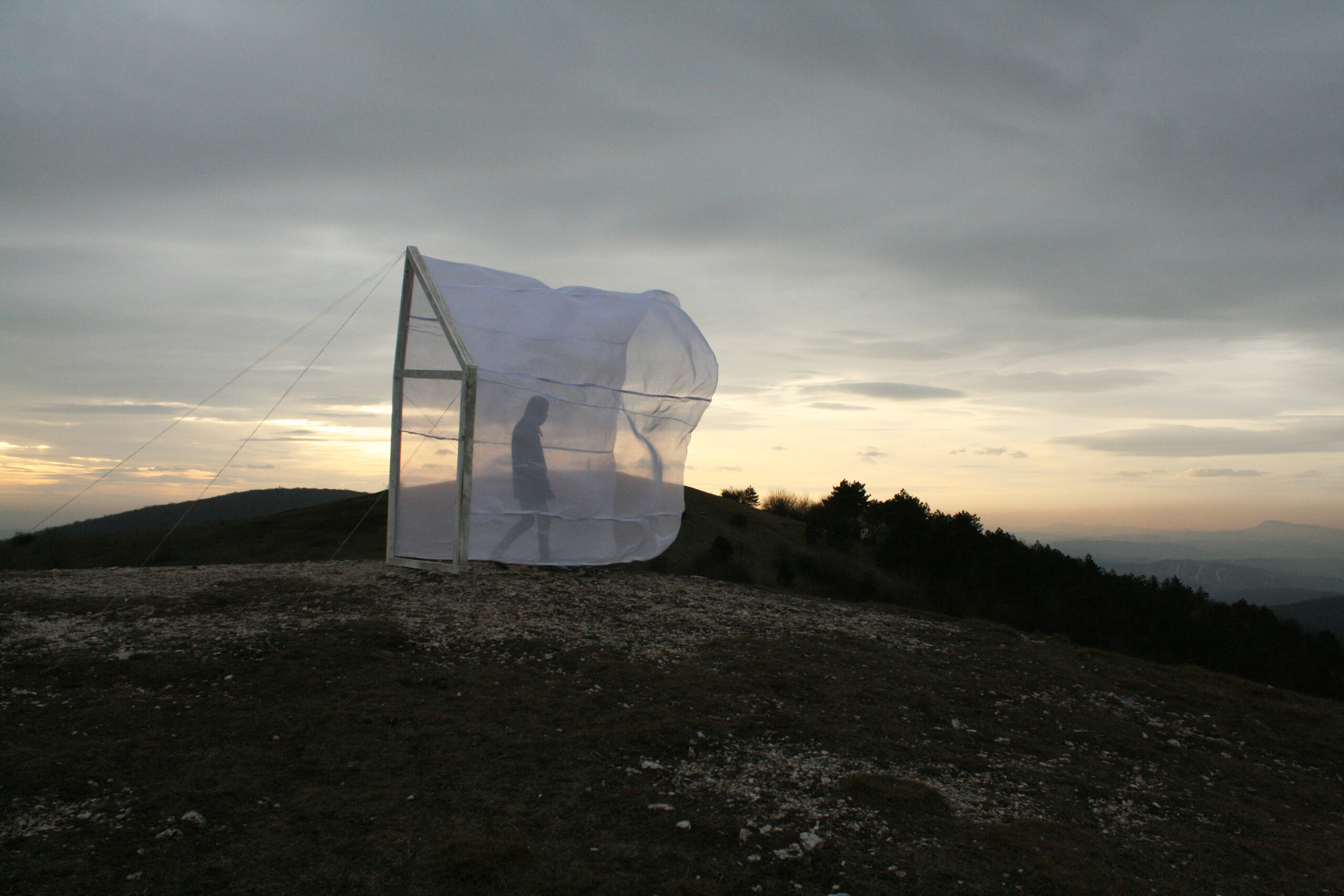

On a windswept hill outside Budapest, a fragile structure briefly takes shape each spring. A simple wooden frame is wrapped in translucent fabric that responds immediately to the wind, swelling and relaxing as gusts pass through. Its outline is never stable. At times it resembles a house, at others a soft volume on the verge of collapse. Inside, or more precisely within the membrane, a human figure becomes visible only intermittently, stretched and blurred by the fabric, appearing less as an inhabitant than as a trace of movement. This structure is known as the Spring Wind House, a temporary work developed and repeatedly revisited by Architecture Uncomfortable Workshop (AUW), a Budapest based collective founded by Denes Emil Ghyczy and Lukacs Szederkenyi.
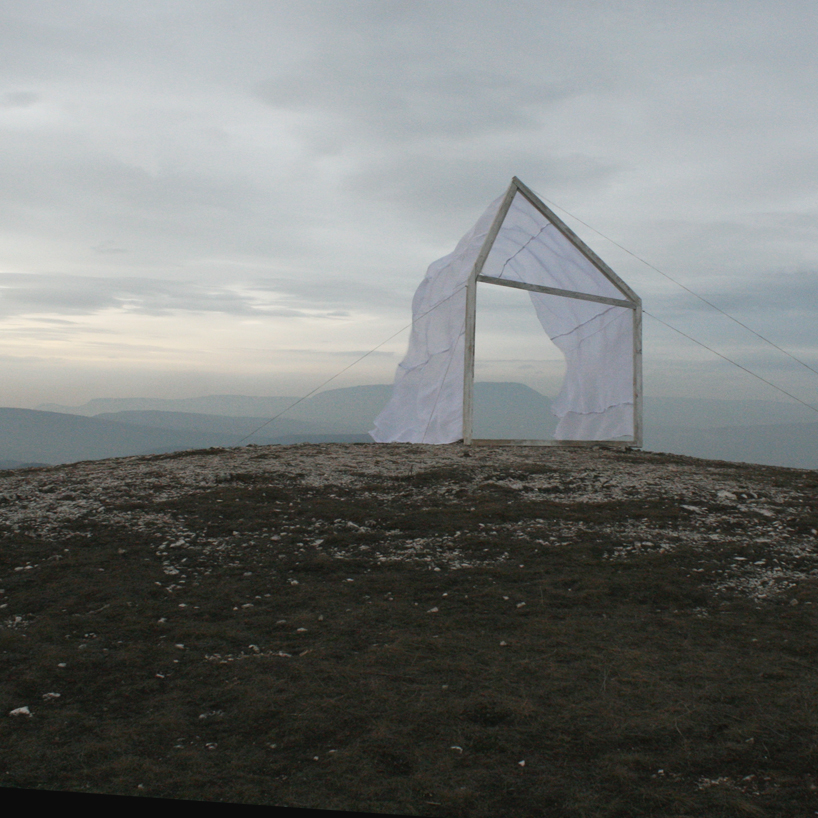
First realised in the early 2010s and rebuilt in various iterations over the years, the Spring Wind House is assembled informally with friends and collaborators, often outdoors and without institutional framing. The process has been described by Ghyczy as closer to a seasonal ritual than a project, something made together on a hill with basic tools and shared labour to mark the arrival of spring winds. The structure is dismantled after a short period, leaving behind no permanent trace. What remains is not a building in the conventional sense, but a shared experience shaped by weather, movement, and time.


Despite its modest scale, the Spring Wind House offers insight into the way Architecture Uncomfortable Workshop approaches architecture and design more broadly. It is not conceived as a pavilion or an object of display, but as a temporary condition in which human intention and environmental forces are held in tension. Shelter is suggested rather than guaranteed. Comfort remains unstable. The structure does not resist the wind, but accommodates it, allowing space to be reshaped moment by moment. Architecture here is neither fixed nor resolved, but emerges through use, material behaviour, and duration.
Architecture Uncomfortable Workshop was formed in 2012 by a group of students from the Budapest University of Technology and Economics. Early access to a small carpentry workshop through family connections proved decisive. Rather than waiting for commissions, the group began building at full scale, producing furniture, installations, and temporary structures that could be realised quickly and directly. The slow and abstracted timeline of conventional architectural practice encouraged them to work through formats where ideas could be tested through making rather than representation. Building, for them, became a form of inquiry.
From the outset, the collective resisted closed definitions of form and function. Objects were not designed to disappear into predefined interiors, nor to resolve spatial problems. Instead, they were conceived as presences capable of altering how space is perceived and used. Furniture could complement its surroundings, but it could also interrupt them. This position draws in part from the work of sculptor Richard Nonas, whose writing on objects creating their own spatial fields has informed the group’s thinking. The aim is not harmony, but awareness that arises when an object asserts itself within a space.
The term uncomfortable in the collective’s name reflects this stance. It does not signal provocation, but a rejection of instant legibility and polished resolution. Ghyczy has spoken of an interest in objects that require time, that resist immediate understanding and reveal themselves gradually through use. Szederkenyi has described this position as a way of questioning dominant ideas of what is considered acceptable or refined within contemporary design culture. Roughness, visible joints, and materials that age and change are treated not as flaws, but as part of the work’s meaning.

Early furniture pieces, including stools, chairs, and bookends combining wood and concrete, exemplify this approach. Edges are left blunt, connections remain exposed, and surfaces retain marks of making. These qualities are not corrected, but maintained. The collective has referred to this attitude as a form of charming brutality, where directness and material honesty take precedence over refinement. Use is expected to transform the object further, adding wear and patina rather than diminishing its presence.

This openness extends from furniture to architecture. For Ghyczy, the relationship between order and contingency remains central. He has drawn on Daoist ideas, particularly those attributed to Zhuangzi, where action emerges through responsiveness rather than control. Architecture, in this view, resembles agriculture more than engineering. A plan acts as a starting point rather than a prescription. Once construction begins, site conditions, material behaviour, and human decisions inevitably alter the outcome. These forces are not treated as disruptions, but as part of the architectural process itself.
This position also reflects a critique of the separation between design and construction that characterises much contemporary practice. Ghyczy has referenced John Ruskin’s writing on Gothic architecture, particularly the idea that dividing intellectual labour from manual execution diminishes both. Within Architecture Uncomfortable Workshop, drawings are often deliberately open. Emotional or symbolic sketches coexist with technical information, leaving room for decisions to be made during construction. Builders are understood not as executors of a fixed vision, but as participants whose actions shape the work as it unfolds.
The Spring Wind House makes this dynamic visible. Its wooden frame establishes a minimal order, while the fabric skin introduces constant variability. Wind becomes an active presence, reshaping the structure in real time. The body inside is neither fully protected nor fully exposed. Stability is not offered. Instead, vulnerability becomes a spatial condition. Related concerns have appeared in other installations developed for exhibitions and events, including a wind responsive structure presented in a Nordic context during the Oslo Architecture Triennale in 2019, where exposure and climate formed the basis of the work.
Material experimentation plays a central role across the collective’s projects. Wood remains a recurring element, rooted in their carpentry background, but it is frequently combined with less conventional materials. Concrete, leather, wool, beeswax, and live bees have all been incorporated into works that test sensory and spatial boundaries. The Wool House, developed around 2018, envelops the user in a space lined entirely with natural wool, producing an environment that is at once insulating and isolating.


In Along with Bees, presented at OFF Biennale Budapest in 2021, participants were invited to spend time alone in a small chamber containing a beehive. Beeswax windows filtered light and scent, softening the boundary between interior and exterior while emphasising the presence of another living system. The experience was intentionally limited in duration, encouraging concentration rather than spectacle. For the Venice Biennale in 2022, the collective developed Beeswax Worker, in which carpenters crafted disassemblable joints from beeswax. The material introduced smell, softness, and impermanence into architectural assembly, challenging assumptions about durability and authorship.


Function within these projects remains deliberately open. As collaborator Anna Zsoldos has noted in discussions around ethnographic chair research, a chair is defined by how it is used rather than by formal criteria. Objects shift roles depending on context. Asymmetry, instability, and awkwardness are treated as sources of meaning. This attitude draws from vernacular and folk architectures, where irregularities and improvisations often arise from necessity, yet produce spaces of strong character.
Narrative and ritual are integral to the collective’s practice. The Spring Wind House is rebuilt not as a replication, but as a continuation of a shared act. Other projects operate as platforms for exchange rather than fixed works. The Thoughts on Architecture events gather ideas from friends and collaborators on simple A4 sheets, assembling them into exhibitions that resist hierarchy and authorship. In Crespo’s Houses, miniature dwellings cast in spiced beeswax are arranged on gypsum landscapes, exploring how materials, scents, and associations infuse space with identity.
Architecture Uncomfortable Workshop has completed a limited number of permanent buildings, including a family house in Csomor completed around 2018. Its influence, however, lies less in formal output than in method. The Csomor house, with its arched glass openings and close relationship to a garden landscape, reflects concerns first explored in temporary work, including material presence and spatial openness. Other projects remain unbuilt or exist only in exhibition form, yet continue to inform the collective’s approach to architecture as an evolving practice.

Within a professional context increasingly oriented toward efficiency and control, the work of Architecture Uncomfortable Workshop foregrounds uncertainty as an operative condition. The Spring Wind House offers no protection from the elements. Instead, it renders the wind perceptible, transforming an environmental force into a spatial experience. When the structure is dismantled and the hill returns to its previous state, what persists is not an object, but a memory of shared exposure.

For Ghyczy, the most meaningful response to the work comes through personal discovery rather than validation. When people encounter these structures and find their own ways of inhabiting them, the project extends beyond its physical existence. Discomfort here does not function as a statement, but as an opening. It asks how much instability can be accommodated, and what forms of attention might emerge when architecture refrains from offering answers.
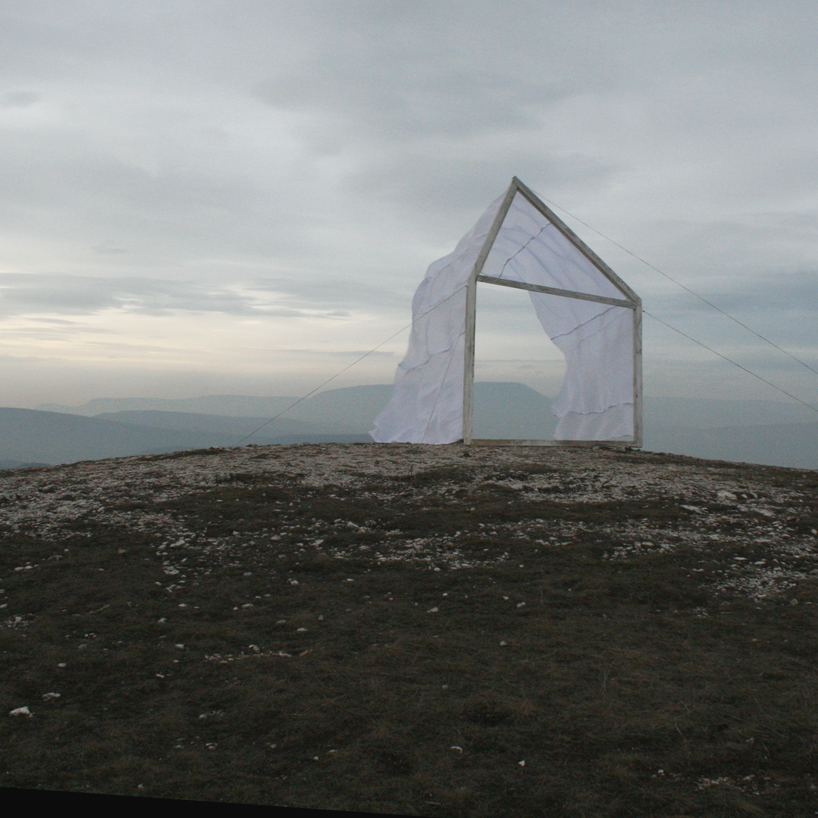
Photo Cover
The Spring Wind House by Architecture Uncomfortable Workshop, a wind-responsive structure on a hill outside Budapest, swelling with fabric in the breeze. Credit: Courtesy of Architecture Uncomfortable Workshop