Now Reading: A cylindrical church in Sazovice filters light into a quiet sanctuary
- 01
A cylindrical church in Sazovice filters light into a quiet sanctuary


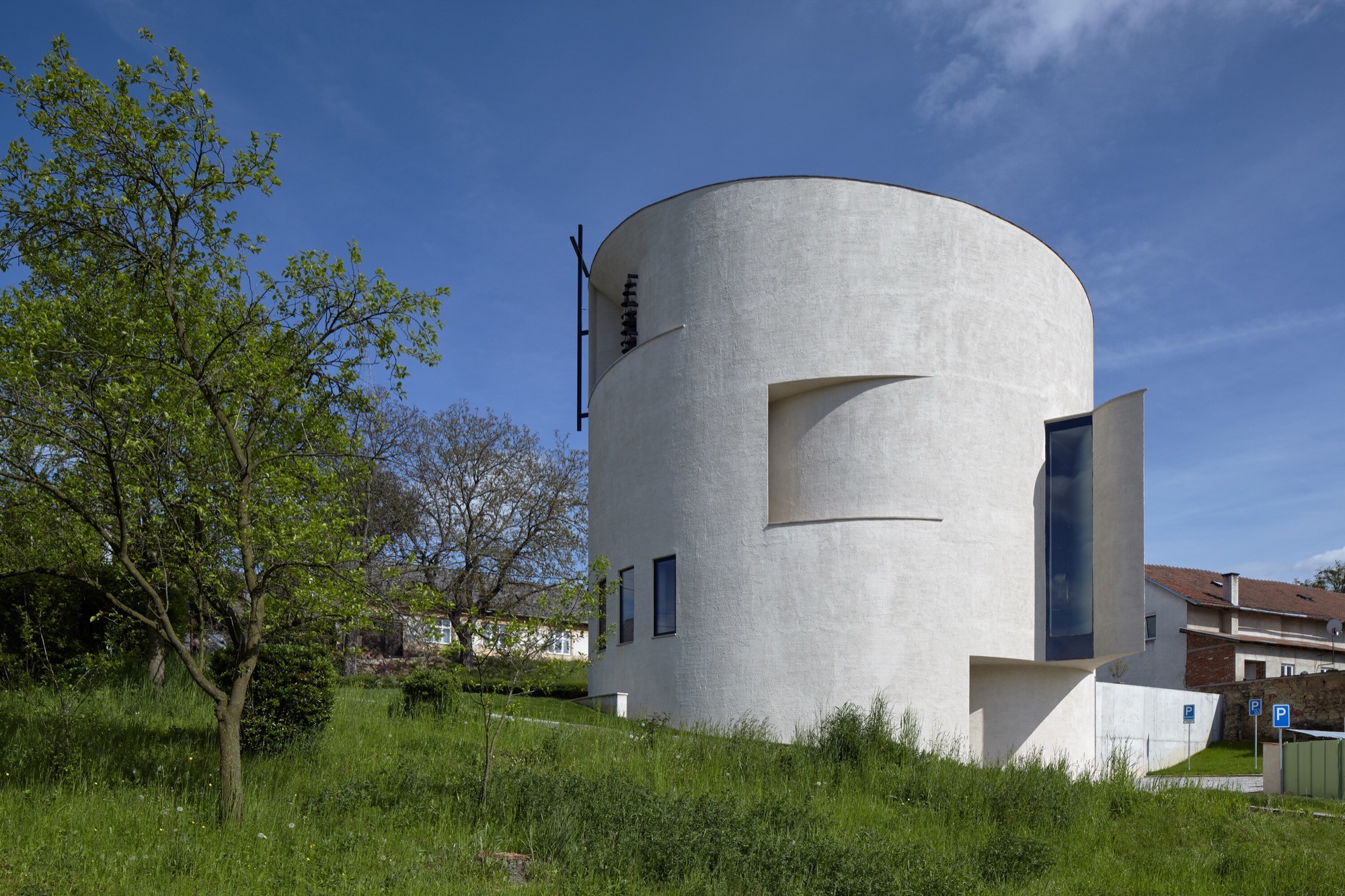
In the Moravian village of Sazovice, the Church of St. Wenceslas stands as a calm, contemporary answer to a long held desire. The ambition to build a local church first surfaced in the interwar years, then faded into the background of history. In 2011, the community revived the idea and, with Atelier Štěpán, translated it into an architecture that feels both new and somehow remembered.


What results is not a building that seeks spectacle. It is a work that relies on clarity, proportion, and the careful choreography of daylight. In Sazovice, spirituality is not expressed through ornament or monumentality, but through a sequence of quiet decisions that shape how the body slows down, how the eye adjusts, and how thought becomes less noisy.
Before form came meaning, and before meaning came material, the project began with position. The team’s first task was to locate a site capable of carrying spiritual weight without breaking the village’s social rhythm. After analysis and deliberation, the chosen location sits at the heart of Sazovice, aligned with the settlement’s existing structure and its daily routes. The church is not placed apart as an isolated object, but anchored as a civic and sacred focal point, a steady presence intended to outlast changing generations. This act of siting is also an act of trust. It treats the village as a living organism and the church as a future oriented node within it, one that gathers people not through visual force, but through quiet inevitability.


The Church of St. Wenceslas takes the form of a simple cylinder, a restrained geometry with deep historical resonance. The choice recalls early rotundas associated with the era of St. Wenceslas, where circular form carried symbolic ideas of completeness and continuity. Here, that reference is not literal quotation. Instead, it is a structural memory, abstracted into an elemental volume that can hold both tradition and contemporary life. The cylinder also allows the building to read as one continuous gesture, uninterrupted by compositional tricks. Its presence is firm yet unaggressive, and its simplicity makes the smallest shifts in surface and light feel significant.


Although the volume is robust, the church is designed to feel light. Tapering walls subtly refine the silhouette, giving the mass a sense of lift, as if the building is gently shedding weight as it rises. This is amplified by carefully crafted windows that do not simply puncture the surface, but modulate it. Pushed and pulled, these openings turn the wall into a responsive membrane, directing soft natural light so it glides across the interior rather than striking it. The effect is deliberate: a kind of dematerialisation, where architecture becomes less about enclosure and more about atmosphere. From certain angles, the church can seem almost like a cut paper form, precise yet delicate, with daylight acting as the invisible hand that gives it depth.

Inside, the language becomes even quieter. The Church of St. Wenceslas embraces minimalism not as an aesthetic trend, but as a spiritual strategy. With decoration reduced, attention is returned to essentials: proportion, silence, and the slow movement of light. The atmosphere encourages personal reflection and meditation, allowing each visitor to bring their own inner life into the space.

Rather than projecting a fixed narrative through imagery, the interior offers openness. Peace here is not performed, it is made possible. The simplicity creates intimacy, a sense of being held without being overwhelmed, and the absence of visual noise lets the mind settle into a steadier tempo.

At the heart of this restrained setting, the altar becomes a singular, tactile moment. Shaped as a smooth bronze shell with an organic character, it is described as a symbol of God’s touch, a reminder of contact and energy moving through ritual. The form draws inspiration from gestures associated with Confirmation and Sanctification, where the act of touch is not incidental but essential, signalling unity, transmission, and presence.


In a space that avoids overt symbolism, the altar’s material and shape carry weight. Bronze introduces warmth and depth, and its softness of contour offers a human counterpoint to the purity of the cylindrical envelope. It is an object that does not demand attention, yet it anchors attention, quietly, through its suggestion of closeness.


The Church of St. Wenceslas in Sazovice shows how contemporary church architecture can be both radical and modest at once. Its references to historical rotundas are filtered through abstraction, its spirituality is carried by light, and its civic role begins with a thoughtful placing within the village. Atelier Štěpán’s approach insists that sacred space does not need excess to be moving. It needs precision, restraint, and an understanding of how architecture can work on the mind and soul without raising its voice.


In Sazovice, the result is a poetic sanctuary built from simple means: a cylinder, a taper, a measured opening, a quiet interior, and one bronze element that speaks of touch. Together, they form a place where contemplation feels natural, and where the divine is suggested not by spectacle, but by the calm persistence of light.
Project Credit
Name: Church of St. Wenceslas
Location: Czech Republic, Sazovice
Design Atelier Štěpán
Completed: BoysPlayNice
More Photos