
Now Reading: The art of nothing: Annie Han and Daniel Mihalyo’s radical architecture
- 01
The art of nothing: Annie Han and Daniel Mihalyo’s radical architecture

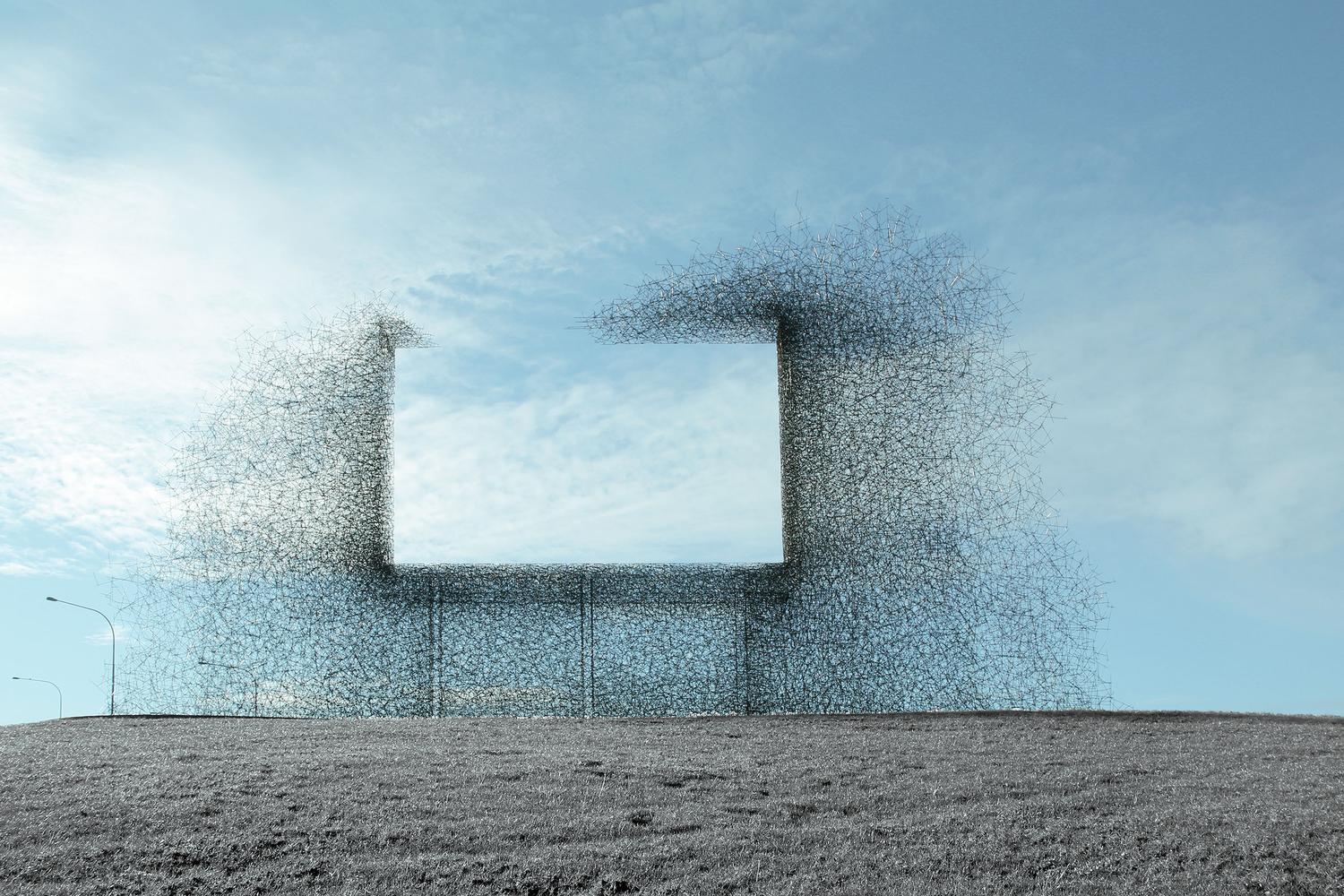

Along a stretch of highway near the U.S.-Canada border in Blaine, Washington, a colossal billboard frame stands silent amid rolling grass and open sky. There is no logo, no slogan, no product. Instead, thousands of slender stainless-steel rods interlace into a delicate mesh, encircling a perfectly empty void. As vehicles pass, the sky, clouds, distant hills, and shifting light pour through the frame like a living painting. This is Non-Sign II (2010), the defining work of Annie Han and Daniel Mihalyo, founders of Lead Pencil Studio. In that single gesture, the artists remove the machinery of commercial persuasion and invite viewers to look, really look, at what consumer culture habitually obscures: empty space itself.

For nearly three decades, since establishing their studio in Seattle in 1997, Han and Mihalyo have used architecture not to fill the world but to reveal its voids. They do not build to complete; they build to expose absence. In an art world often saturated with data, identity, and spectacle, Lead Pencil Studio has pursued a quieter, more radical path: a non-functional architecture centred on perception, memory, and the eloquence of silence. Their site-specific installations are not merely objects; they are precise interventions into how we see, remember, and inhabit the built environment.
FROM MIGRATION TO THE LEAD PENCIL
Annie Han, born in South Korea, immigrated to the United States at fifteen. In her home country, formal art education was a luxury her family could not afford. In America, a perceptive teacher recognised her drawing talent. She began in journalism before switching to architecture at the University of Oregon, drawn by the power of spatial representation. Daniel Mihalyo, born and raised in Washington State, grew up immersed in Seattle’s strong public arts culture. The two met in Oregon’s architecture programme, a curriculum that deliberately blurred lines between art and building, and began collaborating in the early 1990s. Lead Pencil Studio was formally founded in 1997.

The studio’s name is quietly evocative. A “lead pencil” is the humble tool of precise line-making, yet in their hands it becomes an instrument for drawing emptiness. Deliberately small, the practice accepts only a few architectural commissions per year to preserve room for artistic experimentation. Recognition followed swiftly: the Architectural League of New York named them Emerging Voices in 2006, and they received the Founders’ Rome Prize in 2007–08. These awards catalysed their shift toward large-scale, temporary installations that would define their mature voice.
NEGATIVE SPACE AS A PERCEPTUAL TOOL
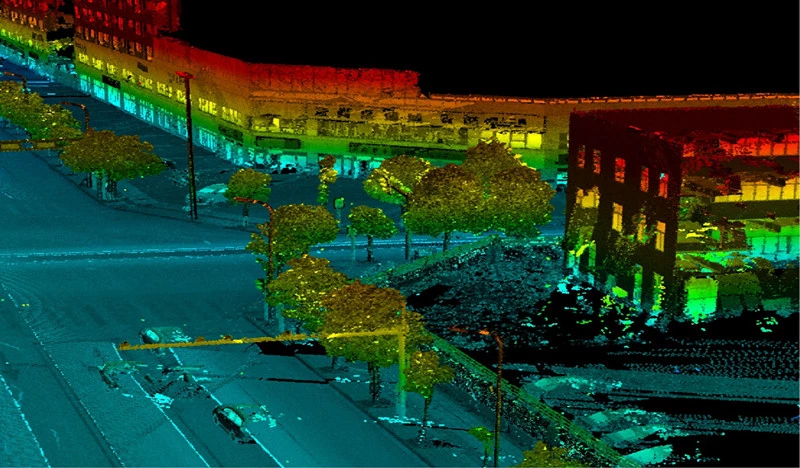
At the heart of Han and Mihalyo’s thinking lies the concept of negative space, not emptiness as lack, but as the most powerful visual and experiential instrument available. In a 2011 interview with Urban Omnibus, Mihalyo spoke of their fascination with “what the eye does not see but the body feels when moving through the city.” They have employed LIDAR (Light Detection and Ranging) technology in the ongoing series Looking at Nothing to scan urban environments and reveal the vast invisible volumes we occupy yet rarely notice. “Ninety-nine point nine nine nine percent of the city we know nothing about,” Mihalyo observed.
This philosophy serves as both critique and antidote to contemporary built culture. In an era of relentless construction, advertising, and visual noise, Han and Mihalyo practise subtraction. Their work challenges the assumption that architecture must always add, complete, or persuade. Instead, they propose that meaningful spatial experience often begins with removal, clearing away the clutter so that perception itself can emerge. The result is a form of architecture that does not dictate but liberates: it invites slow looking, contemplation, and, ultimately, a deeper freedom of awareness.
RAW MATERIALS, SCALE, AND PERCEPTUAL EFFECT
Lead Pencil Studio’s visual vocabulary is remarkably consistent: temporary construction materials such as scaffolding, steel mesh and construction netting, architectural scale, and absolute site-specificity. They take elements usually hidden, structural armatures and safety netting, and make them the protagonists, creating ghostly doubles of existing architecture.
Maryhill Double (2006), realised at the Columbia River Gorge in Oregon, remains one of their masterpieces. Facing the solid stone Maryhill Museum, they constructed an exact-scale replica of the museum’s interior volume using scaffolding and blue-green safety netting. The “ghost” structure stood in dialogue with its solid counterpart, forcing viewers to compare mass and void, permanence and transience. Walking between the two structures, one feels the air itself become charged with architectural intelligence.


If Maryhill Double is a quiet duet between matter and absence, Non-Sign II takes the conversation to the political frontier. Placed at the national border, a site heavy with issues of control, identity, and sovereignty, the artists appropriated the billboard, the ultimate tool of commercial propaganda, and emptied it. “We wanted to remove the sign and use the structure to frame the sky, the atmosphere,” they have said. The result is a constantly changing aperture through which nature and the act of crossing unfold. In an age of border walls and surveillance, Non-Sign II offers openness instead of closure. The wind whistles through the mesh; the sky moves freely. The work does not preach; it simply holds space open.


Without Room (2008) turns inward. In Greensboro, North Carolina, the artists meticulously recreated an ordinary living room, then painted every object, furniture, clothing, shoes and personal items in a uniform matte grey. The space became haunting: everything remains, yet identity and warmth have been stripped away. The work exposes the quiet accumulation of consumer objects and the fragility of domestic “stability.” Visitors often report a visceral unease, as though they have stepped into a memory that has begun to fade.


Their memorial at the Oregon State Hospital (2014) demonstrates the emotional depth of their language. Inside the former crematorium of a historic psychiatric facility, they designed a columbarium of hand-crafted ceramic niches to hold the ashes of approximately 3,500 unclaimed patients. Restrained and dignified, the project transforms a site of institutional forgetting into one of quiet respect. “The final resting place should be simple and elegant,” they noted, “with as little artistic imprint as possible.”


Later works, including Looking at Nothing, Re-Stack, and Inversion: Plus Minus, extend their research through LIDAR data, light, shadow, and ephemeral structures in urban contexts. Across all projects, their choice of raw, industrial materials, steel, mesh and ceramic, ensures the works remain transparent about their making. They never disguise process; they celebrate impermanence and the dialogue between intervention and site.
LEGACY AND CONTEMPORARY RELEVANCE
In today’s landscape of algorithmic advertising, digital saturation, and virtual realities, Lead Pencil Studio’s insistence on looking at “nothing” feels increasingly urgent. Their practice stands apart from contemporaries such as Rachel Whiteread, whose solid casts monumentalise absence, or studios like Diller Scofidio + Renfro, whose work often embraces spectacle and advanced technology. Han and Mihalyo remain committed to modest materials and long-term site engagement, favouring quiet precision over grand gestures.

Their influence extends across public art, experimental architecture, and discourses on perception and the built environment. By consistently demonstrating that subtraction can be more powerful than addition, they have expanded the vocabulary of what architecture, and art, can do. Yet their work also carries an implicit question: in a culture that increasingly commodifies attention itself, how long can such acts of deliberate emptying endure before they too are absorbed?
Today, Non-Sign II still stands near the border. Cars continue to pass. The sky continues to move through its empty frame. It does not shout. It does not sell. It simply holds space open, an enduring reminder that sometimes the most radical act is to leave room for the world to be seen.
Photo Cover
Non-Sign II (2010), Lead Pencil Studio. Credit: © Annie Han and Daniel Mihalyo, Lead Pencil Studio.