
Now Reading: PLAT ASIA integrates hot spring and hotel lobby into a unified landscape in Jinshanling Valley
- 01
PLAT ASIA integrates hot spring and hotel lobby into a unified landscape in Jinshanling Valley

PLAT ASIA integrates hot spring and hotel lobby into a unified landscape in Jinshanling Valley

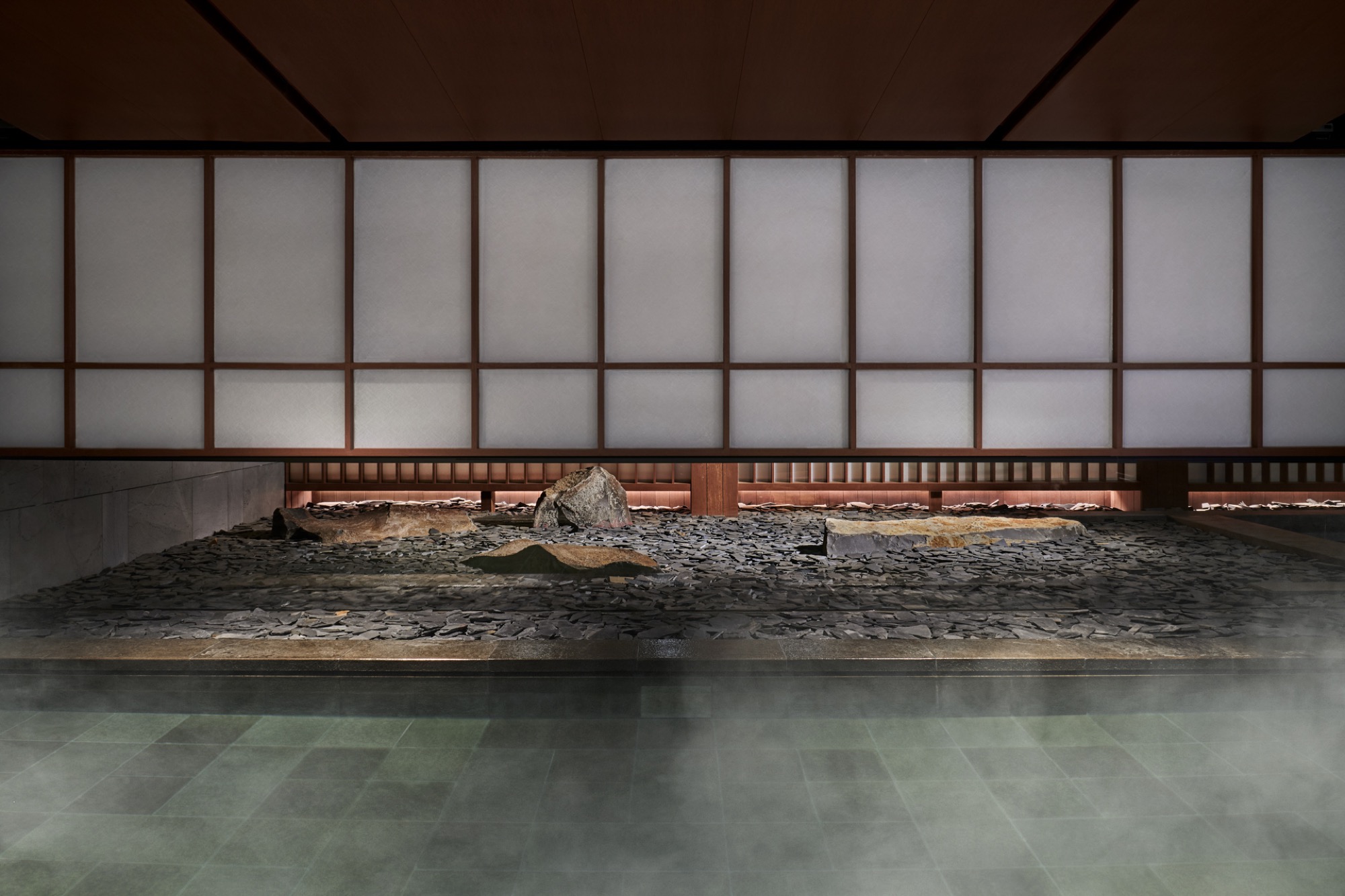
Set at the center of the Aranya Jinshanling community in Chengde, the Valley Hot Spring and the lobby of Lanshan Hotel occupy the ground floor of an L-shaped building, opening toward a broad southern lawn while facing artist studios to the west. Conceived as a shared threshold for visitors arriving from across China and beyond, the project operates as both a social condenser and a retreat, mediating between movement and stillness, exposure and introspection.


Led by architect JUNG Donghyun, the design engages directly with the physical and atmospheric presence of Jinshanling, a landscape shaped by the Great Wall and its surrounding hills. Rather than framing the mountains as distant scenery, the project internalizes their logic. Spatial sequences, textures, and light conditions are composed as an interior landscape that mirrors the gradients of the terrain. The program is divided into two primary zones, a lobby with a breakfast restaurant and a hot spring complex, linked through a single circulation path yet distinguished by contrasting atmospheres.


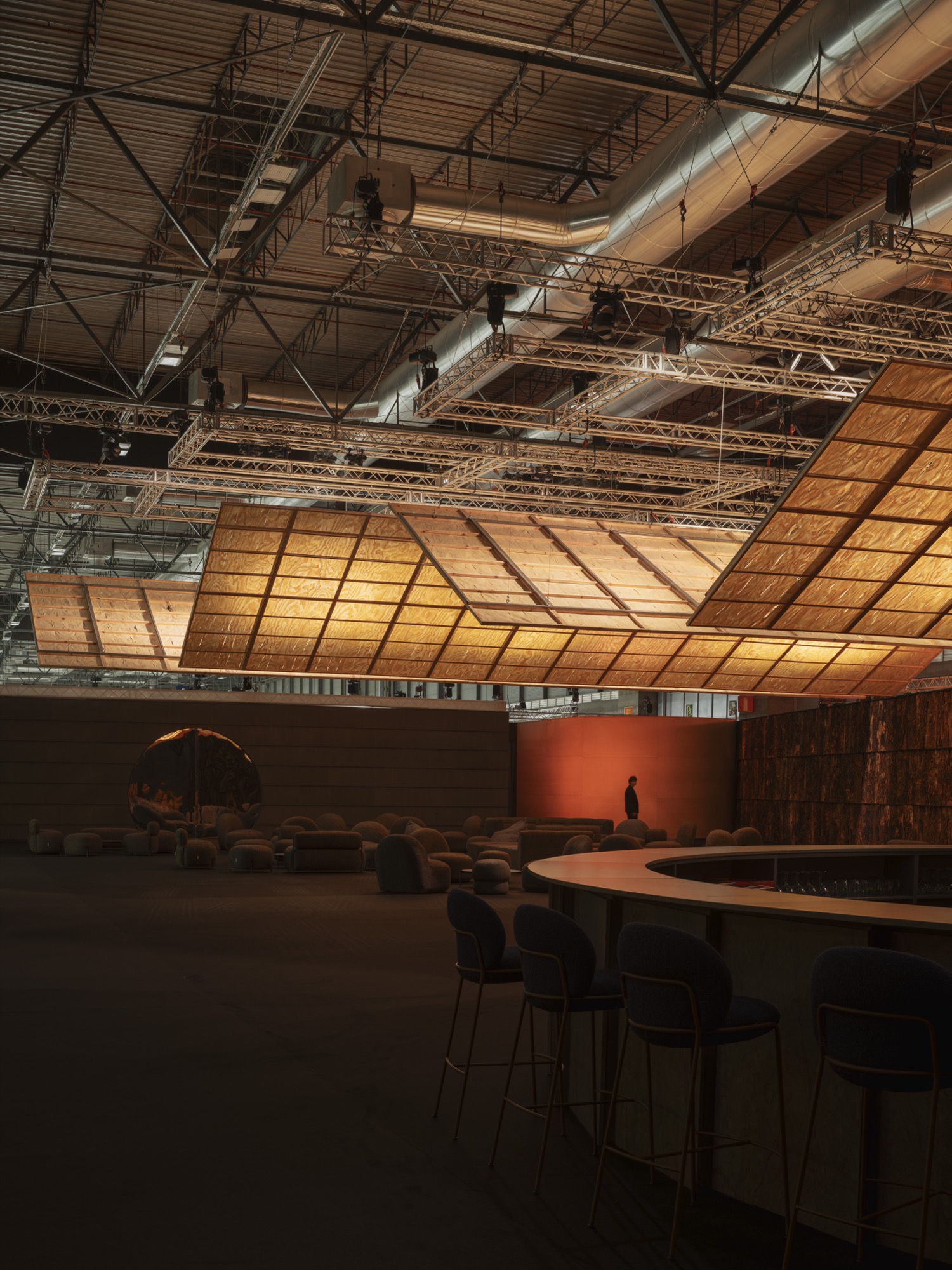
The lobby unfolds as an open and luminous field, defined by warm tones and a porous spatial structure that encourages interaction and flow. In contrast, the hot spring retreats into a darker, more tactile environment where rough materials and controlled light establish a sense of privacy and enclosure. Together, they form a calibrated duality that reflects the rhythms of the mountain itself.
The conceptual framework of the project draws from XUTING, a recurring element in traditional Chinese shanshui painting. Reinterpreted here as a contemporary spatial device, the pavilion becomes both structure and narrative, organizing the interior while extending outward into the surrounding landscape.
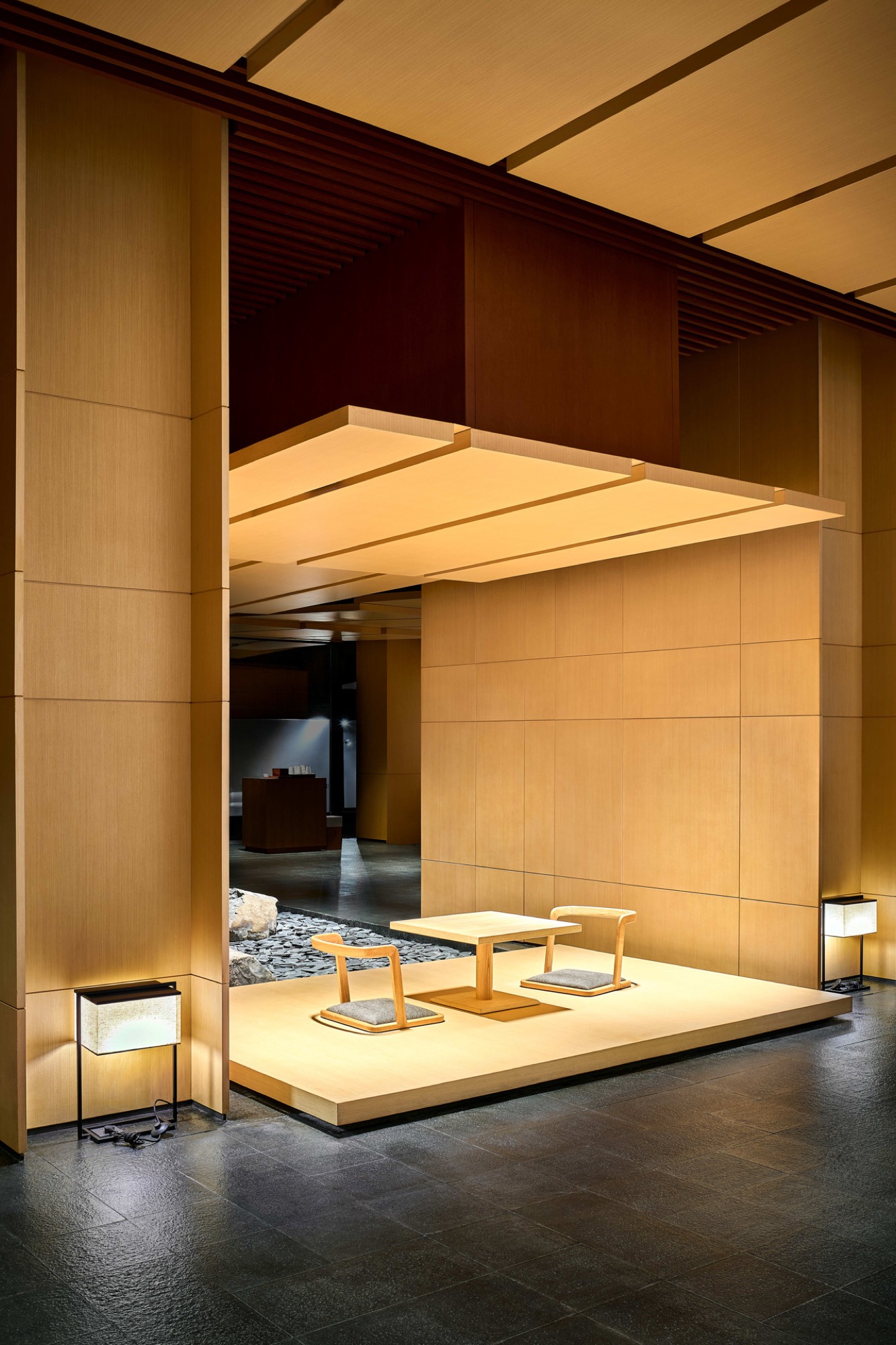


In the lobby and restaurant, a series of elevated pavilion volumes define scale and orientation, their extended eaves projecting beyond the glass façade to form a transitional threshold between inside and outside. This gesture transforms the building edge into an inhabitable interface, accommodating outdoor dining while visually dissolving the boundary between architecture and terrain.
Within the hot spring, the pavilion language becomes more intimate and fragmented. Seven distinct volumes organize the program, including public bathing areas, steam rooms, and private suites. Roof planes extend outward into a field of timber and stone, where filtered light enters through layered screens, reinforcing both enclosure and permeability. The spatial composition negotiates openness and seclusion, allowing the experience to unfold gradually.


Materiality is approached as a continuation of the mountain environment. Timber, stone, and translucent elements are deployed not as finishes but as carriers of atmosphere. During construction, stones were selected and shaped directly at the quarry, emphasizing their origin and physical presence within the space.

Volcanic rock surfaces define the hot spring interiors, where moisture and light create a layered, almost geological effect across walls and floors. Grooved stone and crushed aggregates articulate circulation paths, guiding movement from exterior to interior while blurring their distinction. Bamboo screens soften light and mediate views, introducing a delicate counterpoint to the mass of stone.


Floral installations punctuate the interiors with a sense of seasonality, while timber structures anchor the composition, balancing roughness with precision. The result is a spatial condition where architecture, landscape, and material converge into a unified sensory field.


At Jinshanling Valley Hot Spring and Lanshan Hotel Lobby, architecture operates as a mediator between contrasting states. The project constructs a dialogue between brightness and shadow, openness and retreat, collective space and private ritual. Through the reinterpretation of the pavilion and the careful orchestration of material and atmosphere, the design transforms a service program into an immersive experience rooted in the presence of the mountain.

Project Credits
Project name: Jinshanling Valley Hot Spring and Lanshan Hotel Lobby
Location: Aranya Jinshanling, Chengde, Hebei, China
Total floor area: 1500 sqm
Architects: PLAT ASIA / @platasia
Photo: DW KIM
Construction period: Feb 2023 – Oct 2023
More Photos