Now Reading: Experimental suburban house with inverted roof and playful coloured façades
- 01
Experimental suburban house with inverted roof and playful coloured façades


Within a tightly defined suburban footprint, the house emerges as a deliberate disruption of familiar domestic forms. Rather than following the predictable geometry of the pitched suburban roof, the volume overturns convention. One side curves while the other remains sharply linear, producing a peculiar silhouette that punctures the visual monotony of its surroundings. The building reads almost as an exploded object resting upon a translucent plinth, its geometry at once playful and analytical.

The façade is composed as a graphic field of surfaces. Vertical planes and slanted cuts are distinguished through carefully selected colours, turning the exterior into a layered composition rather than a continuous envelope. Round and square windows puncture the white surface, forming three distinct elevations that appear almost animated. Some arrangements resemble stylised faces, others evoke imaginary creatures. The effect is both architectural and pictorial.


Colour becomes an active architectural device. Blue and green shutters conceal the openings while simultaneously amplifying the façade’s graphic character. When closed, they transform the house into something resembling a paper collage, with fragments of colour scattered across a white ground. The palette remains restrained yet expressive, oscillating between tones of green, blue, light green, black and white. The building operates less as a conventional object and more as a spatial composition assembled through surfaces.


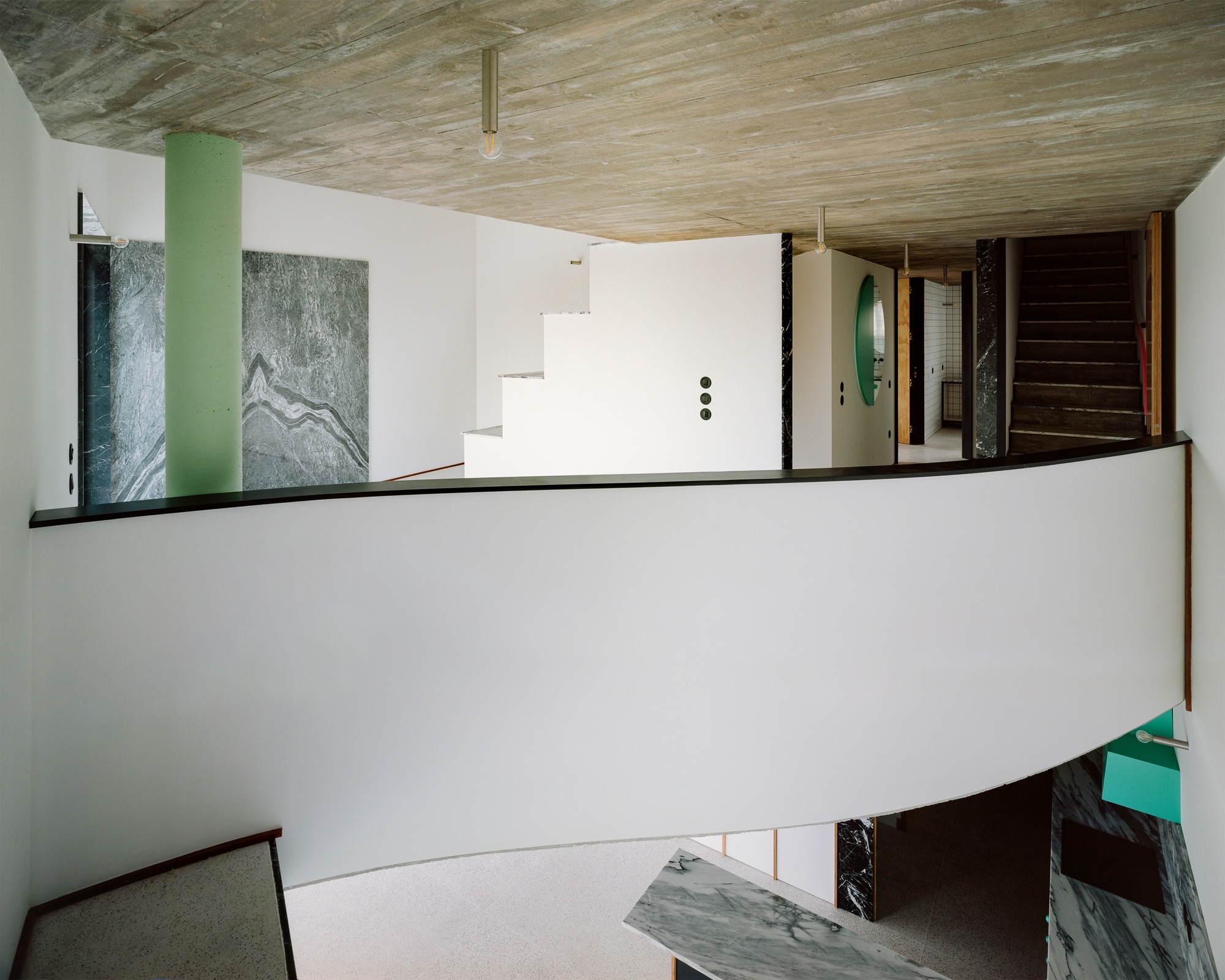
Inside, the structure separates itself from the perimeter walls. A sequence of five slender concrete columns, finished in a pale green tone, reveals itself throughout the interior. Their placement appears almost indifferent to domestic routines. The columns interrupt circulation, cut across rooms, and occasionally stand in unexpected positions. One of them extends to the terrace where it supports nothing, becoming a purely spatial gesture.
The ground floor opens directly toward the garden, forming a fluid living space that connects vertically with an office on the level above. Rather than following a rigid spatial logic, the interior unfolds through a sequence of irregular conditions. Double height volumes appear unexpectedly. Walls bend or kink subtly. Columns interrupt views. Above, the ceiling slopes gently, reinforcing the sense that the house is not organised through conventional orthogonal order.


At the uppermost level, the master bedroom occupies an extruded quarter-circle volume. This curved space, inserted within the larger geometry, introduces yet another spatial register within the house’s layered composition.


The project can be understood as an exploration of surfaces rather than volumes. Straight planes, folded edges, curved sections and tilted cuts are assembled with precision. Materials such as concrete, marble and glass brick reinforce the tactile distinction between these surfaces while maintaining the clarity of the composition.


These elements divide, overlap and intersect with deliberate tension. Columns pierce through the layered planes, acting as anchors that stabilise the otherwise fragmented spatial field. Movement through the house follows a meandering path between these orchestrated elements, revealing a sequence of shifting perspectives.


The resulting figure is paradoxical. The house appears both complete and fractured, simultaneously a singular object and a collage of architectural fragments.


Project Credit
Project name: fala 125 – house with an inverted roof
Location: Matosinhos, Portugal
Time: 2020 – 2023
Design firm: fala / @fala.atelier
Area: 550m2 (site); 250m2 (building)
Photo: fala
More Photos