Now Reading: Richard Wilson and the Illusion of Solid Architecture
- 01
Richard Wilson and the Illusion of Solid Architecture


In Richard Wilson’s work, architecture is never simply a setting. It is tested, inverted, cut open, rotated and made newly uncertain. Few artists of the last four decades have treated the built environment with such sustained curiosity. Wilson’s installations do not decorate space. They alter the terms by which space is understood. They ask what happens when a room stops behaving like a room, when a façade appears to detach from its own logic, or when the interior of a building suddenly seems deeper than its physical limits.
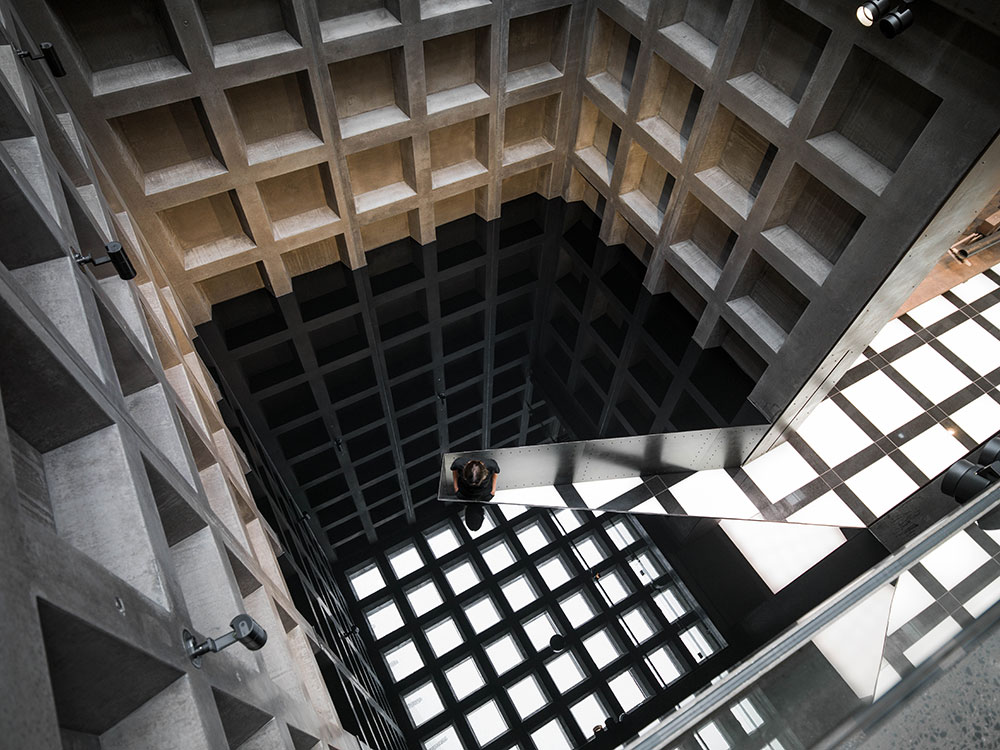
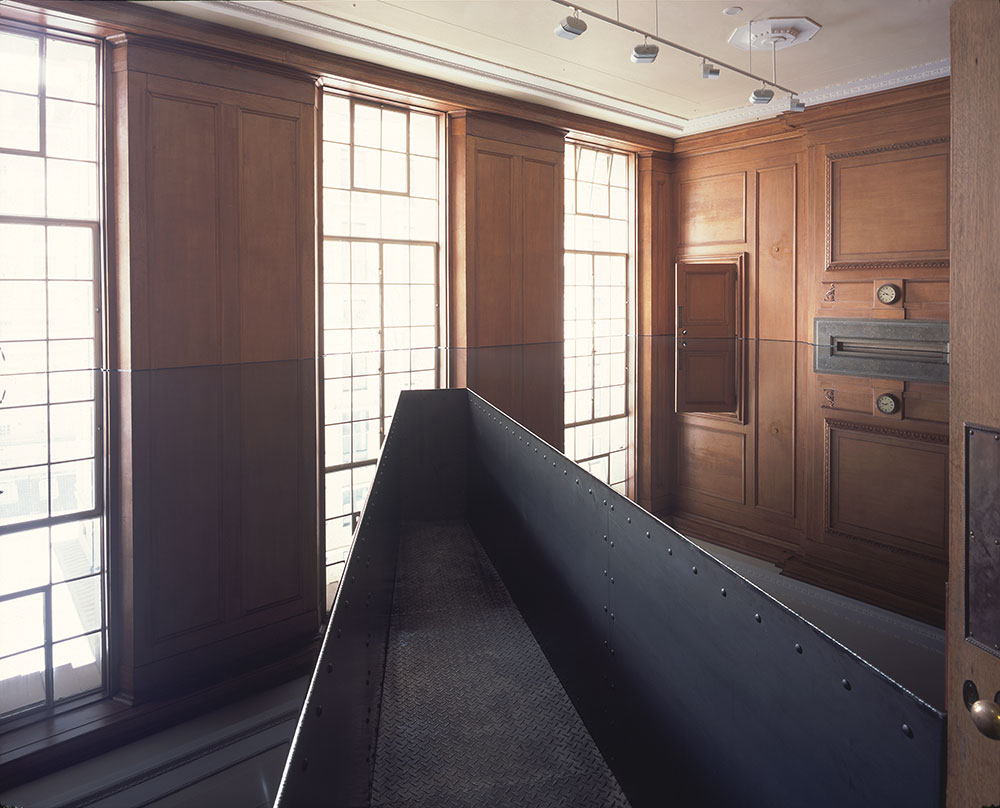
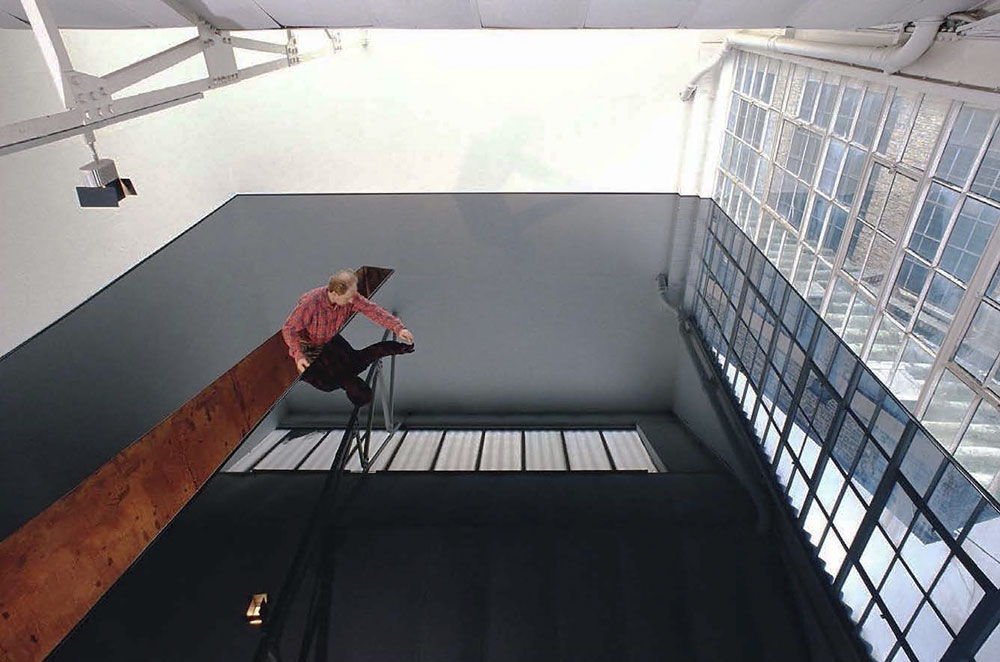
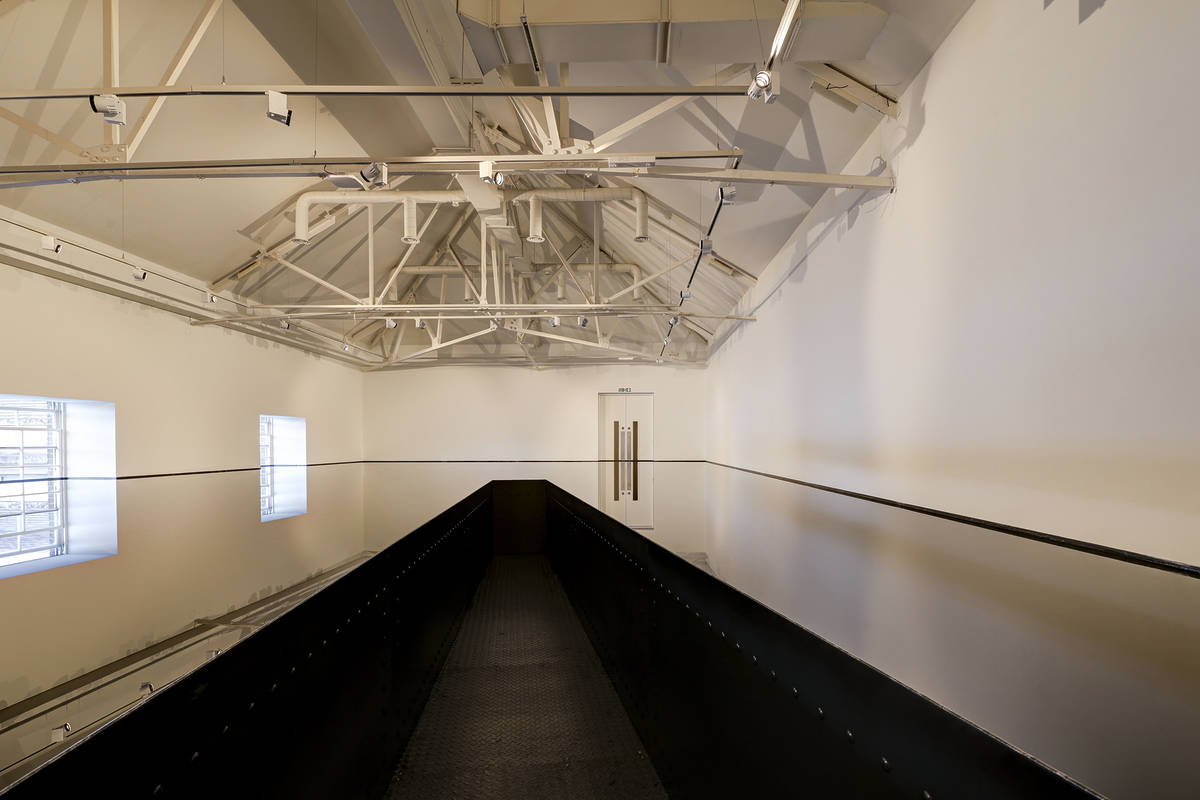
That proposition finds its clearest expression in 20:50, first realised at Matt’s Gallery in London in 1987. The work fills a gallery space to waist height with recycled engine oil and introduces a narrow walkway that leads into the centre of the room. The surface of the oil mirrors the architecture above with uncanny precision, creating the impression that the space continues beneath itself. Ceiling, walls and lights appear duplicated in a dark reflective plane, producing a moment in which the viewer hesitates between solidity and void.
The enduring force of 20:50 lies in its economy. There is no theatrical apparatus. Only a room, a reflective surface and the body’s hesitation at the edge of both. The title refers to the grade of oil used. Visitors are warned not to touch the liquid, whose thickness and indelible blackness reinforce the tension between attraction and repulsion. Wilson never entirely neutralises the industrial material from which the work is made. The installation retains a residue of the mechanical world that produced it.
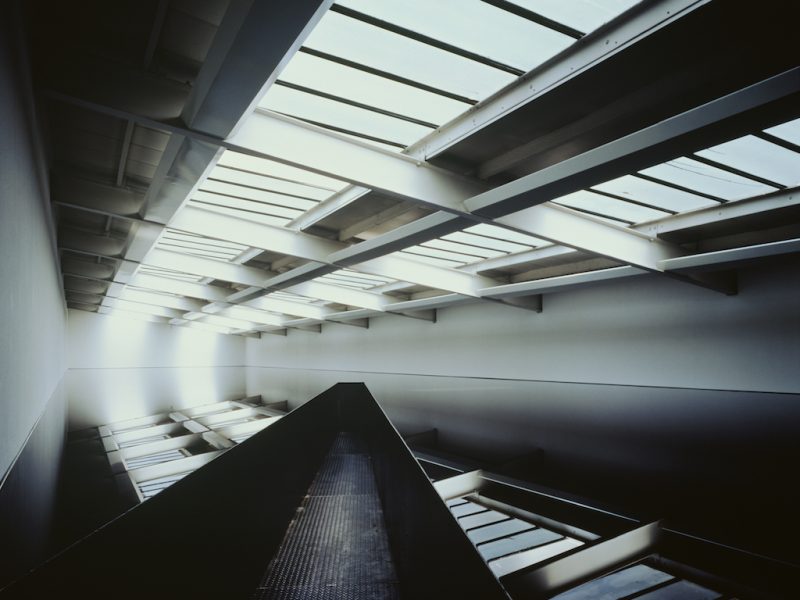
That ambiguity is central to its power. What appears beautiful is also the by-product of industrial waste. The work seduces the eye while reminding the viewer of the environmental damage associated with oil. Within this tension Wilson locates one of the most unsettling paradoxes of contemporary installation art. The reflective surface suggests serenity and perfection, yet the substance itself carries associations of contamination and ecological harm.
The work quickly became one of the defining installations of British contemporary art. After its debut in 1987 it was acquired by Charles Saatchi and displayed for many years in Saatchi’s London venues. Critics frequently cited it as one of the most memorable spatial works of the period. Its significance, however, lies less in its notoriety than in the method it introduced. 20:50 demonstrated that sculpture could operate as a transformation of architectural perception rather than as an autonomous object.
Born in London in 1953, Wilson studied at the London College of Printing, Hornsey College of Art and the University of Reading. From early in his career he moved away from producing self contained sculptural forms. Instead he began working directly with buildings and existing structures. His works intervene in architecture rather than standing apart from it.
This position places him within the expanded field of sculpture that emerged after minimalism, yet his approach remains distinct. Artists such as Richard Serra emphasised the authority of mass and material weight. Wilson, by contrast, often emphasises interruption and instability. His works reveal how easily architectural certainty can be unsettled.
For that reason 20:50 should not be understood simply as a visual trick. It is a proposition about how architecture can be made unreliable. The mirrored oil surface expands the room beyond its physical limits and destabilises the viewer’s sense of orientation. What appears to be a floor is in fact a liquid void. What appears to be depth is only reflection. The installation turns the gallery into an instrument of perceptual doubt.
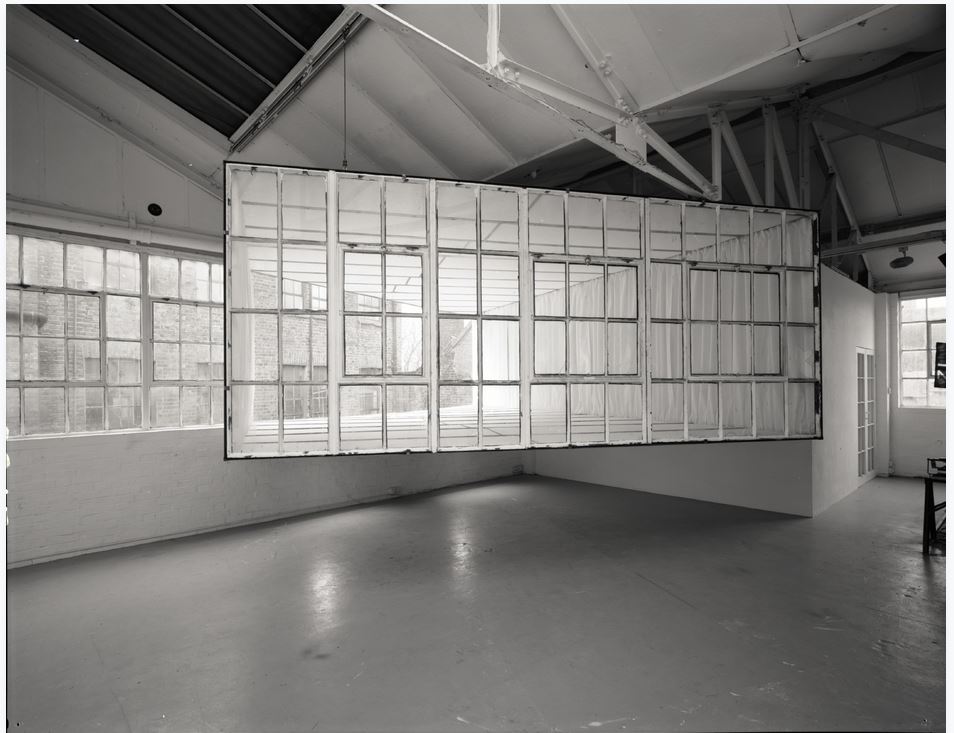
This concern with spatial instability runs through Wilson’s later projects. In She Came in Through the Bathroom Window from 1989, a section of gallery window was removed from the wall and repositioned within the exhibition space. The displaced architectural element becomes the focus of the room. A structure that normally defines the boundary between interior and exterior suddenly appears as an object within the interior itself.
Wilson’s public projects scale up these gestures while maintaining their conceptual clarity. A Slice of Reality, first installed near the Millennium Dome and later relocated to the Greenwich Peninsula, presents a vertical section of the former sand dredger Arco Trent. The vessel was dramatically shortened, leaving a slice that exposes bridge, cabins and machinery. Visitors can enter the structure and move through the ship’s interior spaces. By isolating a fragment of the vessel Wilson transforms a piece of industrial infrastructure into a strange hybrid of sculpture, ruin and architectural section drawing.

Another landmark intervention appeared in Liverpool in 2007. For the Liverpool Biennial Wilson created Turning the Place Over, a work that cut an ovoid section from the façade of a derelict building on Moorfields. The extracted portion was mounted on a rotating mechanism so that the façade slowly revolved during the day. As the structure turned, the interior of the building briefly became visible before the wall closed again. The work operated for several years before being dismantled in 2011, yet it remains one of the most memorable examples of architecture treated as a kinetic surface.
Wilson has also explored subtler distortions of architectural order. Square the Block, installed on the exterior of the London School of Economics New Academic Building, copied vertical fragments from two sides of the façade and recombined them into an impossible corner. At first glance the addition appears part of the building. Only after careful observation does the geometry reveal itself as a deliberate misalignment.
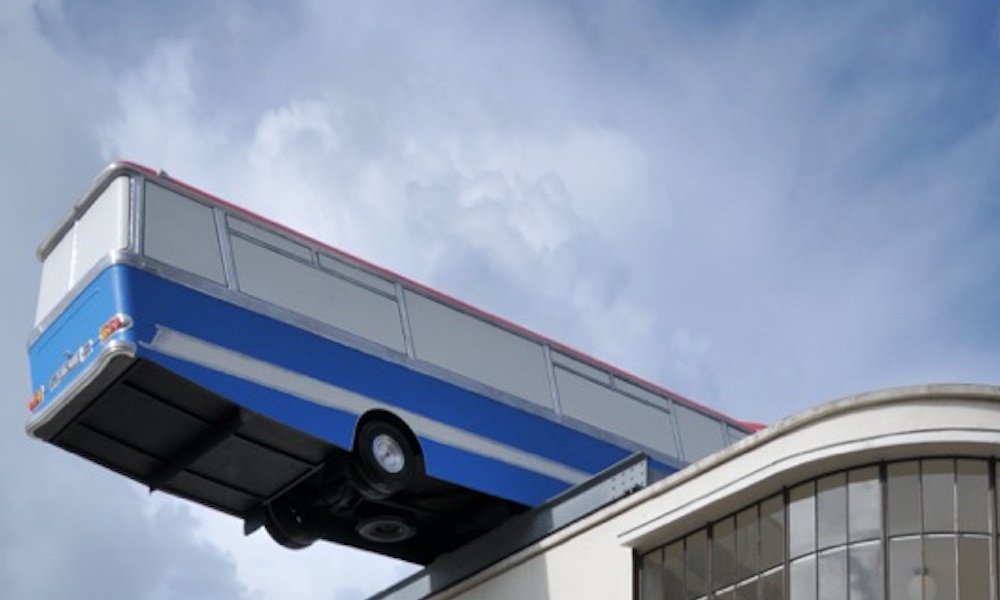
Occasionally Wilson’s interventions adopt a more theatrical form. Hang On A Minute Lads, I’ve Got a Great Idea, installed on the roof of the De La Warr Pavilion in 2012, recreated the famous final scene from the film The Italian Job. A full sized coach balanced precariously at the edge of the roof, echoing the moment in the film when the vehicle teeters over a cliff. The sculpture combined humour with a precise feat of engineering while continuing Wilson’s interest in suspended instability.
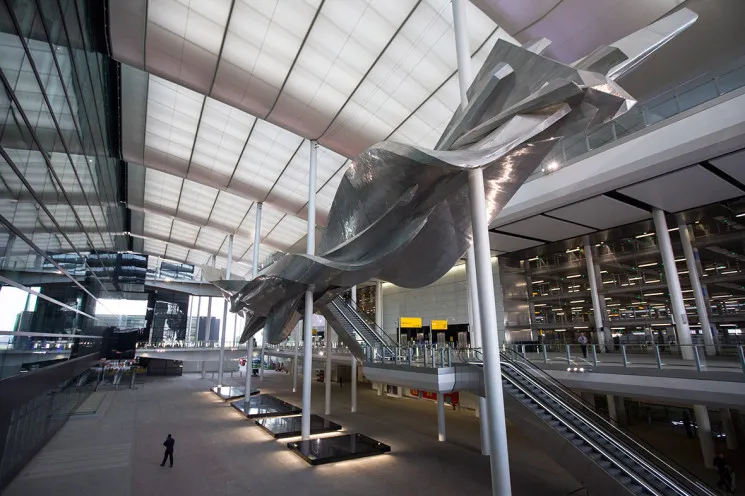
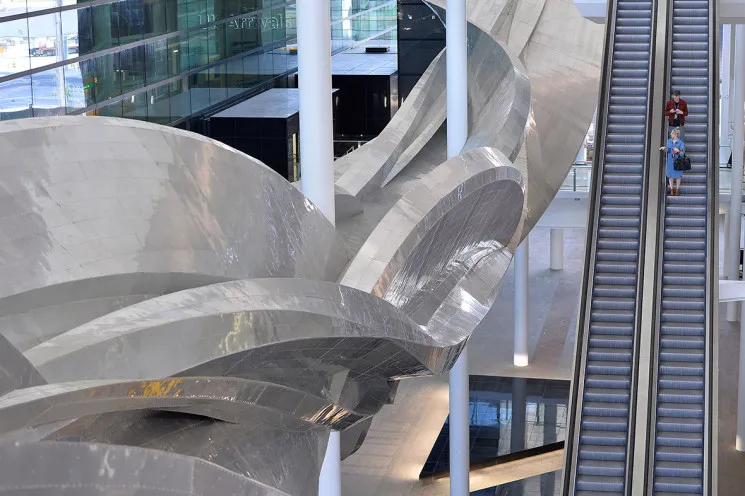
His most ambitious public work to date is Slipstream, unveiled at Heathrow Terminal 2 in 2014. Suspended within the terminal’s vast interior, the sculpture traces an imagined flight path through space. The twisting aluminium form measures over seventy metres in length and weighs many tonnes. Its shape was developed through experiments with the motion of a stunt aircraft, translating the fluid trajectory of flight into a monumental sculptural form.
Installed in one of the busiest airports in Europe, Slipstream introduces a powerful sense of motion into an environment normally governed by strict circulation routes. Passengers move beneath the sweeping form as it cuts diagonally across the architecture. The sculpture transforms the terminal interior into a spatial field animated by velocity.
Across these works a consistent philosophy emerges. Wilson identifies points where architecture appears most stable and then introduces a precise disruption. Reflection, displacement, incision, rotation and suspension become tools for exposing the fragility of spatial certainty.

His installations remind viewers that architecture is not only a physical structure but also a perceptual agreement. When that agreement is disturbed the meaning of the space changes. Walls become apertures. Surfaces become illusions. Buildings reveal themselves as systems capable of transformation.
In a cultural moment increasingly dominated by smooth façades and controlled environments, Wilson’s work restores an element of uncertainty to the built world. His installations remind us that architecture can still surprise, confuse and provoke reflection.
The enduring legacy of Richard Wilson lies in this capacity to unsettle the idea of solidity itself. From the reflective depths of 20:50 to the sweeping trajectory of Slipstream, his projects show that space is never as stable as it appears. With a single intervention a room can double, a façade can rotate, and a building can suddenly reveal another reality within its own structure.
Photo Cover
Richard Wilson’s iconic 20:50 installation at the Saatchi Gallery, featuring a reflective pool of engine oil that creates an illusion of infinite space. Credit: Secret London / Matt Chung Photo.