Now Reading: Down in the Clouds brings inflatable architecture to a rice field
-
01
Down in the Clouds brings inflatable architecture to a rice field


In Dun’ao Village, in Xiangshan County near Ningbo, rice fields sit inside a gentle basin of low hills. The place name carries a clue. The character “岙” (ào) evokes a small valley enclosed by mountains, a geography that naturally feels calm, sheltered, and slow. Practice on Earth and Increments Studio began there, not with a singular architectural statement, but with a mood they wanted to protect: serenity without solemnity, and a countryside quiet that still leaves space for play.
At the project’s outset, the designers avoided typical architectural frameworks and instead worked through short poems and illustrations. The choice was not a stylistic detour so much as a method. It kept the ideas light, abstract, and bodily, asking how the landscape might be experienced through movement, touch, and small acts of surprise. That early reduction sharpened the project’s guiding question: how can a rural tourism programme appear in a working field without turning farmland into a theme park?

A LIGHT FOOTPRINT, BUILT FROM AVAILABLE SYSTEMS
The new structures occupy the sites of abandoned field elements, including disused utility buildings and an existing billboard. The team searched for construction systems that were available, fast to install, and feasible within a tight budget and timeline. They landed on a pairing that feels deliberately mismatched: steel containers and inflatables.


Containers bring logistical clarity and a known construction language. Inflatables bring softness, scale ambiguity, and an immediate public appeal. Together, they allow the project to act as a set of rural landmarks that shelter people while keeping impact on the field minimal. Each intervention is small, but each is designed to be memorable, and above all, to be read through the body.

THE CLOUD CAFE
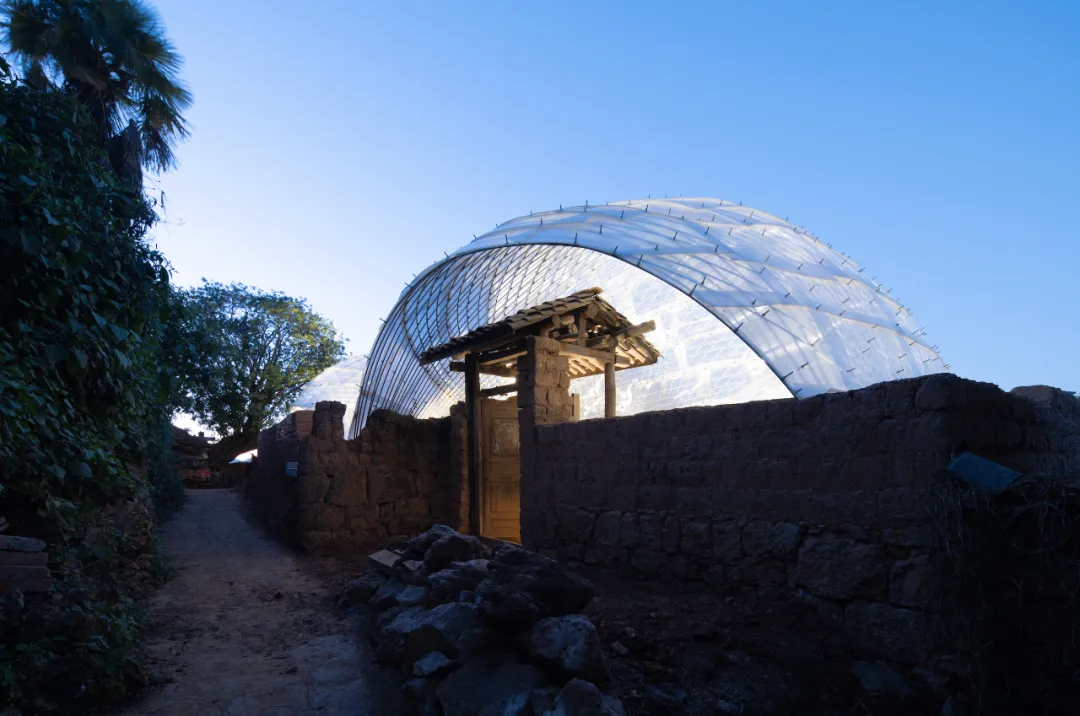
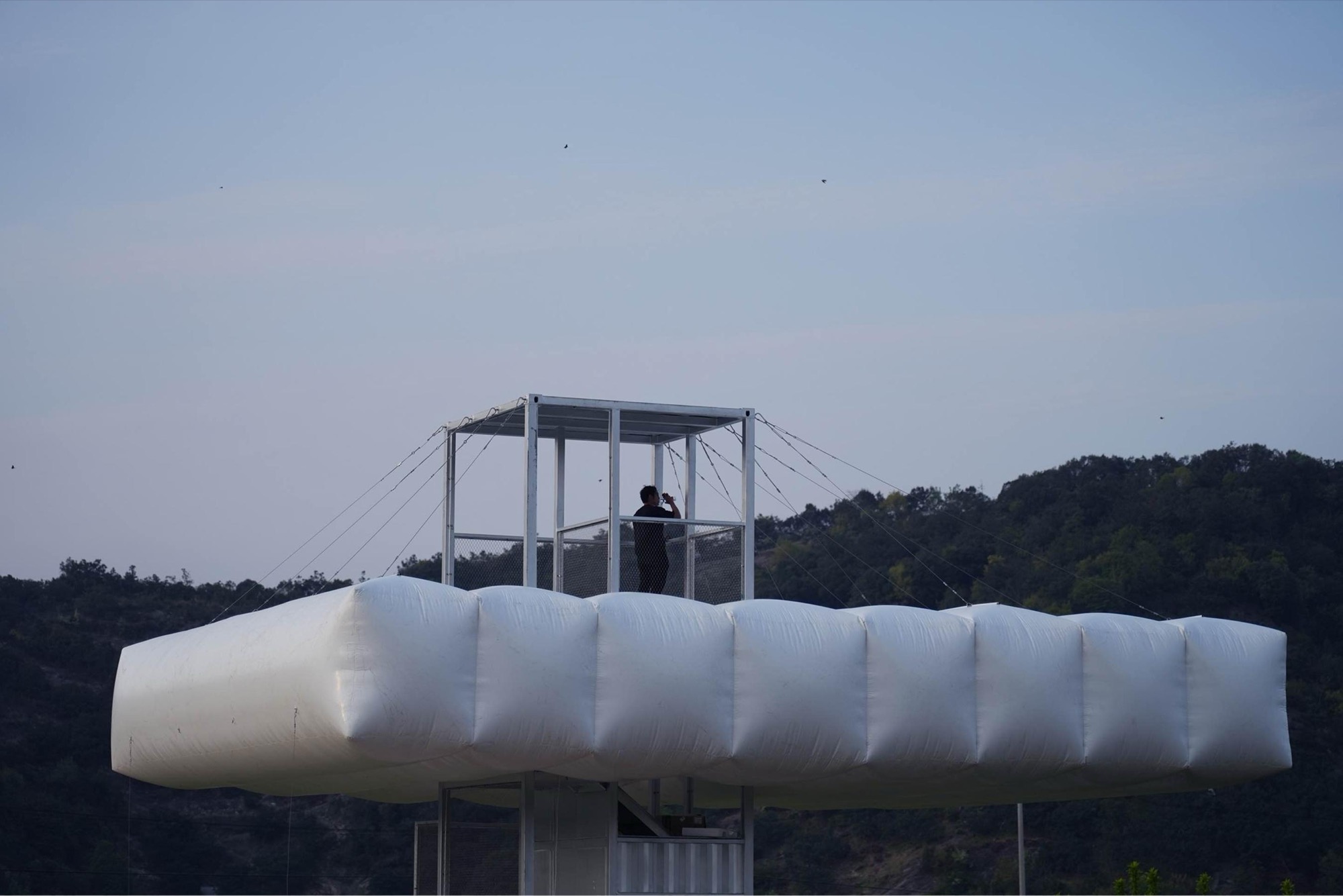
At the entrance to the farmland, an unused utility building had long sat dormant. The site called for a threshold, a moment that signals arrival without overpowering the landscape. The studio’s answer is a cloud: an oversized inflatable canopy hovering above a compact container tower.

The cloud’s role is as practical as it is iconic. Its cantilevered volume creates a generous shaded space beneath, offering rain and sun protection for gathering, waiting, and events, without disturbing the surrounding fields. The café programme is kept compact, designed to serve the outdoor platform rather than pull visitors into a sealed interior.

The container element is not treated as an off the shelf unit. Instead, it is customised using standardised steel components, adapted to function as an occupiable structure. Inside a tower based on a 3 by 3 by 8 metre module, a small coffee station is inserted with kiosk like efficiency. Above it, a viewing deck offers a framed panorama of mountains and rice fields. Access is choreographed as a small experience in itself: visitors reach the deck by passing through the cloud, so the “landmark” is not only something to look at, but something to move through.


THE LEANING CINEMA
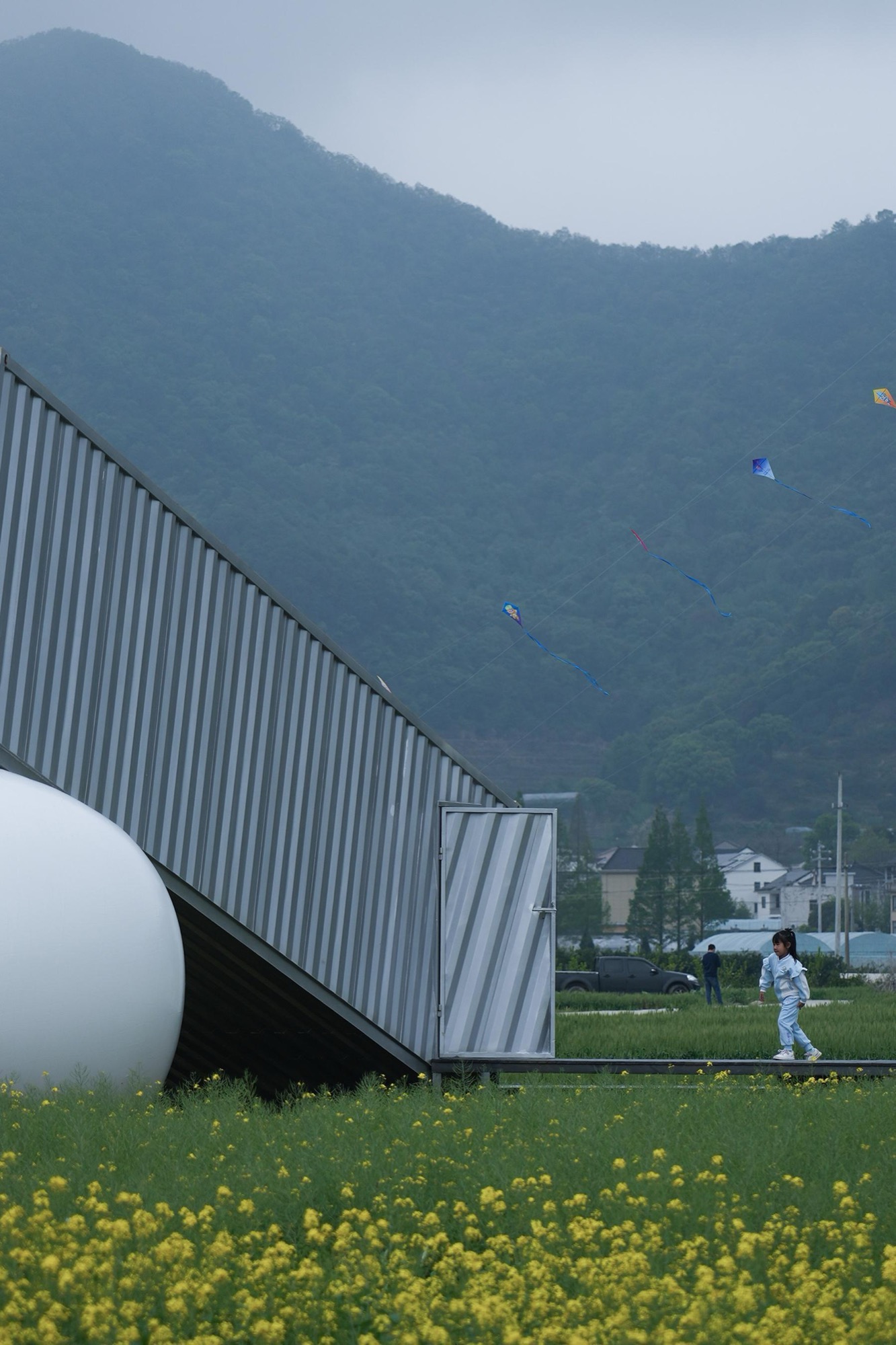
The second intervention begins with a seasonal brief. The client wanted a climate controlled salon space where visitors could rest and gather throughout winter and summer. The solution again prioritises minimal contact with the land. Rather than anchoring a stable box across the field, the studio tilts a container by 15 degrees so it rests on two points of support. That structural decision generates the interior: the slope becomes stepped seating for small screenings, compressing a cinema typology into just over 30 square metres.

Here the inflatables do more than signal play. The supporting columns are wrapped in custom inflatable rings that conceal structural elements and service access while introducing a visual inversion. Heavy steel appears to lean casually on soft, balloon like forms. The effect is gently disorienting, not because it is loud, but because it feels unfamiliar in scale and material logic.

Inside, the room is fully equipped, with screen, projector, speakers, and air conditioning integrated into the design. Wood wool panels line walls and ceiling, working as acoustic treatment and as a textured finish that softens the container’s industrial character. Seating details reinforce the project’s relaxed tone. Beyond standard timber steps, curved backrests are custom shaped to the body, encouraging visitors to recline. It is a cinema designed for comfort and lingering, not ceremony.

THE SECRET READING ROOM
The third site sits at the foot of the hills, quiet, open, and slightly removed. It offered the right atmosphere for a reading space that could hover above the fields rather than interrupt them. For this point, the studio sought a third relationship between containers and inflatables, one based less on contrast and more on tactile encounter.

Seven spherical inflatables are placed within a steel frame elevated above the rice fields. Together they form a circular “wall” without a conventional door. Visitors enter by parting the spheres with their bodies, and many only realise the objects are not solid when they touch them and feel the bounce. This moment of discovery is central to the design. It is an architectural threshold made of touch, something conventional building materials rarely provide.


The room is semi outdoor, and its material palette sharpens the tension between cool and soft. An aluminium panel ceiling, stainless steel desks, and gridded floor panels create a metallic discipline. Against this, the inflatables read as smooth, white, rounded volumes that feel almost like weather instruments. Heat changes their expression. In hot conditions the spheres become plumper and tauter. Light changes the room again. Sun filtered from the south slips beneath the roof and catches the semi reflective ceiling, producing a shifting shadow effect that turns reading into a slow negotiation with brightness, air, and time.

MAKING PERMANENCE FROM AIR
Inflatables most often belong to temporary installations, but in Down in the Clouds they are conceived as permanent architectural elements. That decision raised immediate challenges around durability, maintenance, and how to make softness credible as building.
The team responded with extensive research and repeated prototyping in close collaboration with the manufacturer. Site conditions also demanded different inflation strategies across the three interventions.

For the Cloud Cafe, size and weather behaviour were the decisive factors. The need for stability, and the possibility of retracting in severe conditions, led to a continuously inflated PVC mesh system. Air vents along the sides and a large base area allow two blowers to maintain internal pressure, improving resilience even in the case of puncture while reducing material weight compared with fully sealed inflatables.


Prototyping progressed from a small hand model to a large factory mock up, then to full scale construction. The process tested not only whether a cloud could be inflated at that scale, but also how the project could be assembled on site within procurement led constraints, where sequence and coordination often matter as much as form.

For the cinema and reading room, fully rounded spheres required sealed, thickened PVC with seamless welding to achieve a smooth glossy surface. Early tests revealed sagging from combined material and air weight, and challenges in closing ring shaped elements tightly after inflation. These were solved through repeated adjustments in scale and fabrication details.

Even with prefabricated containers and inflatables, the project depended on careful on site work for ceilings, railings, and installation. Unfamiliar methods made communication essential, sometimes more decisive than drawings. After nearly a month, the built result aligned with the plan, and the local team’s final reaction reportedly carried the most direct form of approval: it really looks good.

A SMALL PROJECT WITH OUTSIZED CLARITY
Down in the Clouds is modest in size, but it functions as a concentrated rehearsal of technique, procurement, and rural public space. It shows how a project can be recognisable and photographable without being heavy handed, and how a farm field renovation can create places to pause without turning land into spectacle. The work is playful, but its play is engineered, prototyped, and built with the seriousness required to make air behave like architecture.

Project Credits
Project Name: ‘Down in the Clouds’ Farm Field Renovation
Site Area: 150㎡
Building Area: 290㎡
Design: Practice on Earth, Increments Studio / @increments.studio
Photography: Cloe Yun Wang
More Photos