Now Reading: Letting the Land Lead: Luana Farms wins at World Architecture Festival 2025
-
01
Letting the Land Lead: Luana Farms wins at World Architecture Festival 2025


Luana Farms is built on a clear refusal: the site is not a backdrop for architecture. Instead, it becomes the author of the plan. Plontur’s process begins with the land’s existing systems, reading topography, vegetation, water movement, wind, and the everyday ecologies that are already doing the work of sustaining life. Architecture arrives later, as a calibrated response rather than an opening statement.

That shift matters because it changes what “leisure” can mean. Here, leisure is not an escape from place, but a deeper entry into it. The masterplan stays outward looking, oriented toward the larger field of Batangas, with Mount Batulao and Taal Lake shaping view corridors, movement, and gathering spaces.

Before any formal planning moves, more than 350 native trees were documented and kept, with circulation and building footprints woven around the existing canopy to preserve ecological continuity across the site. Most importantly, restraint is not rhetorical: 73 percent of the 10.9 hectare property remains unbuilt, protected as forest buffers, ecological corridors, and productive farmland.


Built clusters follow the social spatial logic of the Filipino barangay, arranging structures around shared open spaces instead of isolating them as standalone objects. The result is a development that reads less like a collection of destinations and more like a lived landscape, where community happens in the gaps and thresholds as much as in the rooms.


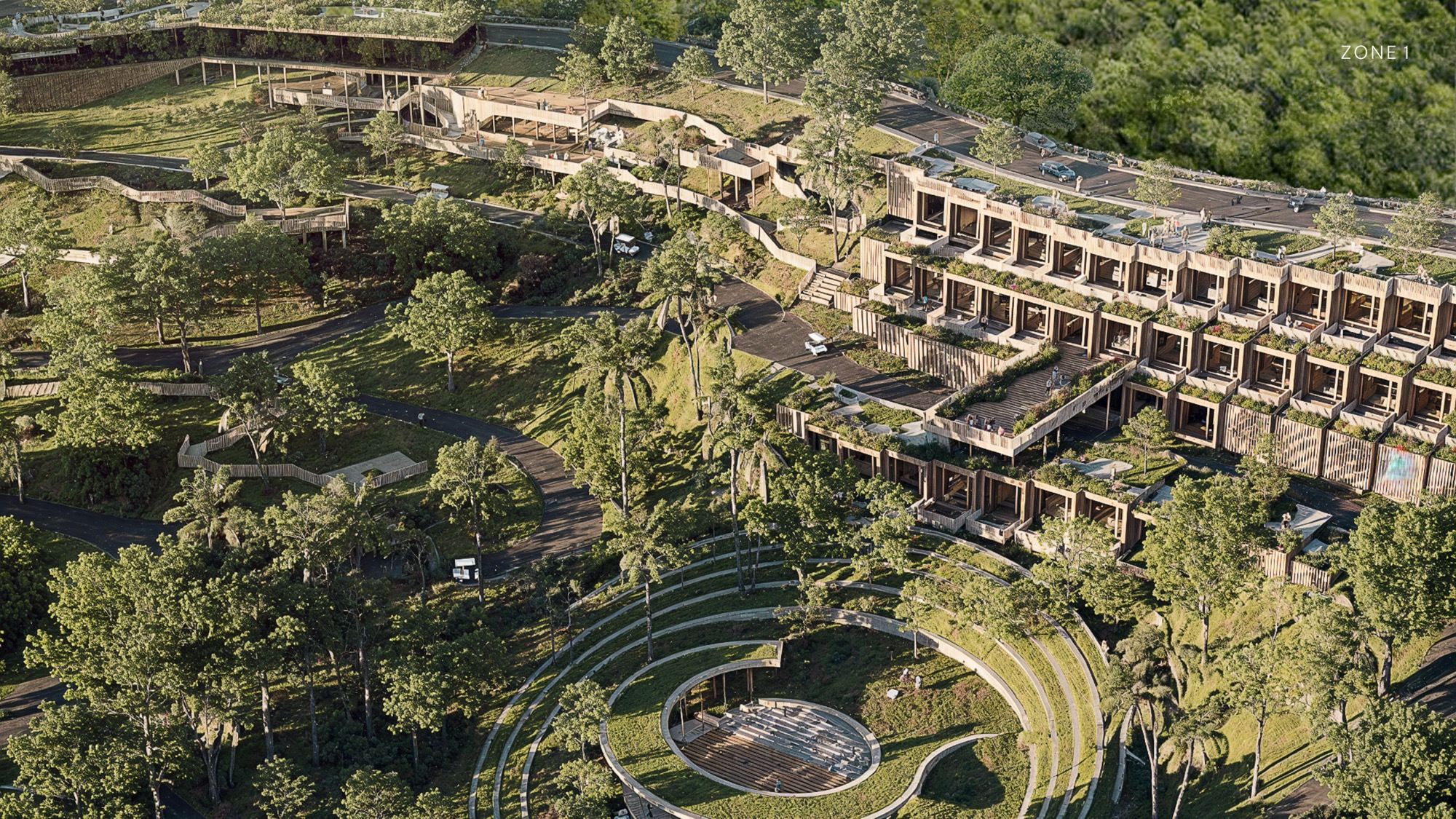
Luana Farms is organised as a sequence of zones, each shaped by elevation, slope, and movement.
At the highest point near the road, the arrival zone acts as a civic threshold with the restaurant, hotel, and pavilion. Green roofs, open decks, and permeable structures keep the ground plane legible and continuous, so visitors meet the landscape first, not a façade.


Moving downslope, villas and amenities are placed lightly on the terrain. Referencing the bahay kubo, structures are elevated and open, allowing air, light, and vegetation to pass through rather than be shut out. Natural pools, rain catchment areas, and raised walkways extend the idea of comfort beyond enclosed interiors, treating microclimate as a design material.


At the centre, the project becomes explicitly productive: a working permaculture farm where guests and farmers share planting, harvesting, markets, and learning spaces. Leisure, education, and livelihood overlap in the same ground, making the landscape both experience and infrastructure.


On the steepest slopes, terraced agroforestry turns difficult terrain into long term food systems. Using on site materials to stabilise and structure the terraces, the design frames resilience as something that grows over time rather than something installed once and maintained against nature.

Environmental targets are embedded early. Rain catchment systems are planned to supply up to 50 percent of irrigation demand, while passive cooling strategies aim to lower indoor temperatures and reduce reliance on mechanical systems. Material and service procurement is intended to stay largely within a 50 kilometre radius, reinforcing local supply chains and craft economies rather than importing an image of sustainability from elsewhere.

The social brief is equally direct: improving farmer income through direct trade, shared agricultural programmes, and on site markets, so the project’s value circulates through the community that the landscape already supports.
Plontur Group has been named category winner in Future Projects, Leisure led Development at World Architecture Festival 2025 for Luana Farms, a landscape driven hospitality and working farm development in Calaca, Batangas.
Project Credit
Project name: Luana Farms
Location: Calaca, Batangas, Philippines
Area size: 10.9 hectare
Design: Plontur Group / @plonturgroup
More Photos