Now Reading: SpY sets gold and silver circles in motion for HALOS
- 01
SpY sets gold and silver circles in motion for HALOS

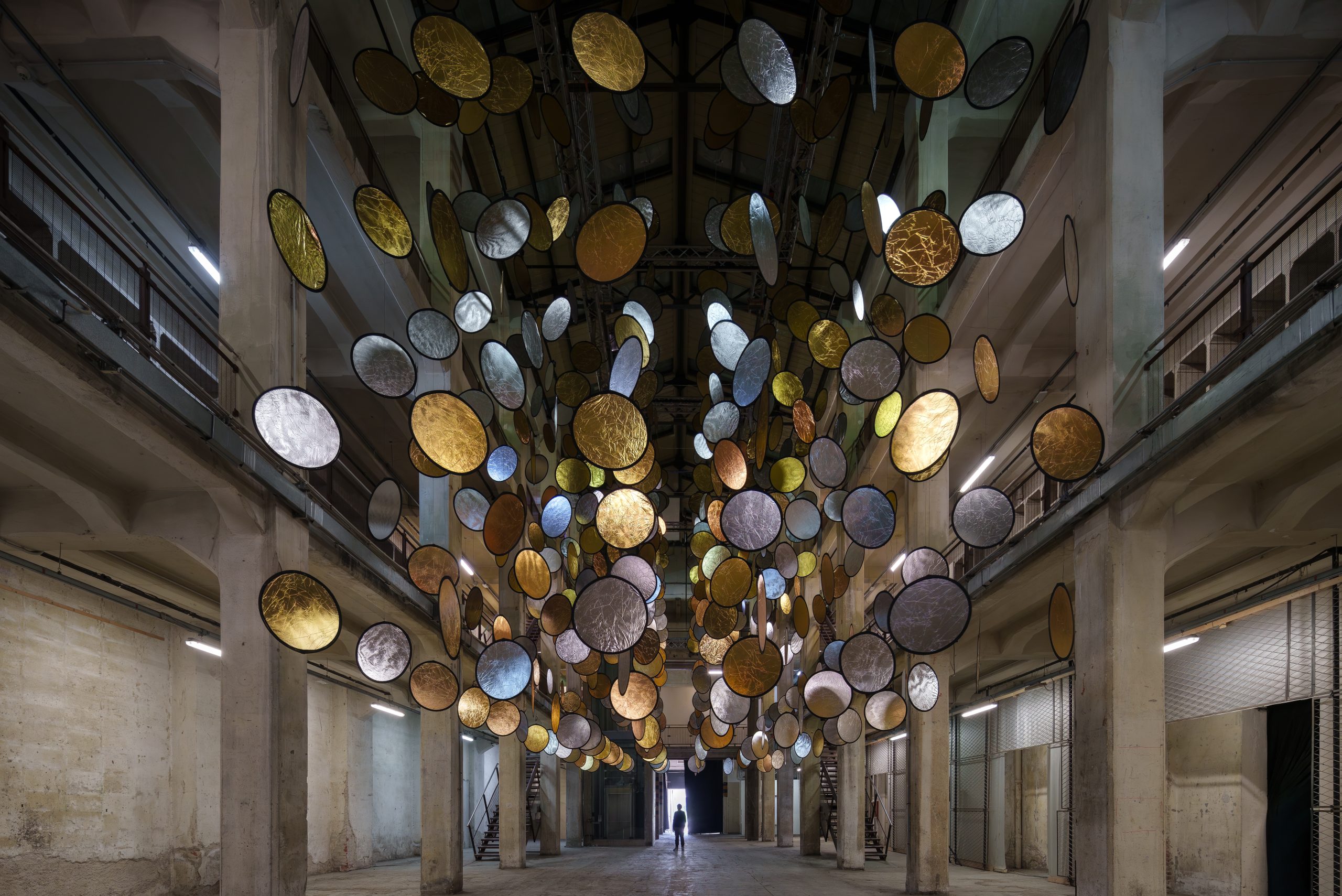

SpY’s HALOS suspends a field of rotating gold and silver circles inside a former railway factory in Florence, using reflected light and the atrium’s three levels to create a shifting spatial composition.
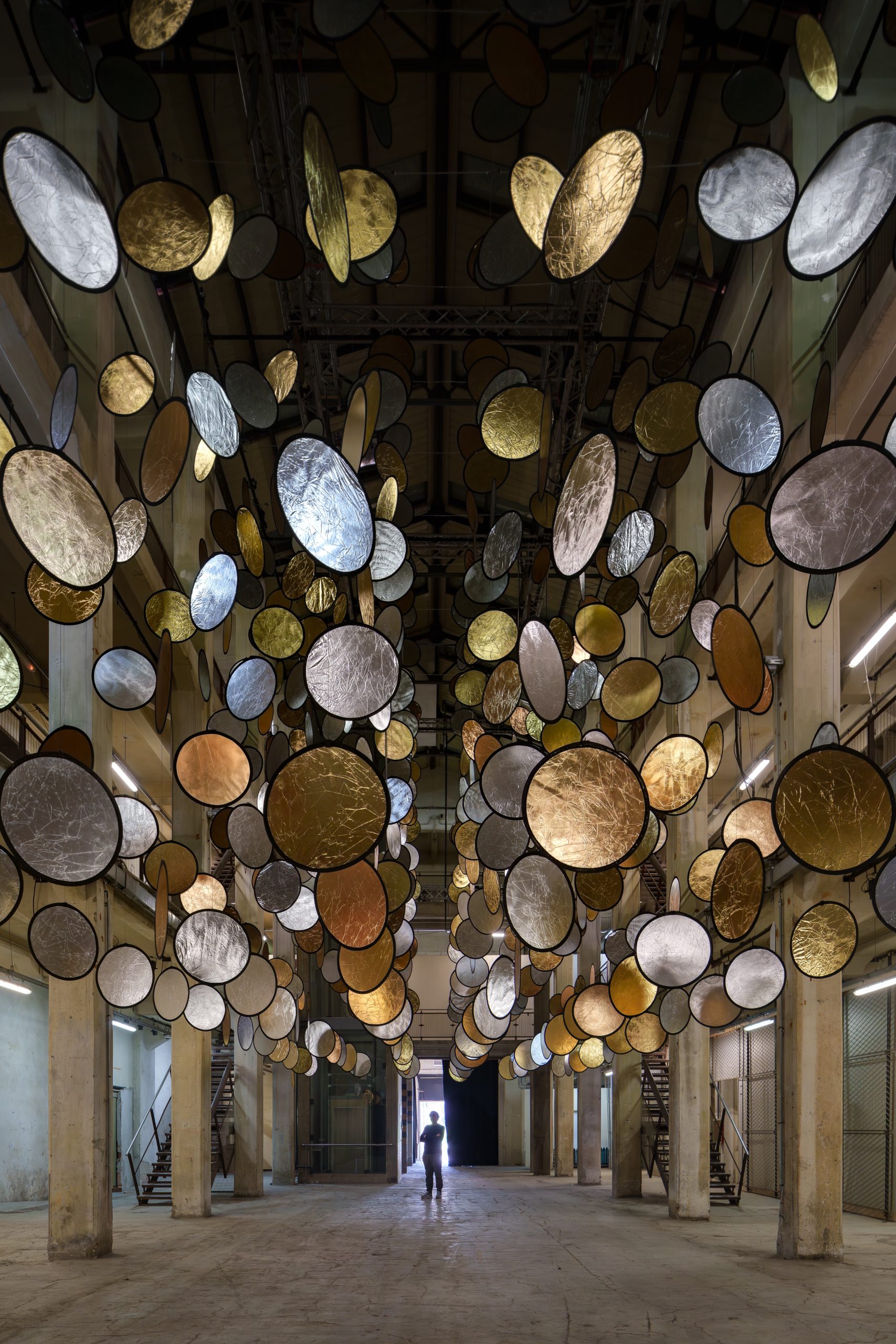
Seen along the length of the atrium, HALOS gathers into a dense canopy of circular forms. Some discs face the viewer, catching light across their surfaces. Others turn towards an edge, opening gaps through which columns, walkways and the far end of the building become visible. The installation changes as the discs rotate and as visitors move around them.
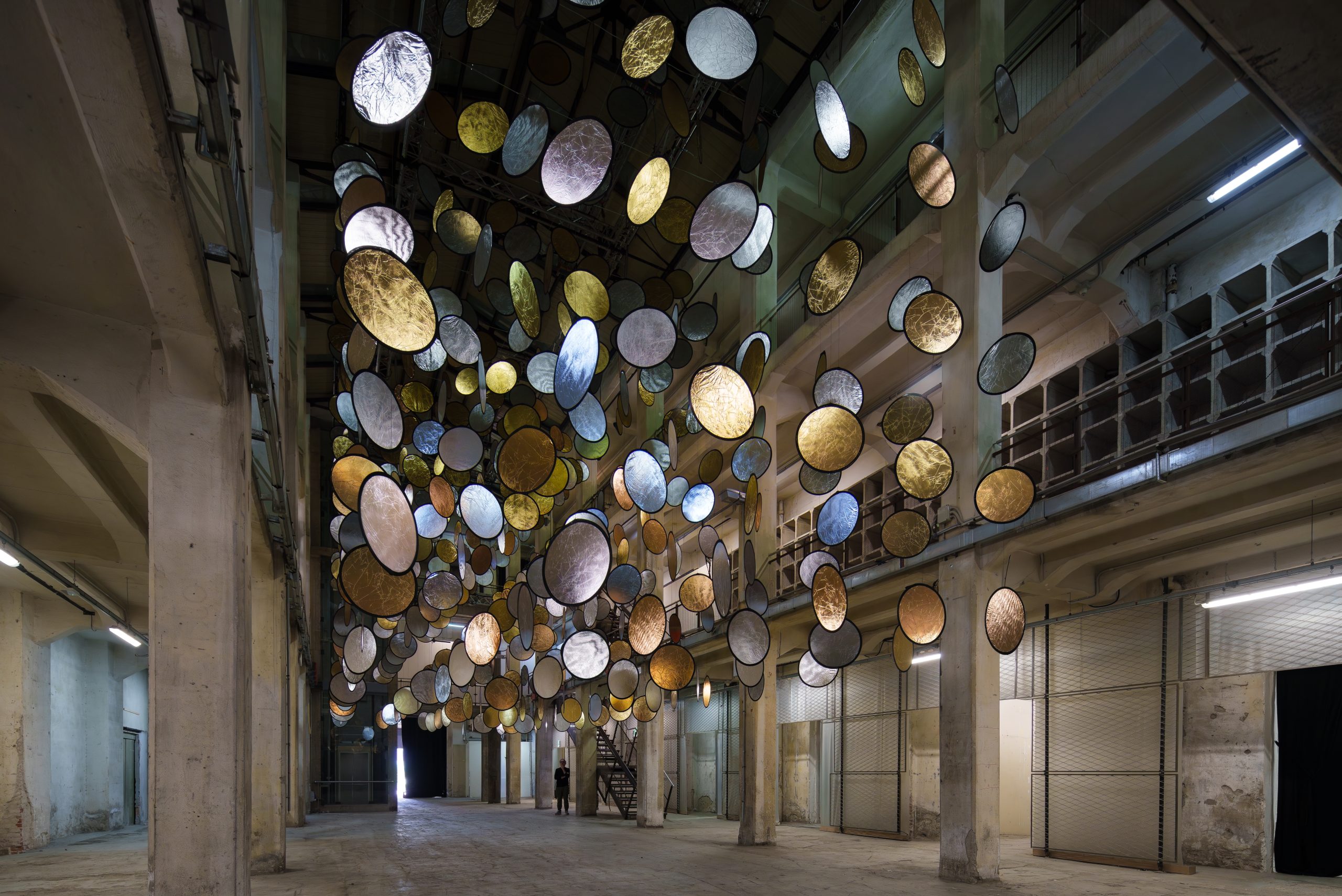
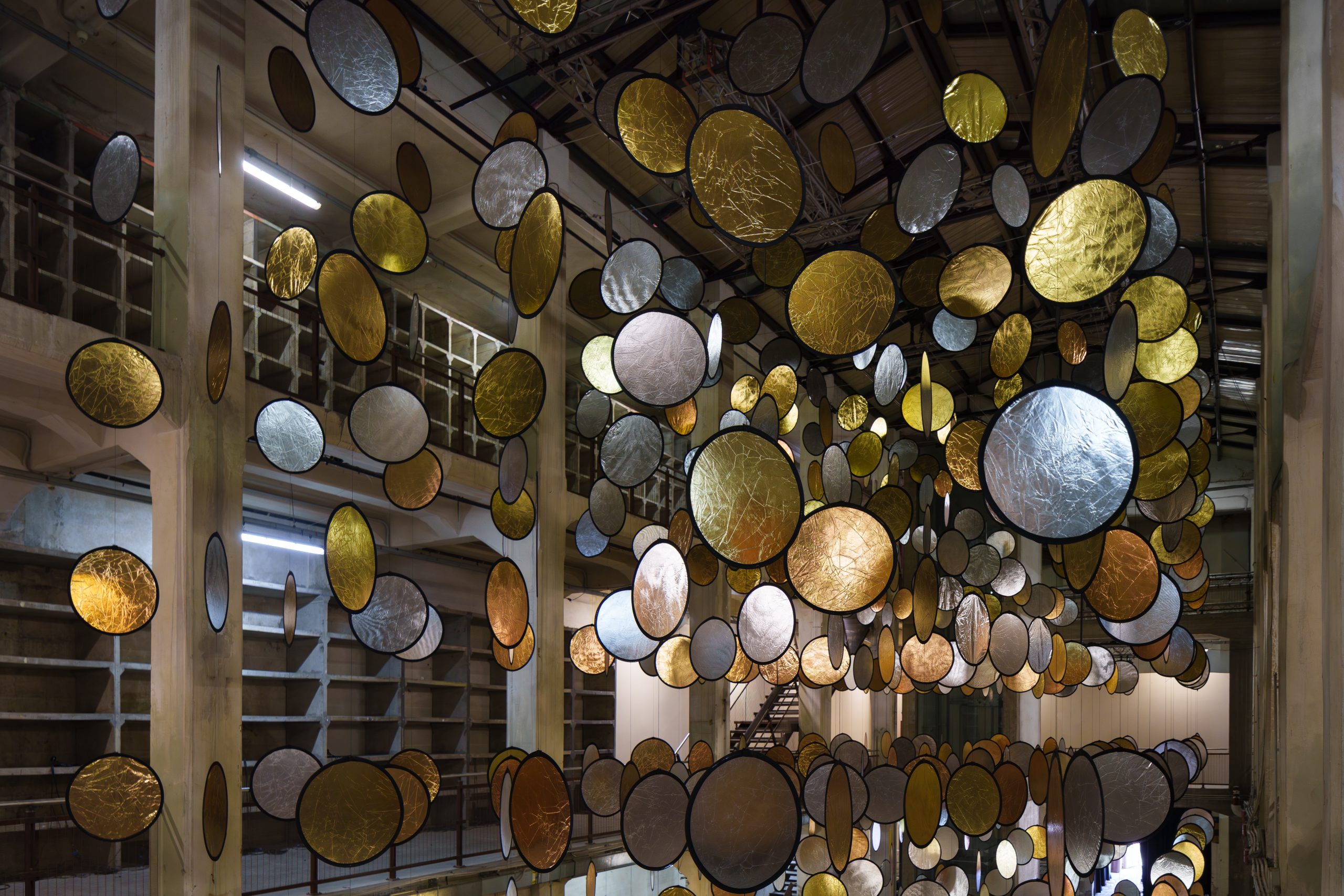
Commissioned by Bright Festival in 2026, the work occupies the central volume of a former railway factory in Florence. Its reflective circles hang at different heights within a suspended matrix. Gold and silver tones alternate across the field, bringing warm and cool reflections into the building’s exposed industrial structure.
A matrix in motion
HALOS begins with a repeated geometric element, but its rotation prevents the array from settling into a single image. Circles overlap when seen from one position and separate when viewed from another. As their orientation changes, broad reflective faces narrow into slivers before becoming visible again.
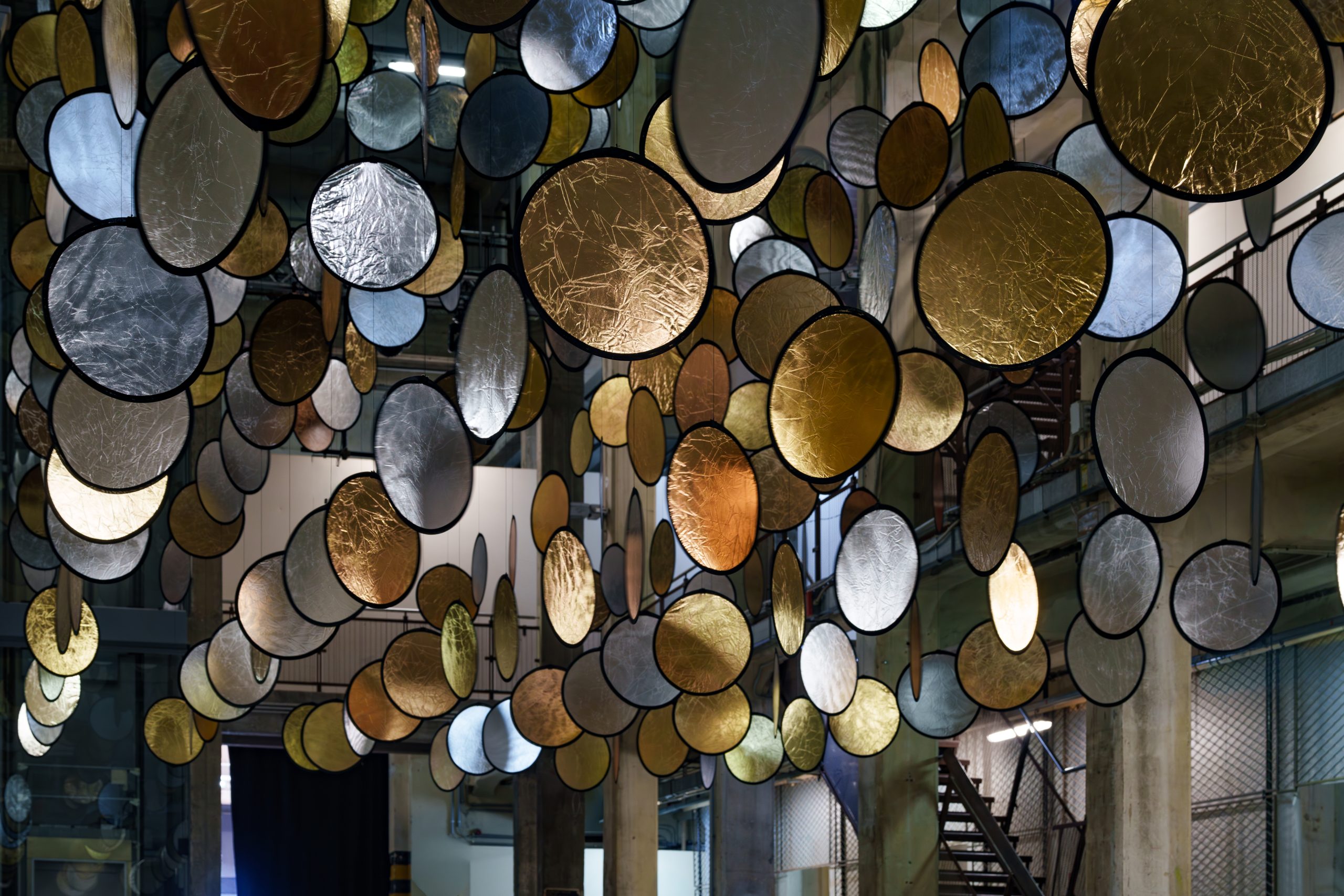
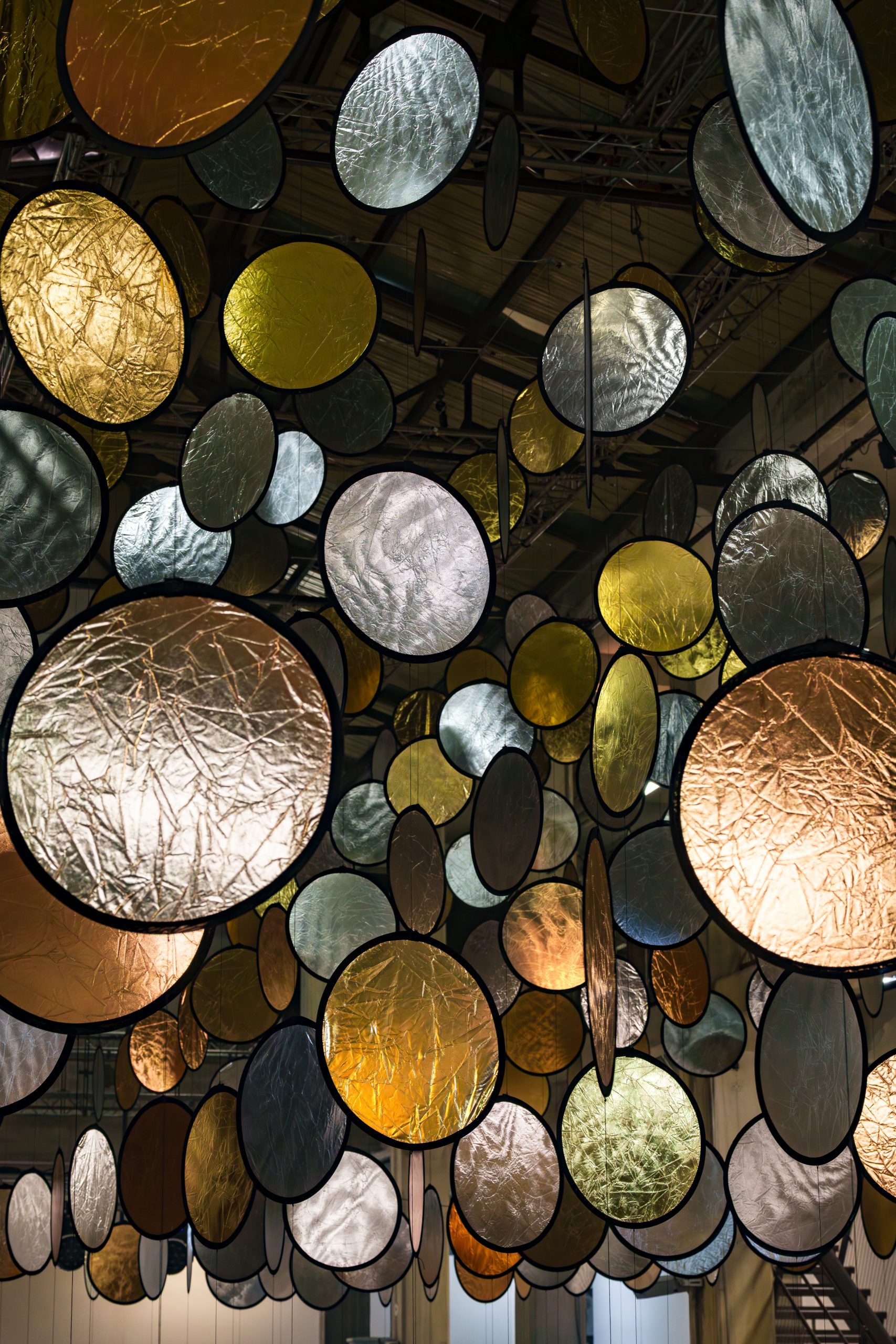
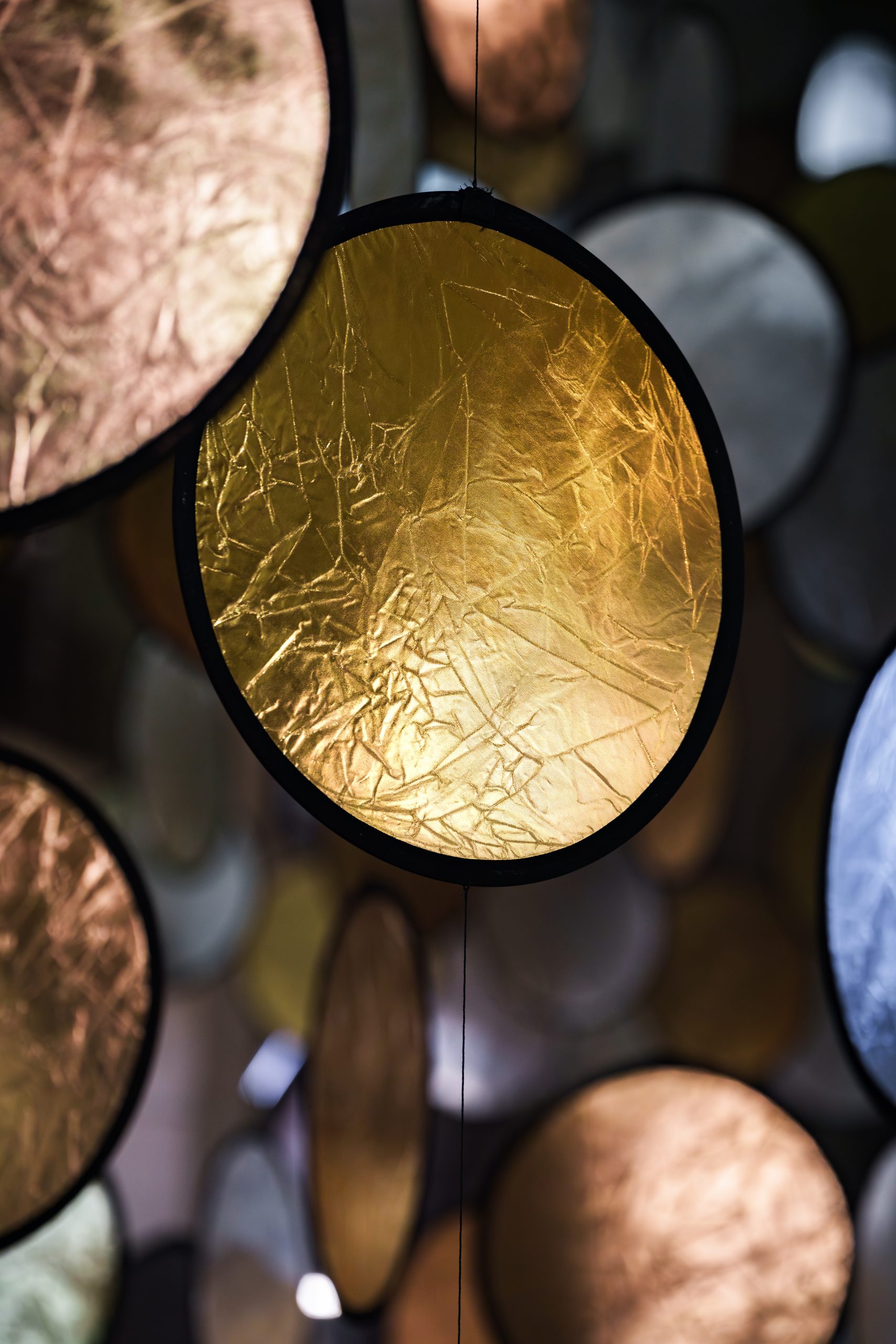
The surfaces themselves add a finer register of variation. Close views reveal creases and irregular textures within the dark circular rims. These catch light in fragments, breaking each disc into smaller areas of brightness and shadow. From a distance, those details merge into a larger pattern of gold, silver and darker forms.
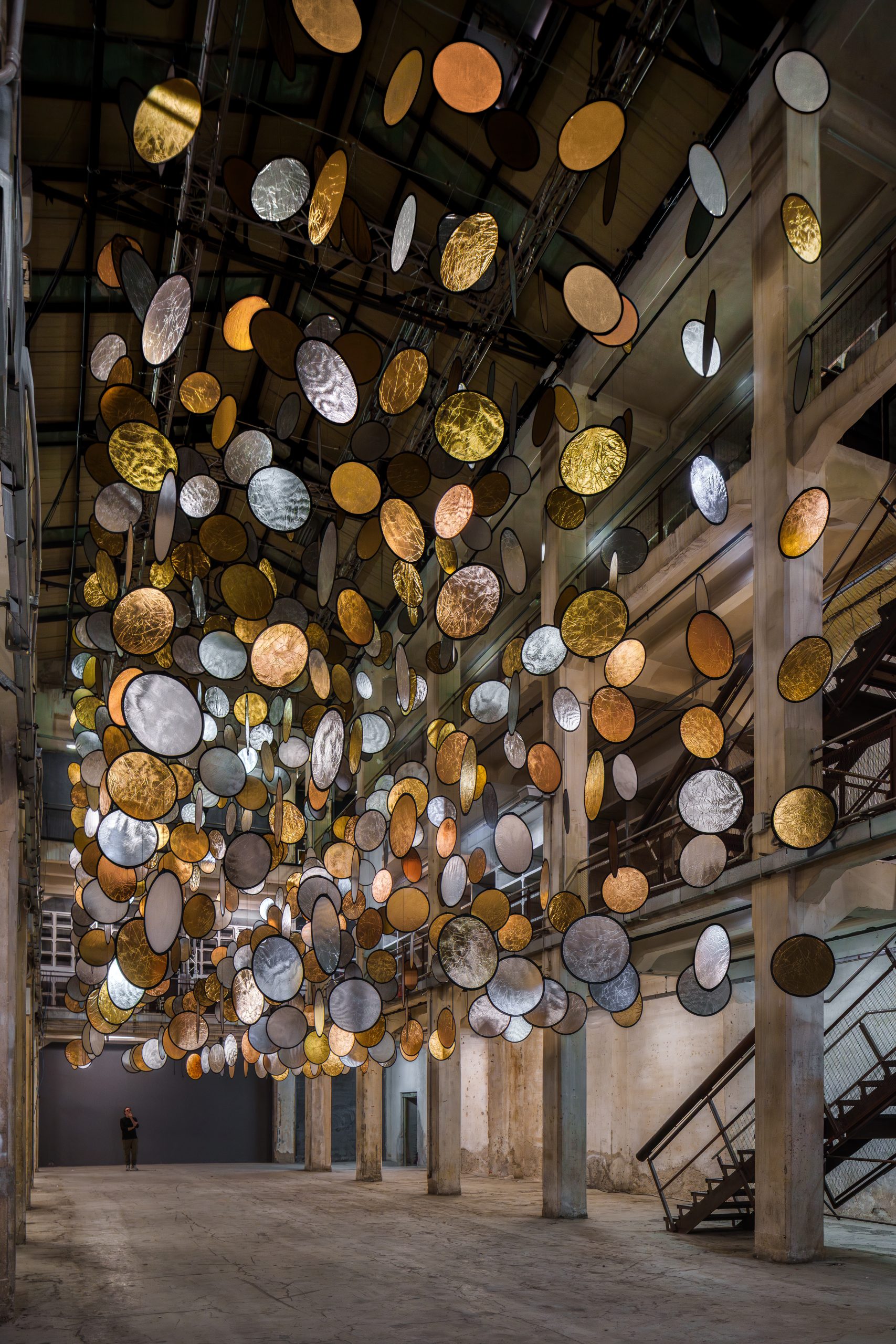
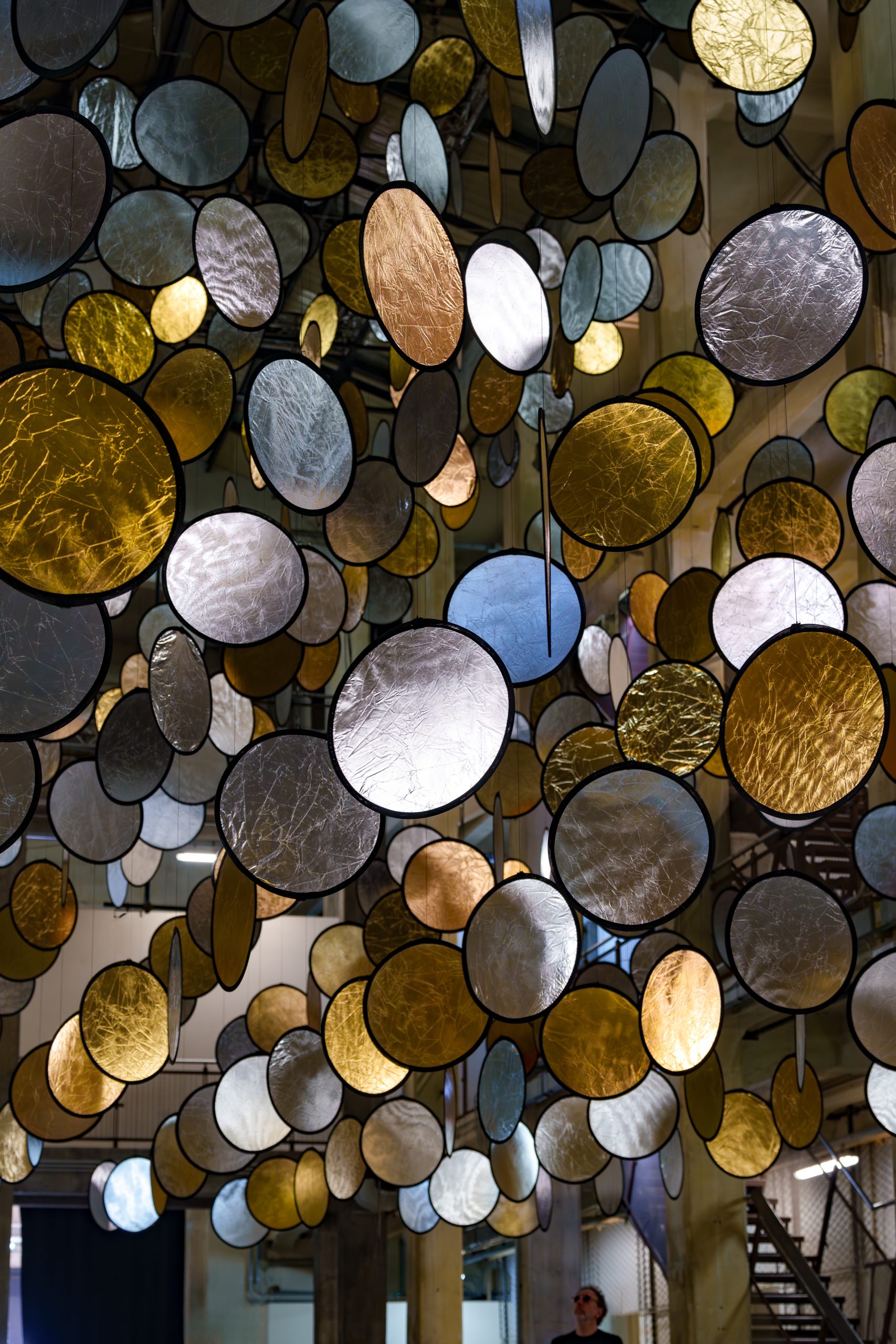
The spaces between the circles are equally active in the composition. Openings shift as adjacent elements turn, allowing the architecture behind them to appear in changing fragments. A repeated matrix produces an image that remains difficult to hold still.
Three levels of looking
The atrium gives the work several distinct viewing conditions. At ground level, the suspended forms extend overhead, with the factory’s columns marking their scale. From the upper walkways, visitors can look across or down through the installation, bringing different layers into alignment.
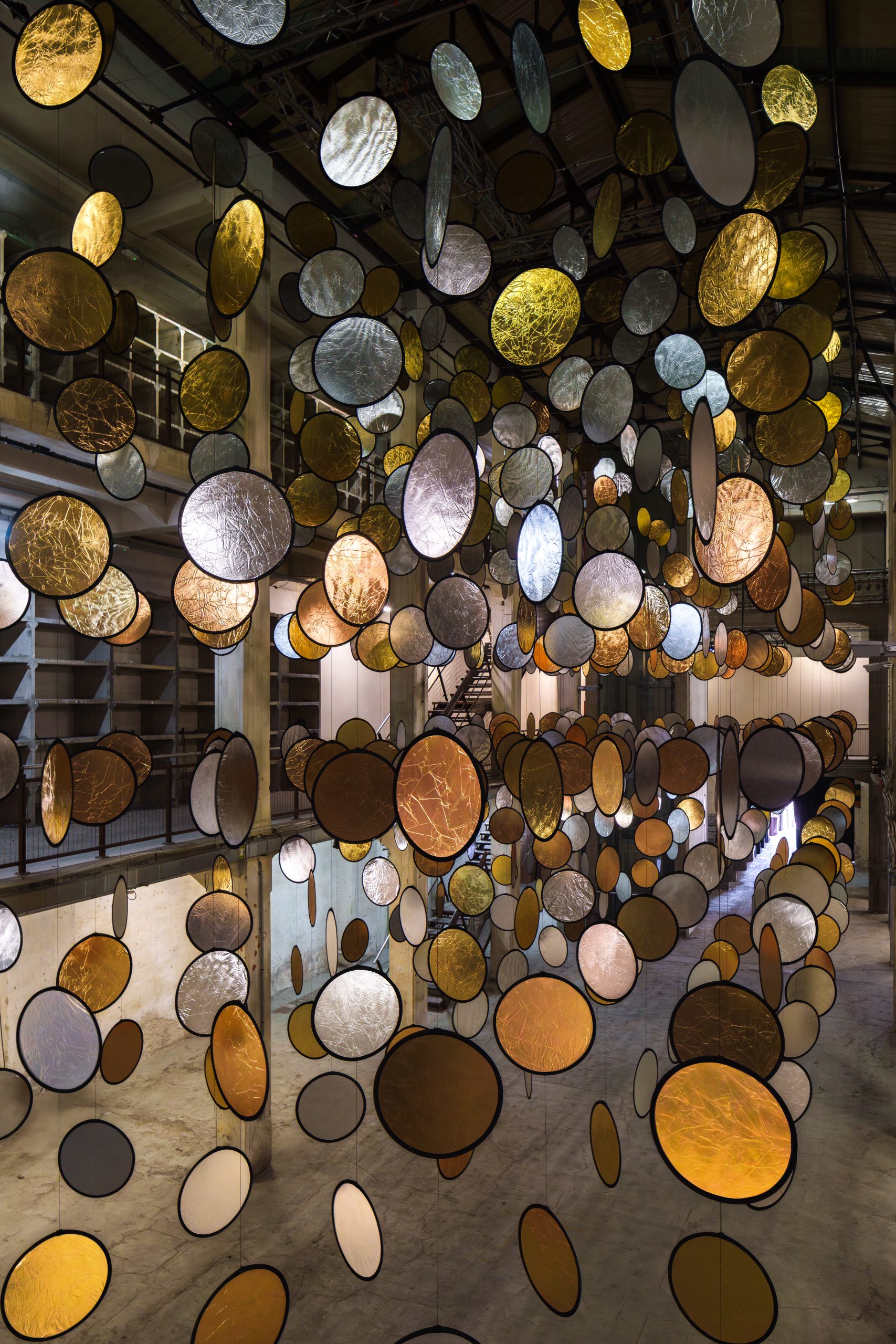
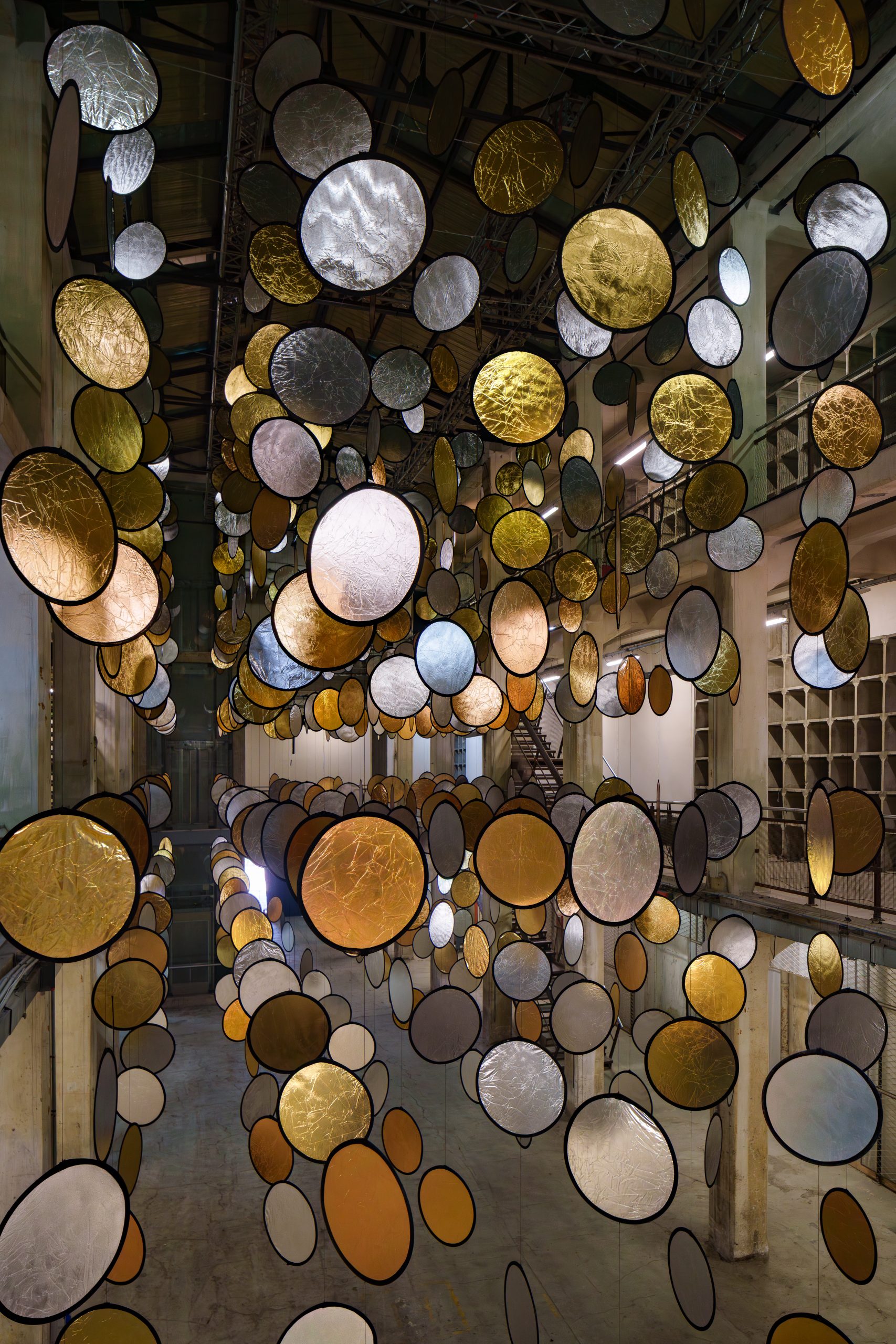
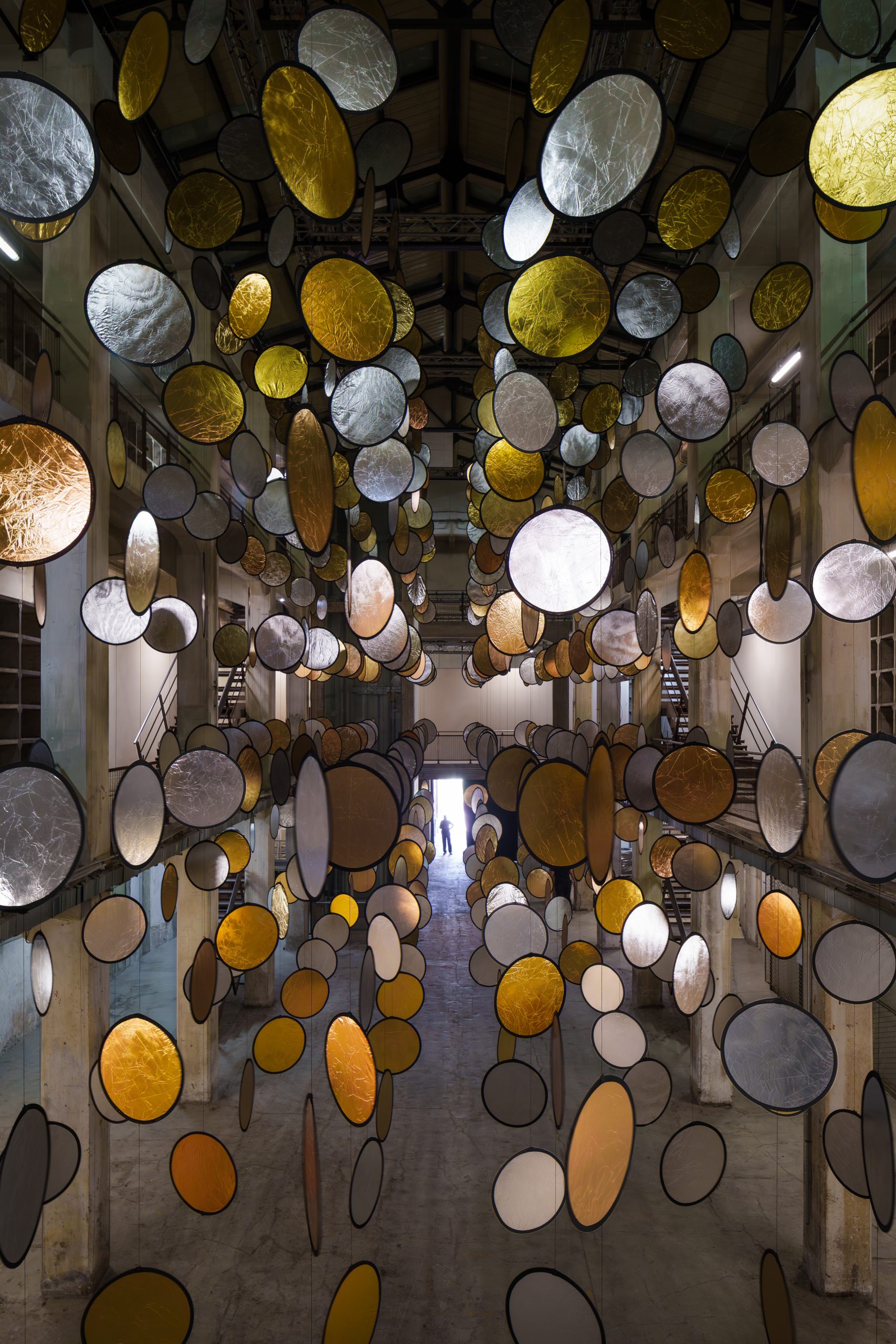
These changes in height alter the apparent density of HALOS. A cluster that seems compact from below becomes more dispersed when seen obliquely. The building’s balconies, railings and structural bays remain visible around and through the circles, providing fixed reference points for their movement.
Visitors therefore encounter two overlapping sources of change: the rotation of the work and their own passage through the building. The three-level arrangement allows a single installation to produce several readings without requiring a separate object at each vantage point.
Reflection and the industrial frame
HALOS retains a clear relationship to its setting. The concrete columns and horizontal walkways establish a regular frame, while the suspended circles introduce changing angles and reflected light within it. The open floor below preserves a sense of the atrium’s full height.
The work’s visual effect depends on this relationship between the repeated forms and the space around them. As the circles turn, attention moves between individual surfaces, groups of overlapping discs and the larger volume they occupy. With a restrained vocabulary of geometry, colour and movement, SpY makes the act of looking unfold across the building.
Project Credits
Project: HALOS
Artist: SpY / @spy__studio
Commissioned by: Bright Festival
Location: Florence, Italy
Year: 2026
Photography: Rubén P. Bescós / @rubenpb