Now Reading: Situations Over Symbols: Concéntrico 2025’s quiet revolution in public space
- 01
Situations Over Symbols: Concéntrico 2025’s quiet revolution in public space


Logroño (Spain) is not the sort of city that typically anchors the international festival circuit. It is neither a capital nor a metropolis. There is no skyline theatre, no high-voltage urban friction ready-made for cultural packaging. Set in Rioja and sized for walking, the city is calm in a way that can feel almost disarming. That calm turns out to be the point. In a small place, an intervention cannot hide behind an “event” perimeter. It lands on the routes people actually use, and it is judged in the only way that matters: whether it changes what people do.
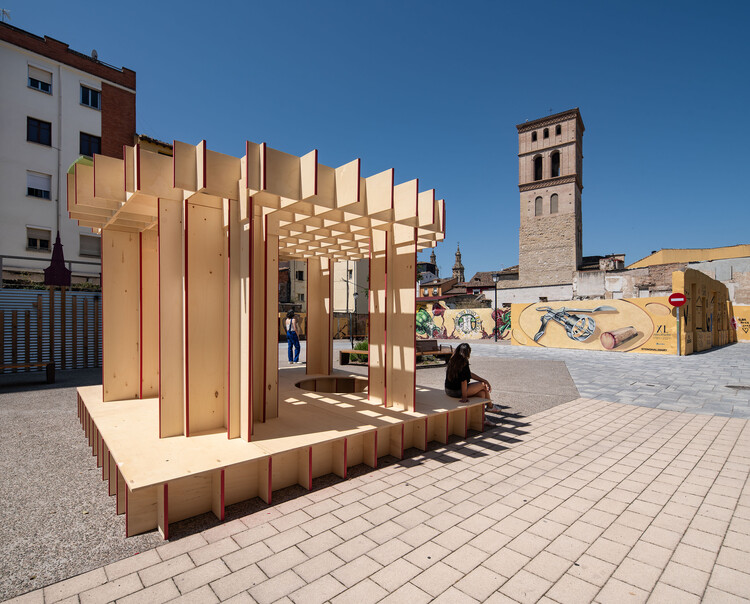
Concéntrico’s most convincing move is also its most modest. It doesn’t arrive as an image campaign. It arrives as equipment. A square becomes an address rather than a void; a bench becomes a mechanism; a traffic island becomes a room. The festival doesn’t ask you to decipher its intentions so much as to test them with your body. The question underneath is blunt, almost infrastructural: what makes a public space worth staying in?
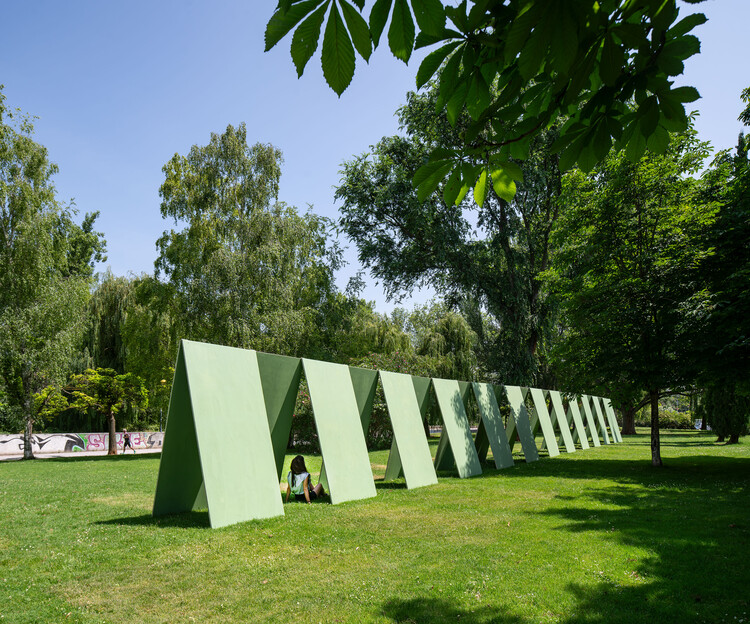
A thread runs through this year’s works, not as a slogan but as a method. Domestic behaviours are pulled into public settings, then left there to see what happens. The point isn’t to sentimentalise the city as home. It is to make public space behave as if it can be inhabited, not merely crossed or admired.
That logic becomes literal in Plaza de San Agustín. Sam Chermayeff Office’s Backstage Fireplace is arranged with an almost stubborn clarity: armchairs, a sofa, a coffee table, all oriented toward a low wall fitted with a fireplace and a stainless-steel flue. Nothing is disguised as art. The set-up reads instantly, and that legibility is its power. You don’t need a text panel to know what to do. You sit down. You face someone. You talk. In many contemporary squares (over-lit, over-managed, designed for movement), the simple permission to linger can feel like a design decision in itself.
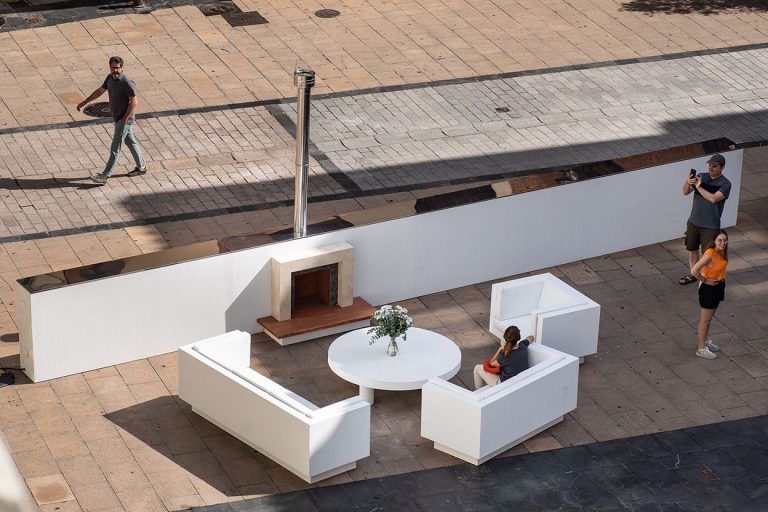

The installation sharpens through contrast. Fireplaces have a long history as devices of interior life, and modernism’s more theatrical moments turned them into props for private spectacle. Here the idea is brought down to street level and its social orientation flips. The fireplace becomes equipment for open-ended conversation: a living room without walls, doors, or ownership.
The surrounding context lends the gesture bite. Nearby stands Logroño’s former central post office, now a five-star hotel – a familiar story of civic fabric sliding into private luxury. Set against that backdrop, the “public living room” reads less like a cosy fantasy than a quiet corrective. It doesn’t argue; it simply offers a situation that public space has increasingly stopped offering on its own.
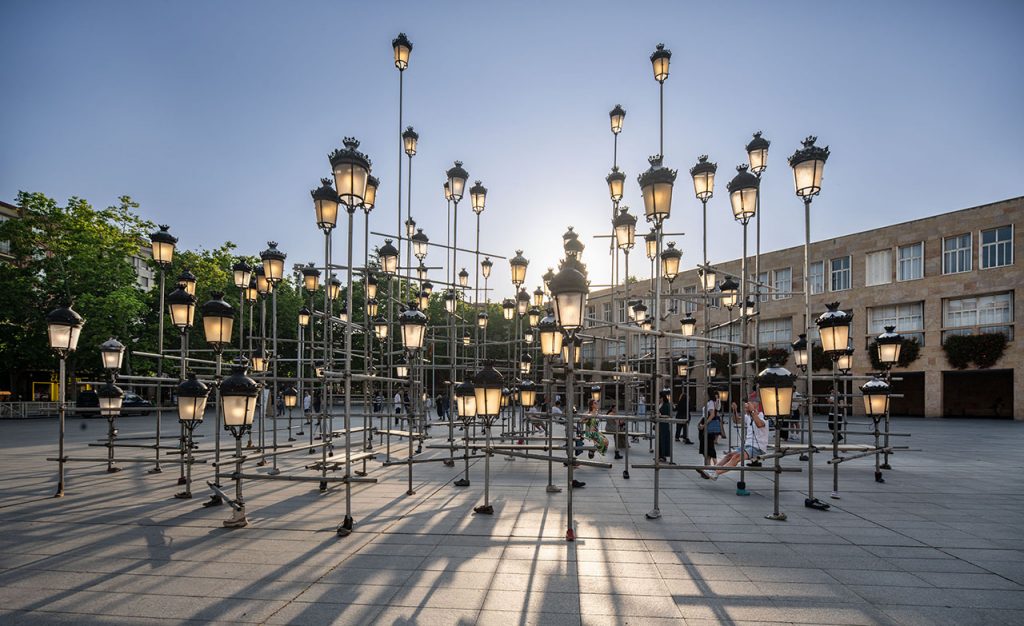
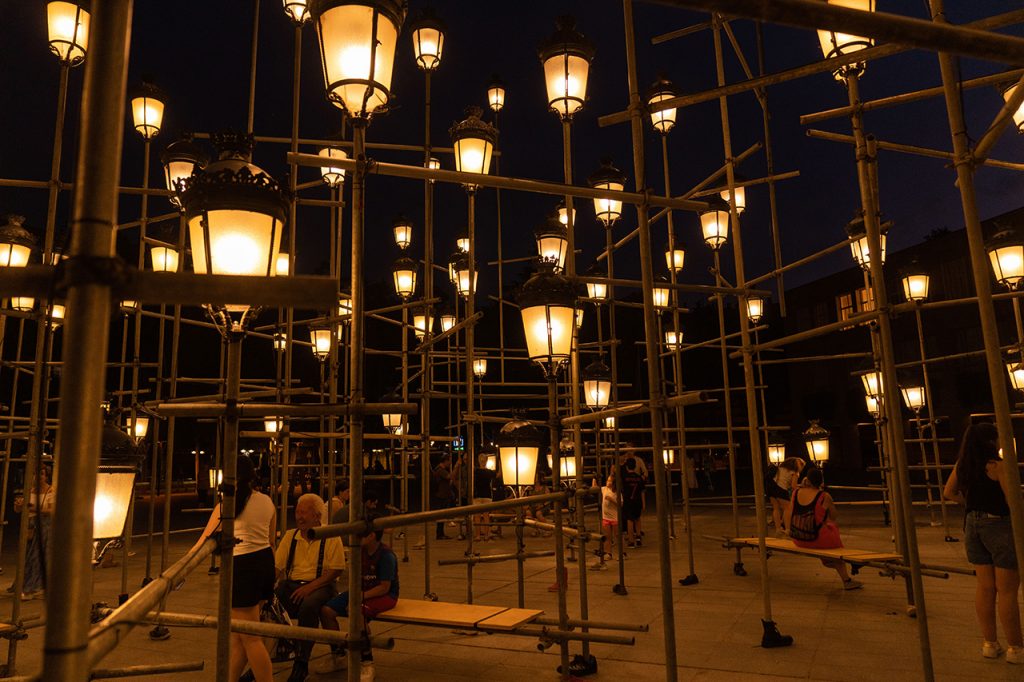
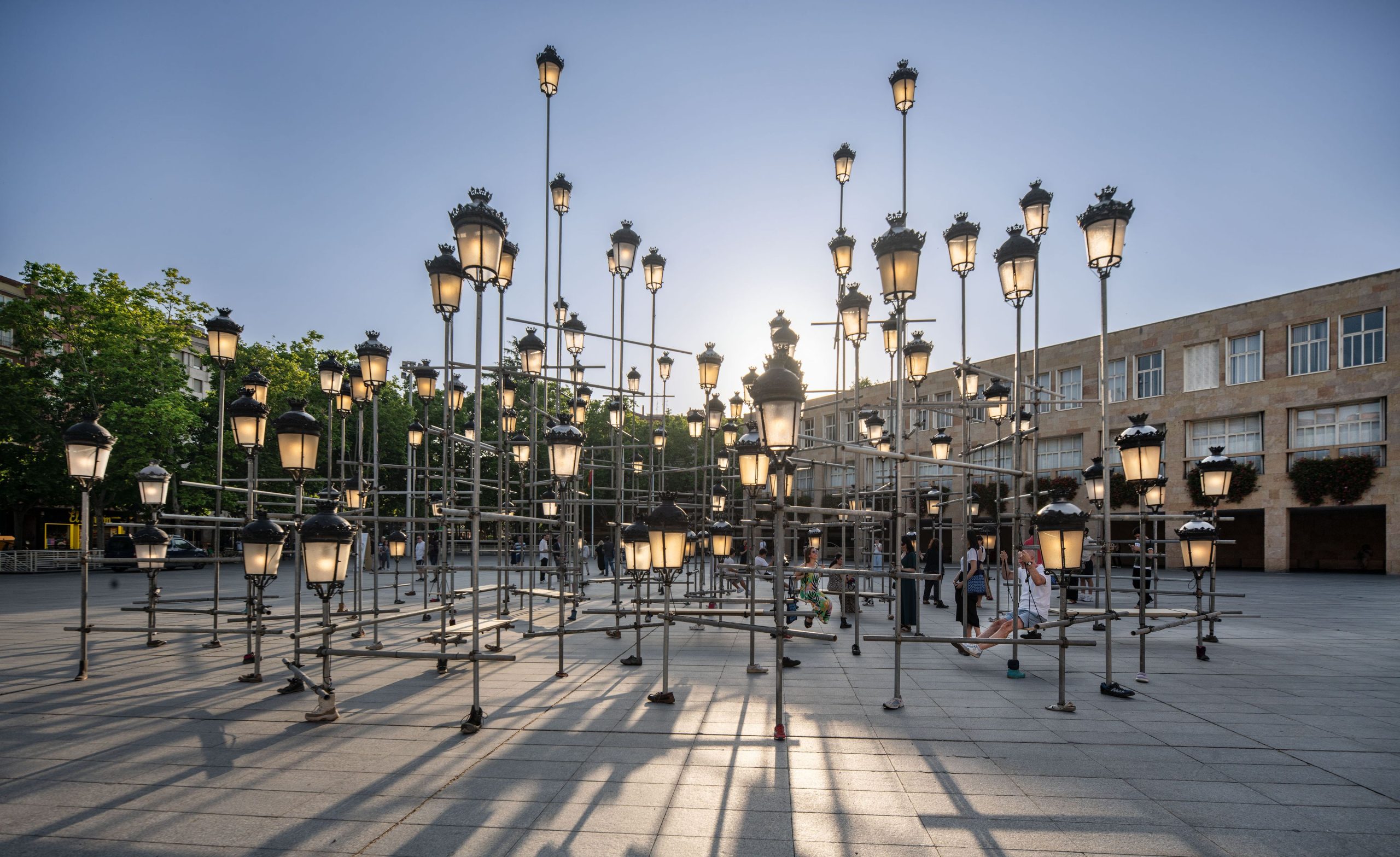
A different kind of corrective appears in Bayona Studio’s 111 Farolas, installed in a broad, dry plaza facing Logroño’s city hall. The forecourt has the familiar stiffness of monumental public architecture: generous, clean, photographable – and resistant to everyday occupation. Bayona Studio refuses to answer that monumentality with another symbol. Instead, they build a scaffolding structure that looks deliberately improvised, and hang swings from it for children and adults alike. The effect isn’t subtle. The square is re-scripted in minutes. Bodies soften, queues form, strangers watch each other take turns. A space that usually produces distance suddenly produces proximity.
Above, 111 traditional street lamps hover as a second layer. In daylight they read as lifted memory; at night they glow like a fairground, returning an evening life that official plazas often lose through a combination of solemnity and control. Here light is not simply atmosphere. It is a reminder of a basic civic provision reframed as spectacle without losing its everyday meaning. The project leans into temporariness with a wink: the scaffolding “wears” shoes, as if it could walk away. Authority, it suggests, is not fixed; it is a relationship, and relationships can be renegotiated.

If the first projects test how a square might behave like a room, Soft Baroque’s Dancing Bench tests how a familiar object can destabilise a familiar posture. At a glance it is almost standard: steel, timber, three seats. Then you sit and discover it can pivot on its legs. Your body has to push; the bench rotates. Sitting becomes movement, and movement becomes attention. This is not comfort designed to make you disappear into a park. It is a device that keeps you present. You can’t “just” sit. You have to negotiate balance, participate in the bench’s choreography, and in doing so acknowledge the space around you.

It’s a small intervention, but it lands on a contemporary condition that cities rarely name: restlessness. Parks are discussed in terms of amenities and shortages, but the more elusive problem is often behavioural. People don’t stay because nothing in the space asks them to stay. Dancing Bench doesn’t pretend to solve the city. It adjusts one object and watches the ripple. The bench becomes a social signal precisely because it is slightly demanding.
Water, too, is returned to use rather than scenery. Public fountains once signalled civic well-being. Today they can lapse into kitsch or irrelevance, maintained as image rather than experience. Leopold Banchini’s Roundabout Baths selects an unlovely basin on a traffic island along a car-dominated artery and does something counterintuitive: it encloses it. Timber wraps the basin to produce an unexpectedly private interior, a place to soak in jacuzzi fashion, detached from speed, noise, and the unspoken rule that traffic islands are for no one.
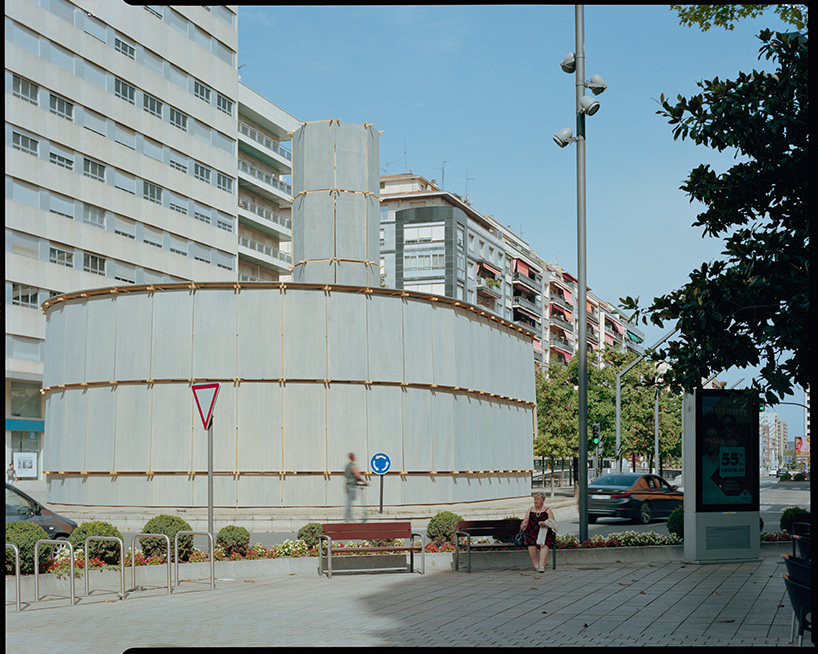
The mismatch is deliberate. Intimacy is installed where intimacy “shouldn’t” exist; a slow act is inserted into a fast zone. That paradox gives the work its charge. It reframes the city’s leftover spaces as sites that can still host a form of life. Material is treated with similar seriousness. Sponsor-provided timber panels are kept intact for reuse after dismantling, insisting that temporary work need not be disposable work.

Where bathing is private, eating together is civic. h3o architects’ ¡Todxs a la mesa! proposes a table not as a symbol but as infrastructure. Thirty metres long and zigzagging like a folded line, assembled from standard street-furniture components, it behaves like a piece of public equipment. That is precisely why it works. It doesn’t require belief; it only requires people to sit.


When the table hosts a community paella, the boulevard takes on the structure of a ritual. People face each other, share food, stay longer than a greeting would normally allow. Beer-garden strings of lights extend the gathering into night, producing a nocturnal conviviality many public spaces lack when they are too official, too sanitised, or simply too under-equipped for lingering. In that sense, the project offers a lesson in how little it can take to convert a thoroughfare into a commons: one long surface, placed with intent.
The edition’s most poetic intervention unfolds inside a derelict building. A Third of Life, by IC-98 and Suomi/Koivisto Architects, turns an abandoned apartment block into a “secret garden”: rooms open to the sky, planted with species that attract pollinators and survive with minimal care. Yet the project reads less like applied ecology than a proposal for rest. Planting evokes sleep. The ruin becomes a green refuge, an interval of pause inserted into the city’s fabric.
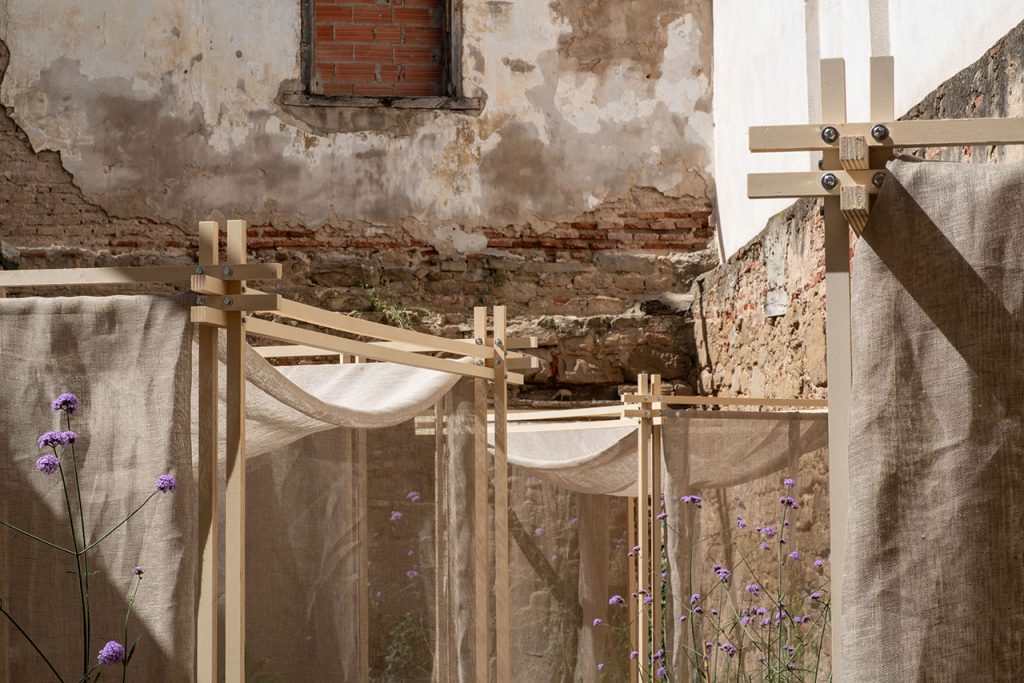
Using dereliction as a garden is deeply of the present. Across Spanish historic centres, abandonment forms literal holes in the urban body, sites that feel both dangerous and melancholic. Logroño may suffer less than other towns, but it isn’t immune. A Third of Life doesn’t patch the hole by hiding it. It turns it into a microclimatic opportunity, softening heat-island effects, restores meaning to ruin. Loss is acknowledged, but recovery is made plausible

What lifts Concéntrico beyond the category of “a beautiful week” is its afterlife. Out of 23 interventions, the mayor of Logroño has selected three to remain: A Third of Life; Borneo’s The Battle of the Planetary Gardener, which transforms a vacant lot into a biodiversity site tended by local schoolchildren; and Chris Kabel’s Picos, a series of birdhouses mounted on blank party walls. Permanence here is not about monumentalising festival work. It is about keeping a few small civic devices in place: shelter for birds, a plot of land relearned as living, a garden hidden within a ruin.
That decision also clarifies a broader shift in the culture of temporary urban interventions. Where earlier radical gestures often spoke primarily against consumerism and urban authority, today’s urgency is environmental crisis and biodiversity loss. Architecture is pushed back toward usefulness, not as a moral posture but as necessity. Yet the core remains. The commons becomes meaningful only when residents are brought into the story and behaviour is allowed to happen.
In Logroño, the argument is made without theatrics. A fireplace, a scaffold of swings, a rotating bench, an enclosed bath, a long table, a garden inside a ruin. None of these objects claims to rescue the city. Together they make a harder claim: public space becomes public again when it is usable – when it permits staying, meeting, resting, sharing. A town square is not an empty stage. It is part of life.
COVER PHOTO
Night view of “111 Farolas” by Bayona Studio – swings and glowing suspended street lamps transforming Logroño’s city hall plaza into a playful public space. Photo by Josema Cutillas, courtesy of PIN–UP Magazine / Concéntrico