
Now Reading: Playground installation reimagines wedding space in Yangzhou
- 01
Playground installation reimagines wedding space in Yangzhou

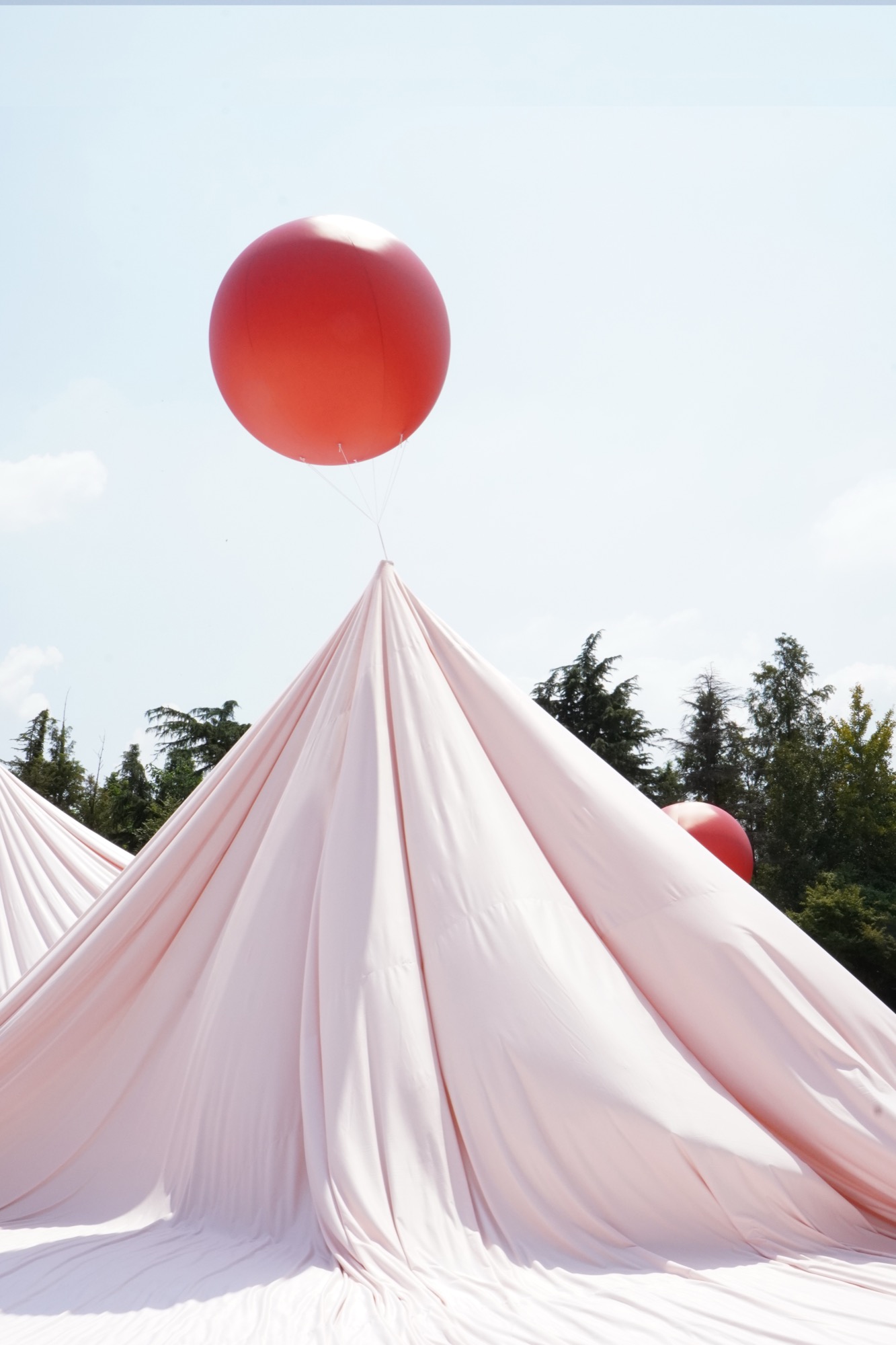

Playground is conceived as an interactive outdoor installation that rethinks the meaning of play as a continuous condition rather than a phase confined to childhood. The project begins from a simple observation. A playground is not only a place where children gather. It is a spatial condition where relationships are formed, tested, and transformed through dialogue, empathy, and shared experience.

In this sense, growth does not end with childhood. It unfolds over time as an ongoing process of connection and becoming. The playground persists wherever imagination remains active and where people engage with one another through acts of exchange and discovery.

Developed for a wedding at Yangzhou Guest House Canal Sanwan Hotel, the installation transforms a single day event into a temporal landscape of participation. Rather than staging the wedding as a fixed sequence of rituals, the project opens it up as a space of encounter. Guests are invited to move, rest, observe, and interact within an environment shaped as much by atmosphere as by structure.

Set on a lawn of approximately 2640 square meters, the installation responds to the scale and openness of the site through a strategy of light intervention. The design avoids heavy construction and instead introduces a spatial system generated by fabric, air, and tension.


The concept emerges from a simple spatial gesture. When a flat surface is lifted at one point, it begins to produce depth. Building on this idea, the project uses draped fabric to construct a shifting field that exists between surface and volume. What begins as a two dimensional plane becomes a three dimensional environment through folds, gravity, and suspension.


Large red balloons anchor and elevate the pale pink fabric, pulling it upward into soft peaks before allowing it to fall back toward the ground. This movement generates a layered condition of space. Above, the fabric defines an open platform for ceremony, performance, and gathering. Below, a shaded interior emerges, supported by slender columns and open along its edges to allow natural ventilation. Cooling systems and seating are integrated into this lower zone, offering relief from the summer heat while maintaining a direct connection to the surrounding landscape.


The installation does not remain static. It is continuously reshaped by the presence of both people and wind. As air moves across the site, the fabric responds by shifting, rising, and settling. The red balloons oscillate gently, amplifying the sense of motion and introducing a subtle rhythm to the space.
This responsiveness allows the installation to operate as an environment rather than an object. It is not defined by fixed boundaries but by changing conditions. Visitors do not simply occupy the space. They participate in its transformation, whether through movement, rest, or observation.

In this context, the playground becomes a shared field of experience. It is composed not only of physical elements but also of fleeting moments. Light at sunset, the sensation of air passing through fabric, distant views framed by shade, and the spontaneous actions of those present all contribute to its formation.
The project ultimately frames the playground as a container of memory. It gathers sensations and interactions, allowing them to accumulate over time. Like a porous structure, it absorbs the traces of what occurs within it and expands through them.
Here, architecture operates at the threshold between the material and the ephemeral. Fabric, air, and light become the primary instruments through which space is defined. What emerges is not a fixed form but a condition that invites continuous reinterpretation, where experience itself becomes the lasting structure.
Project name: Playground
Location: Yangzhou Guest House Canal Sanwan Hotel, Yangzhou, China
Area: 2,640 sqm
Design team: Suki+Partners