Now Reading: UQAM Centre de design hosts Samia Henni’s “Colonial Toxicity” on French nuclear landscapes in the Sahara
- 01
UQAM Centre de design hosts Samia Henni’s “Colonial Toxicity” on French nuclear landscapes in the Sahara

UQAM Centre de design hosts Samia Henni’s “Colonial Toxicity” on French nuclear landscapes in the Sahara

Presented as a world premiere in French, Toxicité coloniale : Architecture et paysage radioactifs français dans le Sahara examines one of the least publicly understood chapters of 20th-century architectural and territorial production. Between 1960 and 1966, the French colonial regime conducted a series of nuclear tests in the Algerian Sahara, detonating both atmospheric and underground bombs across sites such as Reggane and In Ekker.

Samia Henni’s project reframes these events not only as military operations, but as spatial practices that reshaped landscapes, infrastructures and bodies. Radioactivity is approached as a form of architectural production, extending across geographies and temporalities, with consequences that remain materially present yet politically obscured. More than sixty years later, many archives related to these tests remain classified, leaving the full extent of their impact unresolved.

Conceived as an immersive installation, the exhibition operates as an open-ended inquiry. It is structured through thirteen audiovisual “stations” that echo the logic of the original military sites, each assembling fragments of evidence drawn from archives, testimonies and field documentation.


The scenography is deliberately provisional. Lightweight partitions made from suspended A4 sheets form translucent curtains, allowing images, texts and absences to coexist within a layered visual field. Government documents, handwritten testimonies and translated materials are presented side by side, while blank pages signal the persistence of archival silence.


Moving image plays a central role. Eight monitors and five projections introduce filmed testimonies and landscapes, accompanied by a continuous soundtrack of desert wind. The result is a spatial environment that oscillates between exposure and opacity, reconstructing a territory where visibility itself has been historically controlled.
Rather than reconstructing a singular historical account, Henni constructs a counter-narrative assembled from dispersed and often unofficial sources. The exhibition situates architectural tools such as drawing, mapping and spatial sequencing as instruments of critical inquiry.


The Sahara emerges not as an empty expanse but as a contested terrain shaped by extraction, experimentation and displacement. The exhibition traces how infrastructures of testing, containment and concealment produced both physical and epistemic voids, while the persistence of radioactive debris continues to affect inhabited environments.
By bringing together geological, atmospheric and human dimensions, the project challenges conventional disciplinary boundaries, positioning architecture as a medium capable of engaging with invisible and long-term processes.

“Blue Gerboise” sand, 2007 Various metals and materials abandoned in the Sahara around the former Saharan Military Testing Center, Reggane, 2007. Photo credit: Bruno Barrillot. With kind permission of the Armaments Observatory (https://www.obsarm.info/). “Blue Gerboise” sand, 2007 Various metals and materials abandoned in the Sahara around the former Saharan Military Testing Center, Reggane, 2007. Photo credit: Bruno Barrillot. With kind permission of the Armaments Observatory (https://www.obsarm.info/). Ruins, 2007. Ruins around the former Saharan Military Experiments Center in Reggane, 2007. Photo credit: Bruno Barrillot. With kind permission of the Armaments Observatory (https://www.obsarm.info/). 
Radioactive lava flow, 2010. Solidified radioactive lava flow generated by the unconfined underground nuclear explosion of the Beryl bomb in the Taourirt Tan Afella massif, In Ekker, May 1, 1962. Photo credit: © 2010 Larbi Benchiha Metals “Blue Gerboise”, 2007. Various metals and materials abandoned in the Sahara around the former Saharan Military Testing Center, Reggane, 2007. Photo credit: Bruno Barrillot. With kind permission of the Armaments Observatory (https://www.obsarm.info/). Metals “Blue Gerboise”, 2007. Various metals and materials abandoned in the Sahara around the former Saharan Military Testing Center, Reggane, 2007. Photo credit: Bruno Barrillot. With kind permission of the Armaments Observatory (https://www.obsarm.info/). Views of the buildings of the former Saharan Military Experimentation Centre, Reggane, 2007. Photo credit: Bruno Barrillot. With kind permission of the Armaments Observatory (https://www.obsarm.info/). Abandoned barrels in the Sahara around the former Reggane Saharan Military Testing Centre, 2007, Photo credit: Bruno Barrillot. With kind permission of the Armaments Observatory (https://www.obsarm.info/).


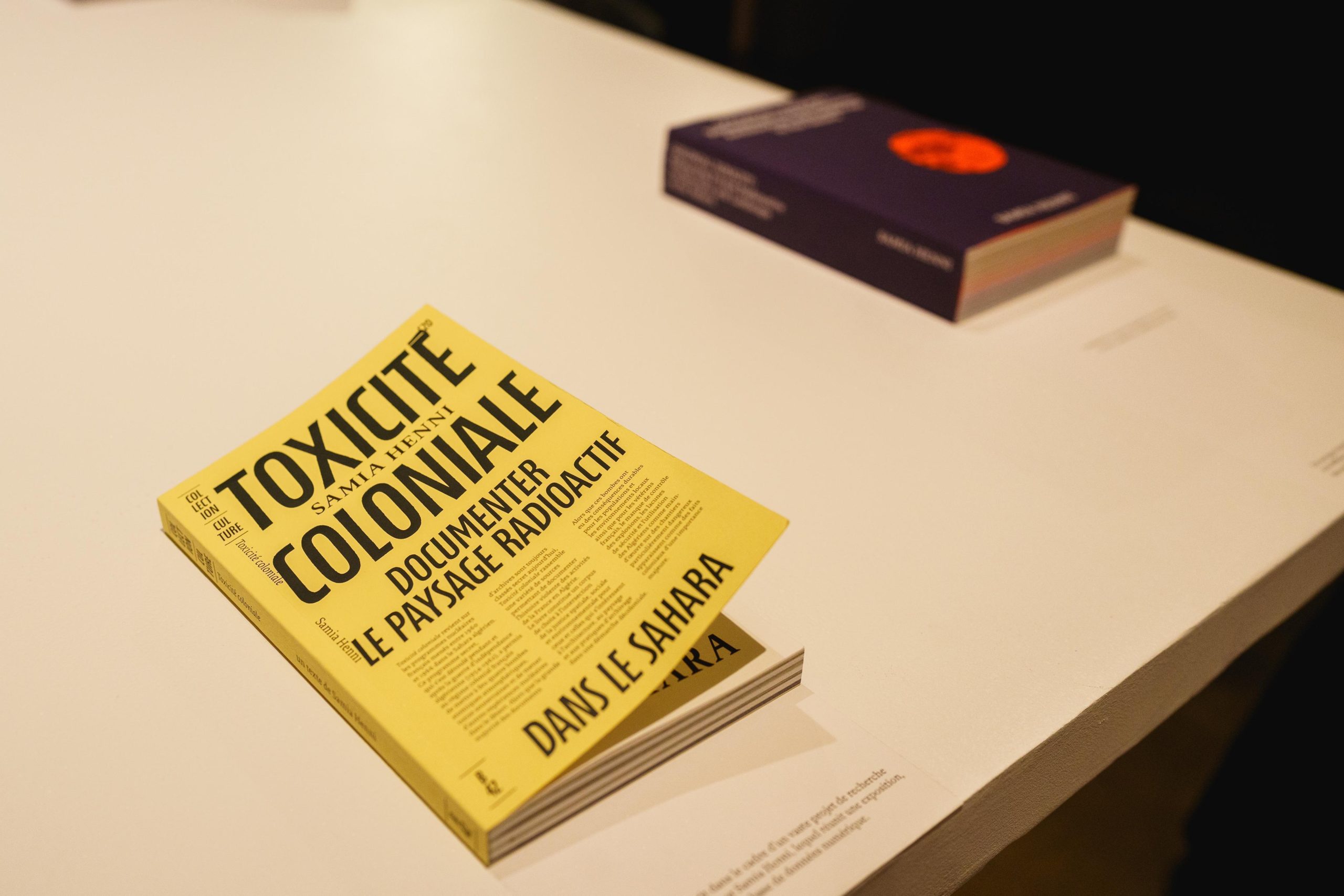
The exhibition forms part of a broader body of research developed by Henni over several years. It extends her publications on colonial toxicity, including a nearly 600-page volume that has received international design awards, as well as a new French-language edition released in 2026.
A key component is the Testimony Translation Project, an open-access digital database that gathers and translates accounts from victims and witnesses of the nuclear tests. Originally recorded in Arabic, Tamahaq and French, these testimonies expand the archive beyond institutional sources, foregrounding voices historically excluded from official narratives.
Together, these materials articulate a method of spatializing knowledge, where exhibition design becomes both a mode of dissemination and a form of research.


Installed within the Centre de design de l’UQAM, the exhibition situates itself at the intersection of research, pedagogy and design practice. It underscores the capacity of architectural thinking to engage with complex historical conditions, not by offering resolution but by constructing frameworks for understanding.
At its core, Colonial Toxicity calls for the declassification of archives and the decontamination of affected sites. It frames these demands not only as political imperatives but as necessary steps toward reconstructing a shared understanding of past and ongoing environmental violence.
UQAM’s Centre de design is a leading Canadian venue dedicated to exhibitions on graphic, industrial and urban design, as well as architecture and fashion. Founded in 1981 by professors from UQAM’s École de design, it has produced over 400 exhibitions, contributing significantly to the dissemination of design culture in Quebec and internationally. Located in downtown Montreal, the Centre offers a 400-square-metre exhibition space with free public access, alongside conferences and events held throughout the year.
Exhibition information
Toxicité coloniale : Architecture et paysage radioactifs français dans le Sahara is on view at the Centre de design de l’UQAM in Montreal from February 19 to April 12, 2026. Admission is free.
Event’s Photos: Benoit Rousseau / @rousseaufoto