Now Reading: Snøhetta unveils circular Ring building for nature-focused Ion Riva district in Istanbul
- 01
Snøhetta unveils circular Ring building for nature-focused Ion Riva district in Istanbul

Snøhetta unveils circular Ring building for nature-focused Ion Riva district in Istanbul
On the northern edge of Istanbul, where the forests of Beykoz descend toward the Black Sea, a new residential district is taking shape. Known as Ion Riva, the development introduces a nature-oriented masterplan designed by a collective of international practices including Snøhetta, MVRDV, and Bjarke Ingels Group. Conceived as a neighbourhood of nearly 1,000 homes set within 100,000 square metres of biodiverse green space, the project combines housing, education, culture and recreation within a landscape-driven framework.


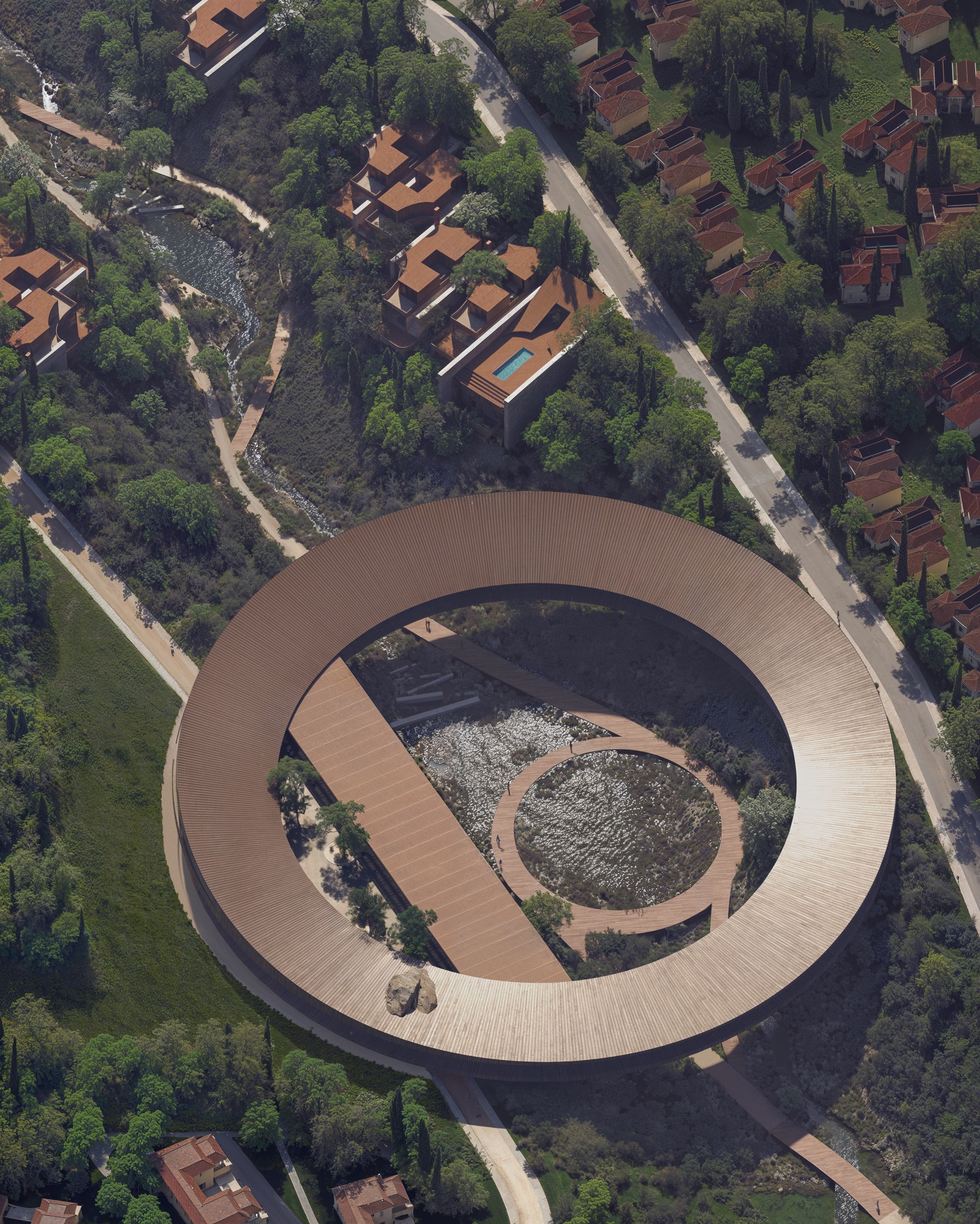
Snøhetta’s contribution to the masterplan, named Greenhouse, includes approximately 400 residences alongside retail, offices and community facilities. At the centre of this district stands The Ring, a circular building that spans a river gorge and establishes a distinctive landmark within the wider plan. Construction has already begun, with the first residents expected to move into completed homes in June 2027.

The Ring is defined by its dramatic circular geometry, appearing to hover above the river valley while framing views of the surrounding forest and coastline. The structure functions less as a conventional building than as a spatial landscape for gathering, reflection and ecological learning. Within its circular span, visitors encounter a sequence of spaces dedicated to wellness, cultivation and everyday encounters with nature.

The building houses a Longevity Center focused on wellbeing practices, while stables and allotments along the river support community agriculture and ecological education. Rather than presenting architecture as an isolated object, the project proposes an environment where the built form becomes a platform for experiencing the rhythms of the valley.
As Tae-Young Yoon, Senior Architect and Project Leader at Snøhetta, explains, the structure is conceived as an invitation to rediscover the site through movement and observation. The circular form frames the landscape while encouraging visitors to climb, walk and spend time immersed in nature.

Surrounding The Ring, the Greenhouse district introduces a range of residential typologies designed to strengthen connections between domestic life, landscape and community. Homes are organised into five smaller neighbourhood clusters of between 50 and 80 residences. Each cluster develops its own identity through distinct landscape qualities and shared programmes while remaining integrated into the wider district.
The architecture draws inspiration from regional building traditions while adopting contemporary strategies for environmental performance. Shared facilities such as recreational spaces and community amenities are distributed throughout the neighbourhood and remain accessible to residents and visitors alike. Digital infrastructure is integrated across the district to enhance comfort, efficiency and long-term sustainability.

The Ion Riva masterplan is shaped by the meeting of forest, river and sea. Rather than imposing a rigid urban grid, buildings and public spaces follow the natural contours of the terrain, preserving views across the valley and coastline while minimising ecological disturbance.
According to Snøhetta’s founding partner Kjetil Trædal Thorsen, the design process began with the landscape itself. The aim was not to overwrite the site but to reinforce its existing ecological relationships. Within this approach, architecture becomes a mediator between people and nature rather than a dominant presence.

Materials throughout the development prioritise locally sourced stone and timber, while modular construction methods help reduce embodied carbon and improve construction efficiency across the housing programme.
Environmental performance is embedded into the planning of the neighbourhood. On-site renewable energy systems include solar panels integrated with the local grid. Rainwater harvesting and greywater recycling are expected to reduce potable water consumption by up to fifty percent, while low-irrigation planting supports the resilience of the landscape.
Green infrastructure also contributes to regulating microclimates and improving air quality. Biodiverse corridors connect parks, trails and open spaces, creating a continuous ecological network across the site.

Walkability is a defining principle of the masterplan. Short pedestrian routes link homes with schools, recreational facilities and everyday amenities. Shaded pathways and landscape trails allow residents to move through the district while remaining immersed in forested surroundings.
The Ring forms one of four major architectural anchors within Ion Riva, each designed by a different practice in the collaborative masterplan.

Along the Black Sea coastline, Bjarke Ingels Group has designed The Drop, a timber building shaped like a teardrop that accommodates cafés, restaurants, wellness facilities and public art spaces.
At the centre of the neighbourhood, The Light House provides spaces for culture, education and recreation, including exhibition halls, studios, co-working areas, a library and sports facilities.
MVRDV’s contribution, The Lantern, will house a performing arts centre alongside cinema rooms, community spaces, an art gallery and a bookshop.
Together these four buildings establish a cultural and social infrastructure for the emerging neighbourhood while reinforcing the broader vision of Ion Riva as a landscape-centred model for contemporary living.

Project Credit
Project name: Ion Riva – Greenhouse District / The Ring
Location: Beykoz District, Istanbul, Turkey (Black Sea coast)
Design firms: Snøhetta / @snohetta, MVRDV / @mvrdv, Bjarke Ingels Group / @big_builds
Expected Completion: 2027
Photo: Proloog / Snøhetta
Previous Post
Next Post
- The timeless elegance of domestic appliances: From the Iconic Braun KF 20 aromaster to the German design ethos

- Emilio Ferro on the light, sound and memory of a place
- At Maniwa, an architect’s family home opens to the neighbourhood
- What bronze remembers of the hand

- Caught in light: Moradavaga’s suspended shoal

- The making of Alex Chinneck’s impossible Dior windows