
Now Reading: MINAX designs Daixi Culture-Sports Commercial Complex inspired by Chinese landscape painting
- 01
MINAX designs Daixi Culture-Sports Commercial Complex inspired by Chinese landscape painting

MINAX designs Daixi Culture-Sports Commercial Complex inspired by Chinese landscape painting

Across the towns of China’s Jiangnan region, rivers, stone bridges, and white-walled settlements have historically formed a delicate spatial ecology where architecture, water, and landscape exist in quiet equilibrium. Yet in recent decades, the acceleration of urbanization has often replaced these nuanced environments with standardized development patterns that gradually erode the cultural specificity of place.
The Daixi Culture-Sports Commercial Complex emerges as a deliberate counterpoint to this tendency. Designed as a new civic center for the town of Daixi, the project reinterprets the spatial philosophy of traditional Chinese landscape painting through contemporary architectural language. Rather than replicating historical forms, it seeks to translate the deeper cultural logic embedded in Jiangnan’s relationship between mountains, rivers, and human settlement.
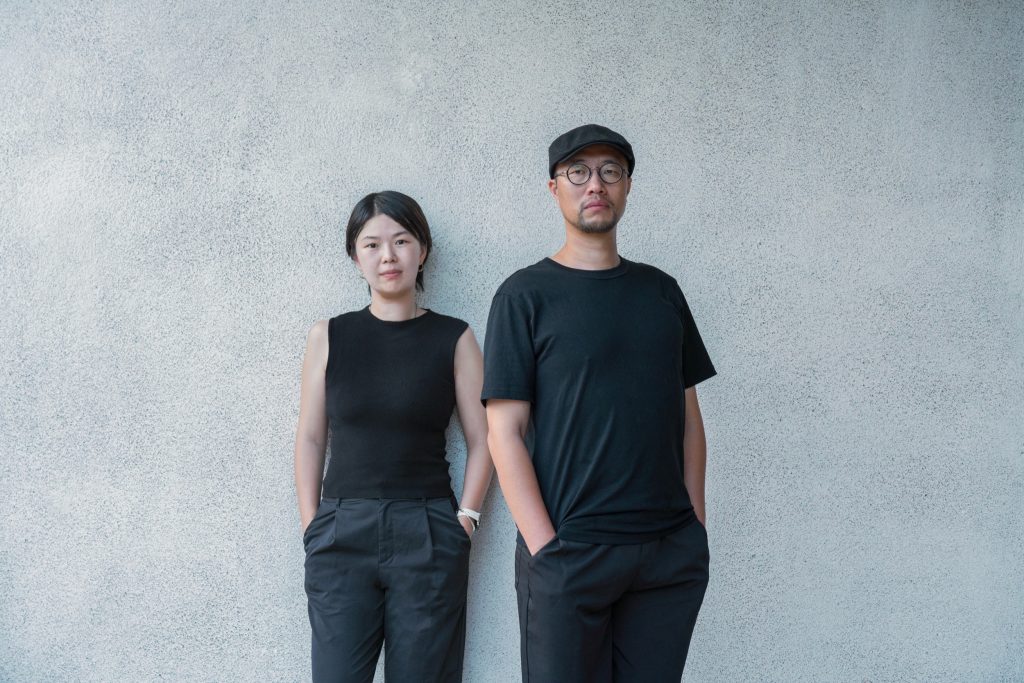
In this interview, Lu Zhigang – Founder and Chief Architect of MINAX and Curator of the Shanghai Qingteng Art Museum reflects on the conceptual foundations of the project. He discusses how ideas drawn from ink landscape traditions, regional water networks, and everyday social life informed the complex’s spatial organization, its abstract geometric language, and its ambition to create a new form of civic identity within the rapidly transforming context of contemporary China.

What were the primary sources of inspiration from traditional Chinese landscape painting that influenced the overall form and spatial experience of the Daixi Culture-Sports Commercial Complex?
Lu Zhigang: Chinese landscape painting has undergone a profound transformation through history. In its early stages, painters constructed magnificent spatial worlds using mineral pigments and rich color. Later, literati painters reduced this visual language to the expressive power of ink wash, depicting vast landscapes through subtle variations of tone, density, dryness, and moisture. Through this abstract language, painters were able to evoke complex layers of the external world with remarkable delicacy.
At its core, this tradition does not aim to mechanically reproduce objects. Instead, it integrates subjective emotions with the characteristics of mountains and rivers, creating within the limited space of a scroll a spiritual realm that is both navigable and inhabitable. The interlocking structure of elements, the continuous flow of energy, and the interplay between void and solid together form an aesthetic system that embodies both holistic awareness and the rhythm of life.
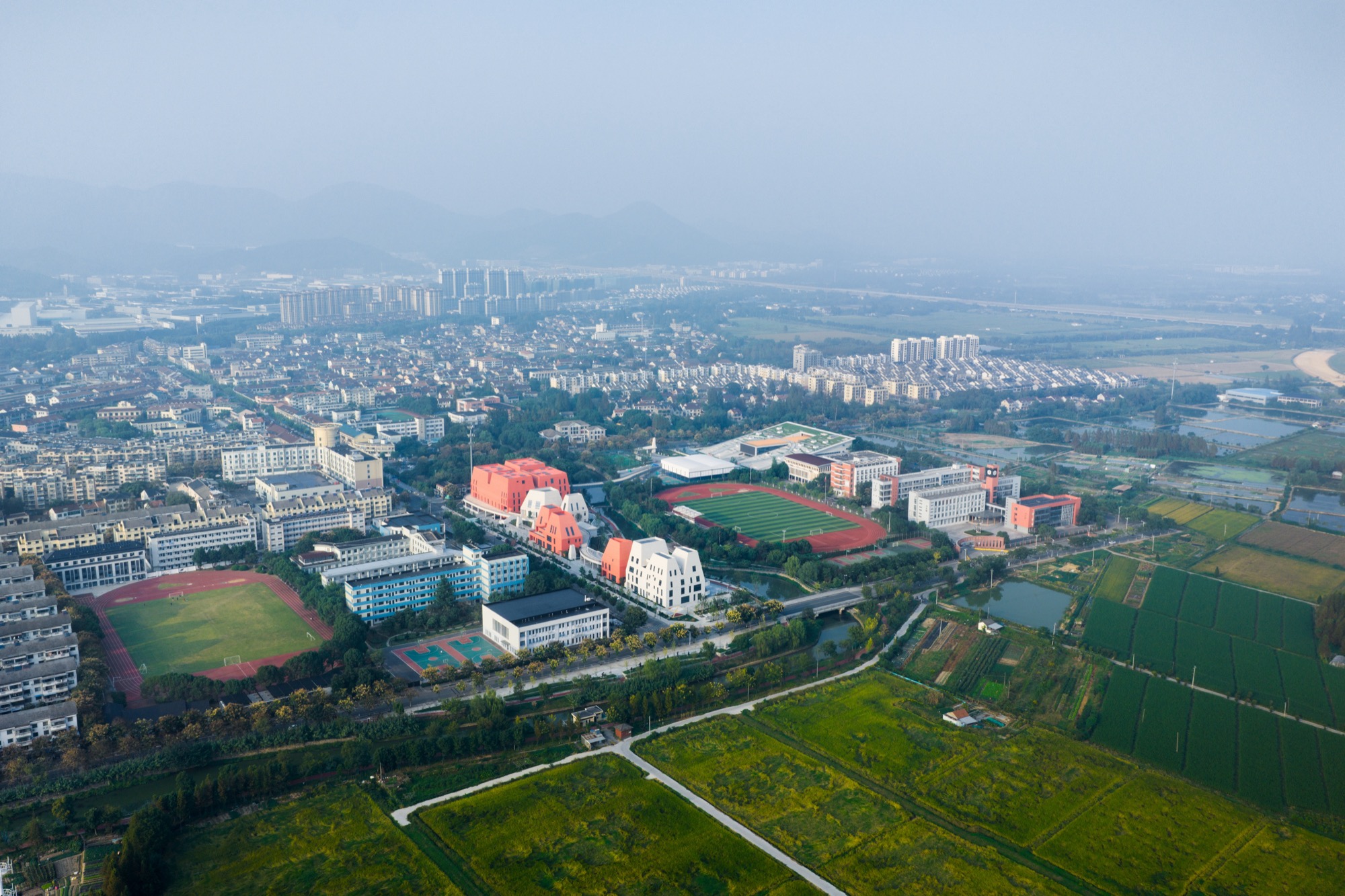
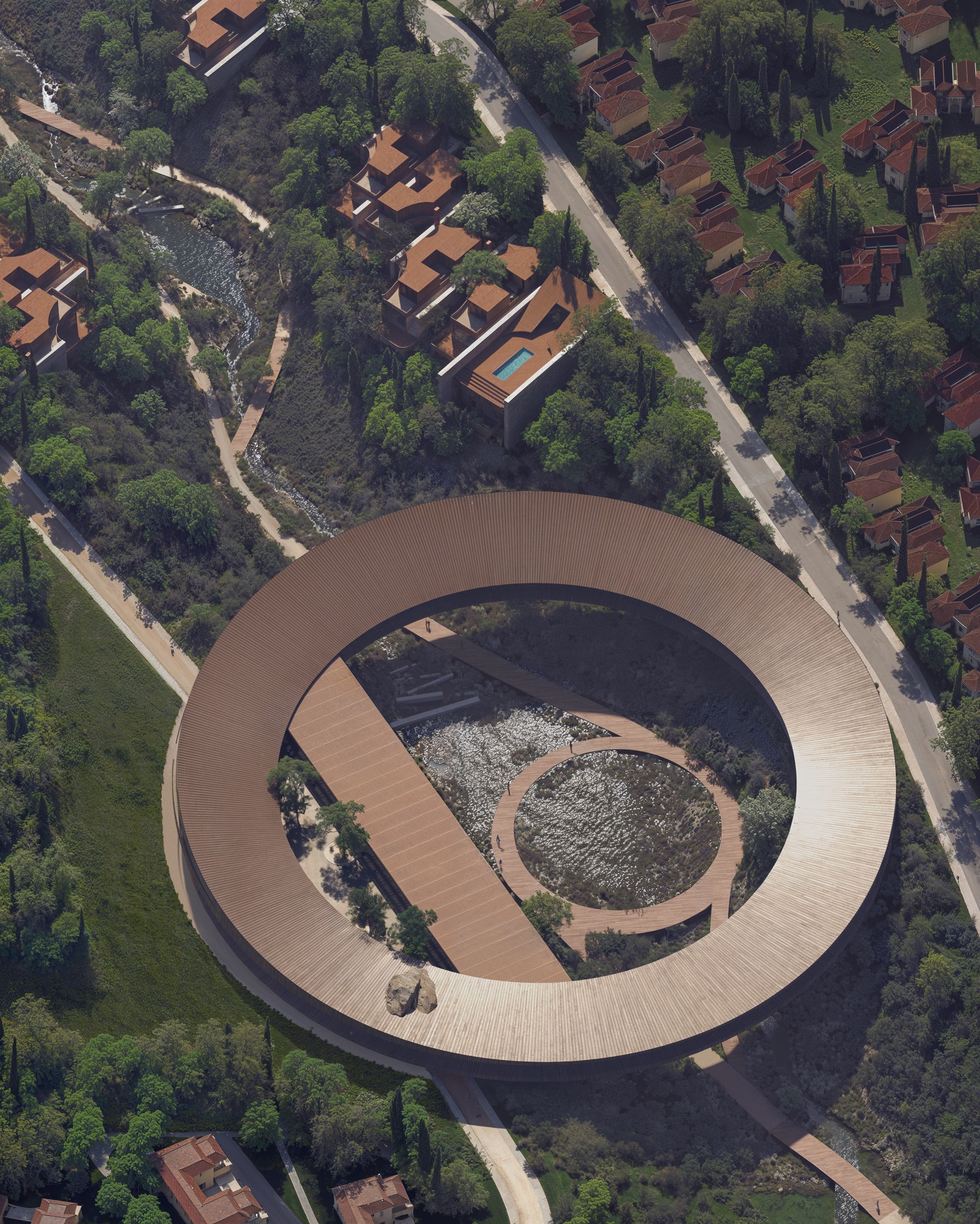
In the design of the Daixi Culture-Sports Commercial Complex, we intentionally departed from conventional architectural thinking that begins with functional arrangement. Instead, we began with imagery. The overall form draws inspiration from the silhouettes of surrounding mountains, presenting an upright and monumental posture. Running through the complex is a corridor system that meanders like a stream winding through mountain valleys, linking scattered functional volumes.
Through this translation, architecture no longer stands in opposition to nature. Instead, it shares an abstract logic with the surrounding landscape, creating a resonance between human construction and natural harmony.
How did historical elements of the Jiangnan region, such as water networks and stone bridges, shape your reinterpretation of tradition into a modern civic landmark?
LZ: The historical landscape of Jiangnan and the spatial reality produced by China’s rapid urbanization over the past four decades form a striking tension. Traditionally, Jiangnan settlements developed through systems deeply integrated with rivers, canals, and undulating terrain. Architecture adapted itself to local conditions, unfolding within the landscape like plants drawing nourishment from the soil. Built forms emerged organically, creating living communities that breathed together with the surrounding environment.

In recent decades, however, urbanization driven by efficiency and capital turnover has embraced planning models centered on functional optimization. The relationship between urban form and local geography has often been severed, replaced by standardized development patterns. As a result, many contemporary urban environments have become homogeneous spatial products where historical layers and the richness of place gradually disappear.
The site of the Daixi project exists precisely within this context. Much of the surrounding landscape has been homogenized, yet fragments of historical memory remain. Rivers still flow through the town, and weathered stone bridges survive as quiet witnesses to the past.
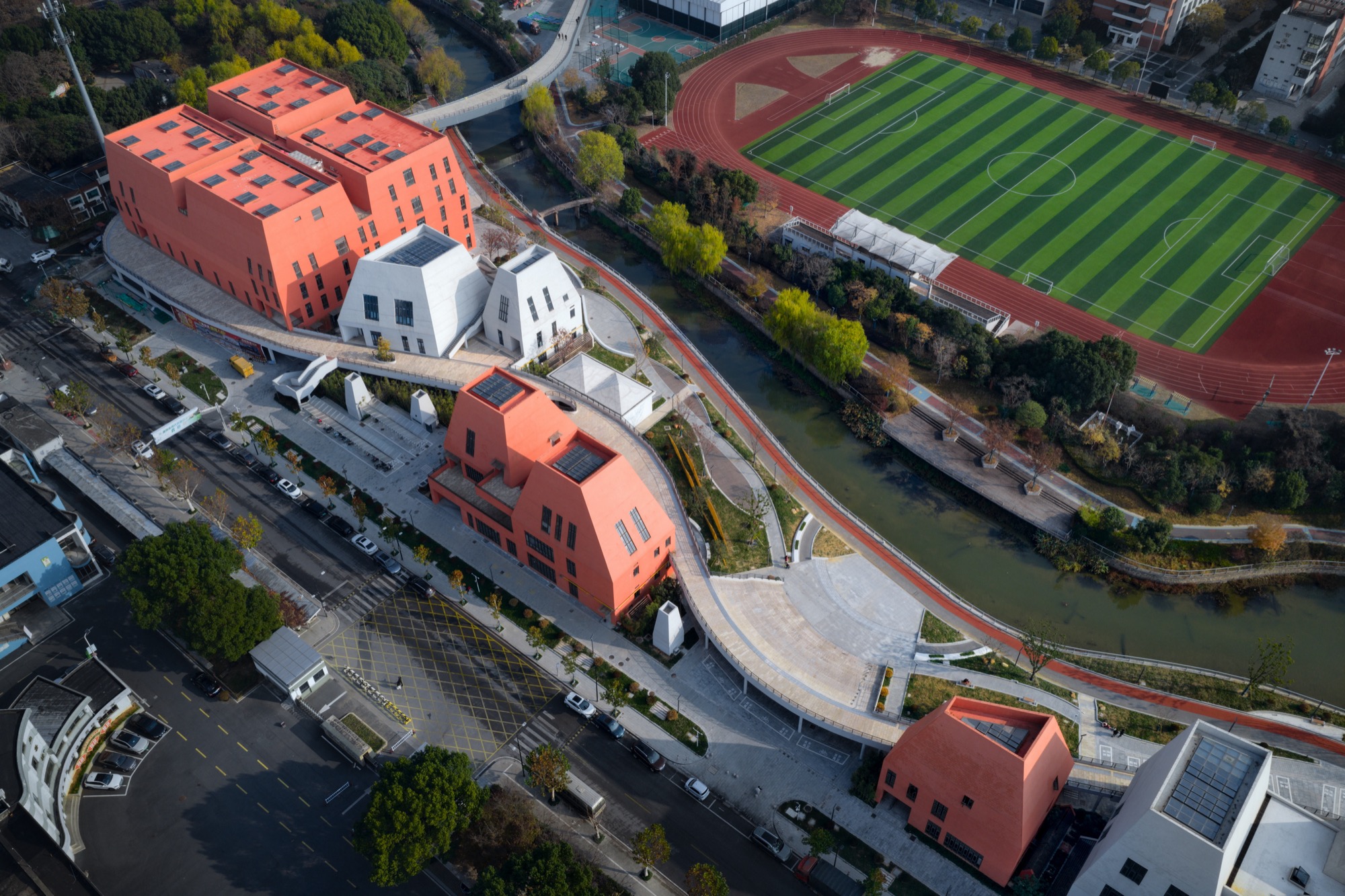
These remnants inspired us to attempt a form of architecture that grows naturally from the site. The project allows architecture to emerge from the folds of the terrain, extend along the veins of the water system, and reinterpret traditional construction wisdom through contemporary spatial language. What emerges is neither nostalgic reproduction nor imitation of Western modernity, but an alternative modernity rooted in cultural consciousness.
In what ways does the design emphasize spiritual resonance rather than literal representation?
LZ: Traditional Chinese painting organizes space through what is often described as a “mobile perspective.” Instead of a single vanishing point, the viewer moves through the landscape visually and mentally, experiencing shifting scenes over time.
This concept informed our spatial strategy. Architectural volumes are decomposed and distributed across the site in a relatively free arrangement. There is no rigid hierarchy of primary and secondary elements. Instead, the project unfolds as a spatial narrative experienced through movement, where scenery changes continuously as one walks through the complex.

The sports center, for example, is partially embedded underground to form a large sloping landscape. Here the architectural mass dissolves into terrain, releasing generous public space above. This gesture reflects an architectural attitude of yielding: the building retreats in order to return the site to greenery and people.
Meanwhile, the commercial center forms a sequence of voids between buildings, streets, and river edges. These spaces become catalysts for dense interactions between architecture and daily life. The architectural language remains geometrically concise, allowing natural elements such as the river, the trees, and the distant mountains to emerge as the true protagonists of the site.
How does the complex integrate cultural, sports, and commercial functions to foster a sense of local identity amid rapid urbanization?
LZ: As China’s economy transitions toward a more stable development model, the distribution of social time is undergoing profound change. Reduced working hours and demographic shifts have created new groups of people with increasing leisure time and an expanding need for public life.
Before the construction of the complex, public life in Daixi largely depended on streets and scattered urban nodes. Cultural performances, sports competitions, and commercial services requiring higher spatial quality were often only available in larger cities.
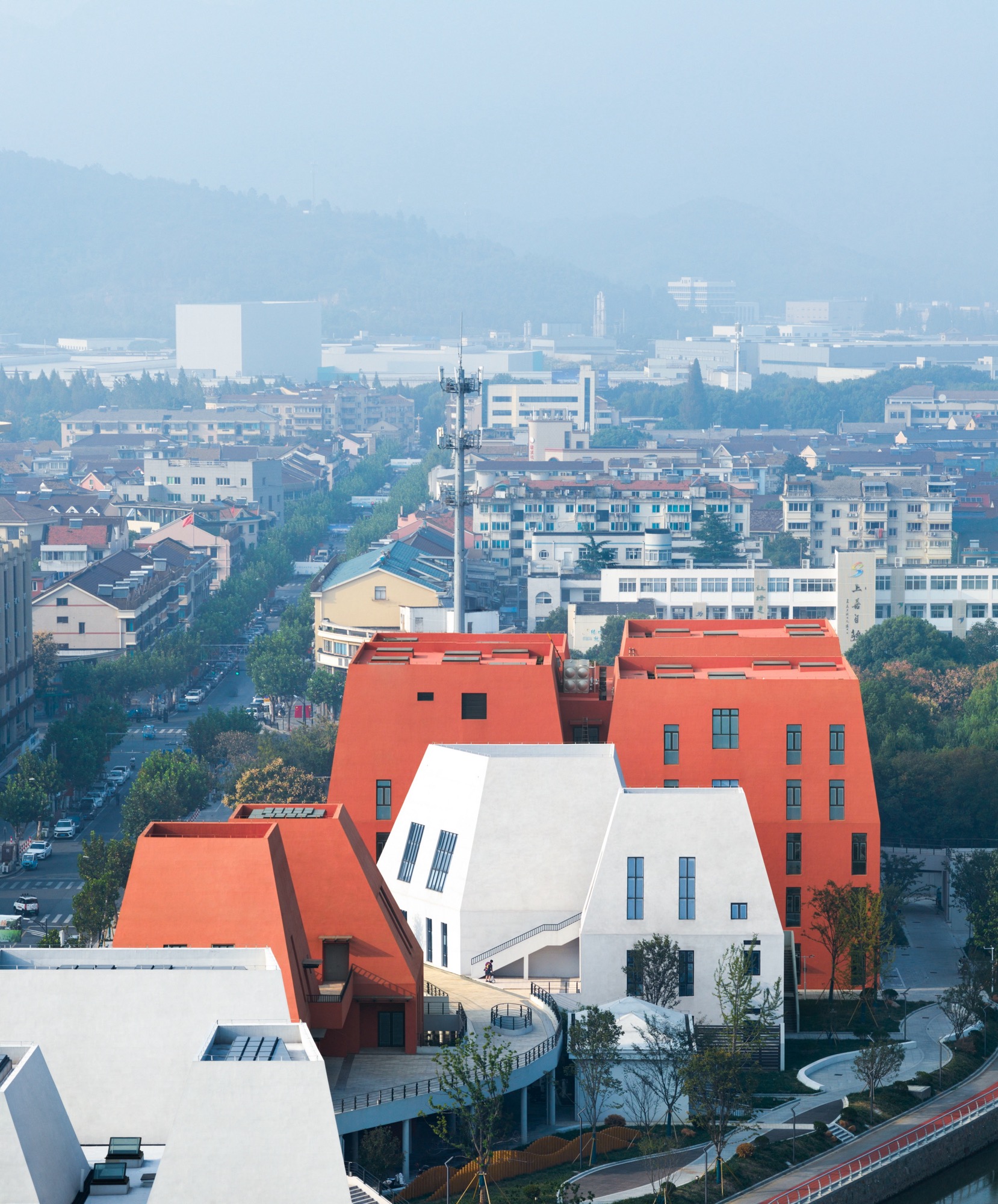
The Daixi complex therefore acts as a social condenser. By weaving cultural, sports, and commercial functions into a single spatial framework, the project reshapes a new public center at the scale of the town. Distance barriers disappear and daily encounters become possible.
Over time, these shared activities accumulate into collective memories. Architecture thus becomes not only a physical structure but also a social device capable of generating a sense of belonging rooted in everyday experience.

What guided the decision to divide the complex across the riverbanks, and how does the winding pedestrian corridor serve as a unifying spatial gesture?
LZ: The two plots available for the project lie on opposite banks of a river in the center of Daixi. Rather than treating the river as a spatial barrier, the project recognizes it as a defining geographical feature.
The eastern plot maintains closer connections to the urban street network and therefore accommodates cultural and commercial programs. The western plot, larger and more regular in shape, hosts the sports center.
A winding pedestrian corridor inspired by mountain streams connects these two conditions. Flowing between buildings and crossing the river, the corridor slows movement and introduces a sequence of changing perspectives. It functions not only as circulation but also as a spatial narrative linking two different urban conditions into a unified whole.
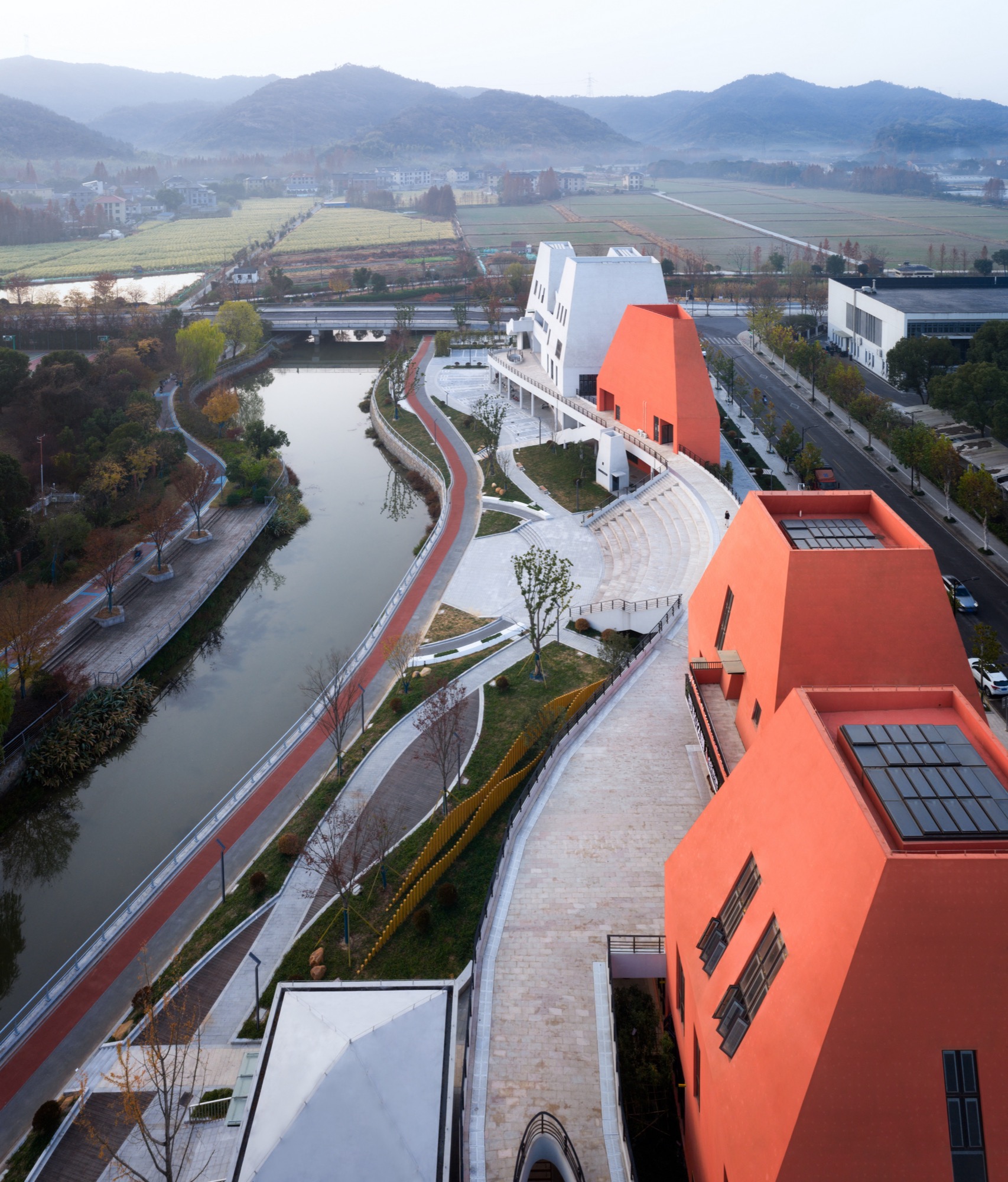
How do the white and orange-red facades create a dialogue between traditional Jiangnan aesthetics and contemporary architectural expression?
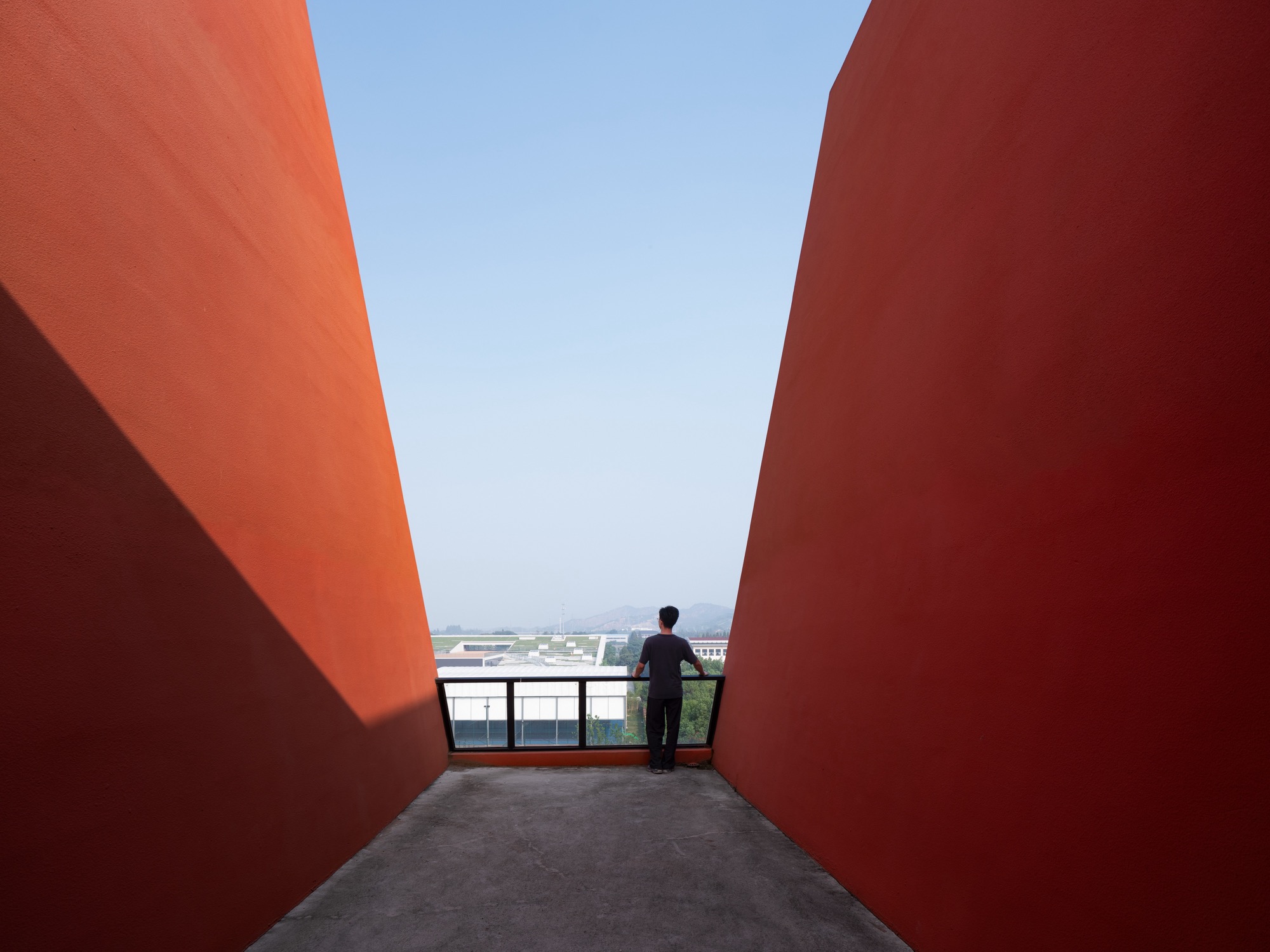
LZ: White references the traditional color palette of Jiangnan towns, where white walls and dark roofs have defined the visual identity of the region for centuries. Orange-red, by contrast, introduces a sense of unfamiliarity and signals the arrival of something new.
The juxtaposition of these colors creates a temporal dialogue. White anchors the architecture in the past, while orange-red points toward the future. Together they produce a visual tension that reflects the present moment of transformation in the town.
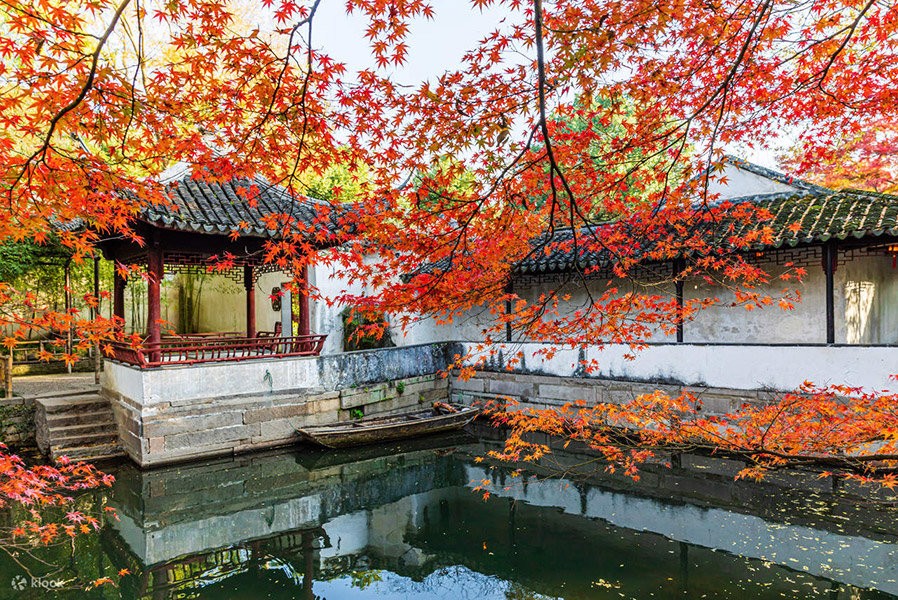
In terms of environmental integration, how does the design encourage interaction with the river landscape?
LZ: A continuous slow-walking trail forms the backbone of the project’s environmental strategy. Winding between buildings and open spaces, the trail connects the two riverbanks and links the entire complex.
Along its route, viewing platforms and public nodes create moments of engagement with the river landscape. The spatial sequence alternates between narrow passages, open plazas, and quiet pavilions, producing a walking experience in which the scenery changes step by step.
What innovative aspects of the interior spaces make the complex adaptable to community needs?
LZ: Physical commerce in China is facing a profound transformation due to the rise of e-commerce. Our view is that the vitality of physical retail will depend increasingly on the uniqueness of spatial experience.
The complex therefore combines large centralized areas with smaller distributed units, enabling diverse commercial activities to coexist. More importantly, it fosters social interaction through everyday exchanges such as greetings between neighbors, conversations between shop owners and regular customers, and spontaneous encounters in public spaces.
In this way, the commercial center becomes a form of social infrastructure rather than merely a place of consumption.

Were there challenges in translating the abstract ‘mountain silhouette’ concept into a functional, everyday architectural environment?
LZ: The greatest challenge was not technical but perceptual. Communities accustomed to conventional rectangular buildings must gradually learn to interpret more abstract architectural forms.
Our strategy was to maintain cultural depth while ensuring practical usability. Over time, as people repeatedly move through the complex, the spatial language of the project gradually becomes part of everyday perception.
Looking ahead, how do you envision the Daixi Complex influencing future urban developments in similar historical towns?
LZ: The Daixi project explores a possible path for the future development of historical towns. Instead of reproducing traditional forms or ignoring historical context, it seeks to reinterpret the deeper cultural logic embedded in the relationship between humans and nature.
When approached carefully, heritage and modernity do not need to exist in opposition. They can instead form a productive dialogue, generating architecture that is both culturally grounded and forward-looking.
Article Credit
Text: Kai Nakagawa
Time: March 2026