Now Reading: Carlo Moretti, the forgotten visionary of post-war lombard architecture
- 01
Carlo Moretti, the forgotten visionary of post-war lombard architecture

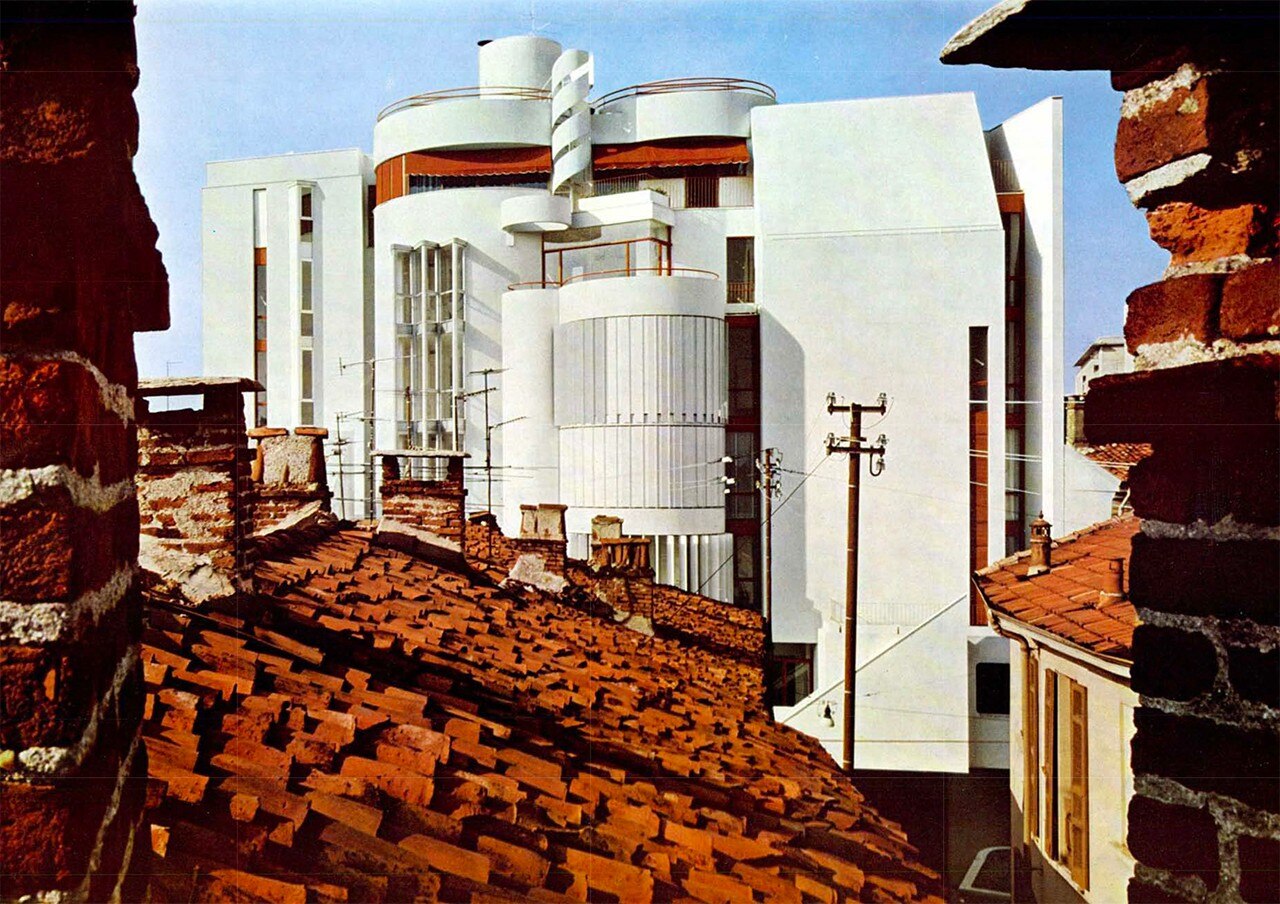

In the quiet town of Cassano Magnago, in Italy’s Varese province, a low circular building rests among trees and open ground. Cast in concrete yet kept close to the earth, it reads almost as a child’s idea of architecture: simple, legible, and oddly joyful. This is the Scuola dell’Infanzia L’Aquilone, designed in the early 1970s by architect Carlo Moretti (born 1931), built in the mid-decade, and introduced to a wider architectural audience through Domus in late 1975. The school began operating in 1974, and it remains in use today, not as a relic, but as a working civic environment that has absorbed decades of changing educational practice without losing its spatial poise.
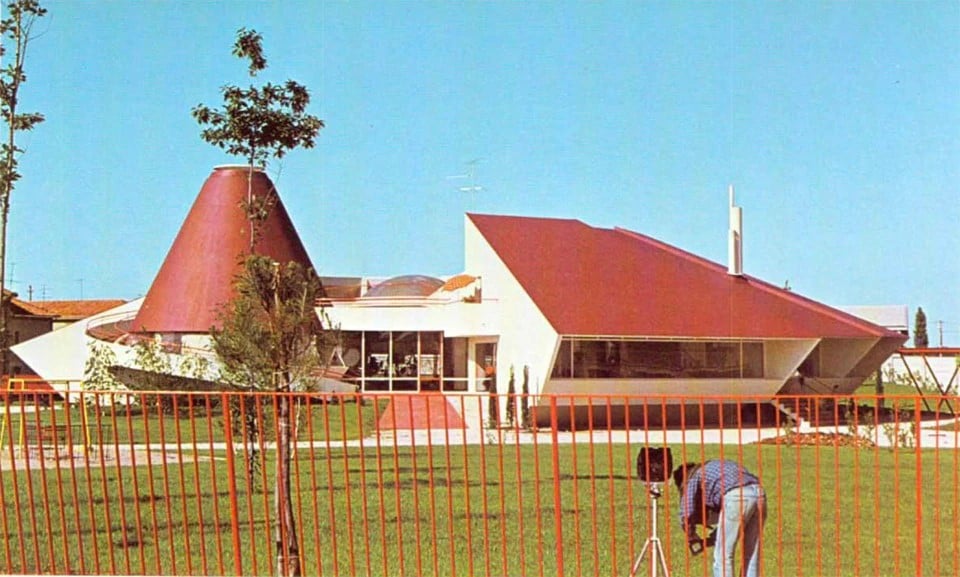
The plan turns on a central commons. It is an interior place of gathering and play, a room that feels shared rather than managed. Around it, classrooms unfold as angled segments, producing a sequence of spaces that can be entered, crossed, and rejoined without the logic of a corridor. The building does not choreograph childhood into neat routes. It allows drifting, doubling back, returning. Light arrives from the perimeter and from above, so the center never becomes a leftover zone. The scale stays low and close, held under a gently sloping roof that softens the silhouette and keeps the school from reading as an institution. Supervision is possible because the plan stays open and readable, not because it closes down behavior.

What gives L’Aquilone its staying power is a combination that is rare in civic work: clarity without rigidity, generosity without vagueness. The building assumes that learning is physical and social, shaped by encounter, curiosity, and the pull of shared space. Over time, educators have adopted newer frameworks and vocabularies, and the school has been able to accommodate them precisely because the architecture does not pin itself to a single method. It provides a condition rather than an illustration.
It would be easy to let the kindergarten stand alone as a provincial delight, a humane counterpoint to the harder tones of 1970s concrete culture. Yet L’Aquilone is not a charming exception. It is the built distillation of an ambition that once placed Moretti in the foreground of Italian architectural debate before his name gradually slipped out of international view.
LOMBARDY AS A LABORATORY
Moretti’s formation belongs to a region in motion. Post-war Lombardy was being reshaped by industry, new infrastructures, and demographic acceleration. Towns near Milan expanded, landscapes were re-parceled, and the routines of civic life changed quickly. Moretti studied at the Politecnico di Milano, graduating in 1957, and entered practice at a moment when Italian architecture was negotiating its own direction. One strain remained committed to continuity between building and landscape, another leaned toward the expressive force of structure and mass, and a third was beginning to question whether the building itself should remain architecture’s primary unit of thought.
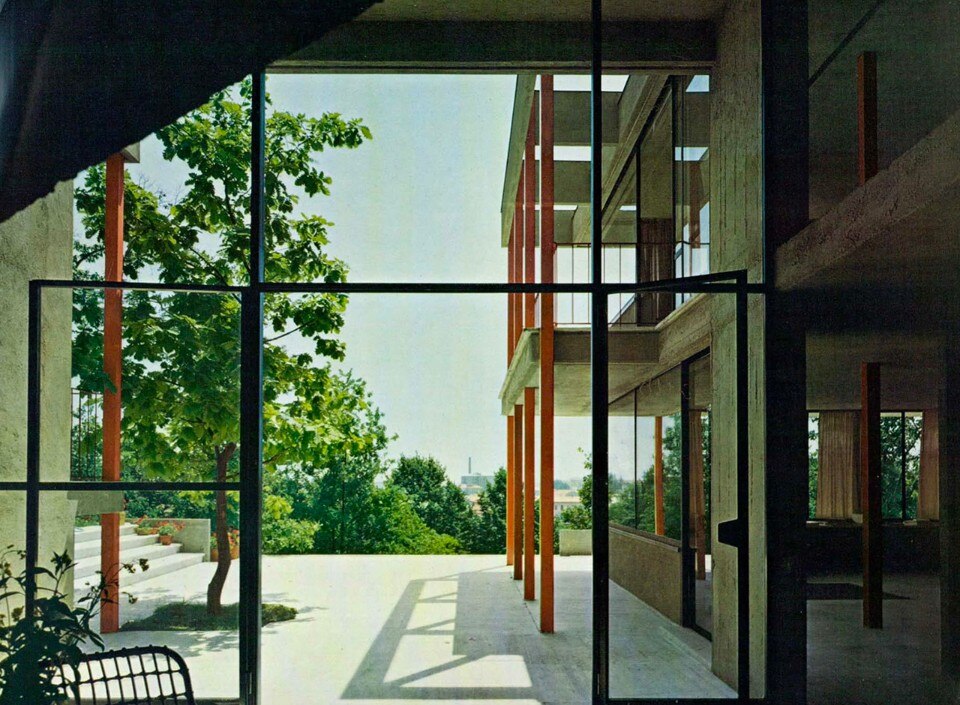
When Domus first drew attention to Moretti’s work in 1966, it did so through projects near Gallarate, including a primary school and a private house. The early language was attentive rather than declarative. Plans opened toward courtyards, glazing drew the outside close, and forms adjusted themselves to the plateau instead of arriving as autonomous objects. Even then, the work was not simply soft or picturesque. It was interested in how bodies move, how groups form, and how space can guide behavior without overt instruction.
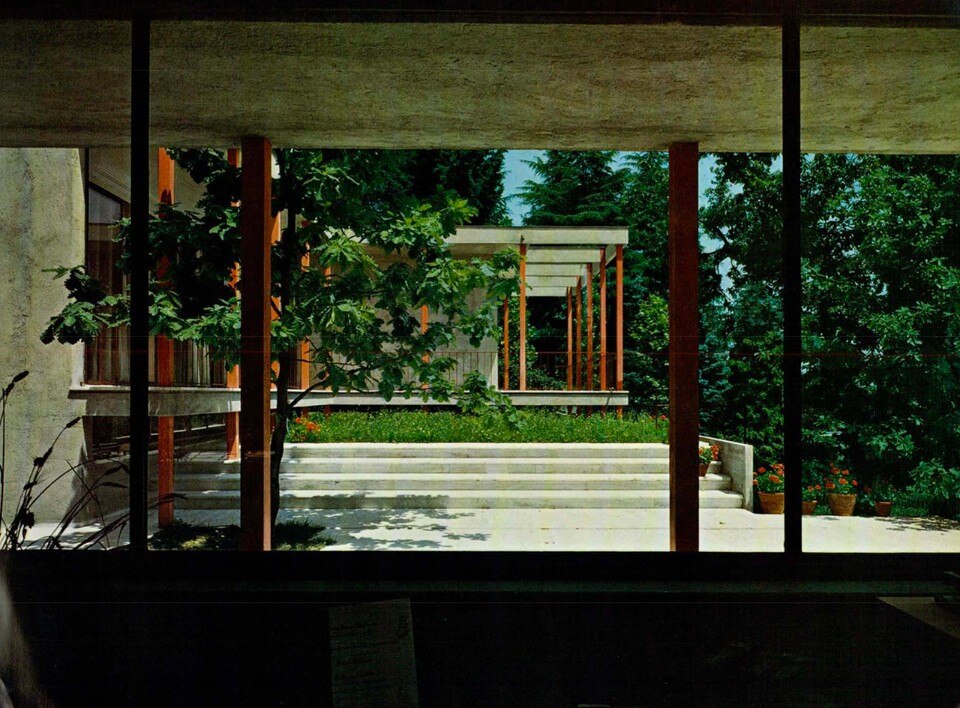
As the 1960s turned into the 1970s, the vocabulary sharpened. Concrete became more than a material. It became an instrument, capable of producing thickness, depth, and presence. Moretti’s architecture grew more willing to confront the city directly.
“METEORITES IN GALLARATE”
That confrontation became visible with housing on Via Mazzini in Gallarate, which appeared on the cover of Domus in July 1971 under the headline “Meteorites in Gallarate.” The metaphor captures the project’s public posture. The building reads as an event, a sculptural insertion that does not dissolve into the ordinary fabric. Domestic life is pressed into a dense concrete form that asserts itself as a new urban mass.
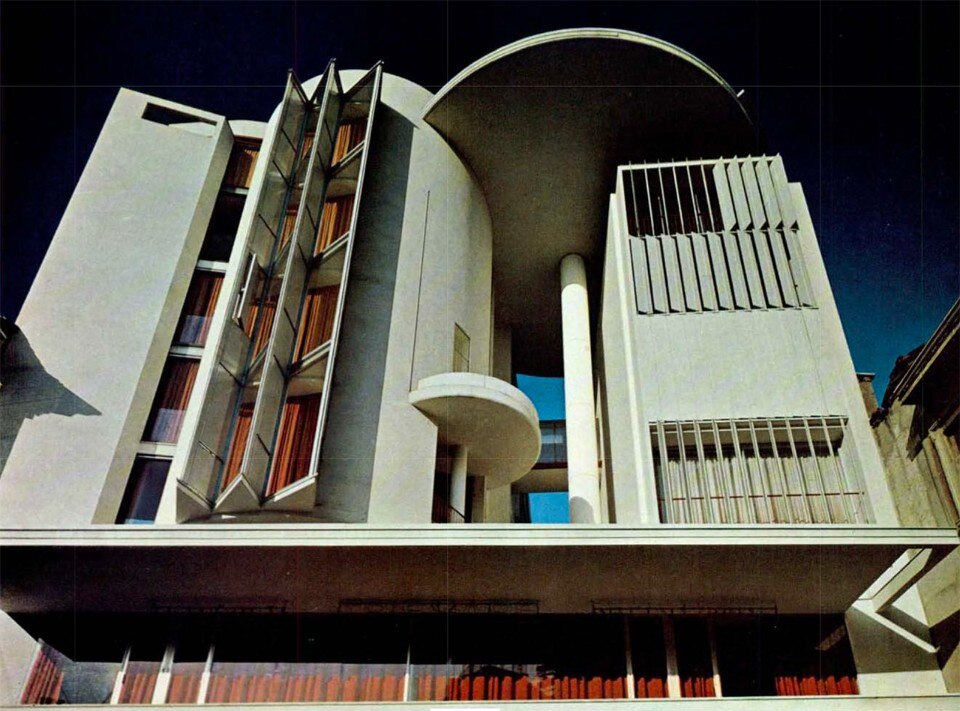
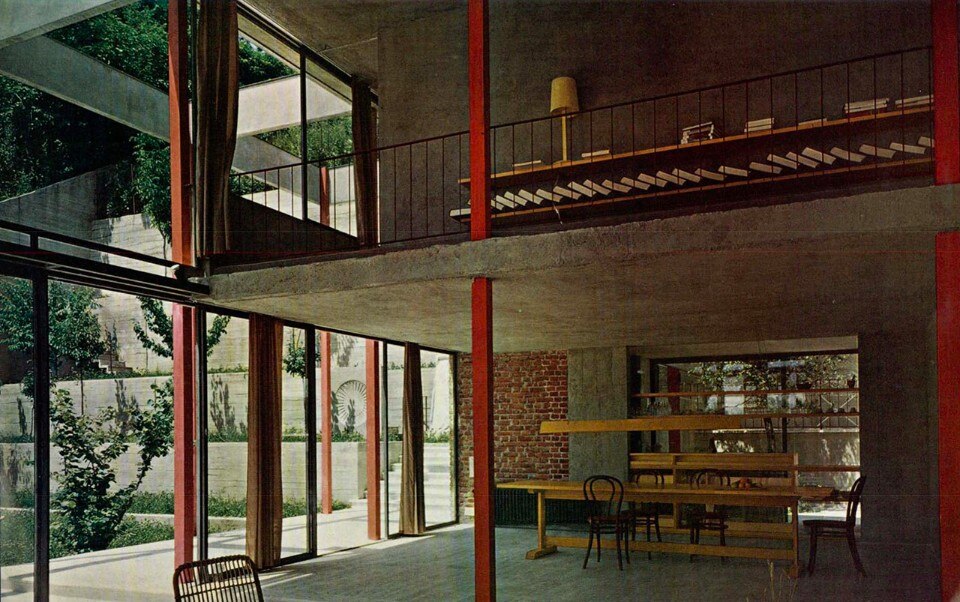
The cover moment matters because it reveals how Moretti was being framed at the time: not as a regional technician, but as an architect of impact. Domus did not treat him as someone adding another object to the city. It treated him as someone changing the way the city might be read.
L’Aquilone arrives a few years later with a different tone, but with the same underlying intelligence. The circular organization is not a visual trick. It is a social strategy. It eliminates leftover space and creates a sense of equality among the rooms. No classroom becomes a dead end. No child is pushed to the margins of the plan. The central commons keeps collective life visible and accessible. The building makes a case for education as a shared spatial condition rather than a sequence of enclosed lessons.
A LEAP IN SCALE
At precisely the moment Moretti produced one of the most sensitive civic works of his generation, his imagination was expanding beyond the scale of a single building. In 1976, he proposed a radical reconfiguration of Milan through spiral residential towers rising to roughly 250 meters, lifting habitation into the air and freeing the ground plane for landscape, circulation, and shared systems. Domus presented these proposals as an argument for living above, a diagram in which the city’s base is not surrendered to traffic but reorganized as common terrain.

Moretti described this approach as salto di scala, a leap in scale. It signaled a refusal to treat architecture as the design of isolated objects. Housing, infrastructure, movement, and environment were to be thought together, at a territorial level. His proposals belonged to the broader megastructural mood of the time, yet they remained rooted in the realities of metropolitan growth and civic strain.
In 1977, his final major appearance in Domus extended this thinking toward historic centers, imagined not as frozen scenes but as adaptable structures inside a wider regional city-territory. Preservation, in this view, was not the opposite of change. It depended on forms capable of accommodating change without cultural amnesia.
WHY HE FADED
Moretti’s disappearance from international attention after the late 1970s follows a familiar pattern. His practice remained largely regional, grounded in Lombardy rather than amplified through the global circuits of commissions and institutions that tend to sustain reputations. The discipline’s focus shifted. As postmodern approaches gained ground, the futurist confidence of megastructures became easy to dismiss, especially under the economic constraints that followed the oil crisis. The editorial world moved on, and with it, a certain kind of visibility.
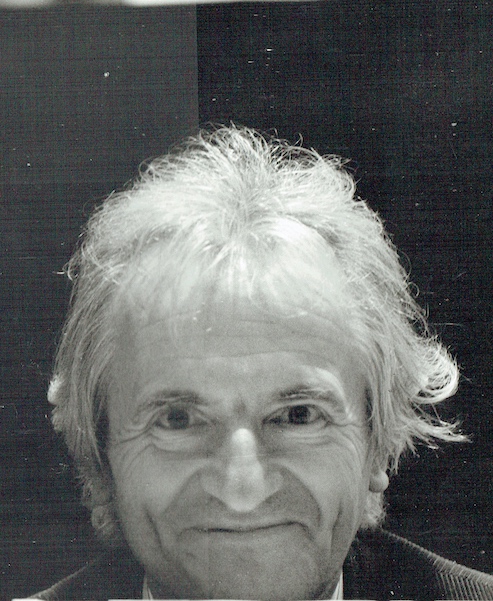
Work continued. Locally, Moretti did not vanish. His buildings remained in use, embedded in daily life, and his name endured within civic and professional circles. In recent years, renewed interest has surfaced through archival attention and local media, including public appearances in 2025, when he was 94, reflecting on architecture’s uneasy relationship with time and history. The tone is not one of grievance. It reads more like a late-career insistence that the discipline rarely catches up to the lives it claims to shape.
WHY MORETTI FEELS CONTEMPORARY AGAIN
Moretti’s relevance today does not depend on nostalgia. It depends on the return of his questions. Cities are again confronting ecological limits, infrastructural overload, and the need to reconsider the relationship between ground, dwelling, and public space. The ambition behind salto di scala, however unbuildable some proposals may have been, appears newly legible as a form of systemic thinking rather than formal spectacle.
At the other end of the scale, L’Aquilone speaks directly to contemporary attention on care infrastructures and childhood environments. It shows how architecture can support education not through didactic form, but through spatial generosity and an ethic of openness. The building’s continued use suggests that projects designed with clear social intelligence can age without becoming obsolete.
Carlo Moretti never achieved the canonical status of Italy’s most celebrated post-war figures, nor the global institutional reach that turns a career into a brand. Yet his work occupies a distinct place in the post-war Lombard landscape. It moves fluently between intimate civic care and territorial ambition, between built reality and speculative projection. His story is not simply about being overlooked. It shows how architectural culture selects, forgets, and then, sometimes, returns when the world catches up to the questions a body of work was already asking.
To rediscover Moretti now is not only to restore a name. It is to reopen a chapter of Italian architecture where concrete could be both tender and radical, where a kindergarten could carry a civic argument, and where the city was still treated as a collective project worth redesigning at the scale of its systems.
Photo Cover
Exterior view of the “Meteorites in Gallarate” housing block on Via Mazzini, a bold concrete insertion in the urban fabric (1971). Photo by Bert Richner, via Domus magazine.
Sources
Domus archive (1966–1977), Domusweb, Lombardia Beni Culturali, institutional school records, Rete55 (2022), ilBustese.it (2025).