Now Reading: Wiki World designs red timber cabin as bridge across water in Zhengzhou
- 01
Wiki World designs red timber cabin as bridge across water in Zhengzhou

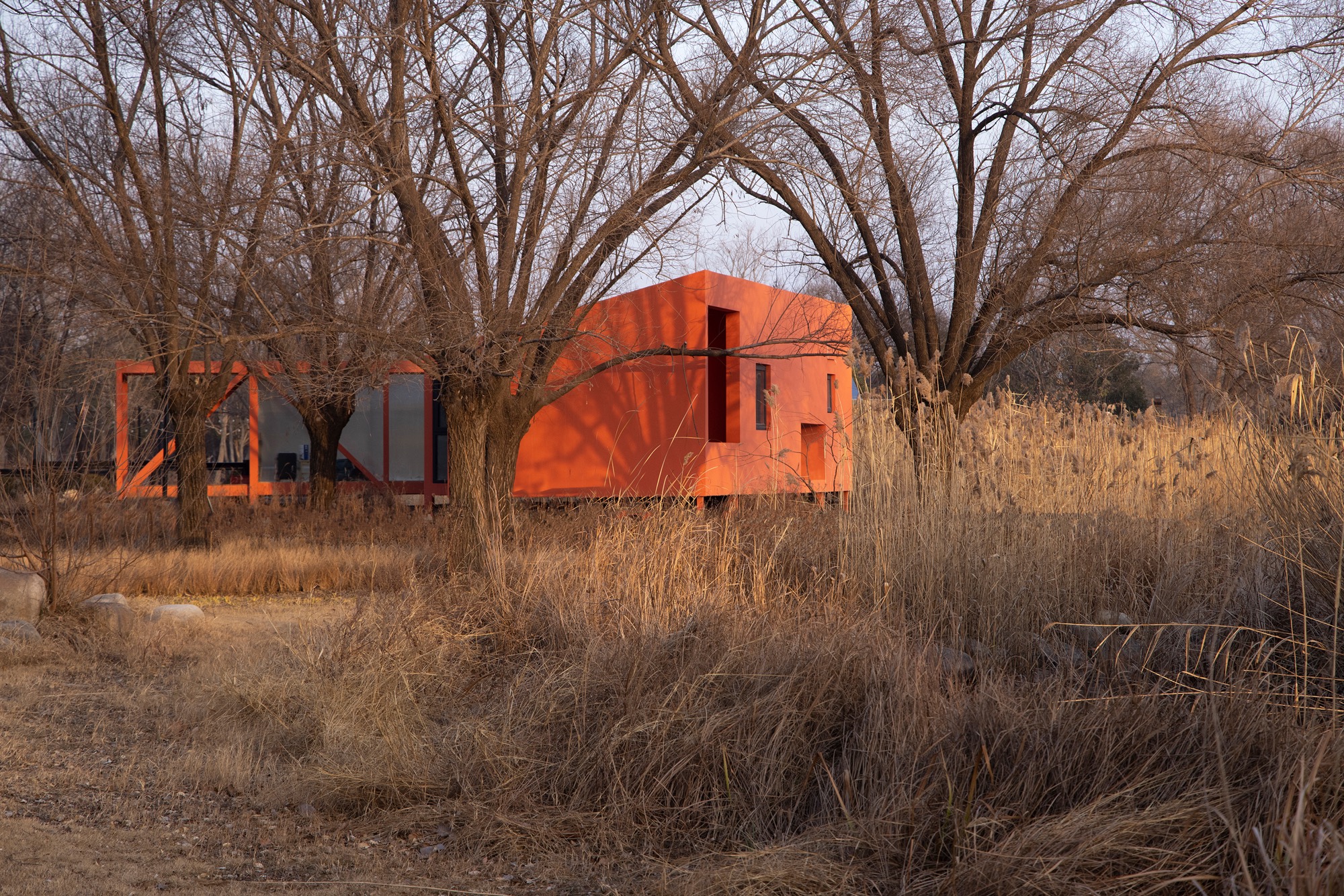

Set within the layered terrain of Yuancheng Cultural Park in the Zhengzhou Airport Economy Zone, Red Bridge Cabin by Wiki World unfolds as a precise yet poetic intervention, where architecture operates less as an object and more as a condition of transition. Built upon the site of the Yuanling Ancient City, the project situates itself within a landscape shaped by memory, archaeology and contemporary leisure, negotiating a delicate balance between preservation and new inhabitation. Rather than asserting a formal presence, the cabin emerges as part of an ongoing inquiry into how minimal architecture can recalibrate the relationship between body, environment and time.


The project begins with a simple inversion that shifts the role of architecture entirely. Instead of functioning as a destination, the cabin becomes a path. Positioned on a small island, it extends outward to meet the land, transforming itself into a bridge that carries both movement and meaning. The act of arrival is stretched into a spatial sequence, where a narrow corridor wrapped in translucent glass guides the body across water.


Light is filtered, perception is softened, and the passage gradually detaches the visitor from the external world. In this moment, architecture becomes a threshold rather than a boundary, recalling the spatial logic of the covered bridge and the pier while resisting fixation into a single typology. It is at once infrastructure and dwelling, an inhabited transition between the noise of daily life and the stillness of the wilderness.

Elevated lightly above the ground and wrapped in a muted red envelope, the cabin appears suspended within the landscape, its presence both distinct and elusive. Inside, the architecture dissolves into a layered field of conditions. Timber surfaces construct a warm and tactile interior, while translucent façades blur the edges between inside and outside. The surrounding environment is not framed as a distant view but absorbed into the spatial experience through calibrated openings and diffused light.


Two internal courtyards and a large skylight introduce an inward landscape, allowing air, light and seasonal change to penetrate the core of the dwelling. The interior becomes less a contained volume than a porous system, where enclosure and openness coexist. Comfort and wilderness, immersion and detachment, remain unresolved, forming an ambiguous spatial condition that resists clear definition.


At just 79 square metres, the cabin deliberately moves away from conventional measures of domestic efficiency. Scale is redefined as proximity rather than size. The compactness of the space intensifies the relationship between body and material, bringing surfaces, textures and sounds into close contact with everyday life. Living is no longer framed as occupation but as awareness, where small gestures and subtle sensory experiences become central. The project suggests that dwelling can be understood as an act of attentiveness, in which architecture amplifies rather than neutralises the presence of the environment.


This sensitivity extends into the logic of construction. The building is realised through a fully prefabricated timber system, with each component digitally modelled and precisely fabricated. Glue laminated timber and Chilean radiata pine form the structural and interior framework, assembled through a dry process that ensures both accuracy and reversibility. The cabin is lifted above the ground, preserving the existing terrain, vegetation and water systems, while eliminating the need for artificial landscaping or enclosure. Nature is not treated as context but as the primary envelope of the project.


Construction itself becomes a collaborative act. Developed by Wiki World and assembled together with users, the system relies on small metal connectors that allow for disassembly and reuse. The façade, composed of carbonised timber boards, is treated through controlled burning, enhancing durability while maintaining the raw tactility of the material. In this approach, architecture is not imposed upon the site but carefully positioned within it, establishing a relationship that is both precise and temporary.


Red Bridge Cabin continues Wiki World’s broader exploration into alternative modes of living, where architecture is defined not by permanence or typology but by its capacity to engage with environment, memory and experience. As both bridge and dwelling, object and landscape, the project proposes a form of inhabitation that is fluid, transitional and deeply embedded in its surroundings, suggesting that architecture can operate as a continuous negotiation between movement and stillness, between the human body and the wider ecological field it inhabits.
Project Credit
Project Name: Red Bridge Cabin [Wild Home #138]
Location: Zhengzhou Airport Economy Zone, Henan Province, China
Completion Year: 2026
Floor Area: 79 m²
Design Firm: Wiki World / @wiki__world, Advanced Architecture Lab + United Investment Merryda Hotel Management Group
Photo: Arch Exist / @archexist, Xhot
Illustration: Wang Yuanying
More Photos