
Now Reading: No trace, no guarantees: Burning Man at the edge of its own myth
- 01
No trace, no guarantees: Burning Man at the edge of its own myth

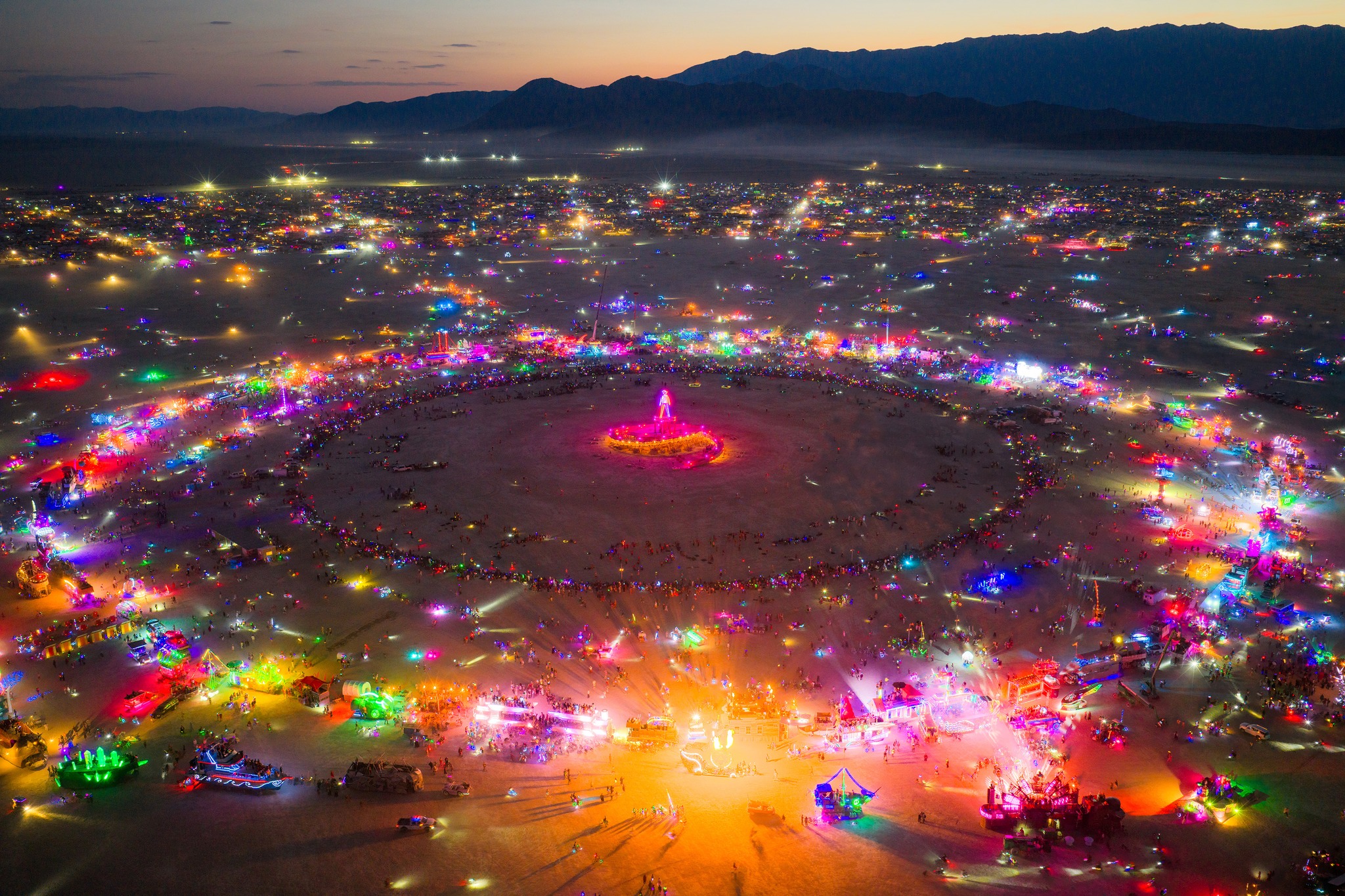

The horizon in Nevada’s Black Rock Desert does not behave. In minutes, a clean line can dissolve into a whiteout, when alkaline dust lifts and the sun turns flat, as if someone has pressed it behind frosted glass. The ground is an ancient lakebed. It is pale, hard, and indifferent. And yet, for a short stretch of late summer, it becomes a city in the most literal sense: a place planned, built, staffed, inhabited, and then dismantled.

That city is Black Rock City. It is assembled by participants and operates on a calendar that folds into Labor Day. In 2025, the event ran from August 24 to September 1. The population changes with permits and counting methods, but the scale is consistently immense, reaching well beyond seventy thousand people when the city is fully awake. Commerce is intentionally kept at the margins, not because money ceases to exist, but because the culture tries to prevent it from becoming the default language between strangers. The most visible sanctioned exception is ice, sold through Arctica, with proceeds directed toward local community causes.
At the center, the Man stands as both landmark and fuse. It is tempting to describe the burn as pure ritual, and many people experience it that way, but the ritual rests on infrastructure. The city has streets, a plan, services, safety systems, and a governance architecture that must function under real constraints. Burning Man’s utopian aura is not a retreat from logistics. It is an experiment built out of them.

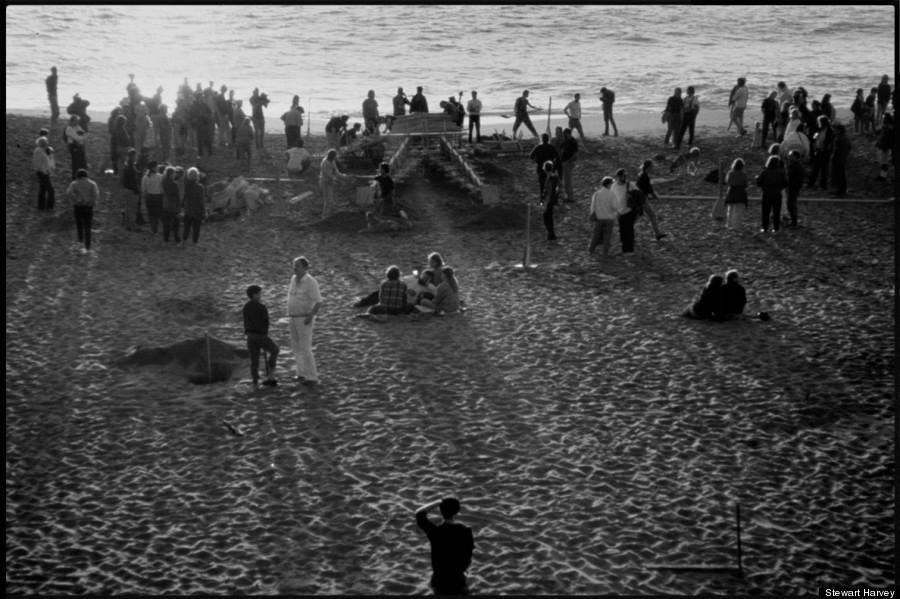
The origin story, by contrast, is almost absurdly small. In 1986, Larry Harvey and Jerry James burned a rough wooden figure on Baker Beach in San Francisco during a solstice gathering. The gesture was intimate and improvised, closer to a bonfire myth than an institution. But it grew quickly, and growth brought friction. By 1990, the event could no longer remain on the beach. That year it shifted decisively in place and identity, moving to the Black Rock Desert and aligning with Labor Day weekend, influenced by the San Francisco Cacophony Society. The first year in the desert drew around ninety participants. The change mattered less as a relocation than as a declaration. The desert offered room, and room invited invention without immediate consequence to neighbors, permits, and city limits.
Over time, Burning Man developed an aesthetic that is best understood as permission made visible. A camp might serve pancakes at dawn, not as a transaction, but as a gift. Another might host an earnest talk on sustainability and become, without apology, a dance floor by midnight. Art cars cross the playa like mobile architecture, engineered into beasts, ships, or improbable machines that are less about transportation than about making movement communal. The city’s signature material is participation, because everything that looks effortless on the surface is held up by people doing work. They build shade, repair structures, haul water, coordinate schedules, staff services, and solve problems that do not appear on postcards.


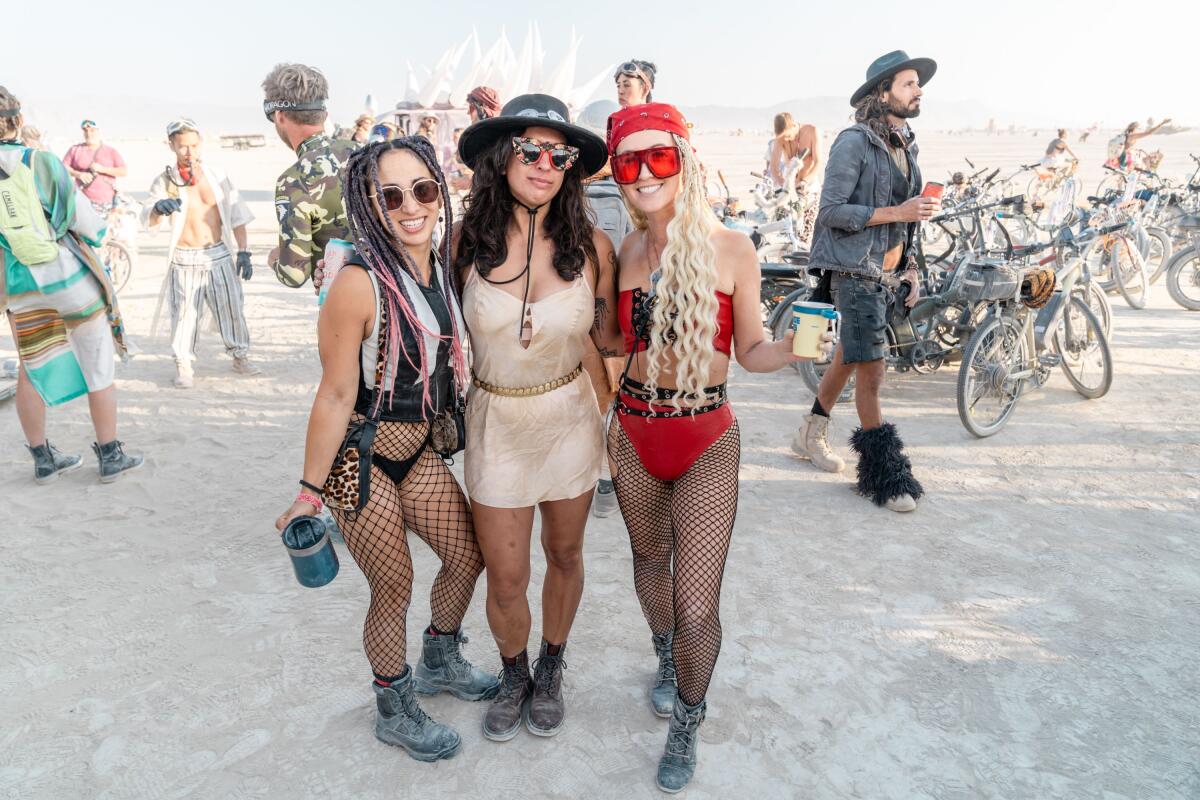

A culture that travels this far and grows this large eventually needs a language that can survive repetition. In 2004, Harvey articulated what became the Ten Principles, initially as guidance for the Regional Network. The principles read like an ethics of temporary society, but they also function like operating instructions. Radical inclusion sets the tone of entry. Gifting shifts social exchanges away from bargaining. Decommodification resists the gravitational pull of branding and sponsorship. Self-reliance and self-expression establish the expectation that personal preparation and personal voice are not luxuries. Communal effort and civic responsibility address the basic fact that a city cannot run on individualism alone. Participation refuses the idea of spectatorship. Immediacy pushes people toward presence rather than documentation. Leave no trace becomes both moral claim and measurable task.
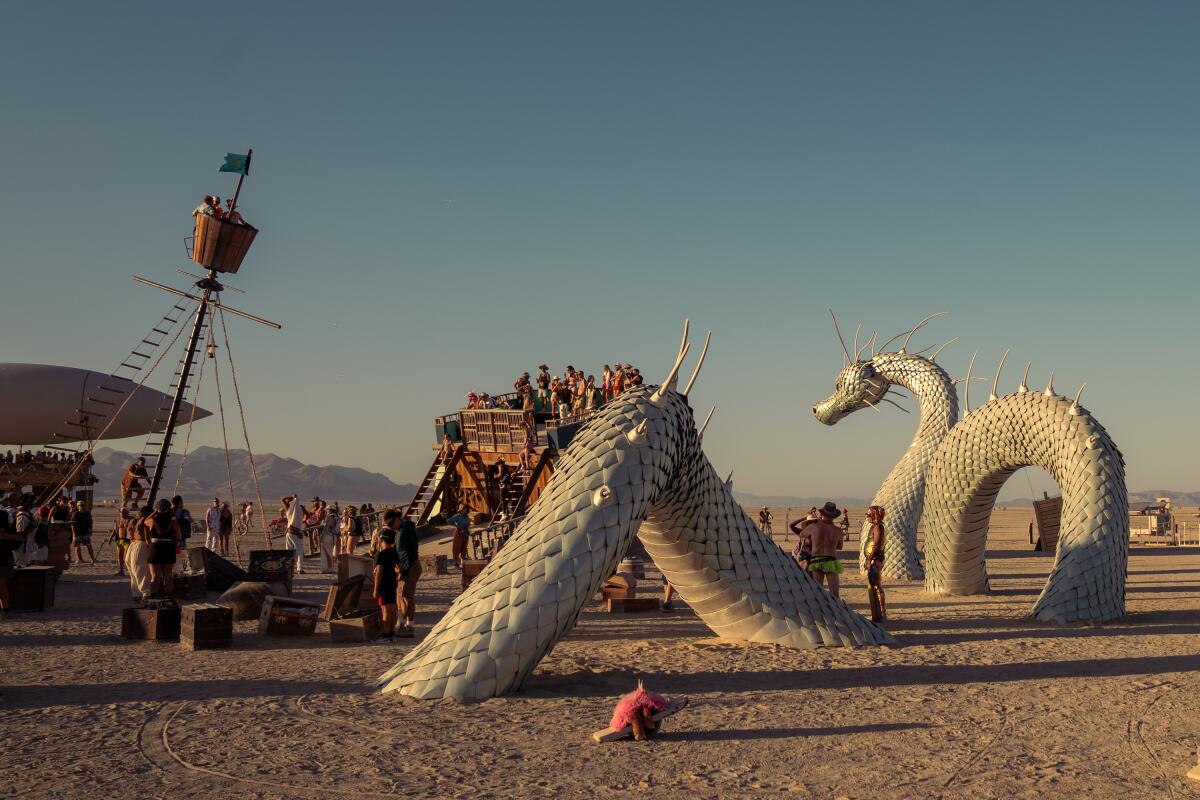
The desert forces these ideals to become practical. Days can burn, nights can drop, and storms can erase orientation. Under those conditions, the difference between a slogan and a rule becomes obvious. A “money-free” city sounds romantic until you understand what replaces money in daily life. Water must be planned. Shade must be built. Food must be stored. Medical contingencies must be considered. Navigation matters. Humility matters, because the environment does not negotiate. The Ten Principles, at their most persuasive, do not describe perfection. They describe the behaviors required for a fragile city to hold.
This is where the Temple enters as a kind of emotional civic infrastructure. If the Man is spectacle, the Temple is counterweight. People leave letters, photos, and names. They write what they cannot say anywhere else, then trust a temporary building to hold it. When the Temple burns, the atmosphere changes. The crowd becomes quieter. The fire feels less like climax and more like release. It is one of the clearest reasons Burning Man cannot be reduced to celebration. It makes space for grief and gratitude as part of public life, as if the city’s purpose were not only to entertain its inhabitants, but to absorb what they carry.


Still, any utopia that is staged in real time inherits real vulnerabilities. Burning Man’s 2025 theme was “Tomorrow Today,” a prompt to treat the future not as a distant idea but as something built through present action. The week, however, delivered a version of immediacy that no theme can control. Dust storms and high winds disrupted camps and forced officials to pause flights and close gates at points while urging people to shelter in place. An electrocution incident required emergency response. A baby was reportedly born on site. Most starkly, authorities opened a homicide investigation after a man was found dead during the event’s final night. None of these moments cancel the experience, but they puncture a convenient fantasy, the notion that a city can suspend the world by collective will.
The desert does not reward good intentions. Budgets do not either. In recent years, the nonprofit Burning Man Project has been open about financial strain, describing shortfalls, fundraising pressure, and rising costs that are not easily matched by ticket revenue. What makes the situation difficult is not only economics, but ideology. Sponsorship conflicts with decommodification. Merchandising cannot become a simple lifeline without changing the culture it would be supporting. The event’s appeal is inseparable from its complexity. A city with this scale and this responsibility costs money to run, even when its mythology insists that commerce should not set the terms of belonging. The result is a tension that feels structural, like a building that wants to remain light and open while carrying loads that increase every year.
Environmental questions add another layer. “Leave no trace” can be measured in cleanup standards on the ground, but it does not erase the broader footprint of travel, energy, temporary construction, and waste. Burning Man is expert at disappearance as performance. It cannot fully disappear from the climate ledger, and that contradiction has become harder to ignore as weather grows more volatile and public scrutiny intensifies.
And still, people return, which suggests that the event’s value lies elsewhere than in its claims of purity. Burning Man is not a perfected society. It is a prototype, a high-intensity demonstration that public space can be built quickly, lived in intensely, and dismantled with care. It resembles a civic rehearsal more than a festival, because it teaches through strain. It shows what cooperation looks like when it is not optional. It reveals what a city becomes when participation is an expectation rather than a slogan.
That is why the themes matter, even when they risk sounding like advertising. In October 2025, Burning Man announced its 2026 theme, “Axis Mundi,” a reference to the world axis or cosmic tree that links earth and sky across many mythic traditions. It is a flattering metaphor for a city built on connection, but it also points toward something more concrete. Burning Man’s most durable structure is not the Man, nor the Temple, nor any art piece hauled into the desert by cranes. The durable structure is agreement, the collective decision to behave as citizens of a temporary place.
After the burn, Black Rock City is dismantled. Rebar is pulled. Shade structures come down. Streets return to blank playa. Lights collapse back into darkness. What remains is not the promise that the desert will be pristine, or that the experience will stay untarnished, or that the myth will remain intact. What remains is the harder question the event now faces more openly than before. Can it sustain itself financially, environmentally, and culturally without becoming the opposite of what it claims to be?
Burning Man has never offered a stable answer. It offers a temporary one. That impermanence may be its most honest form, because it does not allow anyone to confuse an experiment with a solution. It asks what we do with a city we can build, and what we learn when it disappears, while the dust is still in the air.
Photo Cover
Aerial view of Black Rock City illuminated at twilight, capturing the immense scale and layout of the temporary desert metropolis. Photo via Burning Man official Facebook post.