Now Reading: Lynx drone station imagines a high altitude network for rescue missions and eco tourism
- 01
Lynx drone station imagines a high altitude network for rescue missions and eco tourism

Lynx drone station imagines a high altitude network for rescue missions and eco tourism

Ukrainian architect Sanina Arch Club has unveiled Lynx, a conceptual drone station designed to support search and rescue operations while doubling as a new form of public infrastructure in remote mountain landscapes.

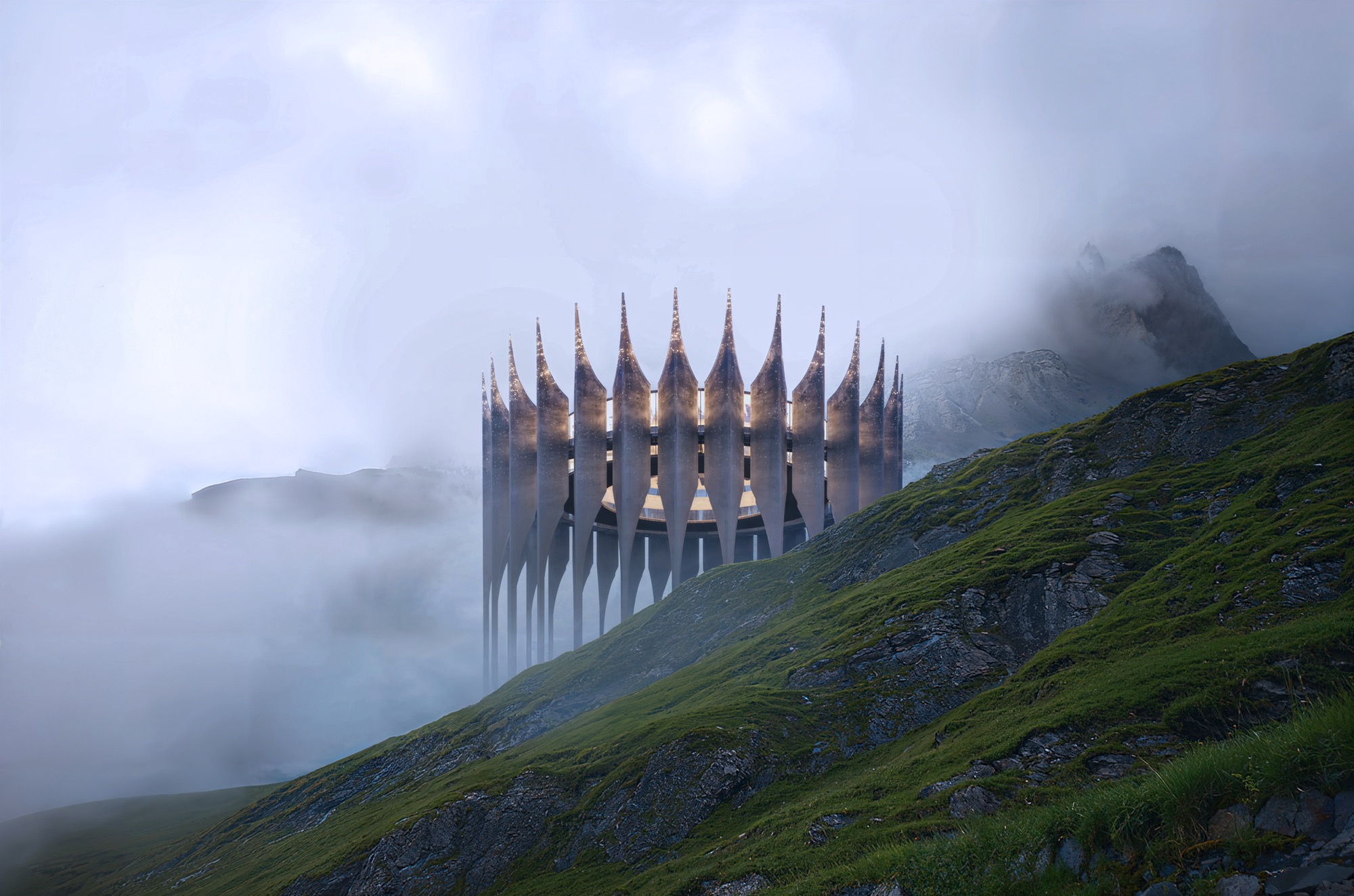
Conceived as a distributed network rather than a single building, Lynx proposes a series of autonomous outposts positioned across hard to reach terrain, including the Carpathian Mountains, the Alps and the Pyrenees. The project explores how drones, architecture and landscape might operate together as part of a shared high altitude ecosystem.
Each station is imagined as a hub for drone storage, charging, maintenance and flight coordination. Alongside its technical role, the circular structure incorporates spaces accessible to visitors, ranging from observatories and research facilities to viewing terraces, media libraries and compact accommodation. By combining infrastructure with public programmes, Lynx positions the drone station as an architectural destination rather than a purely functional object.


Linked into a single digital system, the stations would monitor environmental conditions, support hiking routes and coordinate emergency responses across wide territories. Service drones are designed to deliver water, food and medical supplies to remote mountain segments, while a separate fleet of passenger drones could offer sightseeing flights. Visitors would interact with the system through a mobile application providing route guidance, weather updates and an integrated SOS function.
Architecturally, Lynx adopts what Sanina describes as a gothic futurist aesthetic, combining monolithic concrete forms with lightweight glazing. The building is organised as a series of concentric rings that reference ancient defensive fortresses, while a serrated perimeter wall forms vertical peaks that echo the surrounding ridgelines.
The structure is conceived using a composite material that blends concrete with dispersed glass inclusions. This material shifts gradually from dense and opaque at the base to increasingly translucent towards the upper levels, creating a visual gradient that makes the building appear to dissolve into the sky. Embedded microscopic glass particles refract light across the façade, producing a crystalline sheen that changes throughout the day in response to sunlight and cloud cover.

Energy autonomy is central to the concept. Photovoltaic cells integrated into the glass panels turn the envelope into an energy generating skin, while additional solar panels on the roof supply power for drone charging and internal systems. Inside, a glass clad volume opens onto panoramic views of the surrounding landscape, deliberately blurring the boundary between interior and exterior.
The project responds to the growing pressures placed on mountain environments by tourism and climate instability. In the Ukrainian Carpathians alone, more than five hundred rescue missions were recorded in 2024, often requiring complex and resource intensive operations. Sanina argues that drones can provide a faster and safer alternative, capable of surveying large areas in minutes, detecting thermal signatures and delivering urgent supplies.

Lynx also reflects Ukraine’s rapid innovation in unmanned aerial systems, accelerated by recent wartime technological development. According to Sanina, the necessary conditions already exist, from established aerial routes to a large pool of skilled operators. The project seeks to redirect this technological capacity toward rescue, care and human wellbeing.
By framing drones as part of a broader ecological and humanitarian infrastructure, Lynx imagines a future in which drone stations become as commonplace in mountain regions as shelters or viewpoints. Through its combination of landscape driven design and advanced technology, the concept proposes a new model for safer and more adaptive mountain environments.
Project Credit
Project name: Lynx
Design firm: Sanina Arch Club / @saninaarchclub