Now Reading: i-ypszilon: Intersections of Memory, Space, and the Hungarian soul
- 01
i-ypszilon: Intersections of Memory, Space, and the Hungarian soul

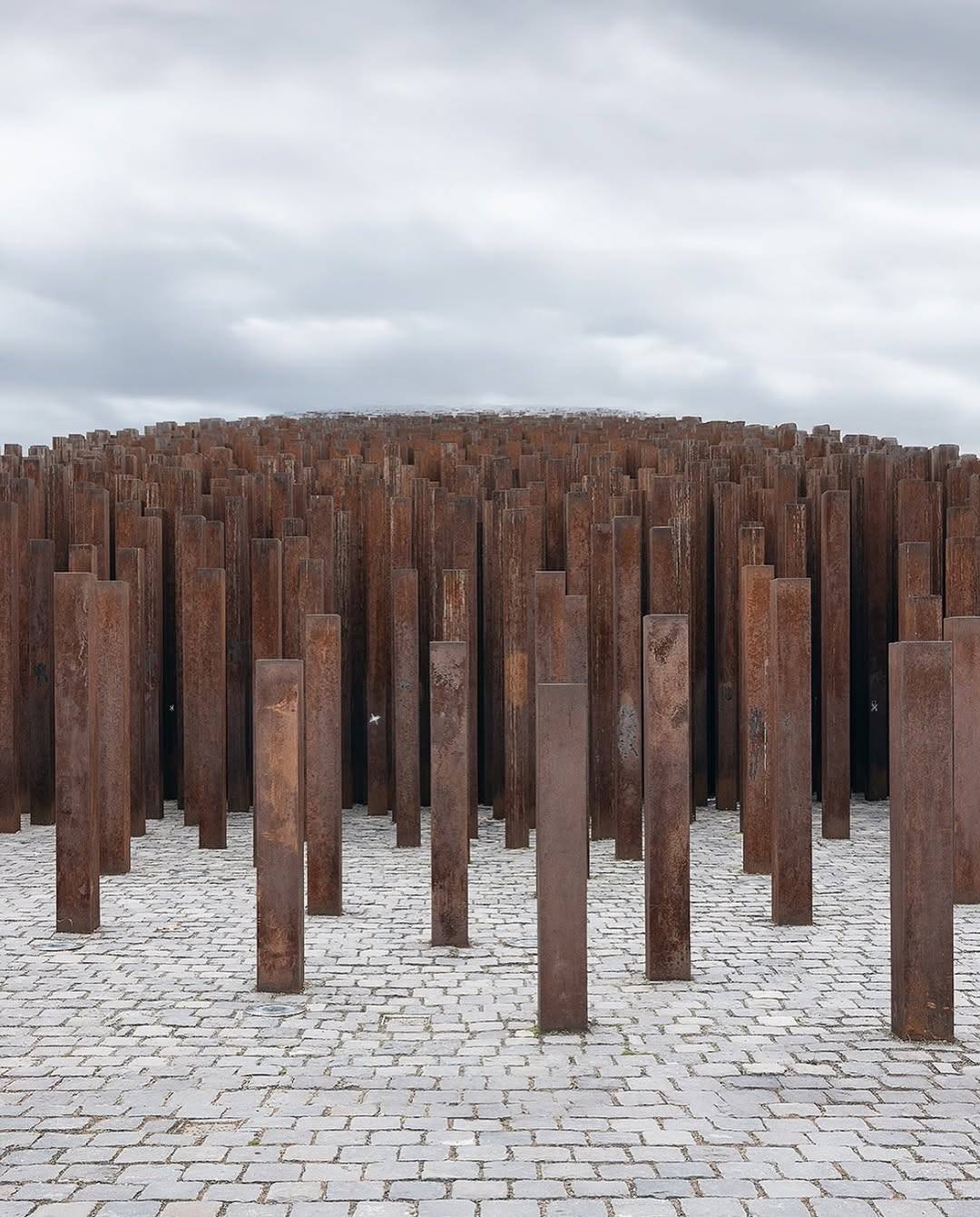

In the open air of Budapest’s Ötvenhatosok tere, Parade Square, the Central Monument of the 1956 Hungarian Revolution does not rely on heroic mass. It gathers as a field: a long, tapering terrain of steel columns set into a square plinth, inviting the body to enter and to move. You do not stand before it so much as step into its logic.

From a distance, the work reads as a wedge drawn through the plaza. Up close, the wedge breaks into verticals. The columns begin low and far apart, weathered in tone. As you advance, the grid tightens. The steel grows brighter, more uniform, and the spacing narrows until the field congeals into a single, dense blade. The work reads in sequence, not at a glance. Its meaning forms through passage, through the shift from one density to the next, through the way your pace begins to sync with repetition.
Completed in 2006 for the fiftieth anniversary of the uprising, the monument was designed by i-ypszilon, a collaborative group founded in early 2005 by architect Tamás Emődi-Kiss, artists Kata György and Csaba Horváth, and architect Tamás Papp, also known as Dósa-Papp Tamás. The group ended its collective creative activities in 2012. Their method sits between architecture and fine art, but the project’s ambition is less about hybridity than about stance: how to build a public work in a city where history is remembered and continually contested.
A MONUMENT YOU ENTER ON FOOT
The monument’s premise is simple and exacting. A forest of steel columns tightens and rises along the work’s axis, transitioning from rusted, human-scale elements to a consolidated stainless steel mass at the front. The designers trace the project back to photographs of students marching from the technical university to the statue of Józef Bem on 23 October 1956. Rather than depicting that scene, the monument translates its structure into space: solidarity as alignment, as proximity, as a body moving with other bodies.


The field is not fully penetrable. There is an engineered limit to access. You can walk among the columns only so far before density becomes refusal. That threshold matters. It preserves the wedge’s solidity while still granting an embodied encounter. You move between uprights that alternately open and close, like a crowd dispersing and reforming. The monument becomes a choreography of approach and compression, a passage from scattered to bound.
But the data is not the point. The point is how the work behaves under the body.

ABSTRACTION AS AN ETHICAL STRATEGY
In Hungary, memorial form is never merely formal. Public monuments are repeatedly pulled into the orbit of cultural alignment: which events are emphasized, which are framed as destiny, which are edged into silence. Against that background, the refusal of figurative heroics reads as an ethical choice. This monument does not tell you whom to admire. It does not offer a single scene to accept. It offers structure, rhythm, and time.
Participation here is not a gimmick. It is a demand placed gently on the visitor: to walk, to choose distance, to accept that the work changes as you move. Trauma is rarely recalled as one stable image. It returns in fragments, in repeated exposures, in sensations that reorder the present. The columns, repeated, become less a motif than a temporal device.
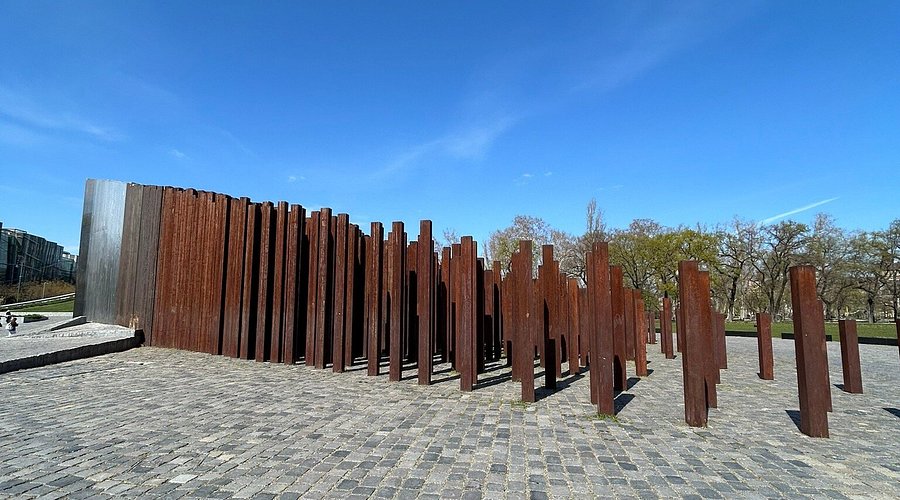
Material reinforces the argument. Steel is not neutral. It carries the language of strength and infrastructure, but also of weathering. The shift from darker, more corroded surfaces to brighter, more finished steel is not a simple narrative of redemption. It is more ambiguous than that. Time changes the way events are held. Public remembrance, like metal, acquires patina through touch, climate, and use.
The historical stakes remain sharp. The revolution that began on 23 October 1956 was eventually suppressed with force. Estimates vary, but historians commonly cite around 20,000 Hungarian casualties, including some 2,500 deaths, along with mass arrests and flight. The monument’s abstraction does not soften this. It sidesteps the habit of turning loss into theatre. Instead, it proposes a quieter provocation: if memory is to remain civic rather than ideological, it must allow for multiplicity, for the private weight carried by individuals and the public meaning negotiated in common.
I-YPSZILON AS A COLLECTIVE
i-ypszilon’s significance lies less in a signature style than in the clarity of a shared proposition: memory can be framed as experience rather than representation. The group states that the monument does not aim to illustrate history, but to make it possible for spectators to imagine themselves living through the events, so that remembrance can act upon the present.
The monument is often described in terms of coalescence: individuals becoming a crowd, a field becoming a blade. That reading is easy to romanticize, and the work resists by keeping its affect measured. It does not celebrate victory. It does not rest in pure lament. It holds a more difficult register: endurance, the uneasy persistence of memory in a public square, and the knowledge that civic space is never innocent.
AFTER THE COLLECTIVE
By 2012, i-ypszilon ended its collective activity. What remains is the monument, encountered not as an object, but as a sequence you pass through. It is a landscape of repetition that makes you aware of your own passage.
The members’ later paths diverged, but it is not necessary to turn this essay into four biographies to understand what i-ypszilon achieved here. The stronger measure of legacy is the standard the monument sets for public memory-making: abstraction that is not evasive, participation without performance, and a structural clarity that can outlast political mood.


THE CIVIC WORK OF REMEMBERING
The Central Monument of the 1956 Hungarian Revolution does not promise closure. It is not built as a finished statement. It is built as a condition: a spatial argument about how remembrance might be carried in public without becoming propaganda or spectacle.
Its wedge is not an icon. It is a device that compresses time into movement, low to high, open to dense, weathered to bright, entry to refusal. In a city where history is often staged in stone and bronze, i-ypszilon’s steel field proposes something harder and more generous. Memory, to remain civic, must stay negotiable. The body, not the pedestal, is where remembrance begins.
Between the columns, Hungary’s twentieth century is not simplified. It is kept present, alive, demanding, and uncomfortably human.
More photo from World Architecture Community