Now Reading: Glasshouse Theatre redefines the civic edge of Queensland’s cultural landscape
- 01
Glasshouse Theatre redefines the civic edge of Queensland’s cultural landscape

Glasshouse Theatre redefines the civic edge of Queensland’s cultural landscape

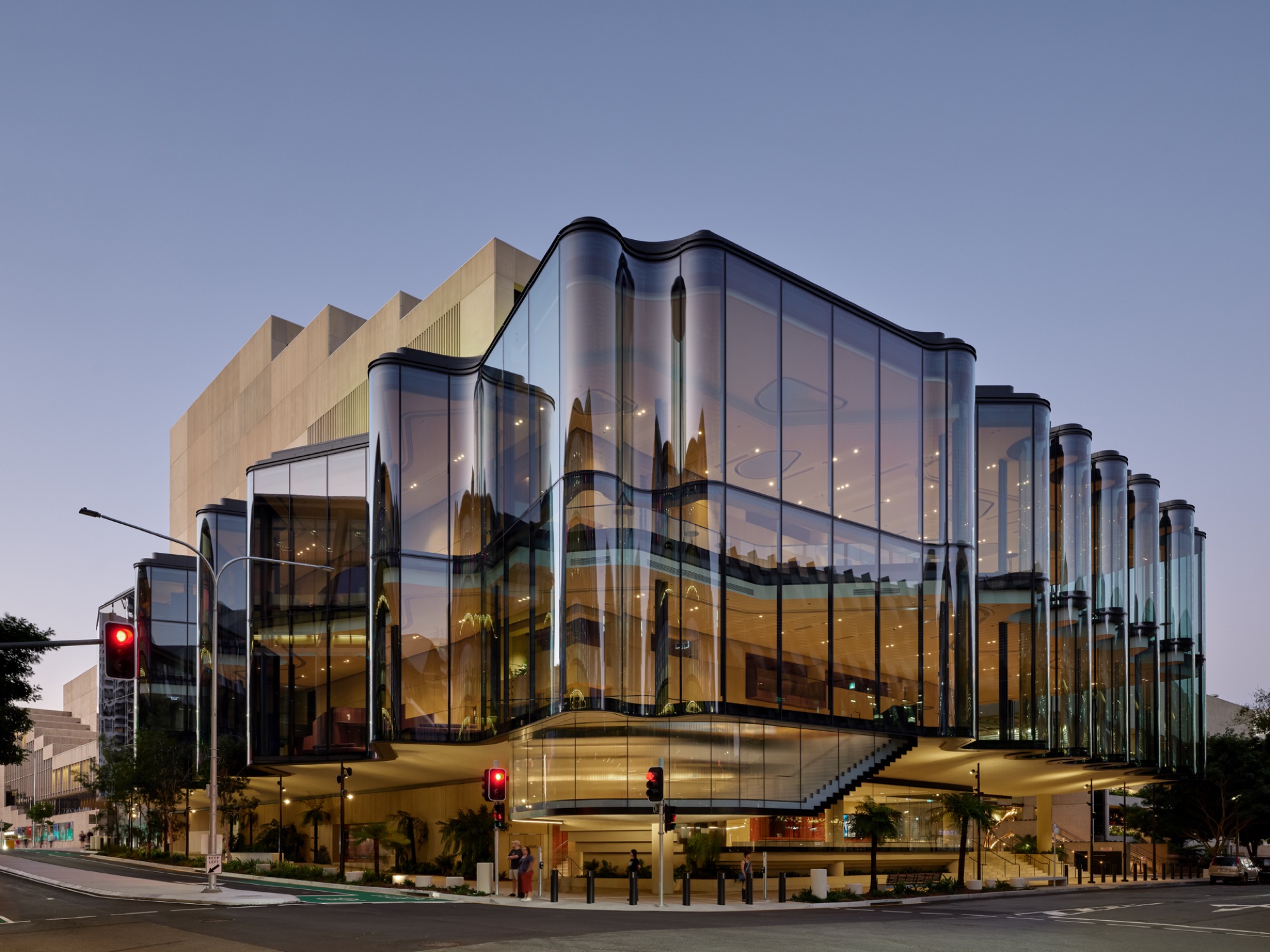
At the southern bank of the Brisbane River, the new Glasshouse Theatre emerges as both an architectural gesture and an urban proposition, reshaping how a major cultural institution meets the city. Conceived as an expansion of the Queensland Performing Arts Centre, the project extends beyond the logic of capacity, instead articulating a porous threshold between performance and public life.
Designed by Blight Rayner Architecture in collaboration with Snøhetta, the 1,500 seat theatre consolidates the precinct into the largest performing arts complex under one roof in Australia. Yet its significance lies less in scale than in its capacity to recalibrate the relationship between audience, architecture, and the surrounding urban fabric.

The defining element of the building is its undulating glass envelope, a surface that oscillates between reflection and transparency. Rather than presenting a fixed image, the façade performs as a dynamic interface, registering light, movement, and the presence of people within. From the street, the foyer becomes a stage in itself, where silhouettes blur and sharpen, dissolving the boundary between spectator and performer.
This fluid geometry draws from a prose poem by Aboriginal Elder and artist Lilla Watson, referencing the rippling surface of the Brisbane River. The building thus embeds cultural memory within its material expression, allowing Indigenous narratives to inform not only symbolic gestures but spatial experience.
Technically, the façade operates as a finely tuned environmental system. Composed of multilayered glass panels with integrated ceramic inlays, it filters solar gain while maintaining visual permeability. The result is a surface that negotiates between climatic performance and atmospheric depth, where light is both moderated and choreographed.

The theatre extends outward through a cantilever that projects over the existing Playhouse Green, its edge deliberately rendered transparent to minimise visual weight. This gesture aligns the new volume with the legacy of the Queensland Cultural Precinct, originally shaped by architect Robin Gibson, while simultaneously introducing a contemporary language of openness and accessibility.
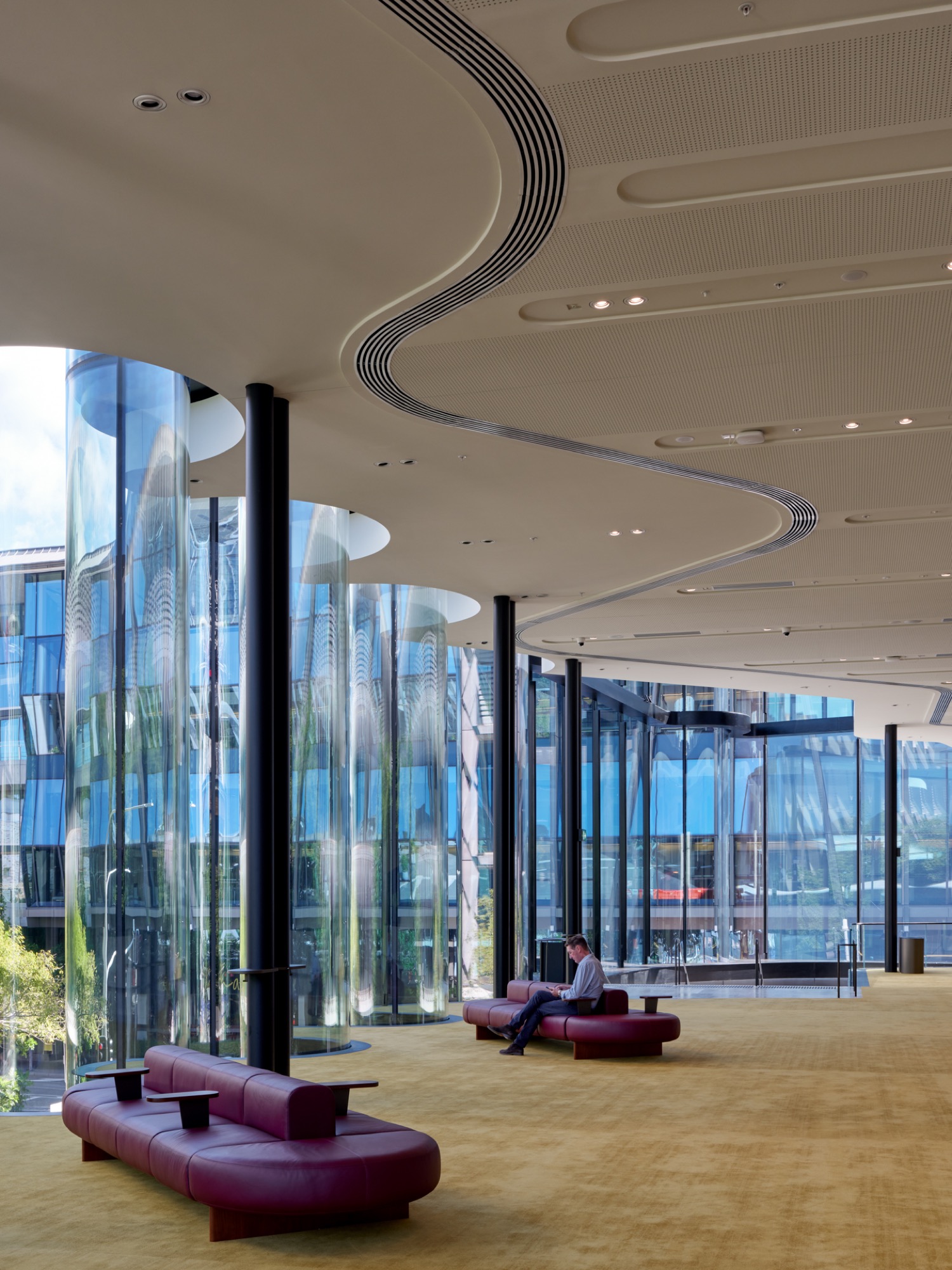
Within, the foyer spaces unfold as luminous volumes, animated by the shifting qualities of daylight filtered through the glass skin. These spaces are not transitional but programmatic, conceived as environments of gathering, encounter, and informal performance. The architecture positions culture not as an enclosed event but as a continuous urban condition.

In contrast to the light filled exterior, the auditorium withdraws into a more introspective atmosphere. Clad in dark ironbark and grounded by deep green tones, the space evokes a cocoon like enclosure, focusing attention on sound, proximity, and performance.
The geometry of the seating and balconies reinforces this intimacy. With a maximum distance of only 28 metres from stage to the furthest seat, the theatre maintains a sense of closeness rarely achieved at this scale. The configuration enables a shared acoustic field, where performers and audience remain perceptually connected.

Flexibility is embedded at every level. The auditorium operates as a calibrated instrument, capable of adapting to opera, symphony, theatre, and dance. A fully automated fly system and adjustable orchestra pit allow rapid transformation, positioning the building as an infrastructure for evolving cultural production rather than a fixed typology.

The project integrates layers of meaning through elements such as seven skylights representing the watersheds of Queensland, informed by research with First Nations knowledge holders. These gestures extend the architectural narrative beyond form, situating the building within a broader ecological and cultural continuum.
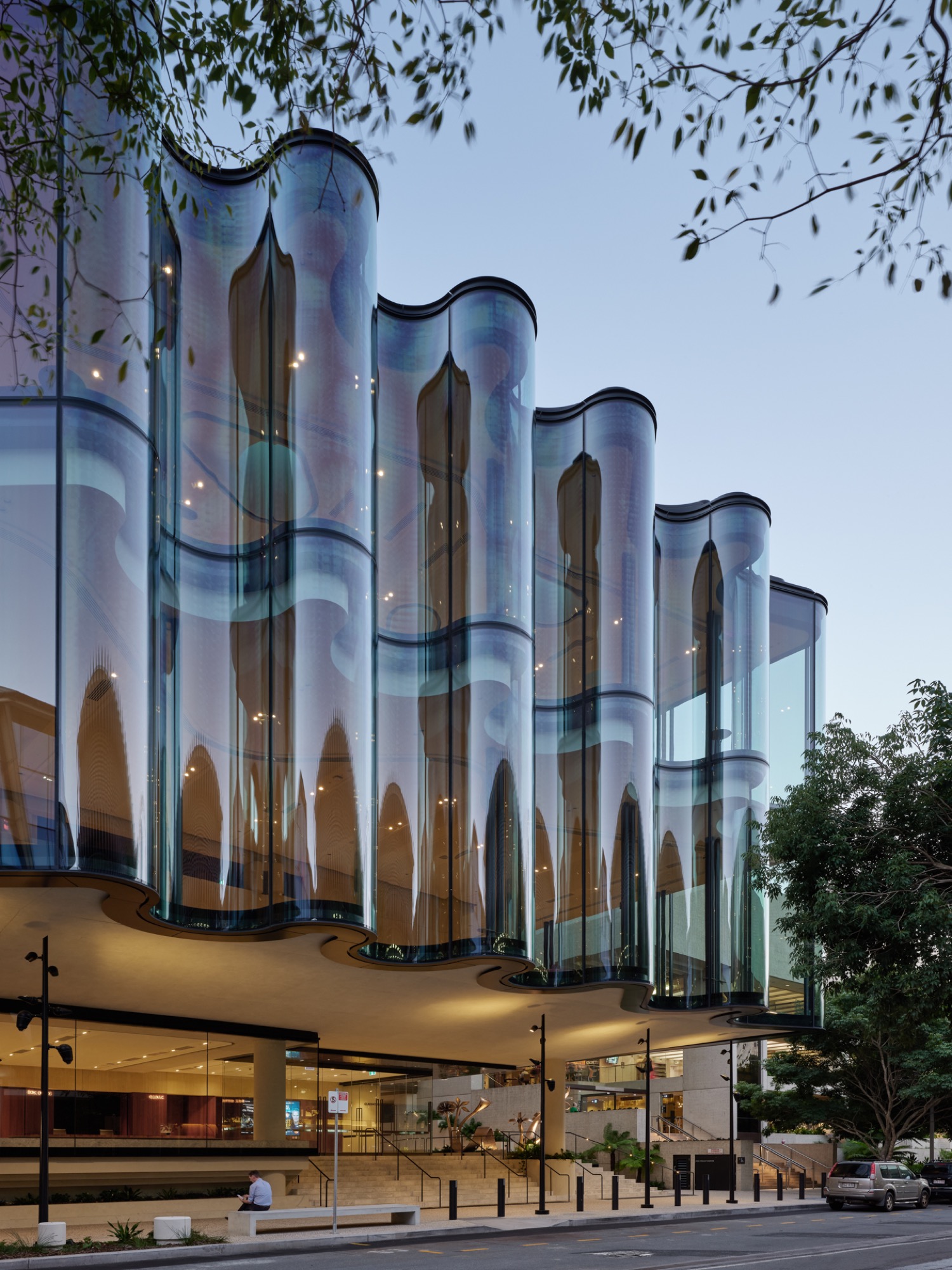
Artworks such as Floriate by Torres Strait Islander artist Brian Robinson further reinforce this dialogue, introducing botanical references that resonate with the regional landscape. The theatre becomes not only a site of performance but a vessel for storytelling, where architecture, art, and territory intersect.
The Glasshouse Theatre ultimately proposes a redefinition of the cultural building as an open system. Its architecture does not retreat into monumentality but engages in exchange, with the city, with climate, and with the diverse publics it hosts.
By foregrounding transparency, adaptability, and narrative depth, the project shifts the paradigm from a theatre as object to a theatre as condition. It is a place where performance extends beyond the stage, unfolding across façades, foyers, and the urban realm itself.
Project name: Glasshouse Theatre, Queensland Performing Arts Centre (QPAC)
Location: South Bank, Brisbane, Australia
Architects: Blight Rayner Architecture / @blightrayner, Snøhetta / @snohetta
Design Competition: Won in 2019
Completion: 2024
Seating Capacity: 1.500 seats
Photo: Christopher Frederick Jones / @christopherfrederickjones