
Now Reading: Mallol completes cedar pavilion beneath a curved roof in Panama’s coffee highlands
- 01
Mallol completes cedar pavilion beneath a curved roof in Panama’s coffee highlands

Mallol completes cedar pavilion beneath a curved roof in Panama’s coffee highlands

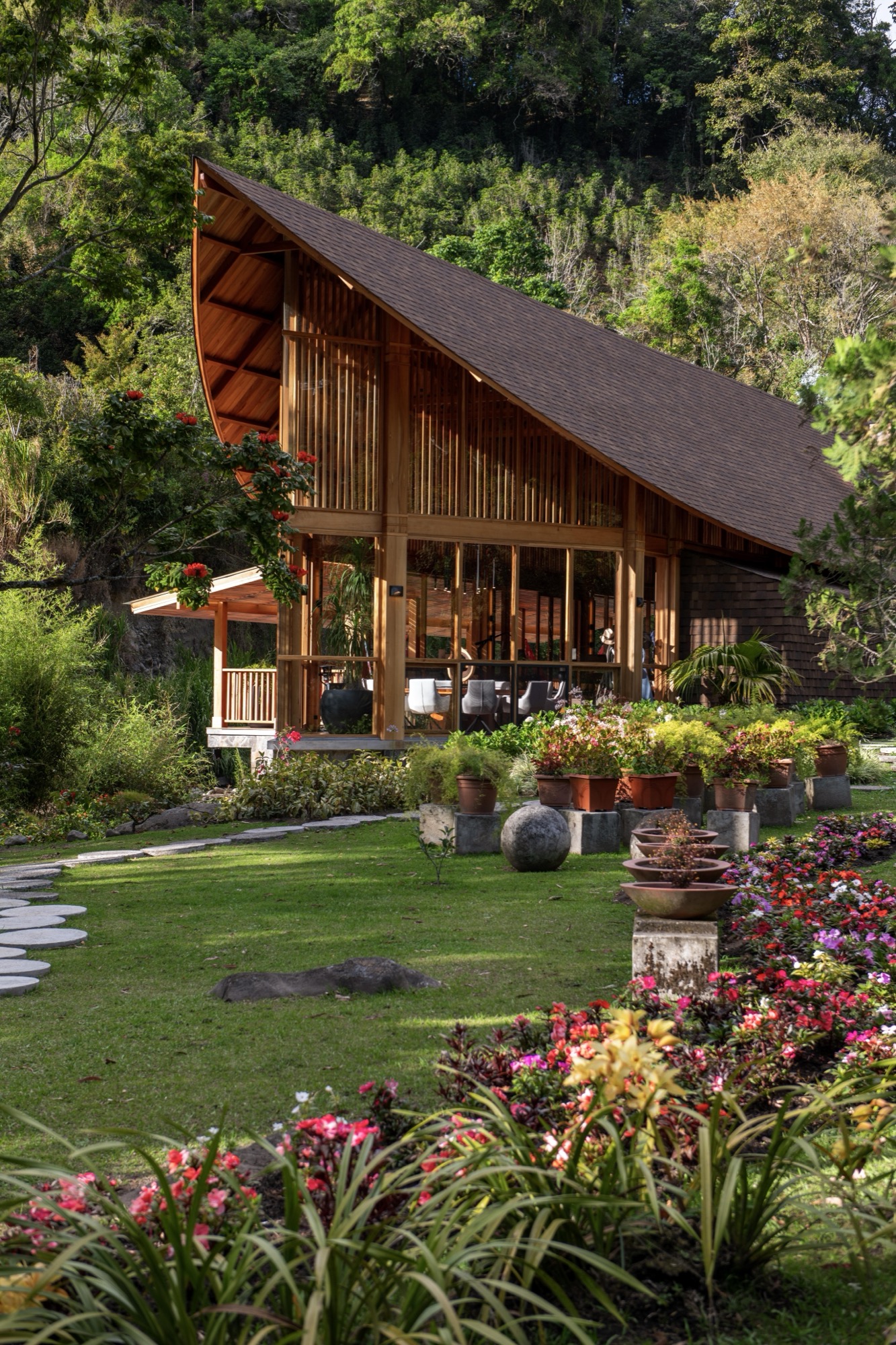
El Arca is a private residential pavilion designed by Mallol in Nueva Suiza, Chiriquí, Panama, where a curved cedar roof shelters a house shaped by rain, cloud forest, local craft and the cultivated landscape of Volcán Barú.

Set more than 2,000 metres above sea level in the highlands of Chiriquí, El Arca sits within a region known for the cultivation of Gesha coffee and for a landscape defined by mist, rain, steep terrain and dense vegetation. Rather than treating the site as a backdrop, Mallol approached the project as a direct negotiation with its climate, materials and local knowledge.

The house is conceived as a timber pavilion arranged beneath a single curved roof. Spanning the full programme, this continuous canopy protects the living spaces from the shifting mountain weather while giving the project its defining architectural figure. Its profile refers to the shape of a dry leaf resting on the ground, an image that informs both the name of the project and the soft arc visible through the forest canopy.

Living, dining and resting areas are organised on one level below the roof, opening toward the gardens, the river and the surrounding cloud forest. Inside, the exposed cedar structure remains visible throughout the house, working both as construction and atmosphere. The roof is not simply a covering, but the primary spatial element, holding the domestic programme together under one continuous gesture.
The material logic of El Arca is closely tied to its place. Cedar used for the structural frame, cladding, floors and ceilings was sourced from the property itself, allowing the house to be built from the same territory it occupies. Local stone was used for paths, terraces and ground surfaces, extending this continuity between architecture and landscape.

The construction was developed in close collaboration with craftsmen Amílcar Rodríguez and Abdiel Rodríguez from the Chiriquí highlands. Their knowledge of timber construction shaped the project from framing to finish, giving precision to the cedar joints, surfaces and details. The result is a house in which craft is not applied as decoration, but embedded in the way the building stands, shelters and ages.
The exterior envelope is finished in timber shingles, chosen for their material consistency with the structure and their response to a climate marked by rain, mist and daily temperature changes. Through this restrained palette, the pavilion acquires a quiet presence within the landscape, neither camouflaged nor imposed, but held in balance with its surroundings.


During the design process, a large boulder discovered on the site was deliberately preserved. Instead of removing it, Mallol organised the pavilion around it, allowing the rock to become the centre of an interior garden enclosed by cedar and glass.
Surrounded by endemic planting and lit from below, the boulder remains visible from within the house and from the riverside through full height glazing. This gesture reveals the broader attitude of the project. El Arca does not begin by clearing the land into neutrality. It adapts to what is already present, allowing the architecture to be shaped by existing natural conditions.


The landscape design extends this same approach. Gardens combine endemic species with carefully composed planting, creating a gradual sequence of arrival before the house is reached. Along the edge of the property, a mountain river remains untouched, neither redirected nor contained.

Its sound enters every interior space, giving the house a constant acoustic connection to its setting. In this way, the river becomes part of the daily experience of the pavilion, not as a view alone, but as a continuous presence.


By sourcing timber from the property, using local stone and working with craftsmen from the Chiriquí highlands, El Arca keeps much of its material and labour chain within the region. The project’s environmental position is therefore not expressed through technology alone, but through proximity, craft and an economy of means.
Now completed and in operation as a private residence, El Arca stands as a compact architectural response to a powerful highland landscape, where shelter, structure and terrain are bound together through timber, stone and rain.

Mallol is a Panama based architecture studio working across residential, cultural, commercial and institutional projects. Its practice combines design, research and technical innovation through projects that engage with climate, urban life, cultural context and material efficiency. Through Mallol FWD, the studio’s research and development platform, the firm explores new design methodologies and collaborative approaches to architecture in Latin America and beyond.
Project credit
Official project name: El Arca
Location: Nueva Suiza, Chiriquí, Panamá
Architects: Mallol / @mallol.arquitectos
Completion: 2024
Construction area: 220 square metres
Photo: Alfredo Maiquez, Pepe Calavera
More Photos