Now Reading: Crest Nine community centre by Sanjay Puri Architects steps down a hillside in coastal India
- 01
Crest Nine community centre by Sanjay Puri Architects steps down a hillside in coastal India

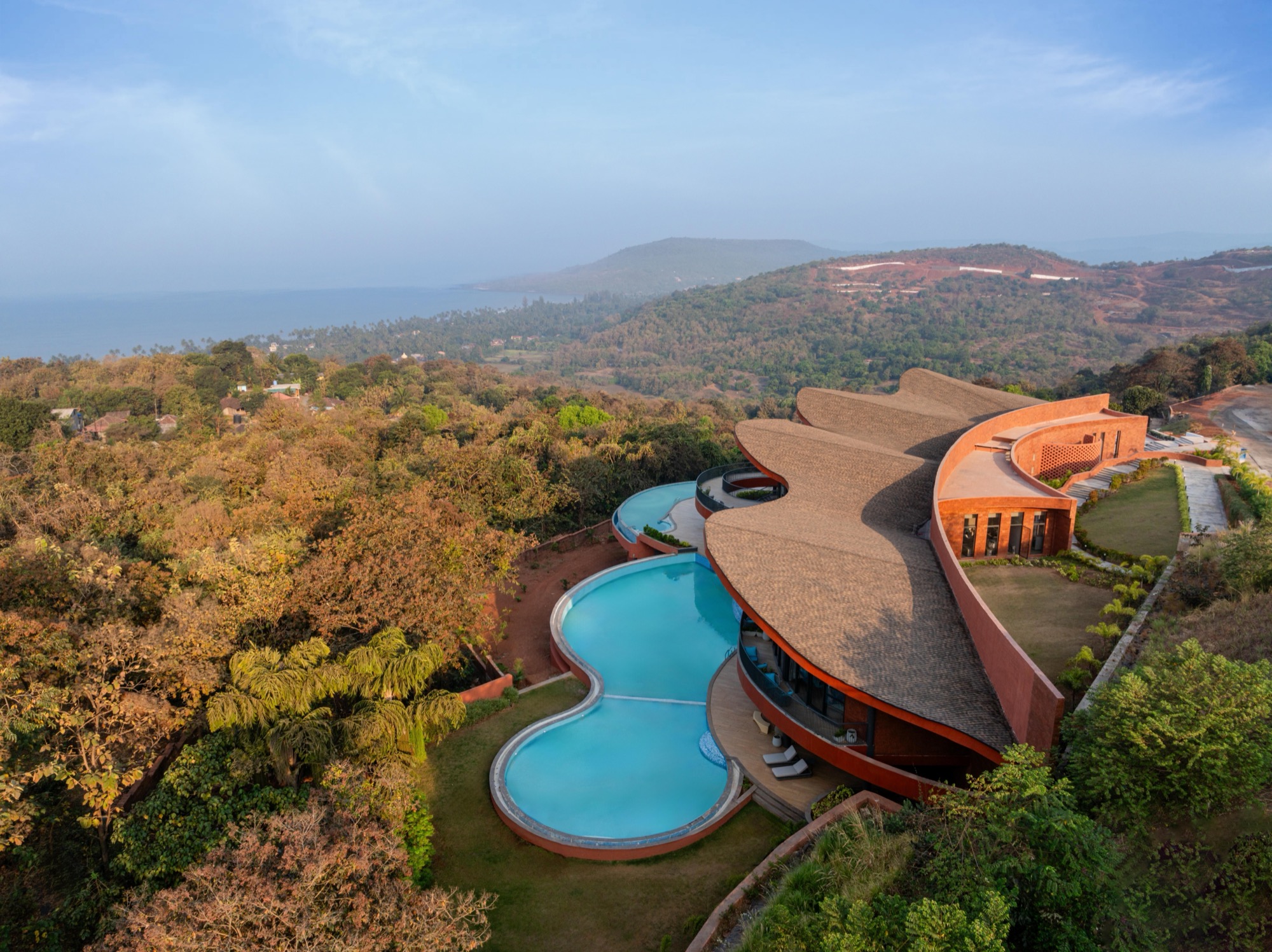
Crest Nine community centre by Sanjay Puri Architects steps down a hillside in coastal India

Set on a steep coastal hillside in Anjarle, Maharashtra, Crest Nine is conceived as a recreational community centre serving a gated villa enclave overlooking the Arabian Sea. Designed by Sanjay Puri Architects, the project responds directly to the dramatic topography of the site, where the terrain drops sharply from the approach road toward the ocean.

Rather than imposing a singular architectural object onto the hillside, the building is shaped to emerge gradually from the land. The entrance is positioned six metres below the access road, encouraging visitors to descend through the landscape before arriving at the building itself. A broad stairway and a gently curving ramp guide the approach, running alongside a sloping garden that mediates between the natural terrain and the architecture.

This descending sequence establishes a gradual spatial transition, allowing the building to unfold progressively as visitors move toward the central circulation spine that runs across the entire length of the structure.


The architecture transforms from a restrained curvilinear entrance façade into a dynamic composition of parabolic volumes of varying heights. These sculptural forms create a rhythmic sequence across the site, interspersed with courtyards and landscaped pockets that allow light, air and views to penetrate the interior spaces.


Each parabolic volume accommodates a different programme, including an indoor sports room, gymnasium, restaurant, bar and four guest bedrooms. Generous curvilinear decks extend outward from these spaces, framing panoramic ocean views to the west and reinforcing the fluid geometry of the architecture.

Above, a sectionally curved roof undulates across the building. The roof rises prominently above the primary volumes and dips between them, shaping a series of intimate courtyard spaces. Deep overhangs extend beyond the decks, offering protection from the intense sun and seasonal monsoon rains while reinforcing the building’s sculptural presence.

At the centre of the building, an open staircase wraps around a circular courtyard, forming a vertical spatial anchor that connects the different levels of the project. The staircase descends to the lower level, where a sequence of leisure spaces unfolds.
This level accommodates three swimming pools, a health club and an open cafeteria connected to a large multifunctional deck. Naturally ventilated and open to the surrounding landscape, this lower terrace becomes the social heart of the complex, designed to host gatherings, relaxation and communal activities.


The interplay between enclosed volumes and open courtyards produces a porous spatial structure in which circulation, landscape and architecture remain closely intertwined.


Material choices further reinforce the project’s connection to its coastal setting. The walls are constructed using locally sourced laterite stone, a material deeply rooted in the region’s architectural traditions. Its warm, textured surface anchors the building visually within the landscape while providing durable thermal mass.
Environmental performance is addressed through passive design strategies. Every interior space receives natural daylight, and approximately seventy percent of the built areas are naturally ventilated and operate without air conditioning. The roof structure consists of a lightweight metal framework finished with shingles, allowing the sweeping roof geometry to be realised while maintaining structural efficiency.

By prioritising locally available materials and engaging regional construction labour, the project significantly reduces embodied carbon while strengthening connections with local craft and building practices.


Integrated carefully into the hillside, Crest Nine appears as a constellation of interconnected volumes that follow the contours of the land. Landscaped courtyards and open terraces weave between the built forms, creating a sequence of social spaces that encourage interaction among residents and visitors.


The architecture does not dominate the site but grows from it. Through its curving geometry, local material palette and climate responsive design strategies, the building transforms a steep coastal terrain into a layered recreational landscape overlooking the sea.


Project Credit
Location: Anjarle, India
Start Date: December 2022
Completion Date: January 2026
Carpet Area: 32,000 SQ.FT.
Architect: Sanjay Puri Architects / @sanjay_puri_architects
Photo: Vinay Panjwani / @panjwani.vinay