Now Reading: Arina Krisanova reinterprets Kikutake’s Metabolist vision in a transformable Moscow apartment
- 01
Arina Krisanova reinterprets Kikutake’s Metabolist vision in a transformable Moscow apartment

Arina Krisanova reinterprets Kikutake’s Metabolist vision in a transformable Moscow apartment

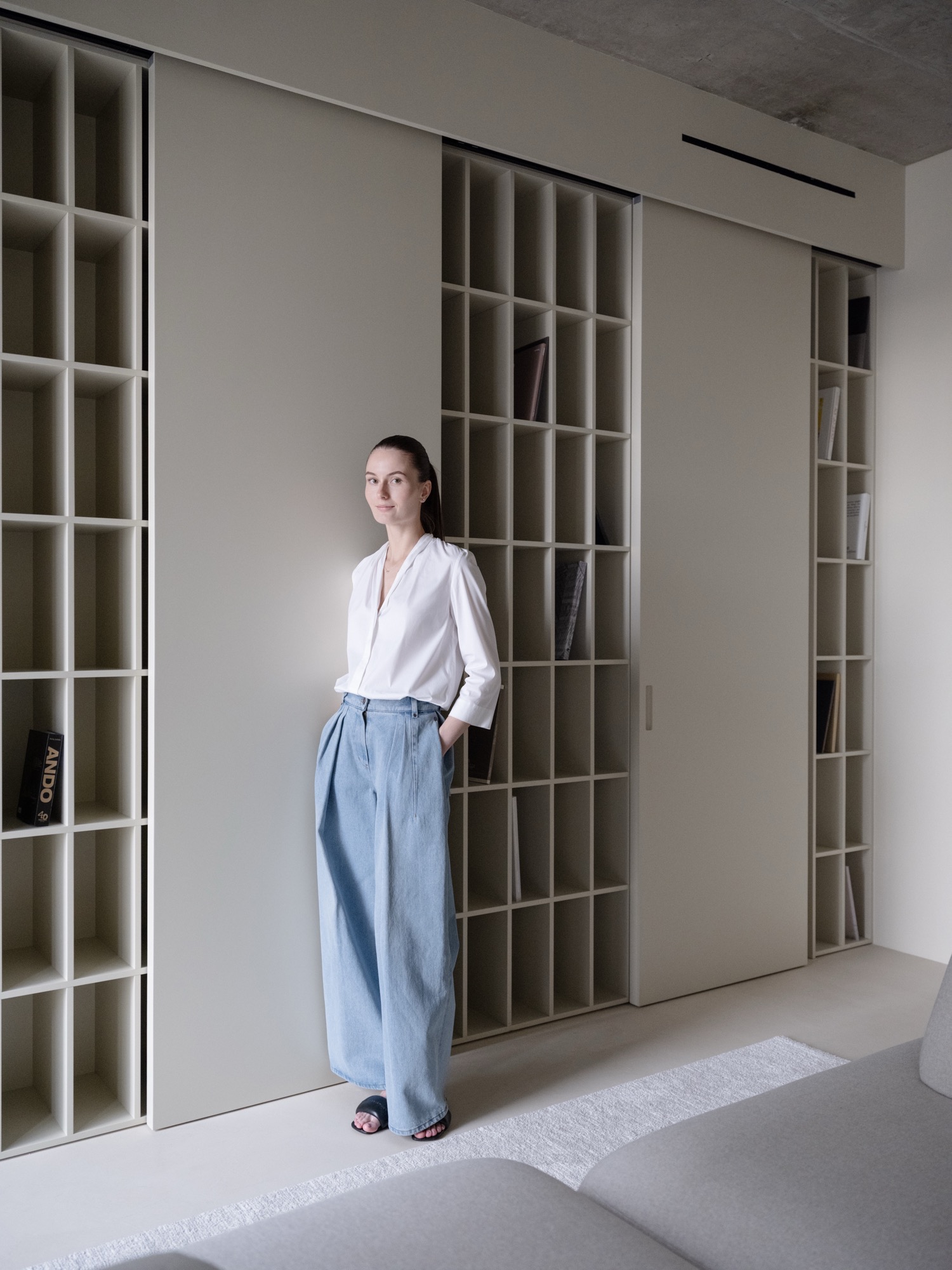
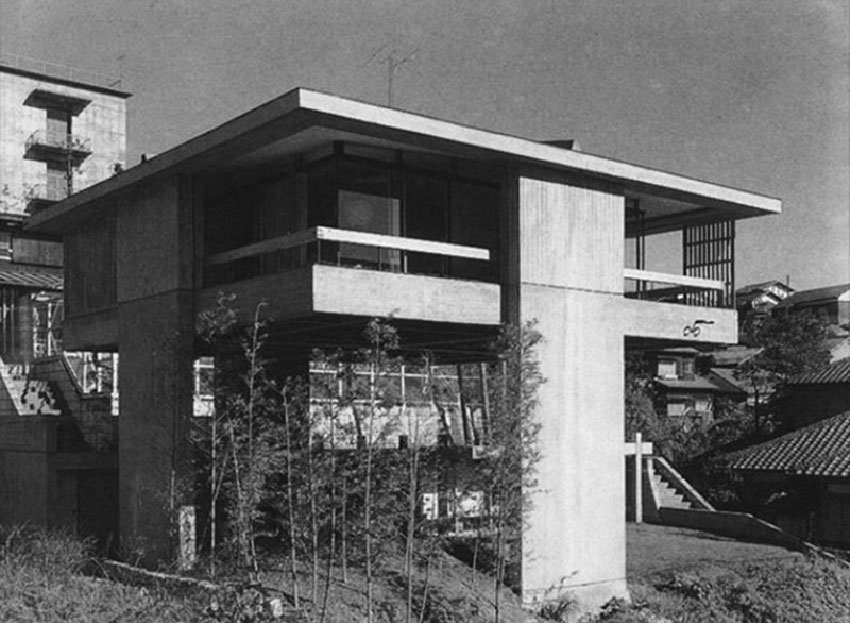
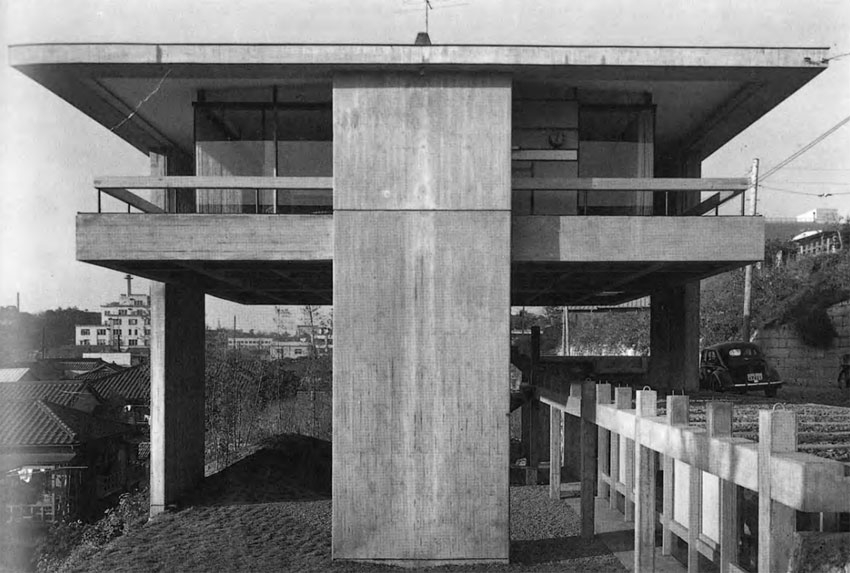
In a compact 72-square-metre apartment in Moscow, designer Arina Krisanova reimagines the radical legacy of Japanese Metabolism through a distinctly contemporary lens. Drawing inspiration from Kiyonori Kikutake’s Sky House (1958), the project explores the idea of living space as a mutable organism, capable of adapting, expanding, and contracting in response to everyday needs.
Rather than treating the interior as a fixed composition, Krisanova approaches it as a layered system of perception, where modularity, reflection, and custom-designed elements work together to blur the boundaries between function, image, and experience. In this conversation, she reflects on the translation of Metabolist principles into domestic scale, the role of illusion in shaping spatial awareness, and the tensions and freedoms of designing for oneself.
What inspired you from Kiyonori Kikutake’s Sky House (1958), and how did you adapt its Metabolist principles for a 72 m² apartment in Moscow?
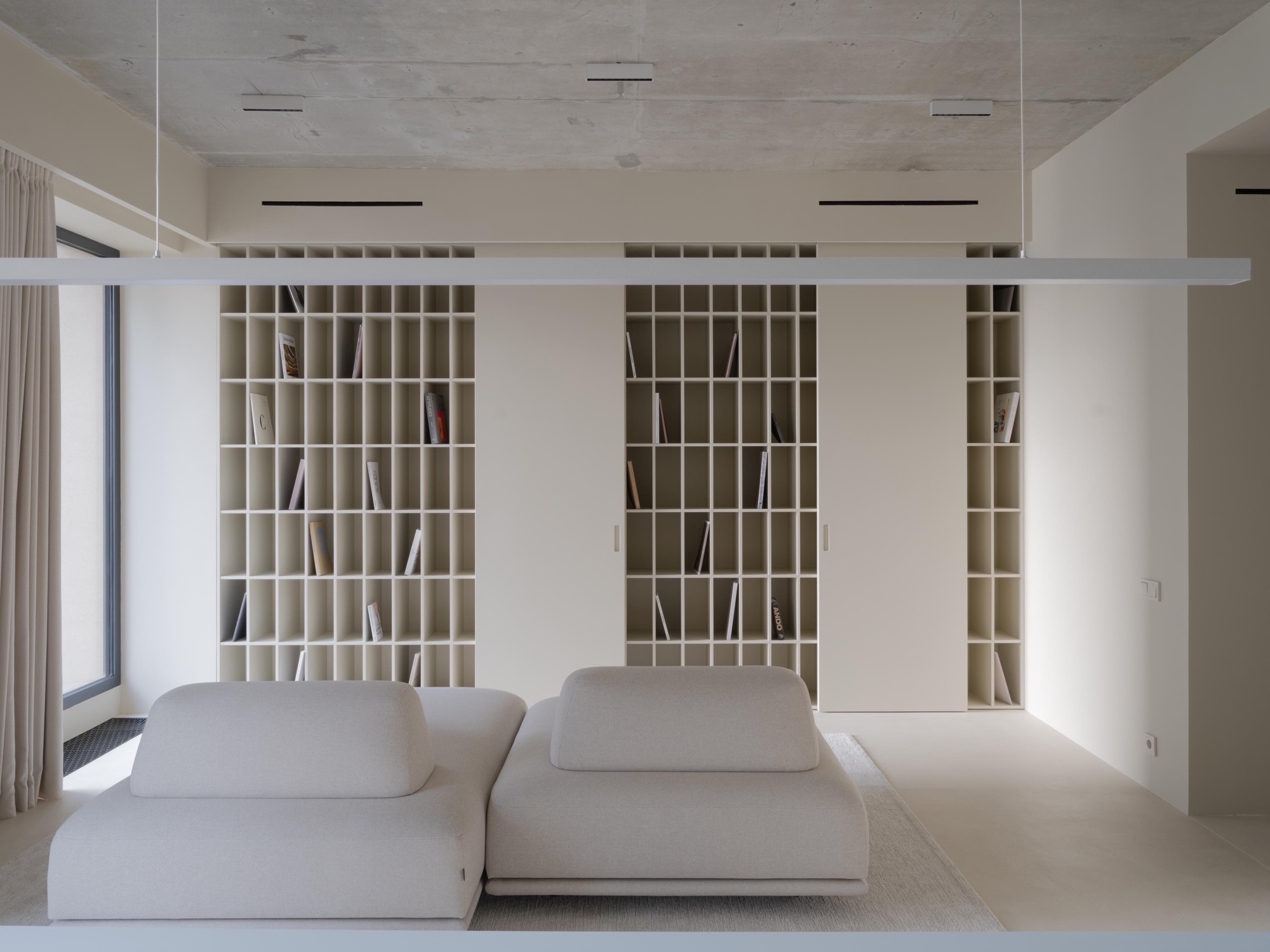
I was drawn to the idea of a building as a living organism capable of transformation in response to external conditions. Therefore, I decided to explore the integration of the principle of modularity into the main living space and to create elements that could change their form according to specific functional needs. Such an approach is relevant in contemporary conditions, when residential space is expected to perform multiple functions simultaneously: serving as a place for living, working, leisure, and social gatherings with friends.
How does the “Kikutake Room” function as the center of the design, and how does it reflect your view of modularity as a way of life?
One of the key principles of metabolism is the capacity of objects to transform in accordance with the resident’s needs. Such adaptability makes it possible to conceal elements that are not required at moment and reveal them when they become necessary. In my view, this reflects a minimalist approach to everyday life – abandoning the superfluous in favor of a well-considered, visually clean and simultaneously comfortable space.
How does the use of mirrors to create illusions of additional windows or passageways influence your thinking about expanding perception versus physical space?
An interior is not a fixed geometric configuration, but also is an environment that generates a range of emotions and impressions. For example, a mirror designed to resemble a window can enhance the sense of light even in the absence of an actual window. Similarly, a mirror framed as a passageway can create the impression of spatial continuity and depth. In this way, space is experienced both visually and emotionally.
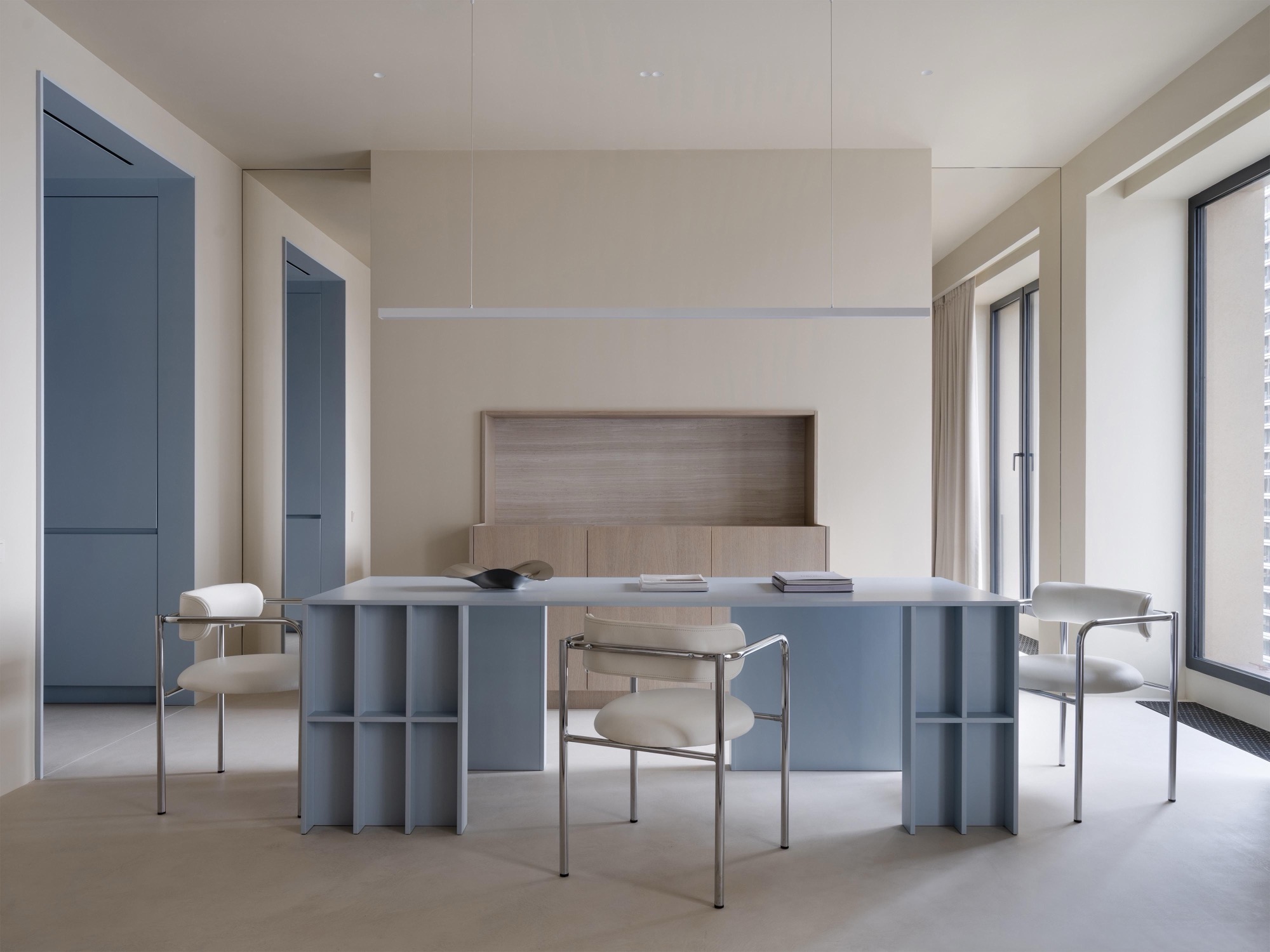
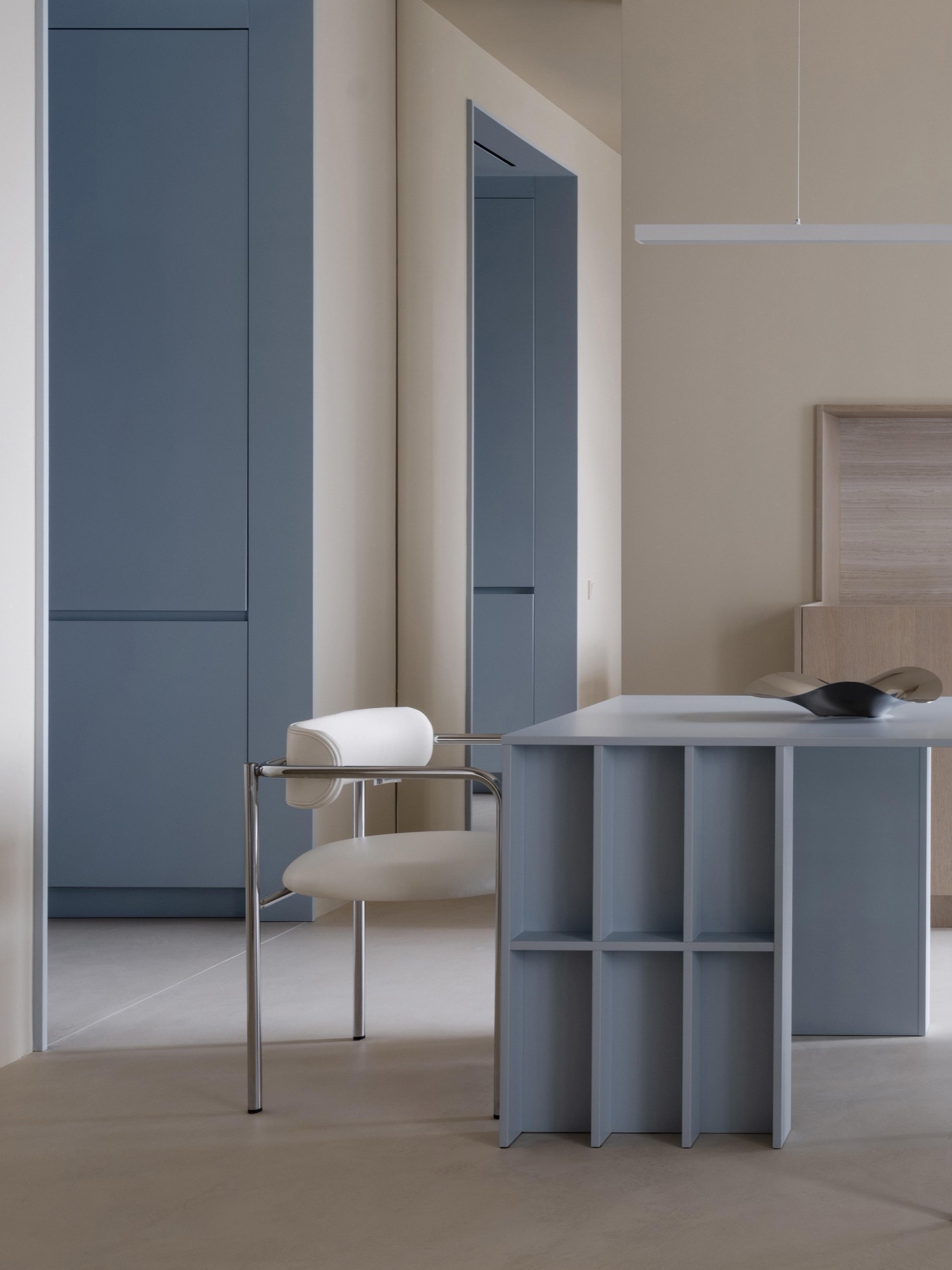
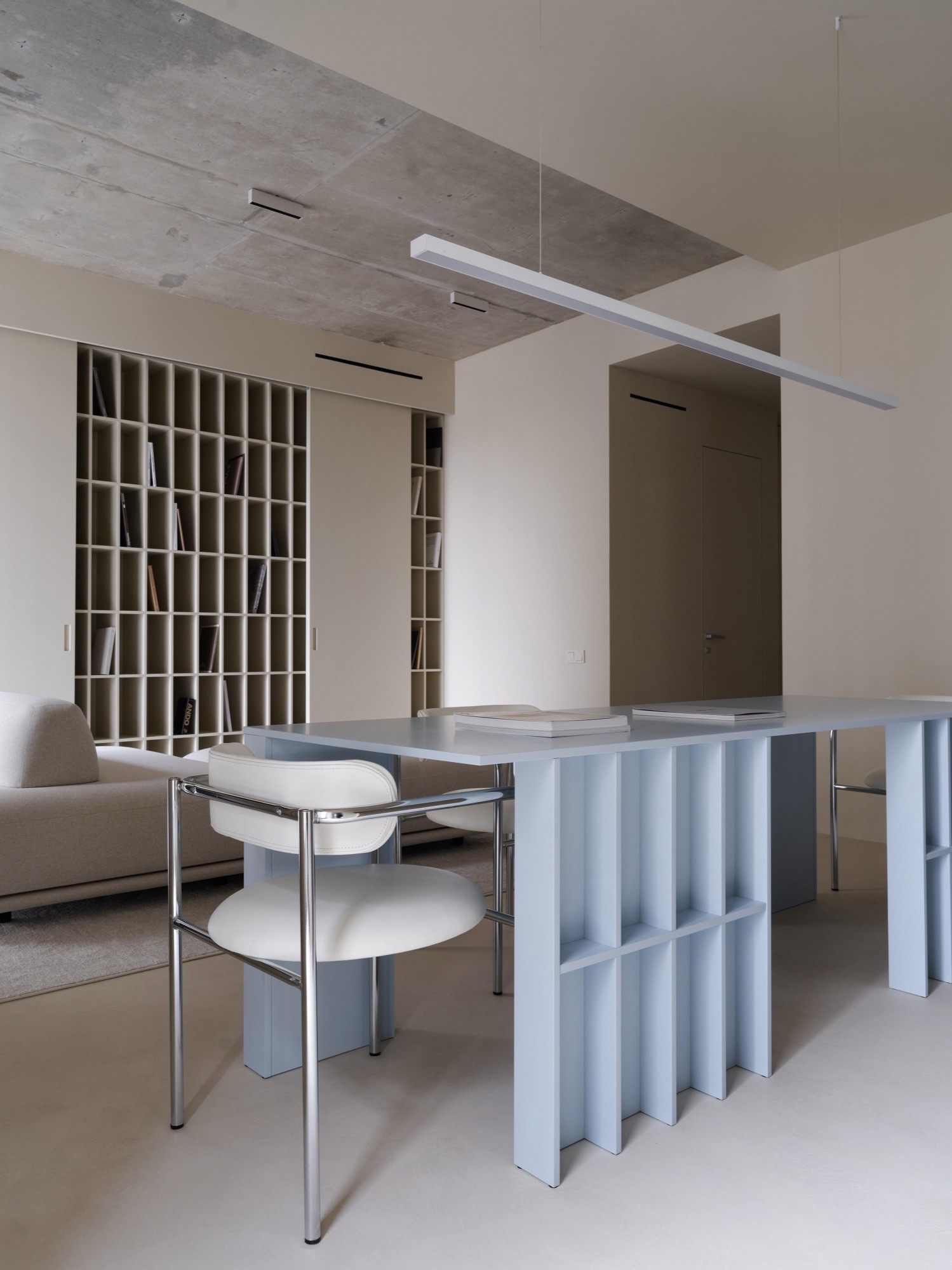
Where did the idea for the custom furniture come from, particularly the dining table legs that change depending on perspective, and how do they reinterpret the portal supports of the original Sky House?
Each custom furniture piece in the project is based on a geometric form derived from Kikutake’s architectural language, where each form functioning as a distinct cell. The legs of the dining table are similarly massive and support the surface with the same structural firmness as the supports of the Sky House.
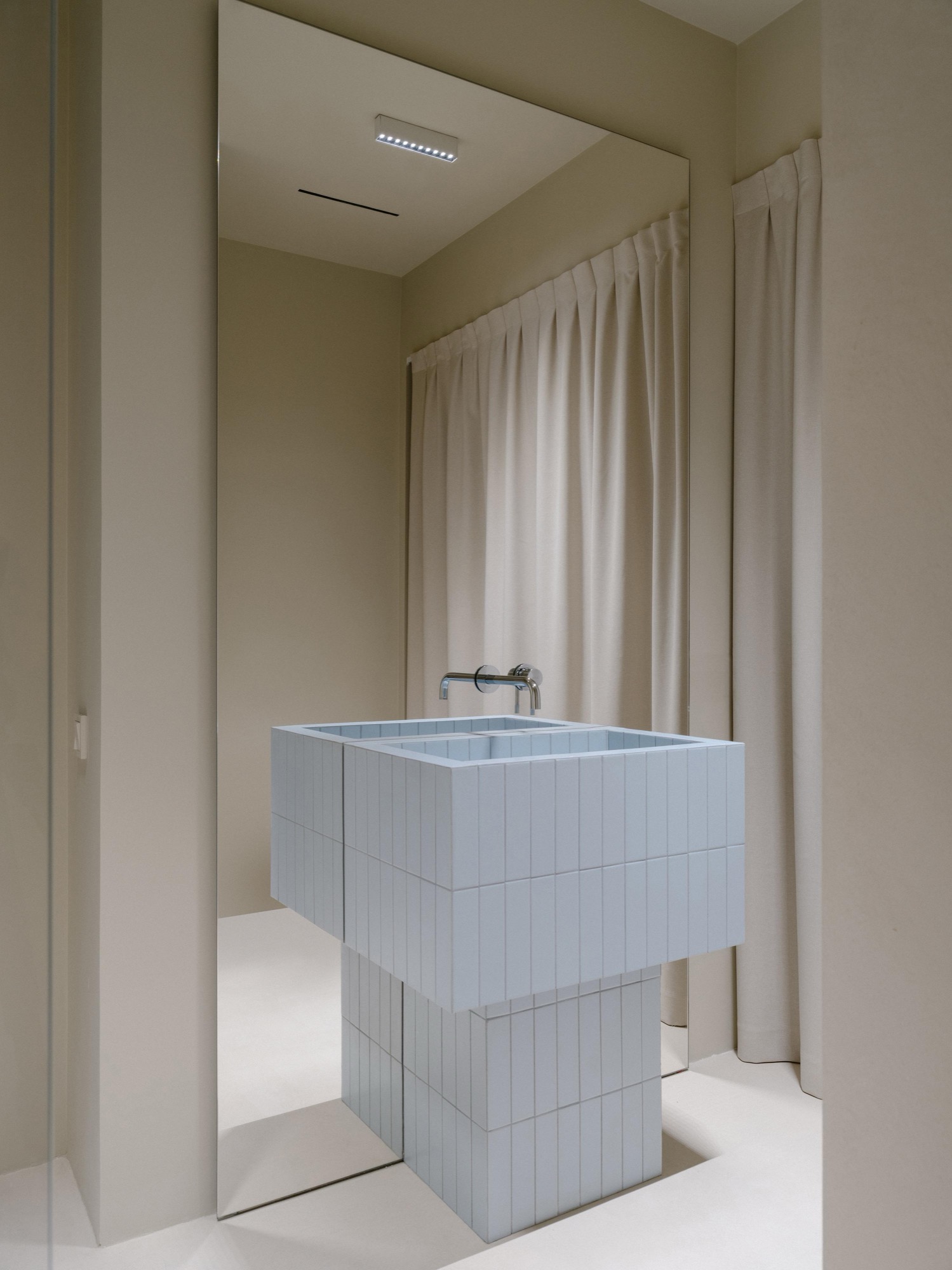
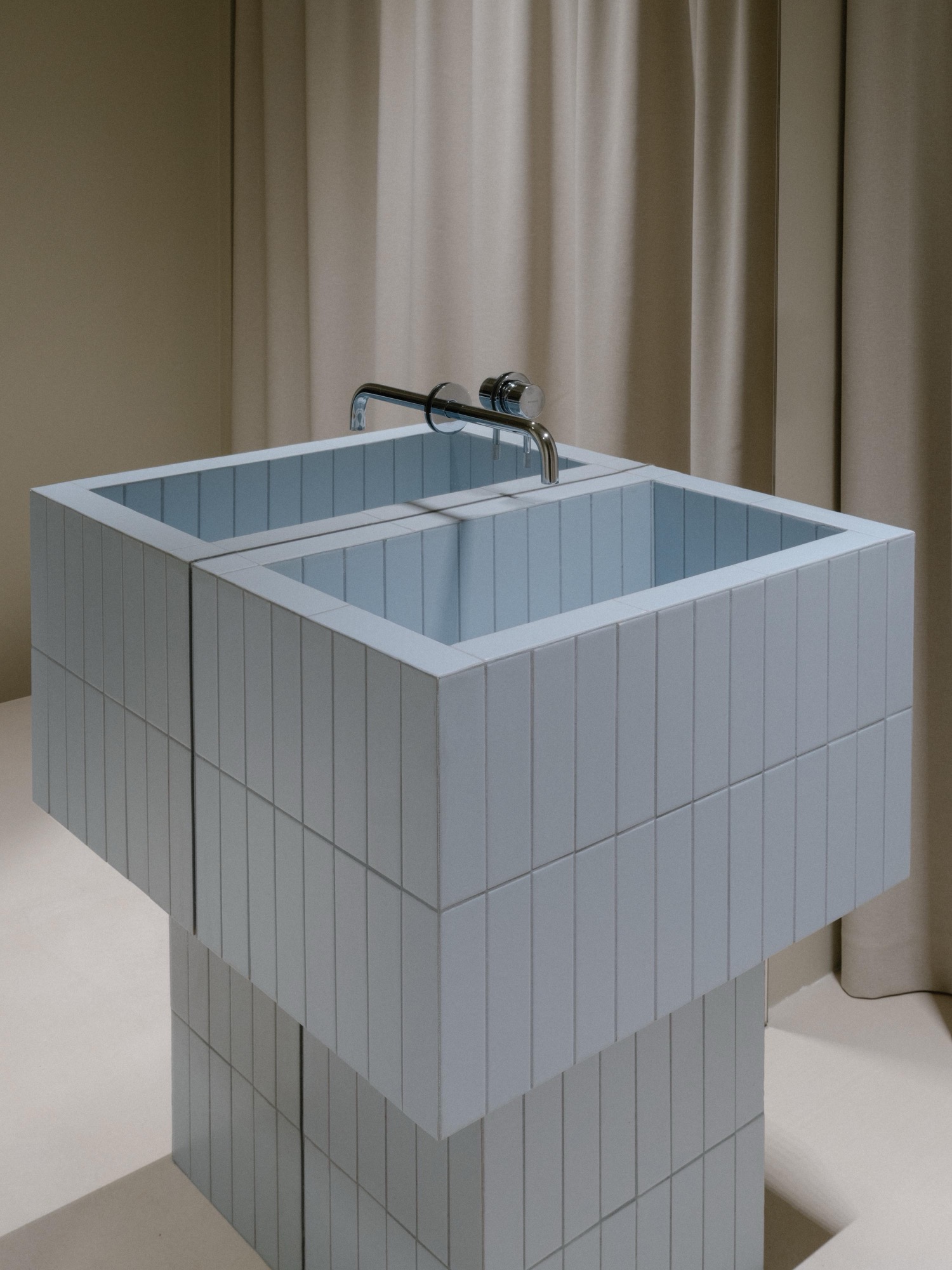
In the main bathroom, how does the reflection of the sculptural sink in the mirror blur the boundary between object and image, and what does this suggest about the relationship between reality and illusion?
In this way the individual no longer perceives the room as an enclosed space. For example, a mirror does not changer the physical structure of objects, such as a sink. Moreover, it does not increase the real area in fact. Nonetheless, reflection can significantly transform the way a person perceives the boundaries of space, as well as its shape and sense of openness.
How does the ASKO x Maxim Kashin washing machine with a Suprematist pattern integrate into the overall design, and what innovations does it introduce?
Suprematism and Metabolism emerged as attempts to address the question of what the architecture in the future should be. Accordingly, both movements are grounded in simple geometric forms, which became tools for experimentation in shaping a new architectural time.
What challenges arose when testing 20 shades of beige for the monochrome palette, and how did this influence the use of light and reflections?
The color changed significantly depending on the lighting conditions, which was expected. However, I sought to identify the best solution that would appear harmonious at any time of day. My aim was to create a continuous transition from the vertical surface to the horizontal plane, producing an effect akin to the sense of infinity generated by reflections in mirrors.
As both designer and “client” of your own home, how did this dual role influence your decisions, particularly in balancing rational thinking and personal desires within a Metabolist space?
A designer assumes several roles when designing a space for themself, becoming responsible for different functions of design and implementation. By conducting author’s supervision, creating a concept and project, communicating with contractors, and selecting materials, a designer can become cornered by their own decisions. However, while it may create internal contradictions, at the same time it unleashes the freedom of creative self-expression.


How might the adaptability and layers of perception in this project inspire future urban housing design in Moscow or elsewhere?
The relevance of such an approach for Moscow is determined by the specific conditions of contemporary urban life. High building density, limited residential space, and the need to combine functions of leisure, work and communication all generate a demand for more adaptive interior solutions. In this context, Metabolist ideas make it possible to conceive of the apartment as an environment capable of gradual transformation without any radical alteration of its basic structure.


Article Credit
Text: Sofia Burky
Photo: Inna Kablukova / @in_kablukova
Time: 03.2026