
Now Reading: Arctic Bath: Where innovative architecture meets immersive Arctic wellness
- 01
Arctic Bath: Where innovative architecture meets immersive Arctic wellness


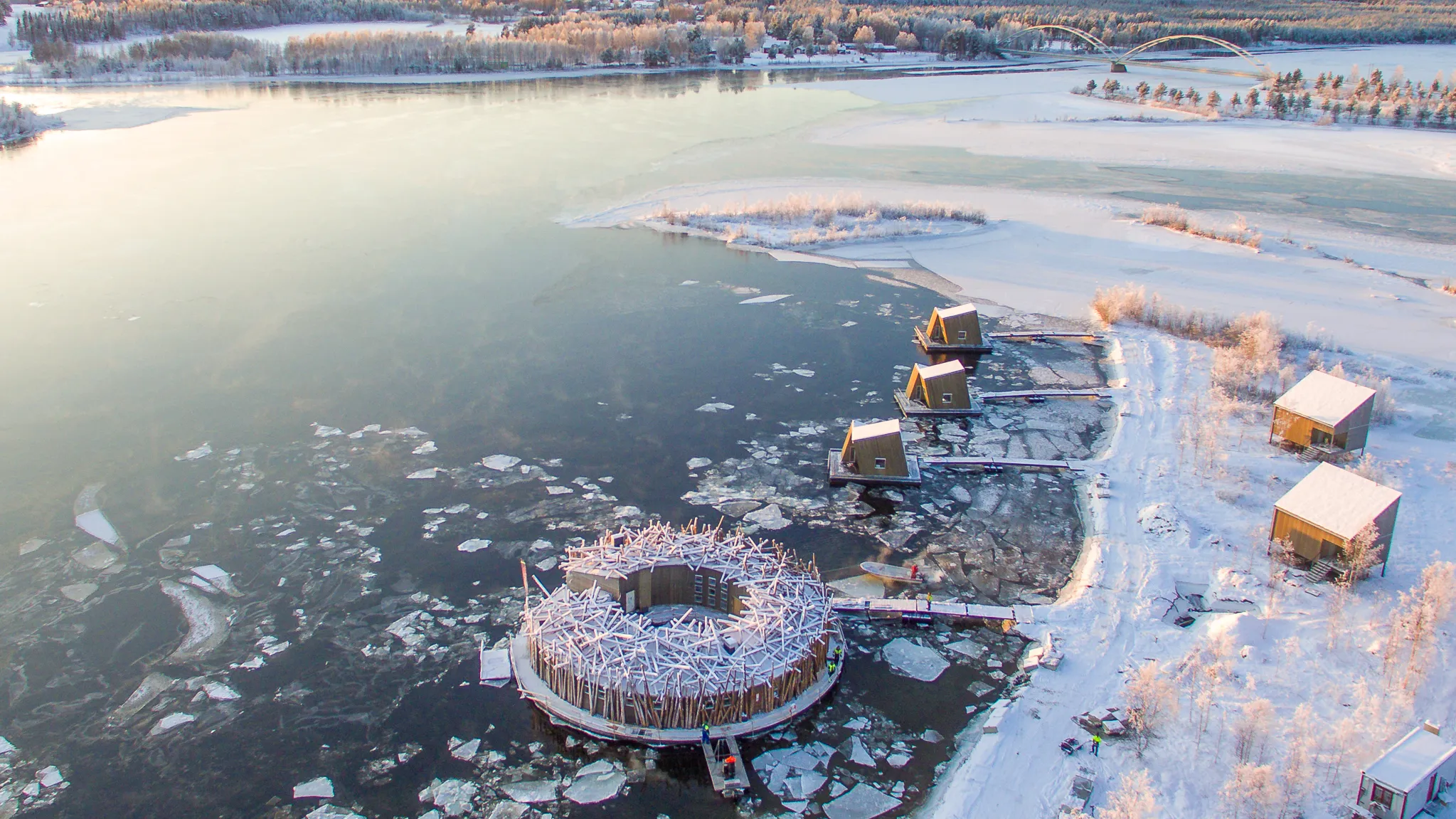
Arriving in Harads, a small village in Swedish Lapland, the landscape already begins to slow you down. The road narrows, the forest thickens, and the Lule River stretches out in long, quiet curves. Then, almost unexpectedly, Arctic Bath appears – resting on the river like a circular apparition, somewhere between a log jam and a contemporary sanctuary.

The first impression is not of a hotel, but of a structure that belongs to the place. Floating gently in summer and locked into ice through the winter months, the building responds to the Arctic seasons rather than resisting them. Its ring-shaped form references the timber-floating era once central to life along the Lule River, when logs gathered naturally into dense clusters on the water. The concept was developed by architects Bertil Harström and Johan Kauppi, also known for the nearby Treehotel. Here, their architectural language feels quieter, more elemental – less about spectacle, more about immersion.

At the center of the circular structure lies an open-air cold bath. Steam rises softly from surrounding saunas and hot tubs, drifting into the Arctic air. Moving between heat and cold becomes a ritual rather than a spa routine: slow, deliberate, grounding. The plunge itself around 4°C is bracing, but never rushed. Wrapped in silence, broken only by water and wind, the experience feels deeply Nordic in spirit.
The floating cabins extend this relationship with water. Their angled silhouettes rise sharply from the river, each with a private deck that faces the vast northern sky. From here, nights stretch long and dark in winter, often lit by the aurora, while summer brings endless daylight and a river that never quite sleeps. The gentle movement of the water beneath the cabin is subtle, almost imperceptible, but it reinforces the sense of being temporarily untethered from land.


Onshore, the land-based cabins and suites offer a different kind of stillness. Designed by Ann-Kathrin Lundqvist, co-founder of Arctic Bath, the interiors balance restraint and warmth. Materials are local and honest used sparingly. Large windows frame the river and forest as living backdrops, while underfloor heating and soft textiles quietly counter the harsh climate outside. Nothing feels excessive; everything feels considered.

Meals here follow the same philosophy. The dining room looks out across the water, and the menu draws almost entirely from the region: Arctic char, reindeer, forest berries, seasonal herbs. The cooking is precise but unpretentious, allowing ingredients to speak for themselves. Dinner unfolds slowly, often lingering well into the evening as light shifts across the river or darkness settles in.

Beyond the spa and dining, Arctic Bath encourages exploration without obligation. Guests head out for husky sledding, snowmobiling, or guided aurora walks, then return to warmth and calm. Others choose to do very little at all—watching ice form along the river’s edge, listening to snow fall, or sitting quietly on a deck as the sky changes color.

Arctic Bath is not about luxury in the conventional sense. Its value lies in how seamlessly architecture, landscape, and experience are woven together. Staying here feels less like checking into a hotel and more like briefly inhabiting the Arctic on its own terms—cold, beautiful, and profoundly still.