
Now Reading: A pavilion along the Tiegang River inspired by Su Shi’s enduring joys
- 01
A pavilion along the Tiegang River inspired by Su Shi’s enduring joys


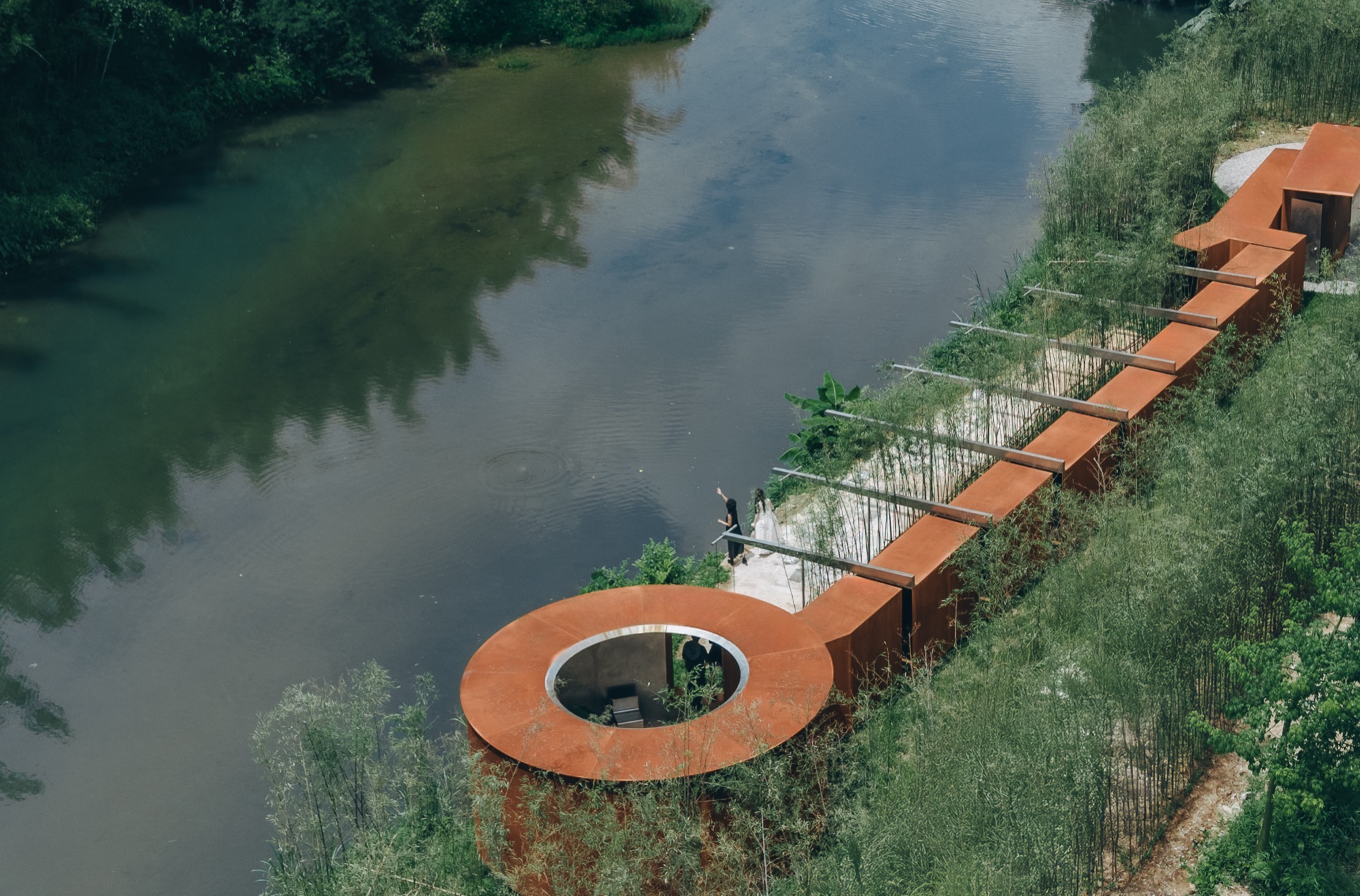
Set on the banks of the Tiegang River in Longtan Town, Huizhou, the Floral Wander Loop revisits a thousand years of cultural memory. It is here that Su Shi, one of the most influential literary figures of the Northern Song dynasty, once walked in exile, finding solace in the Lingnan landscape and composing Sixteen Joys of Life in Huizhou. A millennium later, this poetic legacy becomes the conceptual foundation for a new architectural constellation: sixteen pavilions positioned along the circuit road between Nankun Mountain and Luofu Mountain. Together, they form the Nankunshan–Luofushan Rim Pioneer Zone Architectural Art Project. The Floral Wander Loop stands among them as the Tiegang River Pavilion.

INTERPRETING SU SHI THROUGH SPATIAL EXPERIENCE
The pavilion draws upon one of Su Shi’s joys, the tender metaphor of seeking to “make flowers bloom”. Instead of providing a conventional rest stop, the design engages the body through shifts in scale, light, pressure, and movement. In his later years, Su Shi described his life with the line: “When asked about my life’s achievements, I point to Huangzhou, Huizhou, and Danzhou.” These three geographic and emotional stages become the narrative structure of the project. Visitors move from clarity to disorientation, from confinement to release, mirroring Su Shi’s journey from political downfall to philosophical transcendence.

A LOOP BETWEEN ROAD AND RIVER
The site lies within a dense bamboo grove between a winding road and the endlessly flowing Tiegang River. These two linear trajectories evoke a sense of infinite continuity. The pavilion is conceived as a spatial membrane between them, adopting the rhythm and verticality of bamboo while framing time and movement.


A looped circulation aligns with the flow of traffic and water, creating a long, slender architectural ring that departs and returns to a single point. Within the grove’s limited space, the path is drawn to its fullest extent. Expansions and contractions modulate perception and pace, transforming the act of walking into a symbolic encounter between past and present.

PLEASANT: A GENTLE BEGINNING
The journey begins at an elevated entrance plaza shaped by the natural topography. Gravel paving, bamboo clusters, and seating introduce a sense of calm and generosity. This light-filled forecourt evokes Su Shi’s early optimism as a young scholar-official stepping into the world. Visitors descend from this open plateau into an increasingly narrow metallic passage, where the first shift in atmosphere prepares them for the darker spaces ahead.

POWERLESS: A PASSAGE OF SWAY AND UNCERTAINTY
The central corridor consists of upright weathering steel boxes, each two-point-one meters high and one-point-two meters wide, arranged in staggered formation to allow lateral movement. Raised on thin steel plates, the structure floats above the ground, allowing drainage, vegetation continuity, and a subtle sense of detachment.

Inside, the experience becomes visceral. The boxes sway with the wind, each at a slightly different frequency, creating an unsettling rhythm. Light filters through thin vertical gaps, alternating between brilliance and shadow depending on the weather. Sun, wind, and rain infiltrate the passage, and echoes bounce through its metallic cavity. Vision is reduced to vertical slits while touch and sound intensify. This state of heightened vulnerability echoes Su Shi’s period in Huangzhou, defined by powerlessness and enforced introspection.


SERENDIPITOUS: A BLOOM OF LIGHT
Emerging from the dimness, visitors reach a circular pavilion where the journey pivots. Artist Chen Zhuo’s floral installation traces the curvature of the space, its vivid colors reflected and diffused on hairline stainless steel. At the center, a round oculus frames a disc of sky through the bamboo canopy.
Here, the gloom dissolves. The enclosure becomes soft and radiant, offering a moment of repose. As Su Shi once found emotional clarity within Huizhou’s mist-laden landscapes, the circular pavilion gathers light, color, and reflection into a space of serendipitous relief.


EXPANSIVE: RETURNING TO THE RIVER
A second path opens from the circular chamber toward the riverbank. The heavy weathering steel gives way to open air. The ground widens. The view expands. At the water’s edge, a row of silver mesh swings faces the Tiegang River, moving gently with the breeze.
Swinging outward becomes an act of quiet defiance –
a gesture of reclaiming strength after darkness. When the visitor looks back, the earlier metallic boxes appear to sway in synchrony with the swings, revealing a latent connection. The movement that once felt oppressive now becomes comprehensible, even liberating.

This final scene reflects Su Shi’s wisdom during exile in Danzhou, when repeated hardship transformed into acceptance and transcendence. Along the riverbank, villagers and travelers mingle, dipping their feet into the water, fishing, or resting beneath the bamboo. Wind, river, and people breathe freely in shared continuity.

ECHOES ACROSS A MILLENNIUM
Su Shi’s life resembled a sheet of tempered steel, softened by countless blows yet always resilient enough to return to form. Weathering steel similarly darkens and stabilizes with time, bearing traces of climate and touch.
As Su Shi wrote: “Men have sorrow and joy; they part or meet again. The moon is bright or dim and she may wax or wane. Only the riverside breeze remains unchanged.”

At the Floral Wander Loop, the energy of Su Shi’s reflections persists across centuries. Visitors move through space as he once moved through life, gathering fragments of time along the Tiegang River. The question, “When do the flowers bloom?” subtly lingers throughout the experience. The pavilion suggests a quiet answer: they have always been blooming, and the journey itself reveals their presence.
Project Credit
Project: Floral Wander Loop
Date: 2025
Location: Huizhou, Guangdong, China
Area of the site: 800㎡
Firm: DL Atelier / @dlatelier_china
Architect: Liu Yang, Zhang Mowei
Artist: Chenzhuo
Photography: Zhu Yumeng