Now Reading: Kokichi Sugihara on the depth we imagine
- 01
Kokichi Sugihara on the depth we imagine

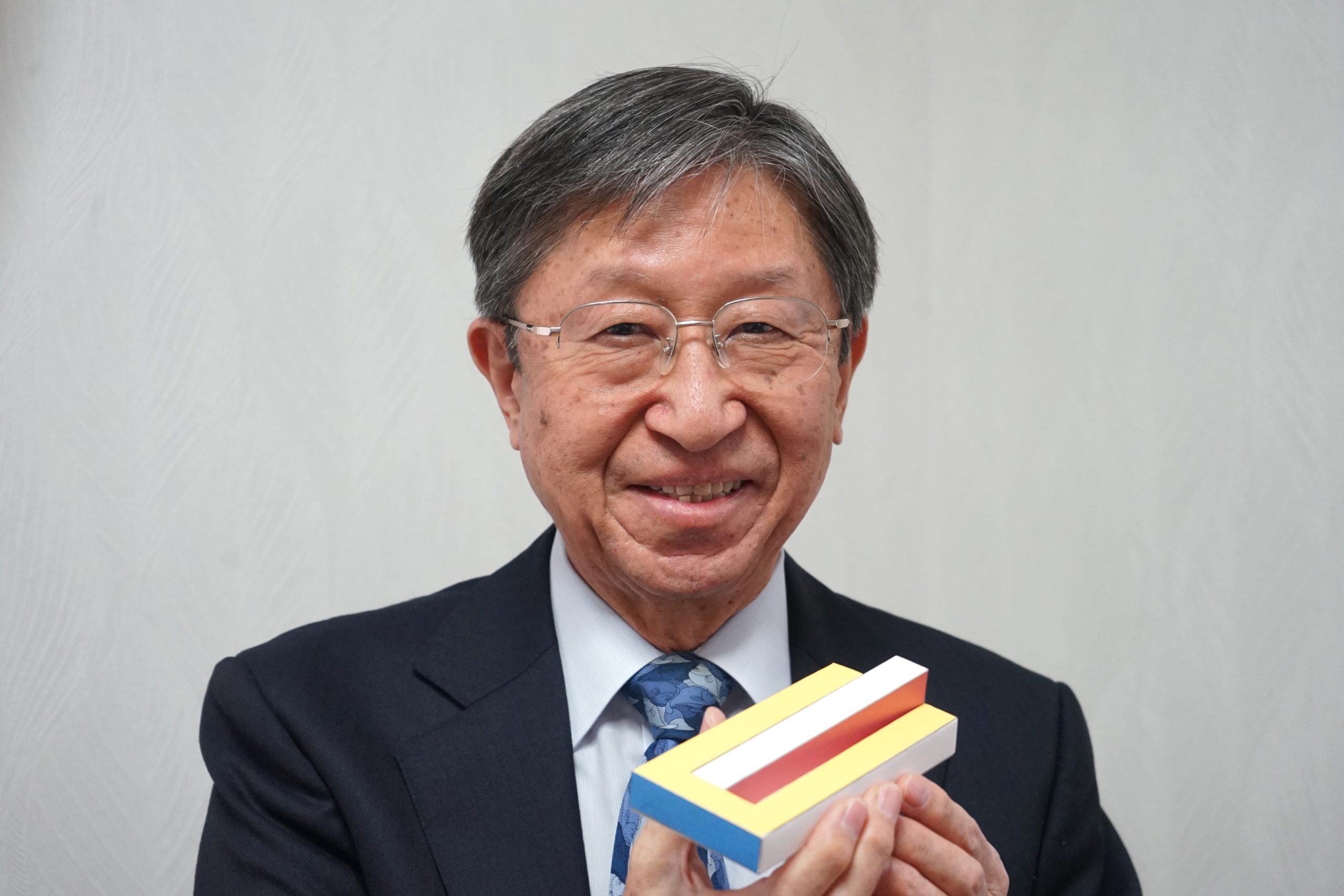

A staircase that appears impossible, a heart that changes shape in a mirror, a bird whose reflection refuses to turn: Kokichi Sugihara’s objects reveal the gap between what exists and what we think we see. In this interview, the Japanese mathematician discusses how he constructs that gap, the role of the viewer and what he learnt from audiences in Hanoi.
A distinguished professor emeritus at Meiji University, Sugihara came to three-dimensional optical illusions through research in computer vision. His calculations revealed that some drawings described as impossible could be built as physical objects, provided their depth differed from what a viewer would normally imagine. His exhibition Optical Illusion, presented by the Japan Foundation in Hanoi from 28 June to 24 August 2025, brought together 53 models. Here, he explains the shared principle behind those varied encounters.
Perception, making and the viewing experience
In your work, our eyes may see one form while careful observation leads reason to recognise a different structure. What does this contradiction reveal about how we perceive the world? When sensation and reasoning disagree, which should we trust?
The external world extends in three directions: height, width and depth. But when we look at it, the image on the retina has height and width, without information about depth. The brain therefore fills in that depth through imagination. If its interpretation is correct, we feel that we have perceived things normally; if it is wrong, we feel that an illusion has occurred.
The brain readily imagines familiar shapes. So an illusion is likely to occur if I make an object that looks familiar from one direction, but whose actual depth is very different from that familiar form. I use this tendency to make my work. Simply looking does not, in itself, give us accurate information about depth.
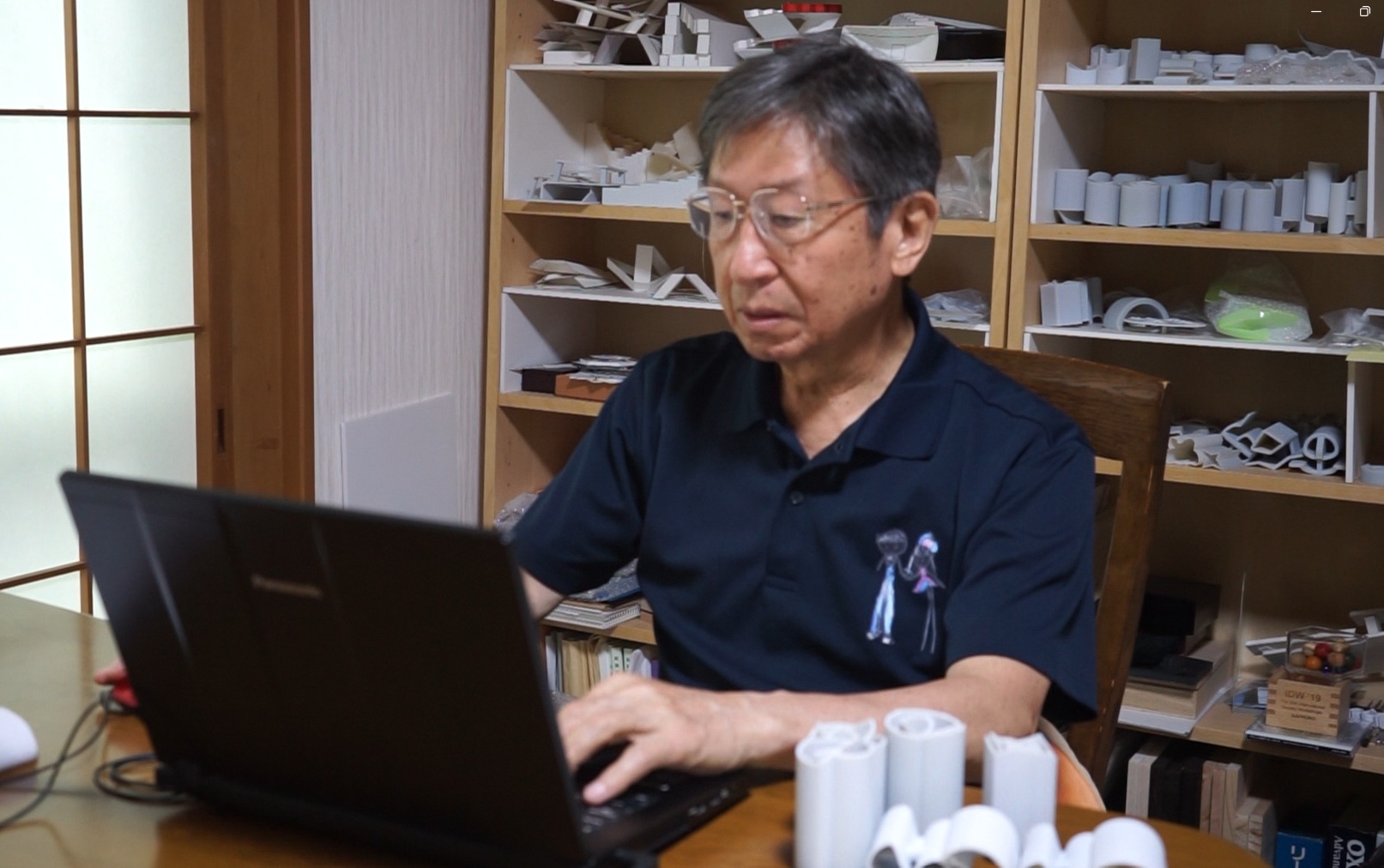
Through your research in computer vision, you began exploring how to turn “impossible figures” into physical objects. Could you describe the process by which a discovery about vision becomes a three-dimensional model, from the initial question through geometric calculation to the intended effect?
In my research in computer vision, I developed a computational method for recovering the depth of an object from its image. However, because the image contains no depth information, there is no single solution. My method can enumerate the different possible depths.
When I used this method to examine deceptive drawings known as impossible figures, I discovered that some could be constructed as three-dimensional objects.
This led me to wonder why people looking at a drawing feel that an object cannot be built when it actually can, and my interest expanded to human perception and three-dimensional optical illusions. I came to understand that people do not consider all the possibilities. They imagine only a particular, familiar depth. If I show them a form whose depth differs from the one they are likely to imagine, they misjudge it and experience an illusion. I use this to create my work.
The mechanism of a work sometimes becomes clear only when viewers change position, look through a mirror or observe it from a particular direction. Is the viewer’s position calculated in advance as part of the work, or is it something each person contributes to complete the experience?
When I make a three-dimensional work, I decide in advance the viewpoint from which I would like it to be seen. From that point, viewers experience the illusion; from another position, they can understand its actual shape. I think the sense of wonder comes from that discrepancy.
Your objects are made through precise calculation, yet viewers often respond first with surprise, laughter or doubt about their own eyes. How do you think about the balance between mathematical accuracy and these unexpected emotions?
I use mathematics as a tool for making the work. Viewers do not need to be particularly conscious of it. I think they can experience the wonder of seeing without any knowledge of mathematics.
On the other hand, if they want to make illusion objects like these themselves, they need to understand the mathematics behind them.
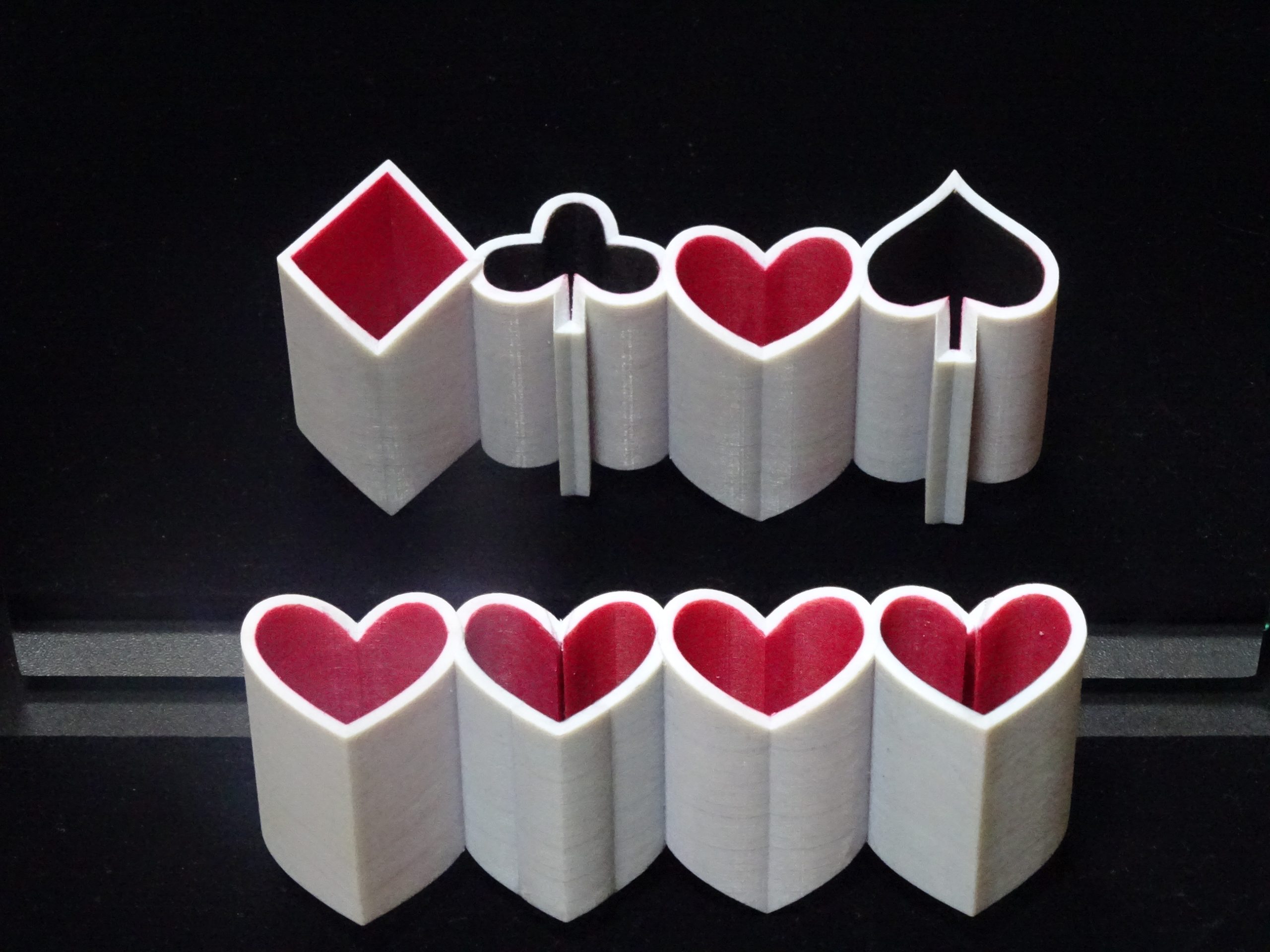
Exhibitions and selected works
The Optical Illusion exhibition in Hanoi presented 53 three-dimensional works, from objects that change shape in a mirror to structures that seem to produce impossible movement. How did you select and arrange the works to guide viewers from initial surprise towards an understanding of the visual mechanisms behind them?
The principle behind all these three-dimensional works is the same. An object has depth, but the retinal image of someone looking at it does not. There is therefore a risk of imagining a depth different from the actual one. I use this to make the works.
Even if viewers imagine the wrong depth, that alone does not make them aware of their mistake. To help them recognise it, I use different methods of presentation: reflecting the object in a mirror, rotating it or adding movement.
Among your best-known works are Ambiguous Cylinder Illusion, which appears to change shape with the viewing angle, and 3D Schroeder Staircase, a stair-like structure that allows multiple interpretations. What questions do these two works raise about how the brain recognises and organises form and space?
These two also work on the same principle. The brain has to imagine depth, and I induce a mistaken interpretation by using its tendency to imagine familiar forms.
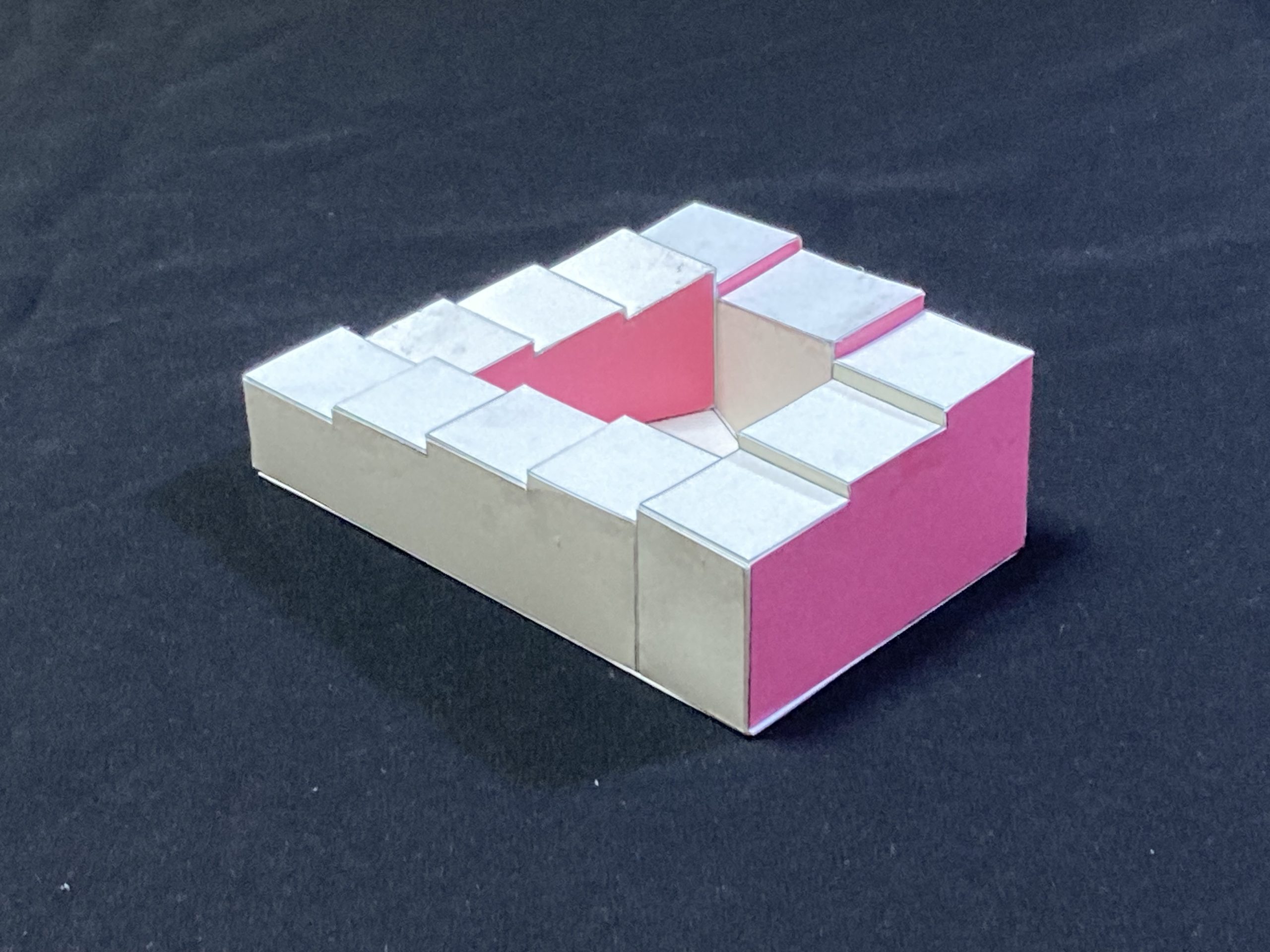
In Impossible Motion: Magnet Slopes, balls appear to roll uphill on a physical three-dimensional model. How does viewing the work through film or photography differ from encountering it in person, particularly in the way viewers try to verify what they are seeing?
When looking directly, we can use two eyes. When looking at a film or photograph, we have information from only one eye, so to speak: the position at the centre of the camera lens.
In the first case, we see the object from two positions, so we can determine its distance through the principle of triangulation. Illusions are therefore less likely to occur. In the second case, depth information does not reach the eyes, and the brain has to imagine it. Because this is an act of imagination, mistakes are common and illusions occur readily.
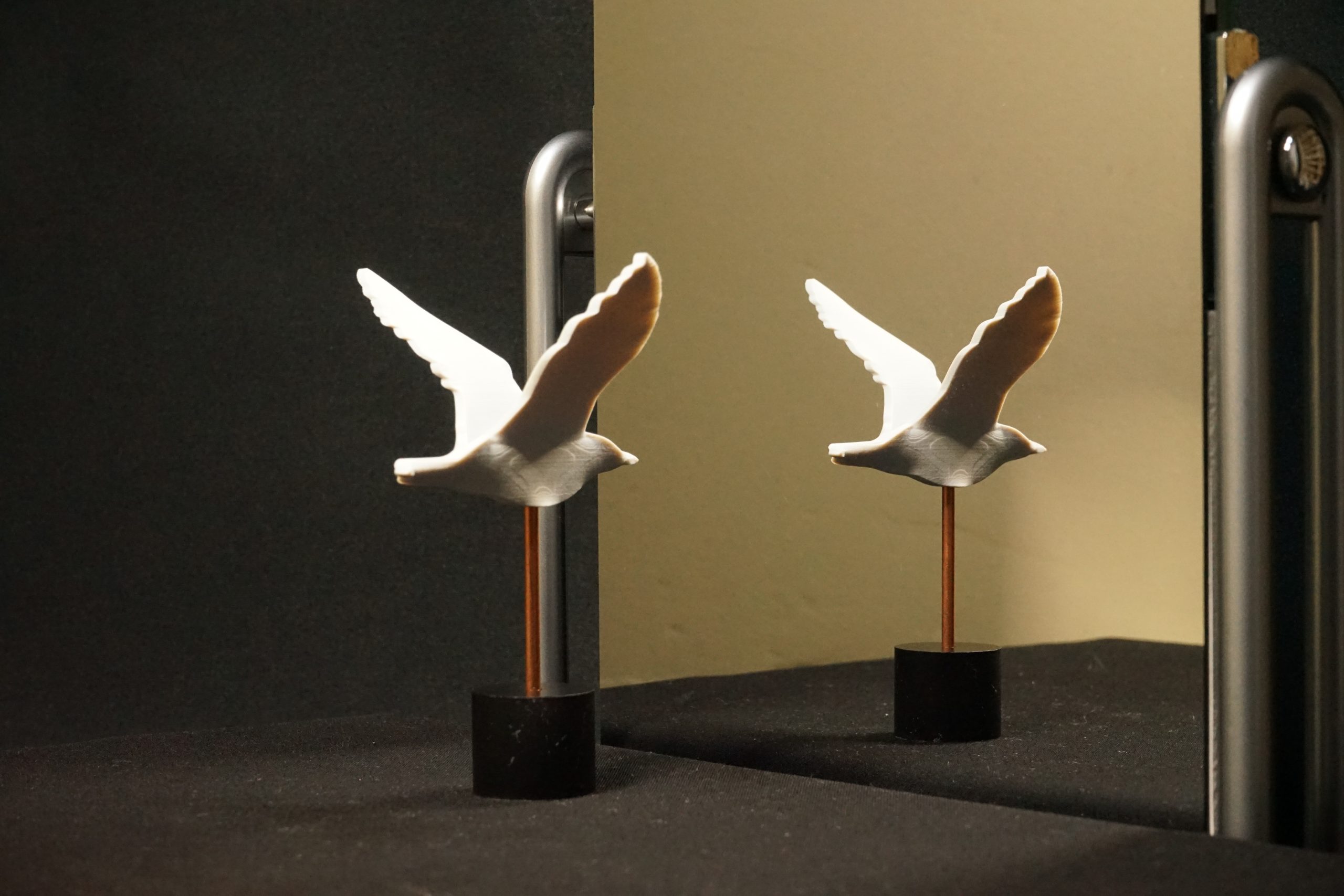
In some of your works, a mirror makes an object’s shape, structure or even its apparent existence seem to change. In your research into vision, is the mirror a tool for revealing the limits of perception, or an element that helps create the work’s form?
I make objects whose appearance changes so dramatically when seen from two directions that it is hard to believe we are looking at the same thing. A mirror is therefore not essential. Viewers can also experience the work by moving around it.
However, a mirror lets us see the object from two directions simultaneously, which I think makes the surprise greater.
Influences and connections with Vietnam
Have any people, artworks, natural phenomena or personal experiences changed how you think about the relationship between a physical object and the image we see?
I have long been interested in the deceptive images of the Dutch printmaker Escher. For a long time, I thought it would be even more enjoyable if I could make them as three-dimensional objects rather than pictures.
I think my mirror works can be regarded as three-dimensional versions of René Magritte’s painting Not to Be Reproduced. Magritte’s work did not prompt me to begin making illusion objects; I noticed the similarity afterwards. But I find the correspondence interesting.
In a painting, the artist imagines and depicts an impossible situation. With a three-dimensional object, by contrast, I show something that actually exists, yet viewers create an impossible situation in their own brains.
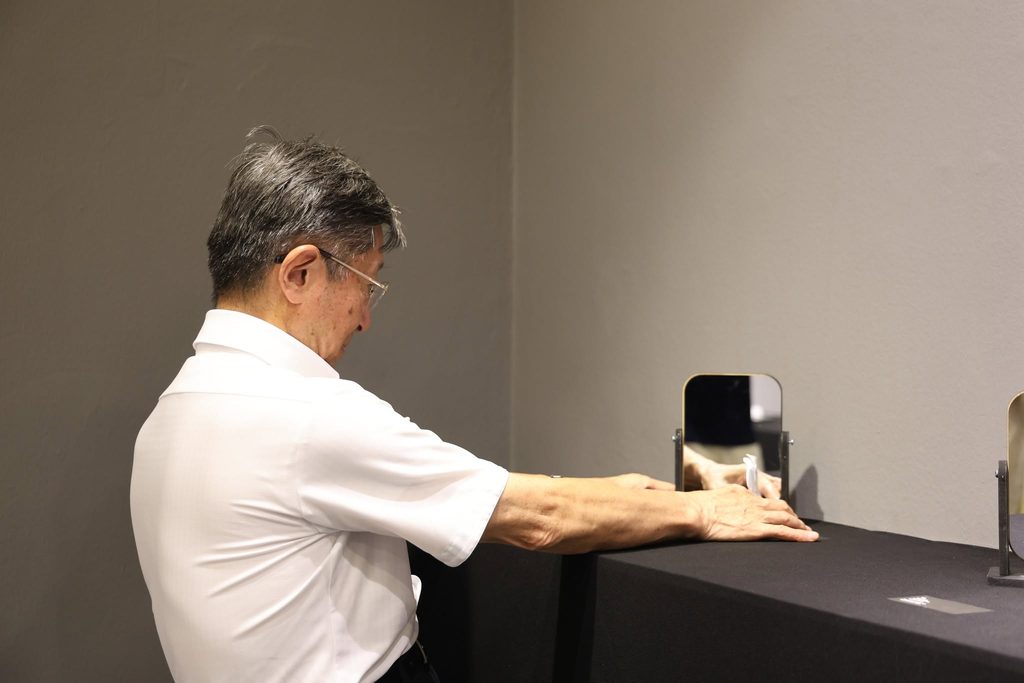
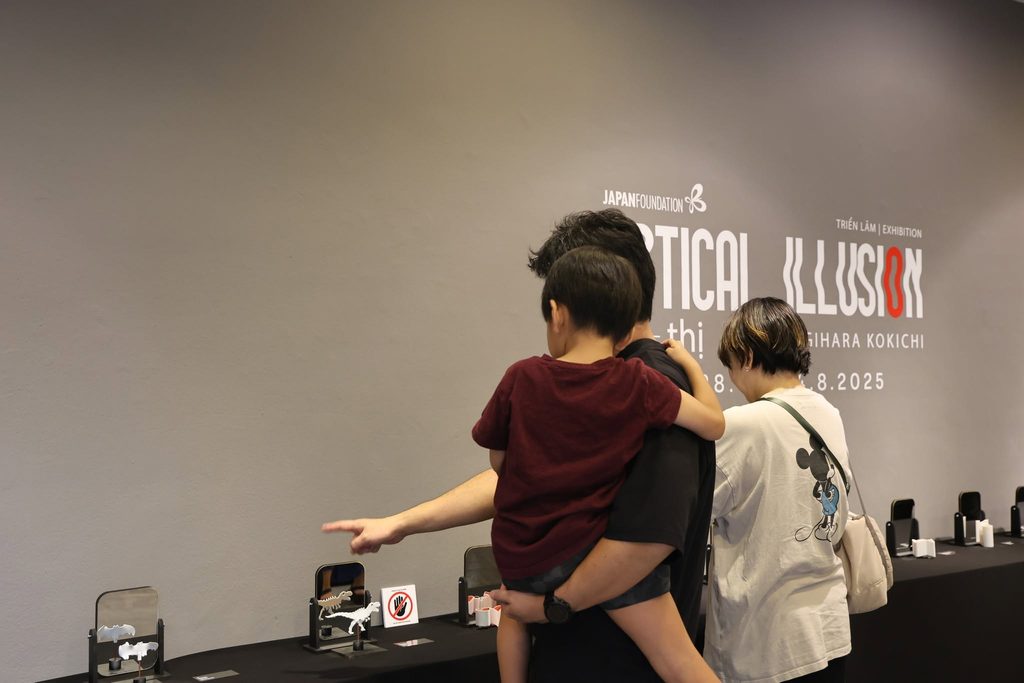
When you visited Hanoi in 2025 and met local visitors, did you notice any differences in their responses compared with audiences elsewhere? Following that experience, do you have any plans or wishes to return to Vietnam or collaborate there in a new way?
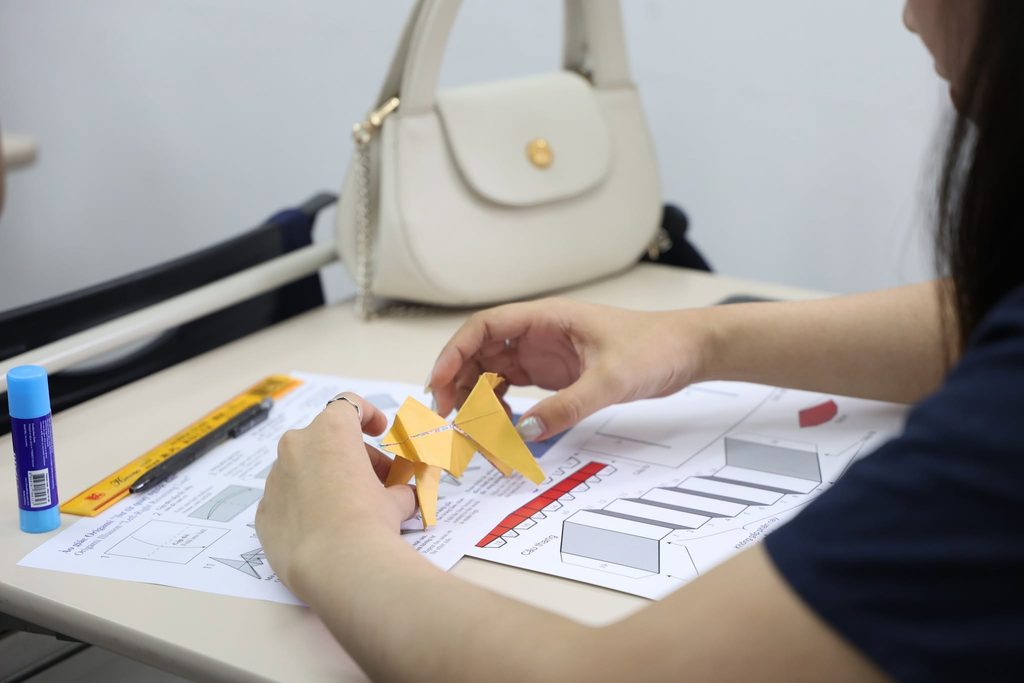
I have no particular plans to return. The greatest difference I noticed compared with Japanese visitors was during the workshop on making three-dimensional illusion objects.
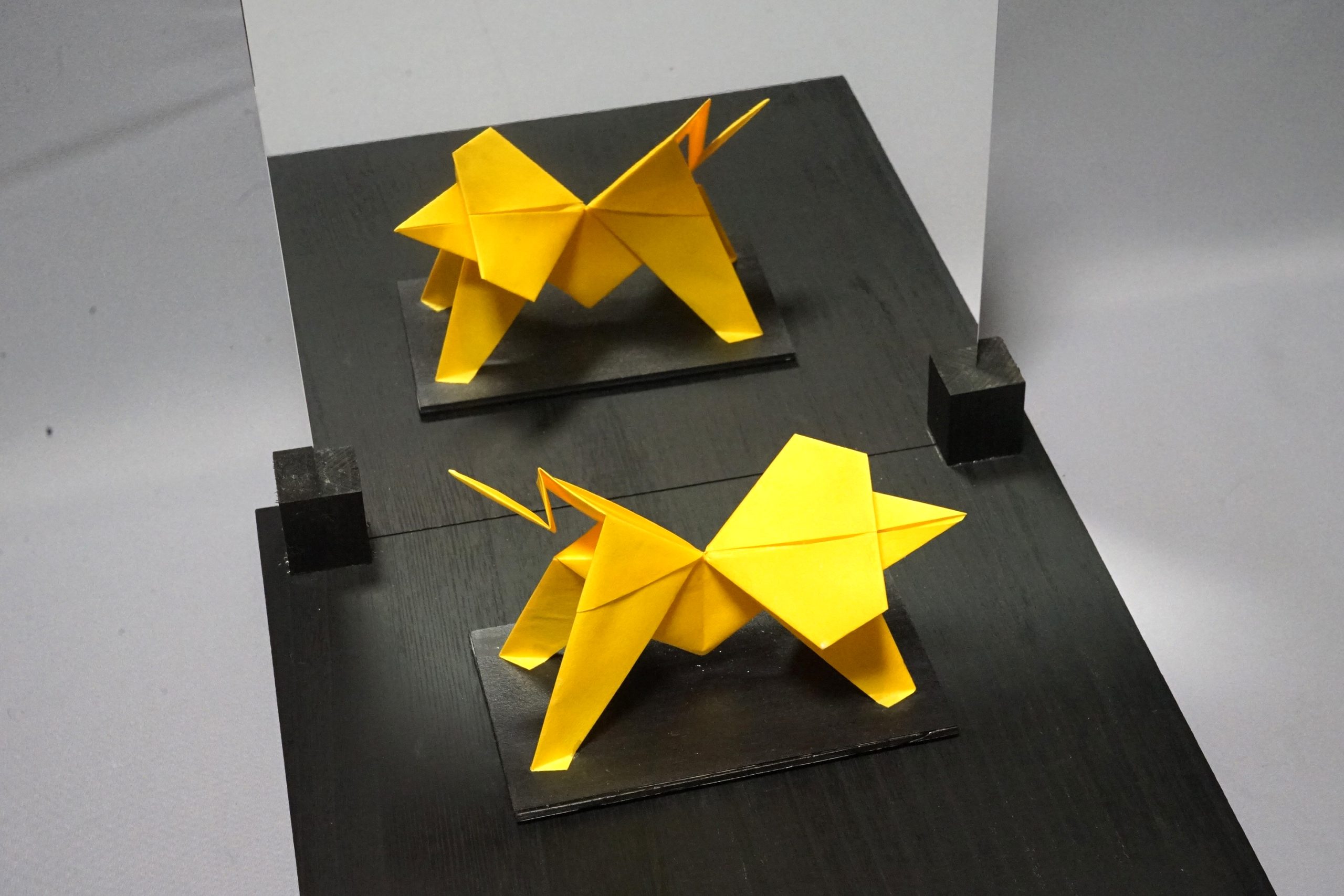
One of the works participants made was the origami piece すれ違うライオン [Lions Passing Each Other]. They seemed to find it considerably more difficult than I had expected. In Japan, origami is a familiar childhood activity, so people know the basic patterns and can combine them easily. That was not the case for the Vietnamese visitors. Looking back, I think the work I chose was a little too difficult.
Project Credits
Interview: Shizu Tomioka
Interviewee and artworks: Kokichi Sugihara
Images supplied by Kokichi Sugihara
Works pictured: 変身立体「気まぐれハート」(2020); 平行移動立体「振り向かない鳥」(2022); だまし絵立体「無限階段」(2023); 折り紙錯視立体「すれ違うライオン」(2025)
Exhibition discussed: Optical Illusion, Japan Foundation, Hanoi, 28 June–24 August 2025
This interview was conducted in writing in Japanese and translated into English.