
Now Reading: Bamboo and woven mats form Kerala Literature Festival pavilion by The Purple Ink Studio
- 01
Bamboo and woven mats form Kerala Literature Festival pavilion by The Purple Ink Studio

Bamboo and woven mats form Kerala Literature Festival pavilion by The Purple Ink Studio

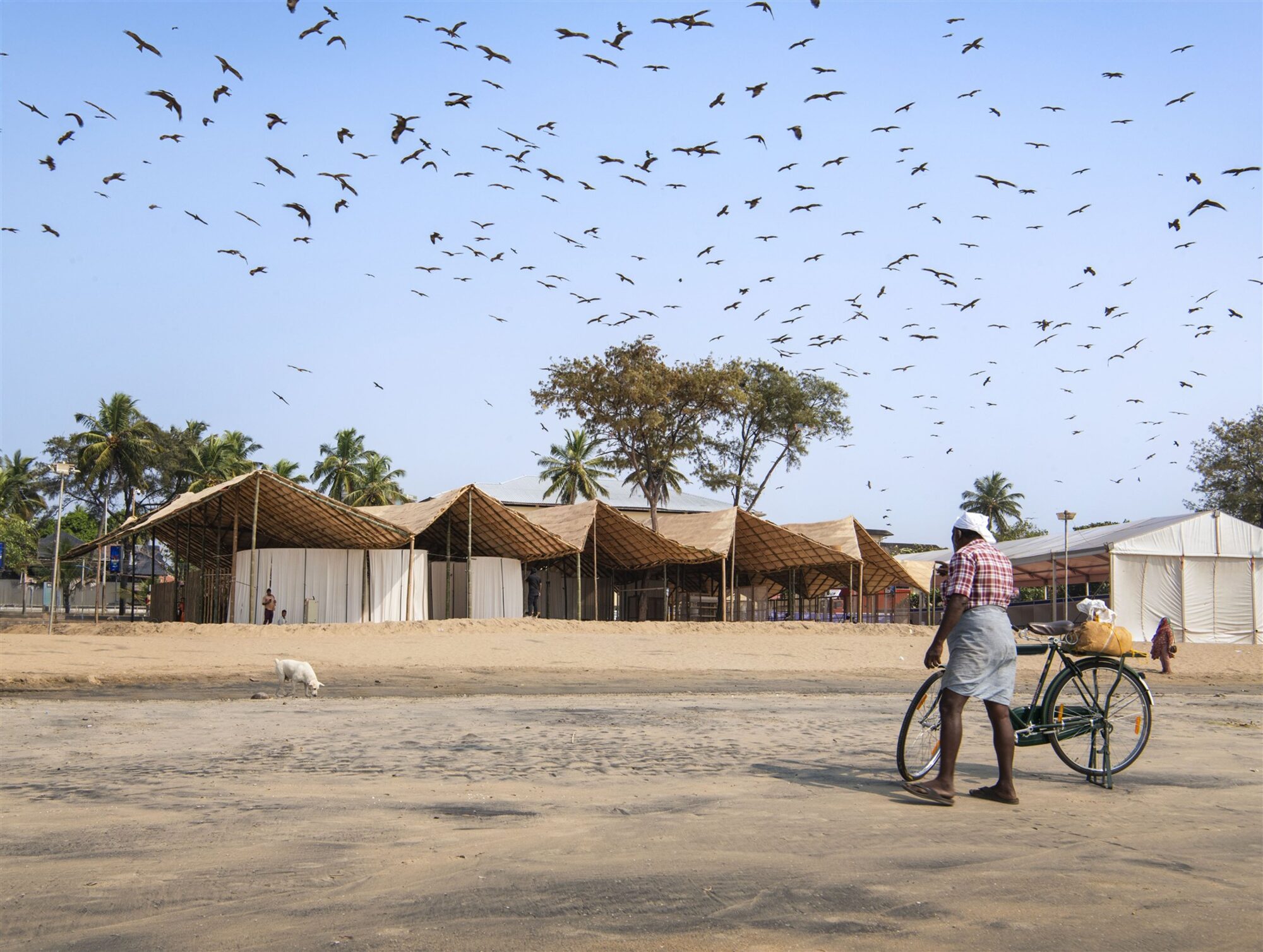
Set along the shoreline of Kozhikode, the Kerala Literature Festival unfolds as a dense cultural landscape, where literature meets the horizon of the Arabian Sea. Within this context, the pavilion resists the logic of the temporary spectacle, instead positioning itself as a spatial vessel shaped by memory, exchange, and material continuity.

The project traces its conceptual roots to early encounters between Kerala and Germany, beginning with the arrival of Basel missionaries in the nineteenth century and extending through industrial and intellectual exchanges. From the Commonwealth weaving and tile factories to the linguistic work of Hermann Gundert, these histories inform a pavilion that translates cultural narratives into spatial experience.


The pavilion unfolds through a geometry derived from the sail, responding to the openness of the beachfront with a series of angled planes. This formal language mediates wind, light, and movement, creating a porous environment that oscillates between exposure and enclosure.


Rather than operating as a singular object, the structure behaves as a temporary home by the sea. Its atmosphere draws from the familiarity of domestic space, introducing warmth and intimacy into the transient intensity of the festival. The pavilion becomes a place not only for gathering, but for slowing down, inhabiting, and remembering.


Locally sourced bamboo forms the primary structural layer, establishing a lightweight framework that can be rapidly assembled on the sandy site. Around this structure, a series of soft and tactile elements define the enclosure. Woven cotton rope screens, produced using a plain weave technique, filter light and air. Calico fabric drapes introduce softness and movement, while terracotta floor tiles ground the pavilion with a sense of permanence. Overhead, woven paaya made from dried grass creates a breathable roof surface that mediates heat and shadow.


These materials are not applied as finishes but integrated as a continuous system rooted in local craft traditions. Their use recalls the legacy of the Commonwealth Weaving Factory and Tile Factory established by the Basel Mission in Kozhikode, embedding historical continuity into the act of construction. Each layer is assembled through local skill, allowing the natural qualities of the materials to remain visible and active within the space.
The construction process responds to both urgency and sustainability. The pavilion is built within a limited timeframe directly on a sand bed, yet its components are conceived with an afterlife in mind, capable of reuse beyond the duration of the festival.


The pavilion operates as a translation of memory into matter. It transforms historical encounters into a spatial condition that can be inhabited in the present. Through its material logic and atmospheric qualities, it creates a quiet continuity between past and present, between event and dwelling.

In doing so, it redefines the role of temporary architecture. The pavilion does not disappear once the festival ends; it lingers through the narratives it carries, the materials it preserves, and the experiences it hosts.

Project Credit
Project name: The German Pavilion for Goethe-Institut / Max Mueller Bhavan Bangalore
Design firm: The Purple Ink Studio / @the_purple_ink_studio
Location: Kozhikode, Kerala, India
Year of Completion: January 2026
Gross Built Area (ft2): / 11,000sqft/1020 sqm
Photo: Stories of Kunju, Advait Vinod, Saurabh Suryan