Now Reading: Qasr AlHokm metro station in Riyadh features reflective canopy and underground garden
- 01
Qasr AlHokm metro station in Riyadh features reflective canopy and underground garden

Qasr AlHokm metro station in Riyadh features reflective canopy and underground garden

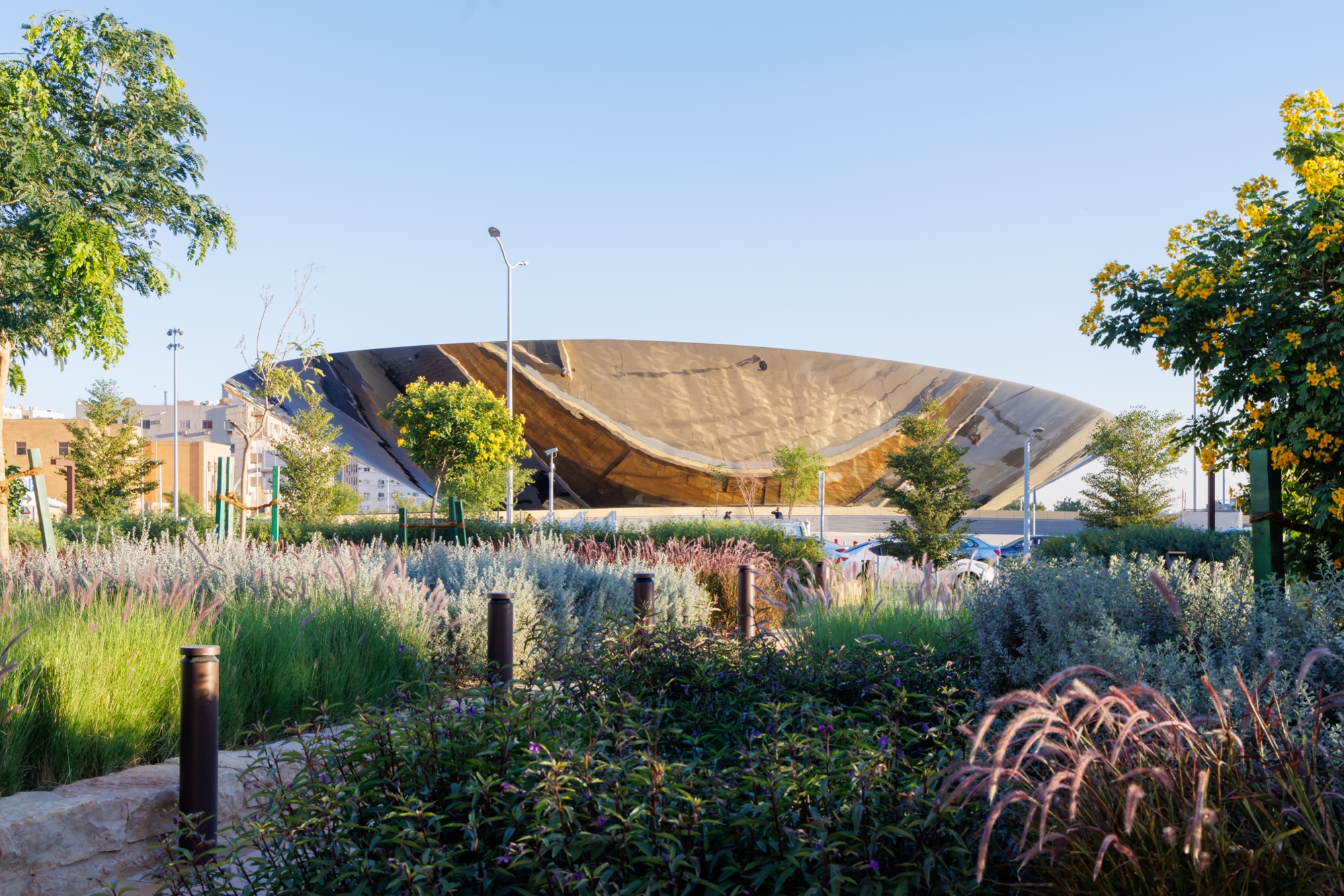
At the historic core of Riyadh, the Qasr AlHokm metro station by Snøhetta is conceived not simply as infrastructure, but as an urban room where movement, orientation, and civic life converge. Positioned as one of the four principal hubs within the city’s new metro network, the station connects two major lines while unfolding as an open pedestrian plaza anchored by a monumental stainless steel canopy.

This canopy operates as both architecture and device. Its mirror polished underside captures a continuous 360 degree reflection of the city, allowing arriving passengers to immediately situate themselves within Riyadh’s urban fabric. From above, the same surface mirrors the activity below, establishing a reciprocal visual dialogue between city and infrastructure. The result is a spatial condition where orientation becomes intuitive, almost instinctive.

Engineered from double curved stainless steel panels and supported by a lightweight spaceframe, the canopy extends beyond its structural base with a sense of suspension. It shades the plaza, redirects daylight into the depths below, and integrates photovoltaic panels across its upper surface, embedding environmental performance within its formal clarity.


Beneath the plaza, the station unfolds across eight subterranean levels, structured around a central atrium carved into a conical volume. Here, light is not incidental but orchestrated. Reflected from the canopy and filtered through patterned openings inspired by Najdi architecture, it travels downward, softening the transition between the intensity of the desert climate and the tempered interior environment.


Within this void, the metro platforms are enclosed in transparent glass tubes that project into the atrium space. These luminous vessels transform circulation into spectacle, revealing the movement of trains as part of the architectural experience. The visibility of arrival and departure enhances wayfinding while reinforcing the station’s role as a connective hinge between past and future Riyadh.
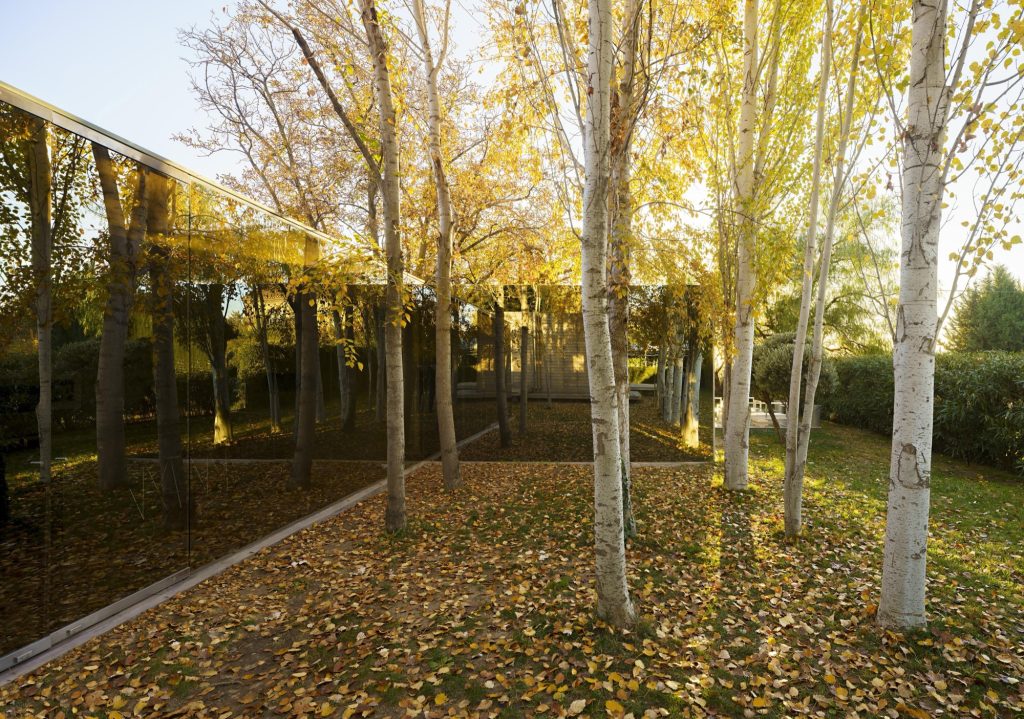
At approximately 35 metres below ground, the spatial narrative culminates in an unexpected condition: a shaded underground garden. Designed as a climatic refuge, the garden maintains a stable, temperate atmosphere even during extreme summer heat. Water collected from the plaza and canopy above sustains its vegetation, embedding a closed loop of resource management within the project’s ecological strategy.

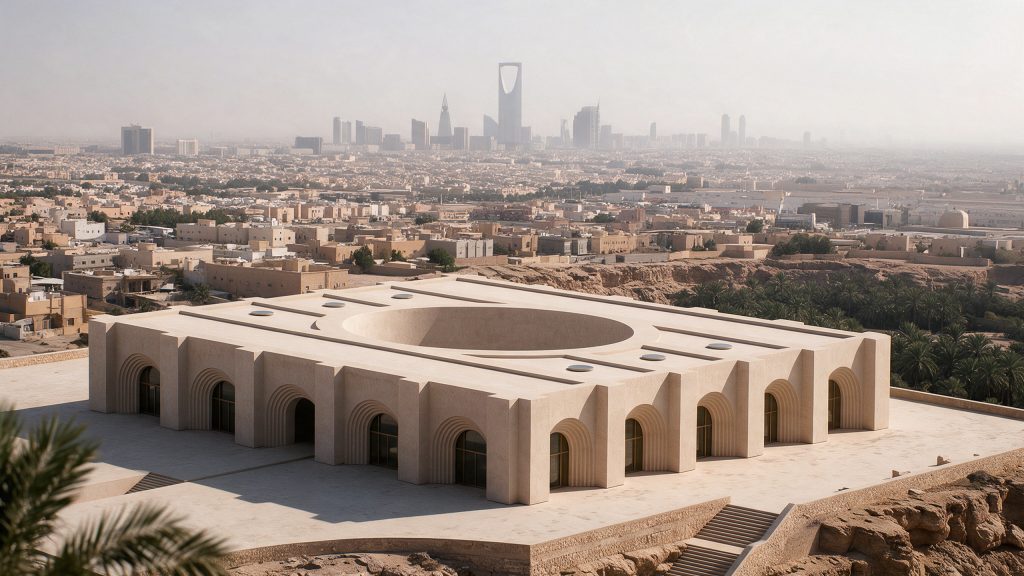
The station’s significance extends beyond mobility. Located adjacent to historic districts and a major Eid prayer ground, it operates as an infrastructural extension of public life in Riyadh. The expansive terrazzo plaza above is conceived as a continuous civic surface, accommodating daily flows as well as large scale gatherings.
A reconstructed mosque forms part of this composition, integrated seamlessly into the broader spatial framework. Subtle elements, such as illuminated drainage channels aligned with the direction of Makkah, allow the plaza to transform into an extension of the mosque during prayer, merging infrastructural logic with ritual practice.

While technologically advanced, the project remains anchored in its cultural context. The inner atrium walls are articulated with geometric cutouts derived from traditional Najdi motifs. These perforations frame partial views across levels while modulating light, producing a layered spatial depth that resonates with regional architectural language.


In contrast, the outer liner wall introduces a contemporary layer through a continuous media installation extending over 100 metres. Composed of hundreds of integrated panels combining acoustic treatment, lighting, and digital display, the wall operates as both orientation device and ambient backdrop. Its restrained visual rhythm offers a deliberate counterpoint to the speed and density of movement within the station.

Completed in 2025, Qasr AlHokm station embodies a broader transformation underway in Riyadh. As the city shifts from car dependency toward a more sustainable mobility model, the project positions public transport as a catalyst for social and environmental change.
Rather than isolating infrastructure from daily life, Snøhetta frames it as a shared civic platform. Reflection, light, and landscape are not decorative gestures but instruments that redefine how space is perceived, navigated, and inhabited. In this sense, the station is less a point of transit than a constructed horizon where the city becomes visible to itself.
Project Credits
Architect: Snøhetta / @snohetta
Collaborators: Cremonesi Workshop, One Works
Location: Riyadh, Saudi Arabia
Status: Completed 2025
Area: 20,000 sqm station, 20,000 sqm plaza and mosque
Photography: Iwan Baan / @iwanbaan
More Photos