
Now Reading: The Farmstay explores semi-prefabricated rural living in Vietnam
- 01
The Farmstay explores semi-prefabricated rural living in Vietnam

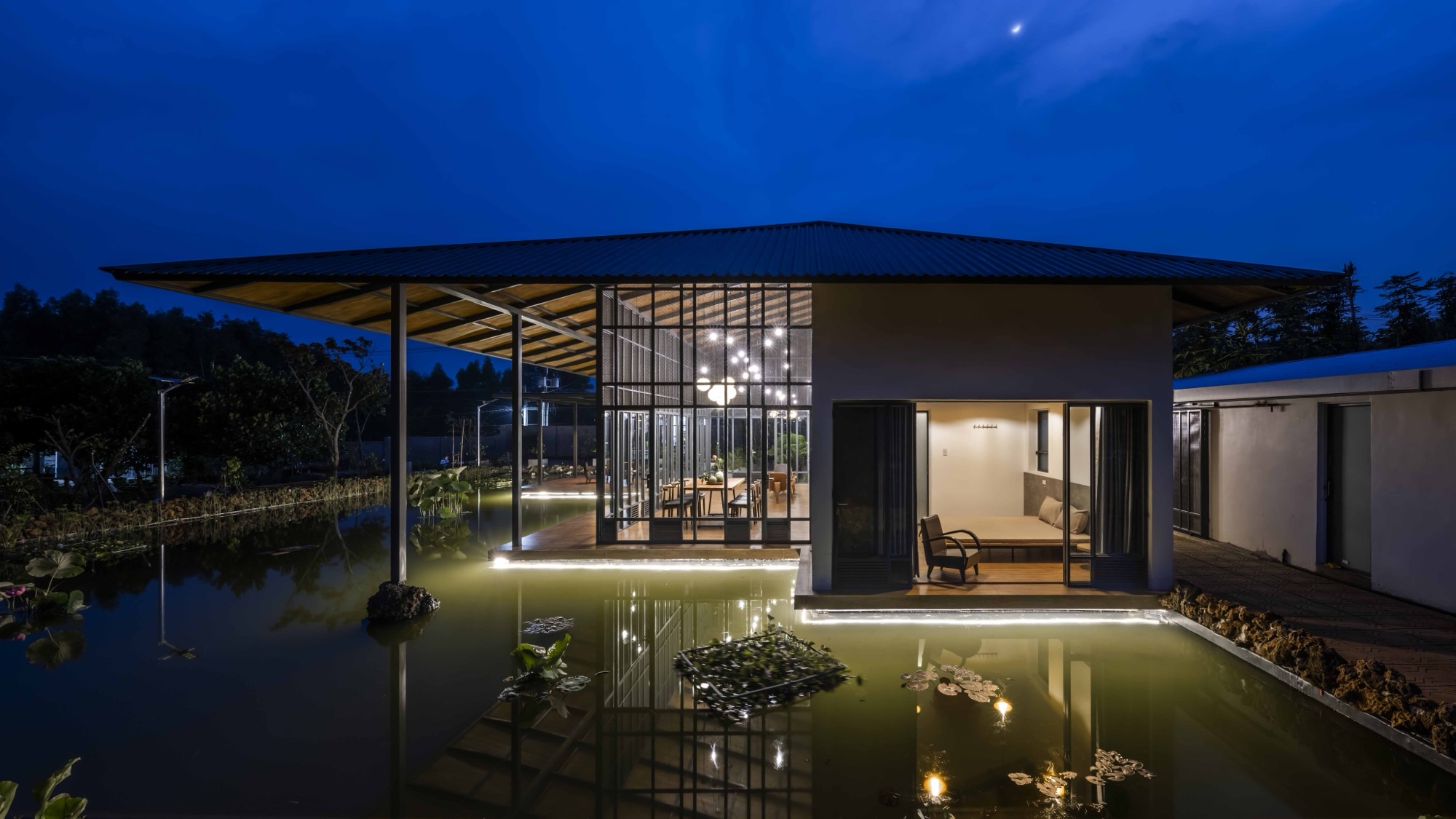

Located in Dong Nai in Southeast Vietnam, approximately 55 kilometres from the future Long Thanh International Airport, The Second Farmstay marks the beginning of a long term research process between the architects and the homeowner to develop a contemporary farmstay model rooted in agricultural practice and environmental responsibility.
The site lies within a rapidly transforming rural territory, only eight kilometres from the North South Expressway and around twenty kilometres from the Chua Chan Mountain tourist area and Gia Lao Pagoda. Despite its proximity to new infrastructure, the landscape remains defined by orchards, ponds, and small scale agricultural production. Young locals sometimes refer to the area playfully as Lang Me City.

The homeowner belongs to a new generation of farmers who approach agriculture through scientific research and technical experimentation rather than traditional cultivation methods. From the earliest stages of the project, the design team collaborated closely with the owner to discuss water circulation, energy efficiency, and the spatial relationship between the house, the orchard, and the surrounding landscape.
The resulting plan integrates accommodation, leisure, and agricultural activity into a single spatial system, allowing the farmstay to operate both as a productive landscape and as a place of rest.
WATER AS LANDSCAPE, INFRASTRUCTURE, AND MICROCLIMATE
Agricultural production in Southeast Vietnam has long depended on groundwater extracted through boreholes. In many areas, decades of intensive use have significantly depleted underground water reserves, making irrigation increasingly unreliable.

Responding to this condition, the project prioritises water storage as a central component of the design. A large pond functions as a reservoir that stabilises irrigation for the fruit orchard. Water is pumped from the well, stored in the pond, and gradually redistributed across the garden.

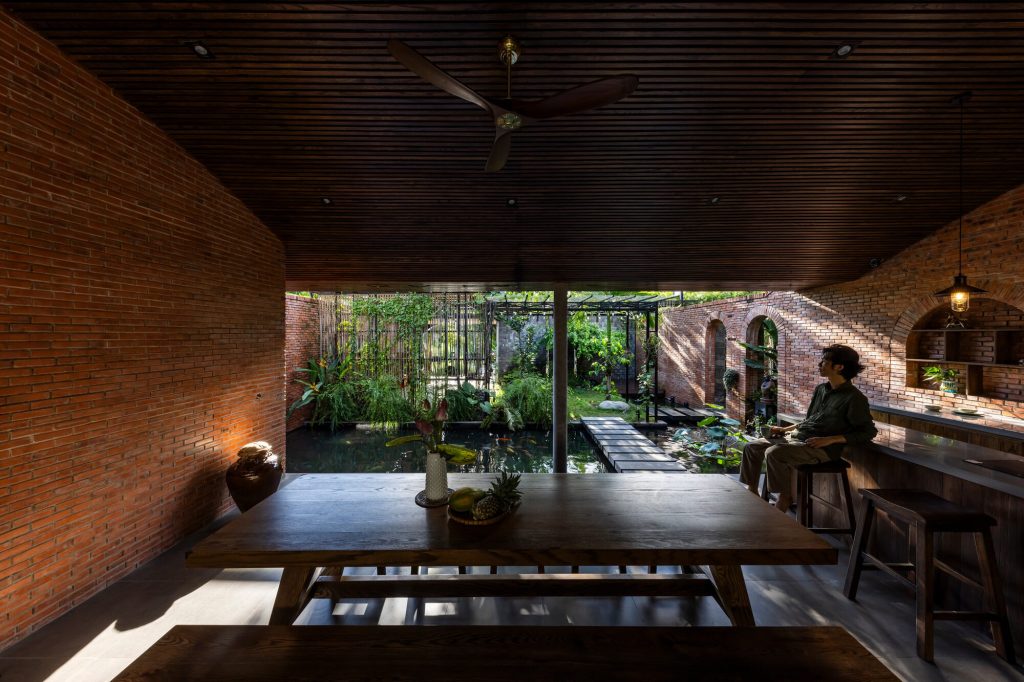
Rather than treating the pond solely as infrastructure, the architects developed it as a multi functional landscape element. It moderates the microclimate, reflects light into the house, and becomes the visual centre of the farmstead.

Aquatic vegetables grow along the water surface, providing clean food for the household while contributing to natural filtration. The owner also raises fish in moderate quantities, supporting daily meals and creating an additional experience for visitors who come to stay at the farm.


ARCHITECTURE ORGANISED AROUND THE POND
The spatial organisation of the house follows a clear division between private and communal zones. The private functions are concentrated in a sequence of compact masonry volumes that contain the altar room, bedrooms, kitchen, bathrooms, and a sauna. These solid blocks are placed to one side of the site.


By consolidating enclosed rooms in this way, the entire frontage facing the pond is freed for communal activities. The living area, dining table, and open porch all orient toward the water, creating a continuous relationship between the interior and the surrounding orchard landscape.

The layout also responds to the social habits of rural life. In many Vietnamese villages, neighbours visiting the house typically gather on the porch to drink tea and talk rather than entering the formal living room, which is often reserved for special occasions and family ceremonies.

To accommodate this cultural practice, the architects created a small tea pavilion located within the pond itself. This intimate structure allows family members and guests to sit surrounded by water, creating a quiet space for conversation and relaxation.

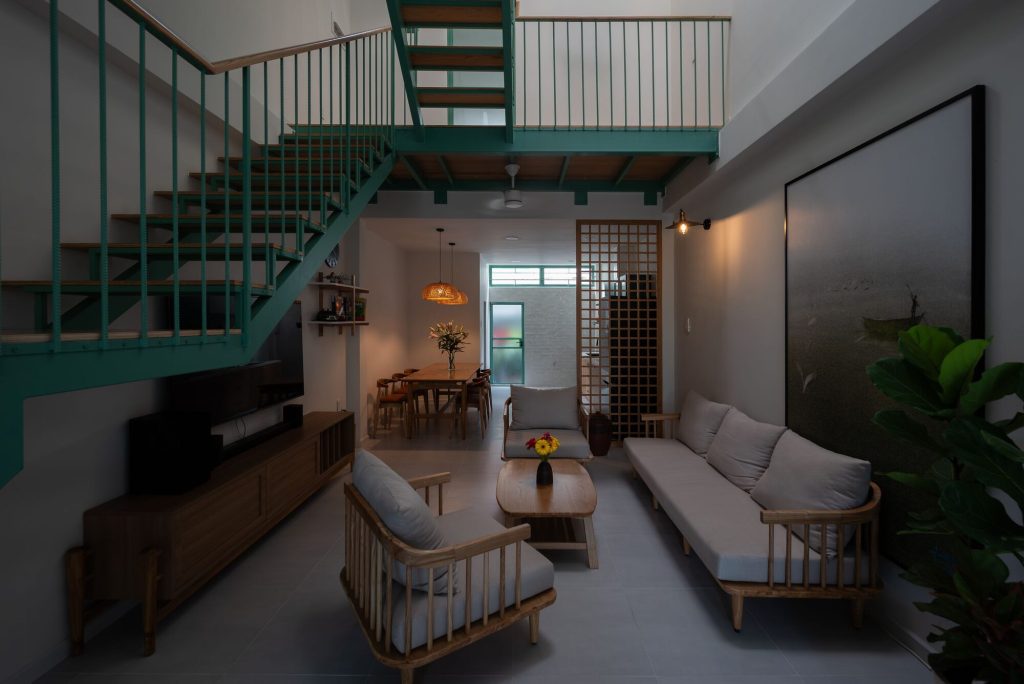
Inside the house, the living room functions as the main communal interior space where the family gathers in the evenings, often watching television together while remaining visually connected to the landscape outside.


A SELF SUFFICIENT GARDEN LANDSCAPE
The farmstay is surrounded by a productive garden composed of fruit trees and edible vegetables. The planting strategy allows the household to approach a largely self sufficient lifestyle, with only occasional visits to local markets to diversify daily meals.

This close relationship between dwelling and cultivation reflects the broader ambition of the project. Rather than separating leisure from agriculture, the design integrates them into a single living environment where production, hospitality, and everyday life coexist.

EXPERIMENTING WITH LOW EMISSION CONSTRUCTION
Beyond lifestyle considerations, the project also investigates construction strategies aimed at reducing environmental impact. Conventional building processes such as material extraction, cement production, brick firing, transportation and on site construction generate significant emissions. Reducing this footprint therefore became a central objective of the design.
The Second Farmstay serves as the first prototype in an ongoing research programme exploring prefabricated housing systems. The project adopts a semi prefabricated approach that combines traditional brick construction with a modular steel structure.

Private functions are organised within three simple painted brick volumes containing the bedrooms, kitchen and service areas. These blocks are intentionally separated, allowing air from the pond to pass through the gaps and create natural convection that improves ventilation and reduces reliance on mechanical cooling.

The communal spaces and roof are constructed using a prefabricated galvanised steel frame. Insulated PU roofing panels provide thermal protection above, while a natural wood ceiling softens the interior atmosphere below.
Perforated metal panels, steel framing and prefabricated glass form the envelope of the shared areas, allowing natural light and airflow while maintaining unobstructed views of the pond and orchard. Deep roof overhangs extend toward the water, reducing direct solar heat on the large glass openings.


TOWARD A MODULAR RURAL ARCHITECTURE
Together, these strategies produce a building capable of responding to the hot and dry climate conditions typical of Southeast Vietnam while maintaining a light environmental footprint.
The project also acts as the first field test for what the architects call the 5G Construction Solution, a modular prefabricated approach focused on reducing complexity, labour requirements, construction time, costs, and carbon emissions.

For this initial prototype, the system remains only partially implemented, resulting in a semi prefabricated structure with a total construction budget of approximately 1.5 billion Vietnamese dong, equivalent to about 58,800 US dollars.
Following the completion of The Second Farmstay, the design team continues to refine and expand this construction methodology for future projects. The house therefore functions not only as a rural retreat and agricultural residence, but also as a research platform exploring how prefabrication, landscape integration, and sustainable living might reshape the architecture of farmstays in contemporary Vietnam.


Project Credit
Project name: The Second- Farmstay
Design firm: CTA | Creative Architects / @cta_creativearchitects
Completion Year: 2025
Location: Cam My, Dong Nai, Vietnam
Land Area: 1737 m2
Ground Floor Area: 116 m2
Photo: Hiroyuki Oki