Now Reading: Abstract landscape shapes a new civic landmark in Daixi
- 01
Abstract landscape shapes a new civic landmark in Daixi

Abstract landscape shapes a new civic landmark in Daixi
A TOWN IN TRANSFORMATION
Across China, many historic towns are confronting the paradox of rapid modernization. Centuries of cultural evolution once produced distinctive spatial patterns and rhythms of life, yet contemporary development has gradually blurred these identities. Uniform construction and generic urban expansion have diluted local character, leaving many towns visually indistinguishable from one another.
Architecture therefore faces the urgent task of restoring a sense of place within landscapes where cultural identities have become increasingly indistinct.

The Daixi Culture, Sports and Commercial Complex in Huzhou approaches this question through a reinterpretation of traditional landscape aesthetics. Instead of reproducing historical imagery, the project translates the spirit of Chinese landscape painting into contemporary architectural language.

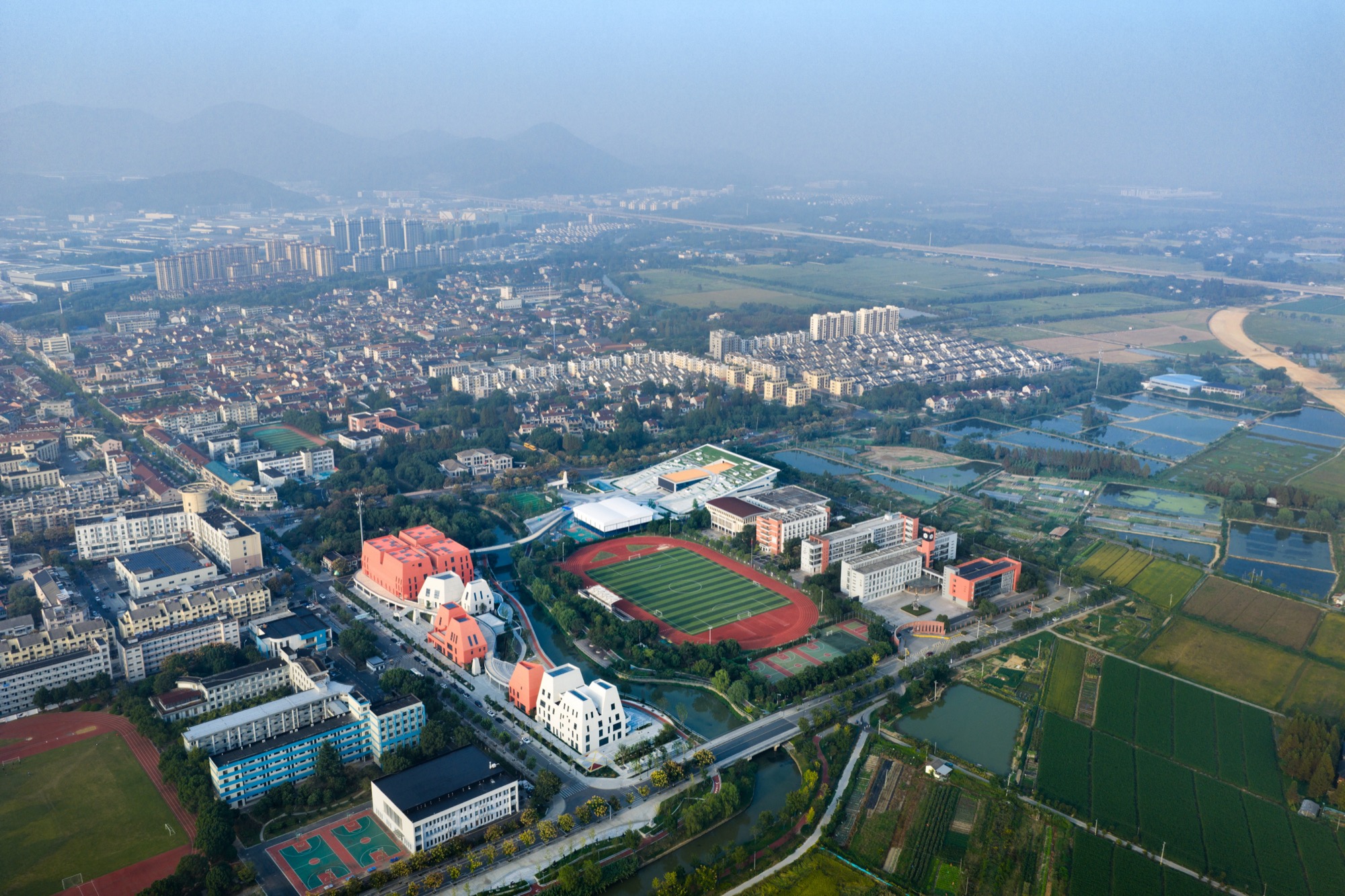
Located in Wuxing District, Daixi Town sits between the Tianmu Mountains and the Hangjiahu Plain. The town belongs to the Jiangnan cultural region, known for its water networks, stone bridges and whitewashed architecture. In recent decades Daixi has shifted from an agricultural economy toward a specialized beauty industry, accelerating urban development while weakening the visual identity of the town.

To respond to this transformation, the local government designated a central riverside site for a public complex combining cultural, sports and commercial functions. Divided by a north south river and framed by two schools, the site still contains a Qing dynasty stone bridge that quietly recalls the town’s historical continuity.
ABSTRACT LANDSCAPE
The project moves beyond a purely functional interpretation of architecture. While meeting practical requirements, the design seeks to create an architectural landscape inspired by the aesthetic principles of Chinese painting.
Traditional landscape painting emphasizes spiritual resonance rather than literal depiction. Mountains and rivers are suggested through minimal gestures that invite imagination. The architecture adopts this principle by translating natural imagery into abstract geometric forms.

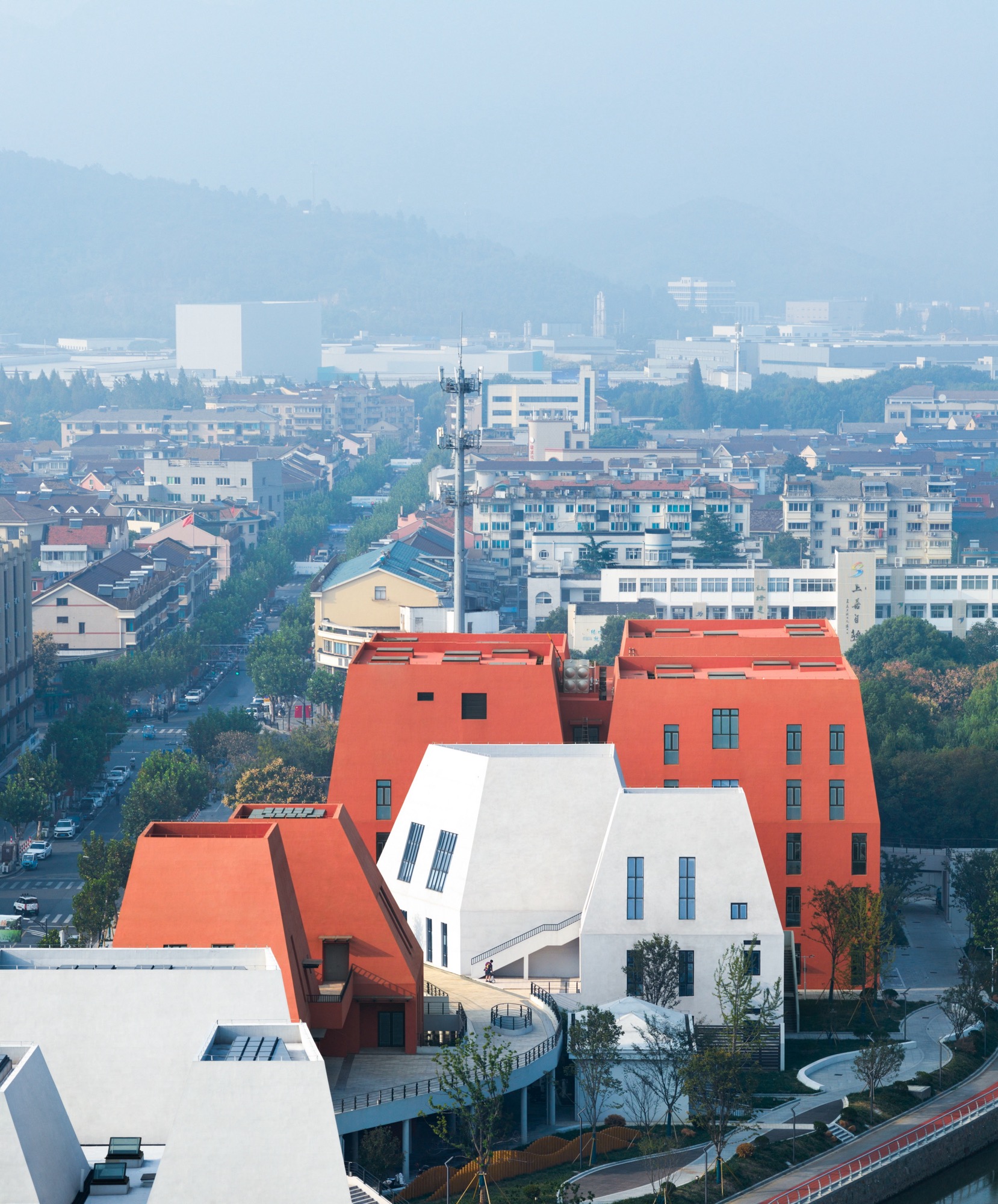
The complex unfolds across both sides of the river. A commercial center occupies the western bank while a culture and sports center stands on the eastern side. Their fragmented volumes and sloping roofs create a sculptural composition that evokes distant mountain silhouettes rising from the terrain.

White and orange red facades establish a vivid chromatic dialogue. The palette recalls the white walls of Jiangnan architecture while introducing a contemporary intensity reminiscent of land art.


A RIVER CORRIDOR
Connecting the two parts of the complex is a winding pedestrian corridor that crosses the river. Rather than functioning merely as a bridge, it becomes the central spatial gesture of the project.

Its curved form follows the rhythm of flowing water. As visitors move along the corridor, the surrounding scenery gradually unfolds. Views shift between architecture, river and distant skyline, recalling the experience of walking through a traditional Chinese landscape scroll.
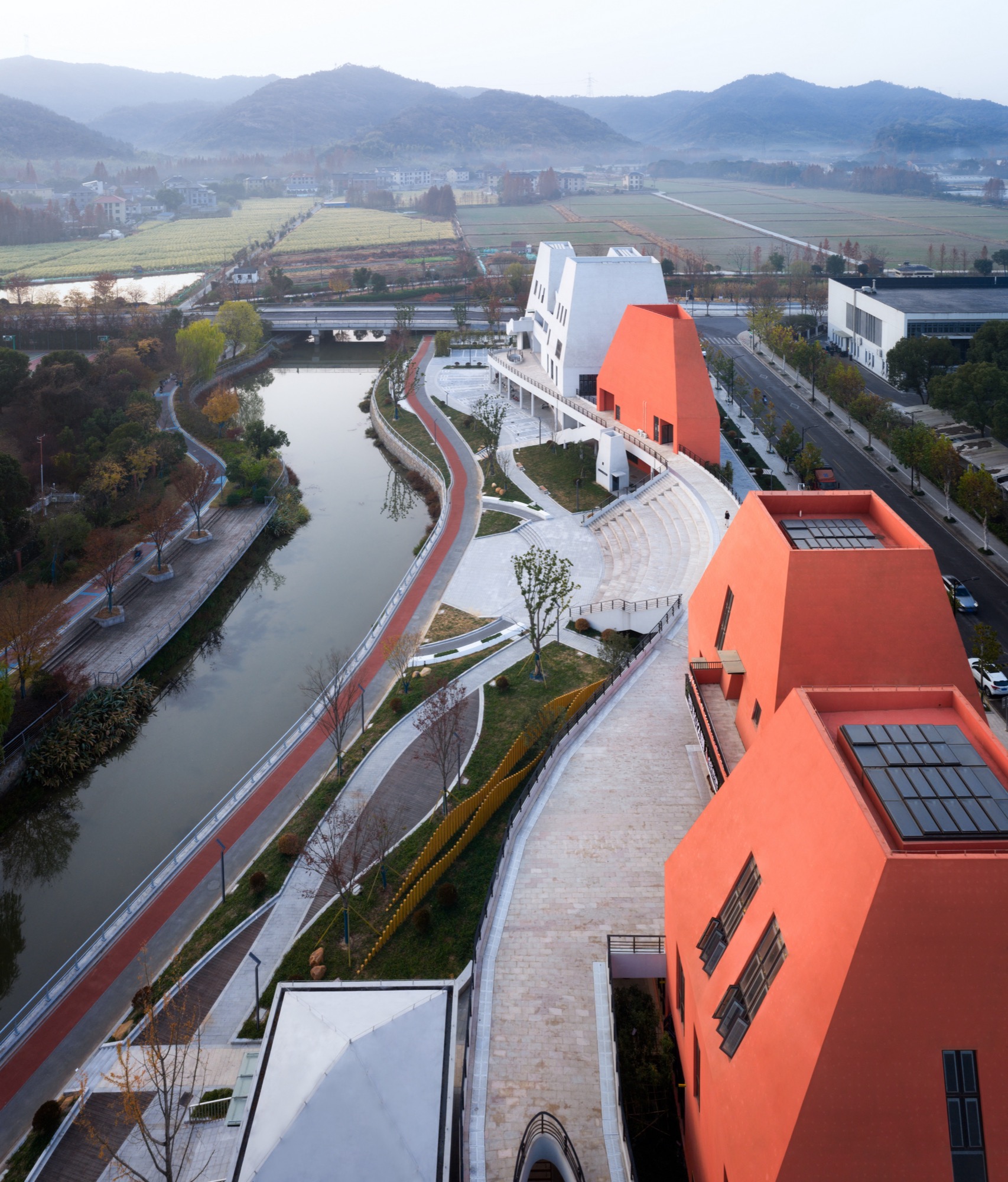
The corridor also connects different dimensions of everyday life. The commercial center represents the vitality of daily urban activity, while the cultural and sports facilities provide spaces for reading, learning and physical exercise. By linking these programs together, the project creates a continuous civic landscape where social interaction and cultural life coexist.
ARCHITECTURE AND EVERYDAY LIFE
Despite its sculptural presence, the complex is rooted in daily use. The commercial center offers flexible interiors capable of accommodating diverse programs, while the cultural facilities include a swimming pool, gymnasium and basketball court that serve the town’s residents.

Outdoor spaces extend this civic role. Walking paths and resting platforms line the riverbank, encouraging people to pause and engage with the water landscape. The corridor itself functions not only as circulation but also as a place for observation and gathering.


Through this integration of architecture, landscape and public activity, the project transforms an abstract concept into a lived environment.
A CONTEMPORARY LANDSCAPE
Seen from afar, the complex appears as a composition of abstract mountains connected by a flowing stream. The architecture reinterprets the cultural imagery of landscape painting without resorting to literal imitation.

In doing so, the project proposes another possibility for rapidly transforming towns. Cultural identity can emerge not through nostalgic reproduction but through reinterpretation, where tradition becomes a source of spatial imagination.

The Daixi Culture, Sports and Commercial Complex ultimately functions as a contemporary architectural scroll. Within this landscape of forms and spaces, everyday life becomes the brushstroke that completes the picture.


Project Credit
Architectural Design: Minax Architecture / @minax_architects
Area: 32,959 m²
Project Period: 2020-2025
Photographer: Shan-jian images
Location: Huzhou, Zhejiang, China
More Photos


Related Posts
Previous Post
Next Post
- The timeless elegance of domestic appliances: From the Iconic Braun KF 20 aromaster to the German design ethos

- Emilio Ferro on the light, sound and memory of a place
- At Maniwa, an architect’s family home opens to the neighbourhood
- What bronze remembers of the hand

- Caught in light: Moradavaga’s suspended shoal

- The making of Alex Chinneck’s impossible Dior windows