Now Reading: The Room Inside a Cupboard: Schreibmayr’s Hausbüro and European Furniture of the 1950s
- 01
The Room Inside a Cupboard: Schreibmayr’s Hausbüro and European Furniture of the 1950s

The Room Inside a Cupboard: Schreibmayr’s Hausbüro and European Furniture of the 1950s
Schreibmayr’s Hausbüro, a 1950s cupboard that opens into a complete home office, is a small key to post-war German life: the cramped flats, the new middle class, and a way of designing that began with very concrete questions.
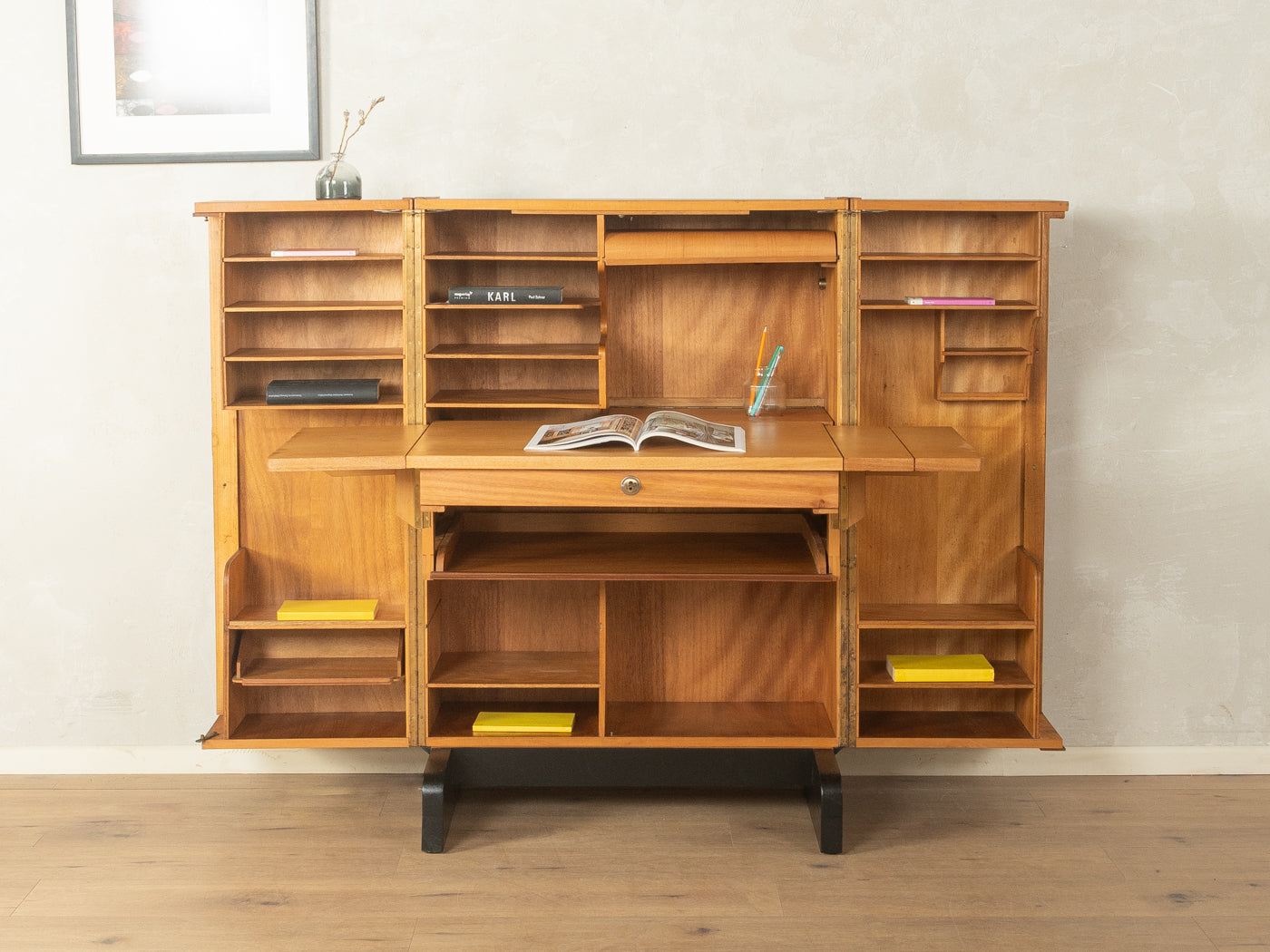
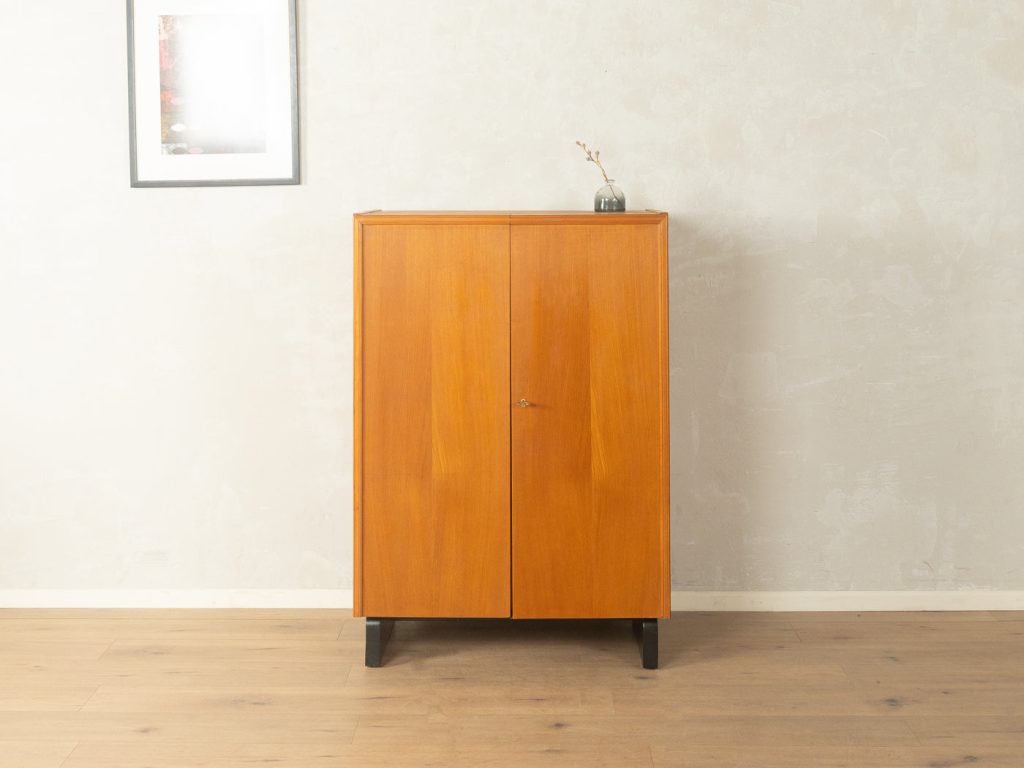
A short video from a second-hand shop in Düsseldorf opens on a brown wooden cupboard, roughly chest-high, standing on black-lacquered sled legs. Put it in a living room today and people would take it for an ordinary storage cabinet. Nobody would think of work. Then a hand swings the two doors open to either side. Afternoon sun slips in and falls on tiered wooden compartments, a pot of pencils, a curved hood wrapped in veneer. The writing surface is drawn out, lowered and settled into place. The cupboard is now nearly twice as wide, and a complete workspace has appeared. The Germans call this kind of cupboard a Hausbüro, an office in the home. The one in the video was made by Schreibmayr some time in the 1950s, and today hardly anyone remembers the name.
On the lower shelf, beside a roll of paper and three lever-arch files, someone has left a laptop. I lingered on this detail longer than any other. An object conceived for paper, ink and the typewriter is still doing its job almost seventy years on. Only the work has changed shape.
After the ruins, small flats
To understand the Hausbüro, one has to go back to the German cities of 1945.
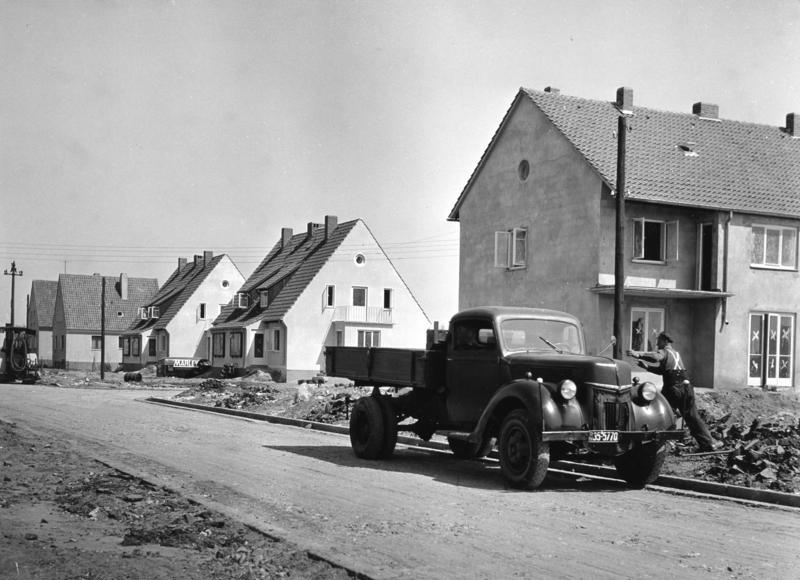
The bombing had wiped out millions of homes. Refugees poured in from the east, and many families had to share a single room, sometimes in the cellar of the very house that had collapsed above them.

West Germany answered with social housing, and the first housing act came into force in 1950. Rows of four- and five-storey blocks rose one after another on the edges of the cities. The flats inside were clean, with running water and electricity, but they were cramped. Every room had already been assigned a purpose, and there was rarely one to spare.
At the same time, the economy recovered so quickly that Germans called the period the Wirtschaftswunder, the economic miracle. A new middle class took shape: civil servants, insurance agents, craftsmen opening their own workshops, small traders. They had steady incomes, and with them came contracts, ledgers and correspondence, and a share of the work that followed them home.
But their flats had no study. By day the sitting room received guests; in the evening the whole family gathered there to listen to the wireless. A desk strewn with files in the middle of it all was hard to accept for the orderly habits of Germans at the time.
The Hausbüro was born in exactly that tension, between the need to work and the wish to keep the home a home.
The lineage of an idea
Schreibmayr’s cupboard did not come from nowhere. It is the meeting point of at least three lines of thought, and each has left a trace in it.
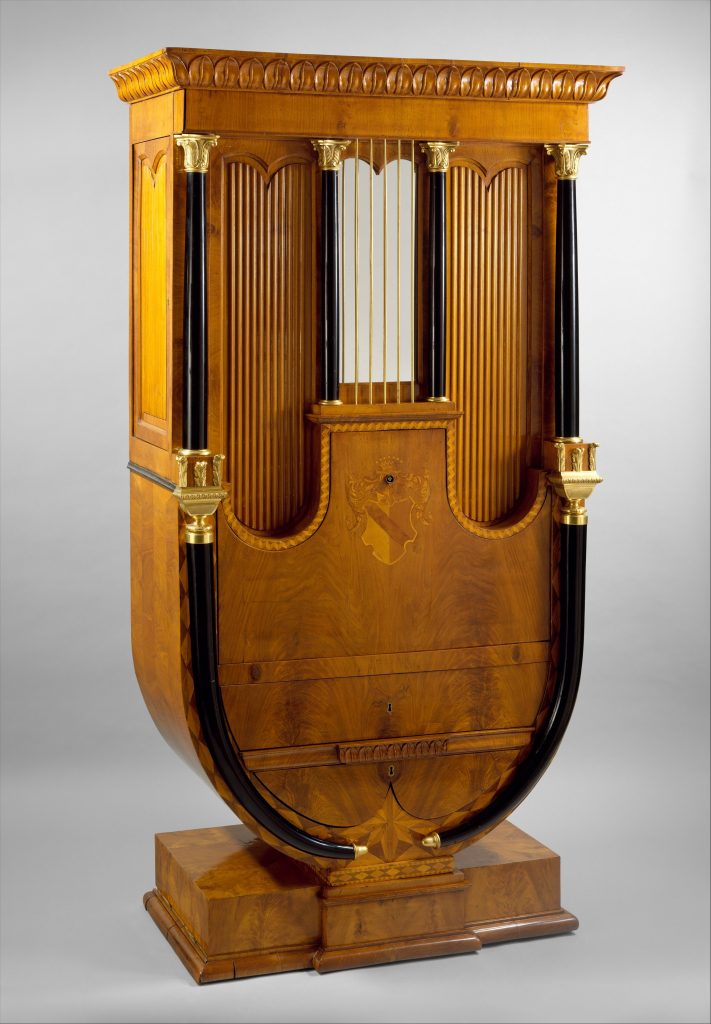
The first is the Sekretär, the drop-front writing desk familiar in European homes of the eighteenth and nineteenth centuries. Its wooden flap folds down into a writing surface, and behind it sit small drawers for letters and papers. By the Biedermeier period it had become something close to an emblem of private, orderly bourgeois life. The Hausbüro keeps that spirit intact: writing and keeping records are private matters, and so they need a door and a lock.
The second comes from across the Atlantic. In 1874, William S. Wooton of Indianapolis patented a cabinet desk whose two wings opened onto hundreds of pigeonholes. The Wooton desk was the office of American businessmen in the industrial age: large, heavy and expensive. The Hausbüro borrows its two-winged structure, then scales it down and strips away the ornament until it suits an ordinary household.
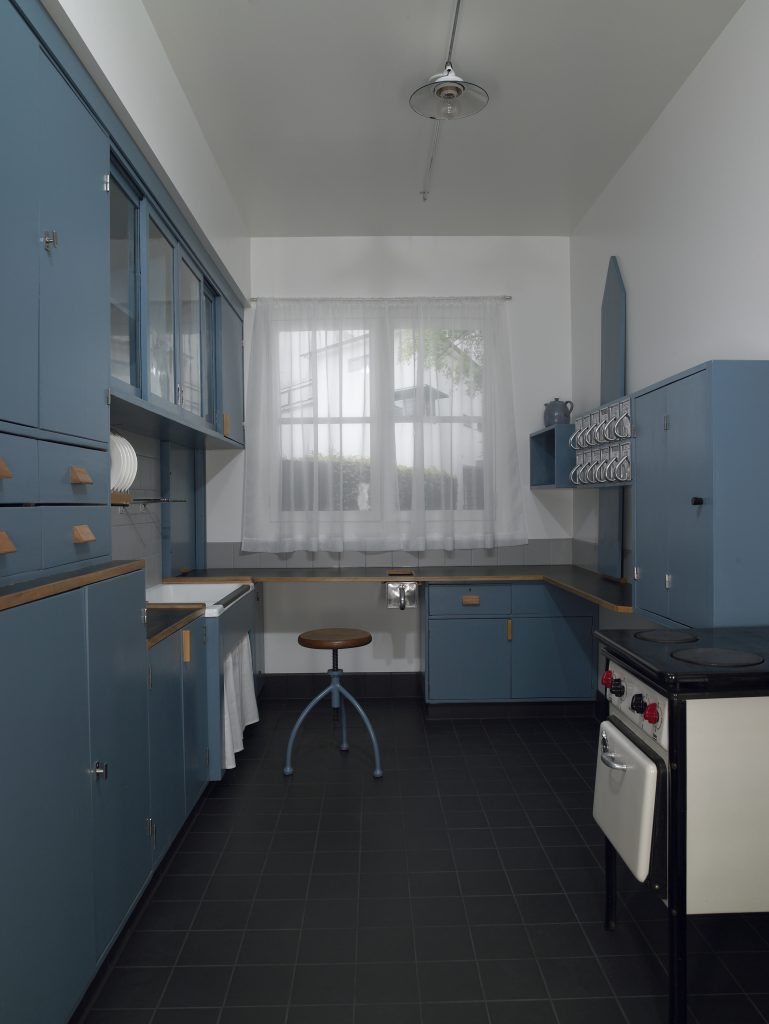
The third is closer, and perhaps the most decisive. In the late 1920s, modern European architects argued at length about the Existenzminimum, the minimum space in which a person could live with dignity. In 1926, Margarete Schütte-Lihotzky designed the Frankfurt Kitchen, a small kitchen in which every step and every reach of the cook had been measured. The Hausbüro carries the same way of thinking from the kitchen to the desk.
After the war these ideas gradually hardened into a moral standard. Max Bill and the Swiss Werkbund spoke of ‘Die gute Form’, good form. West Germany set up its Design Council, the Rat für Formgebung, in 1953, the same year the Ulm School of Design was founded. A good object had to be true to its materials, durable, sufficient and free of display. A country that had just come through years of grandiose delusion wanted to find itself again in modest things.
Schreibmayr was probably just a workshop, with no theoretical ambitions. But its cupboard breathed the same air as its time.
Behind the two doors
Let us go slowly through the cupboard, from the outside in, as someone using it in 1956 might well have done each morning.
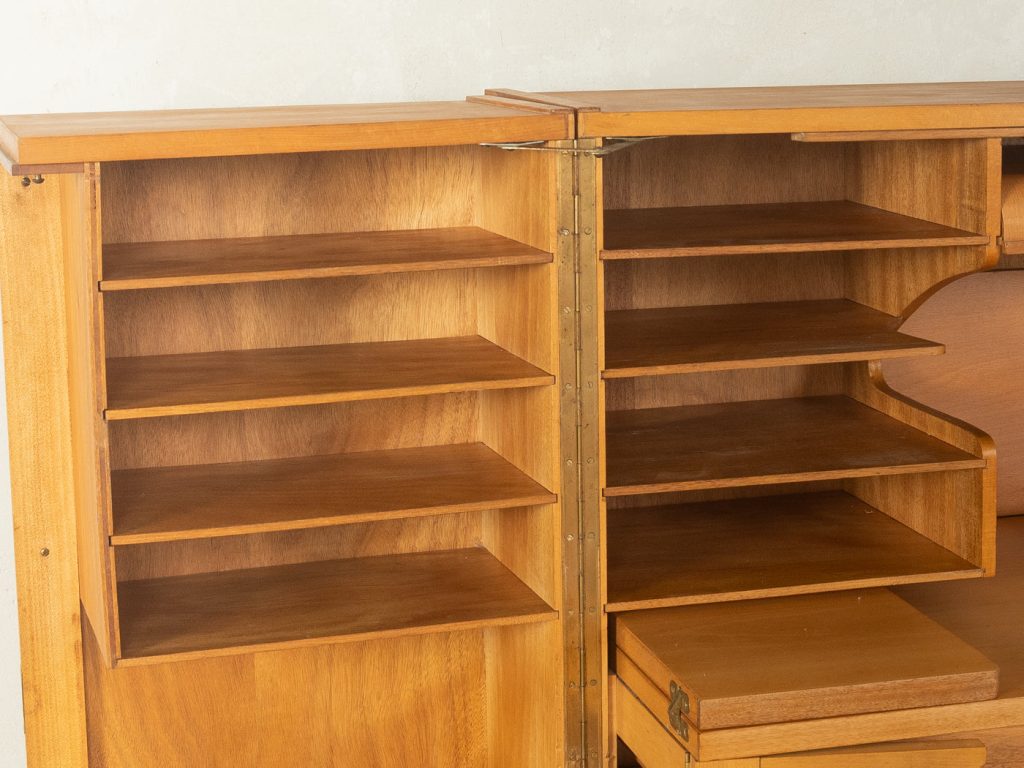
When the two doors swing open, even their inner faces are put to use. Each carries a row of narrow shelves, just deep enough for a stack of paper or a bundle of envelopes. Fully opened, the cupboard surrounds the person sitting at it with shelving on three sides, as if a small room had just been put up in the middle of the sitting room.
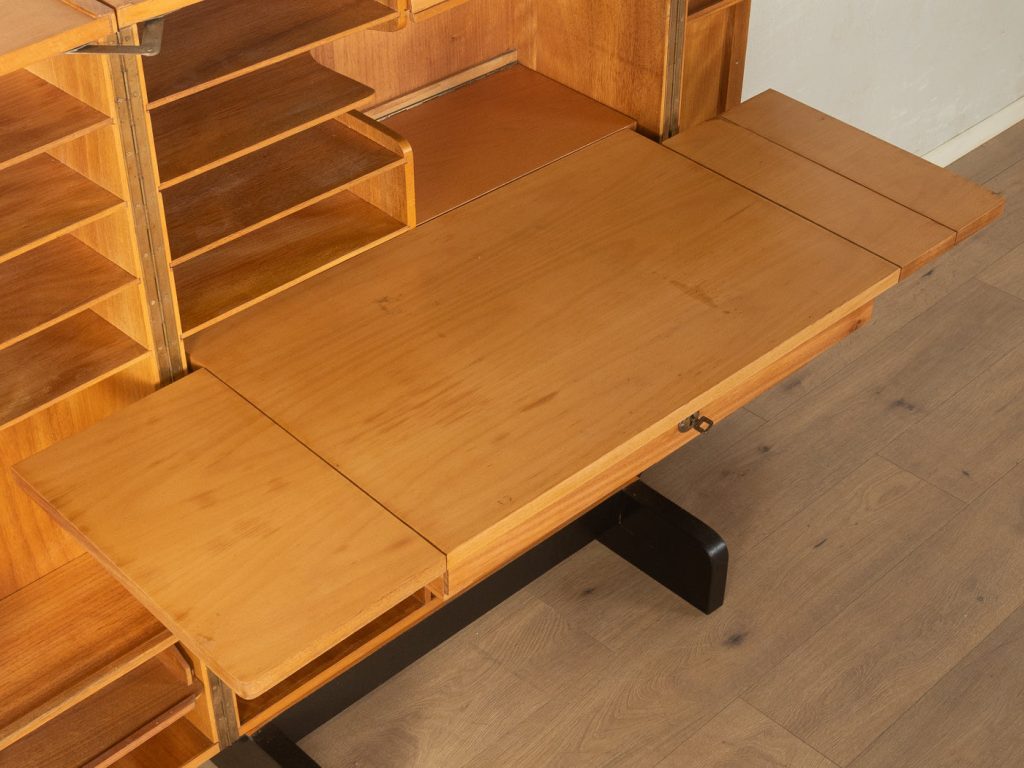
In the centre is the writing surface. It lies tucked inside the carcass, slides out and folds down, coming to rest at around 76 to 78 cm, the height of a proper desk. Beneath it there is room for the knees. The designer was thinking of someone who would sit for a long time, not merely a hand signing something in passing.
Above is the curved hood wrapped in veneer, with a lamp hidden underneath. This is the detail I like most. The light falls straight onto the page without catching the eye, and when the cupboard is closed the light source disappears with it. The desk lamp, normally an object in its own right, has become part of the cupboard.
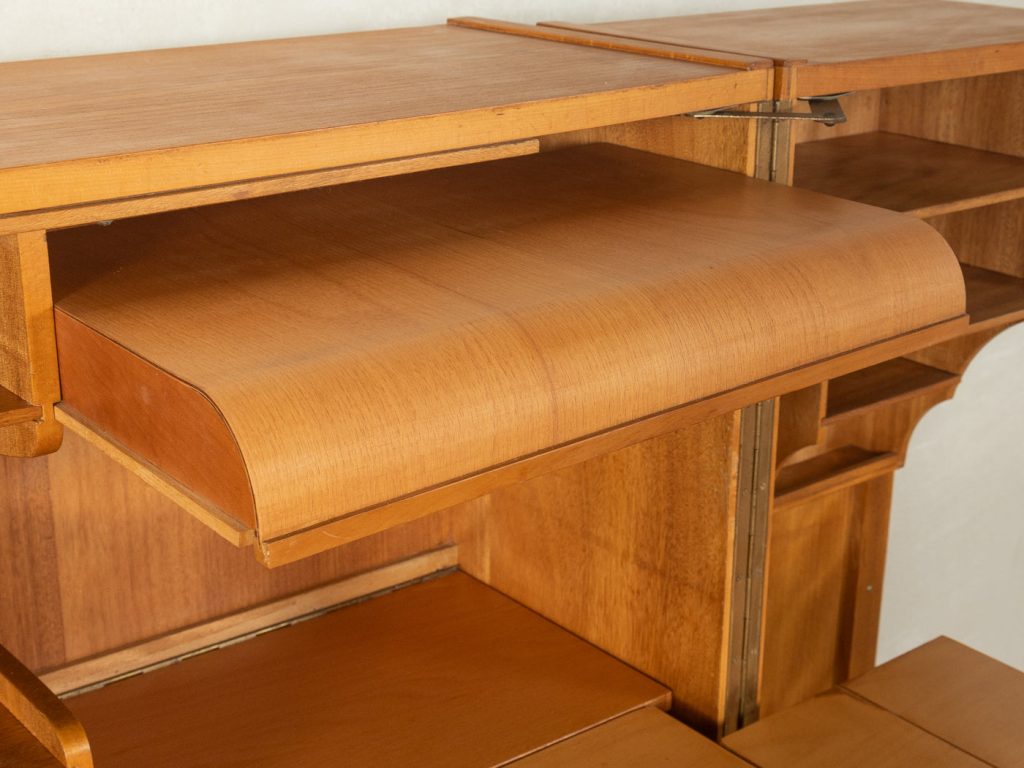
Below are upright compartments for lever-arch files, the stiff-backed binders with a round finger hole in the spine that German offices had used since the early part of the century. The compartments fit the files exactly. From this small detail one can see a whole way of designing: decide first what is to be held, then build the case around it.
Last of all comes the lock. When the work is done, one folds the writing surface away, pushes the lamp back in, closes the two doors and turns the key. The work is put away and locked up, set apart from the family’s evening.
The cupboard does not try to solve many things at once. It does one job, but it thinks that job through very carefully.
Wood, veneer and a layer of Formica
The materials of the Hausbüro tell of a time of scarcity, and of the ingenuity of the craftsmen who worked through it.
The carcass is made of hardwood and plywood, faced with a thin layer of veneer. Most of the surviving examples are veneered in walnut. Some are in teak, the wood that followed Danish furniture across Europe in the late 1950s. A few were veneered in several woods laid out in geometric panels.
Veneer is often regarded as a deception, a sliver of precious wood glued over something cheap. I see it differently. After the war, good solid timber was both scarce and expensive. Veneer allowed a single walnut log to cover dozens of cupboards, and brought fine grain within reach of families who could never have afforded solid wood. The plywood beneath also warps far less than natural timber, which suits large doors that are opened and closed every day.
The drawers are another matter. They are made of solid wood, because this is where the friction is greatest. The distinction shows makers who knew exactly where they could economise and where they could not.
Some examples have a writing surface faced in cream Formica, a material of the new age. It does not absorb ink, does not scratch under a heavy hand, and wipes clean in a moment. Warm wood on the outside; a hard-wearing laminate where the hand does its work.
The metalwork deserves attention too. In the video, a long brass hinge runs down the edge of each door, a piano hinge that spreads the weight of the door and its shelves along its full height. The black-lacquered sled base lifts the carcass off the floor and makes the heavy block of wood look lighter, a move very typical of the decade.
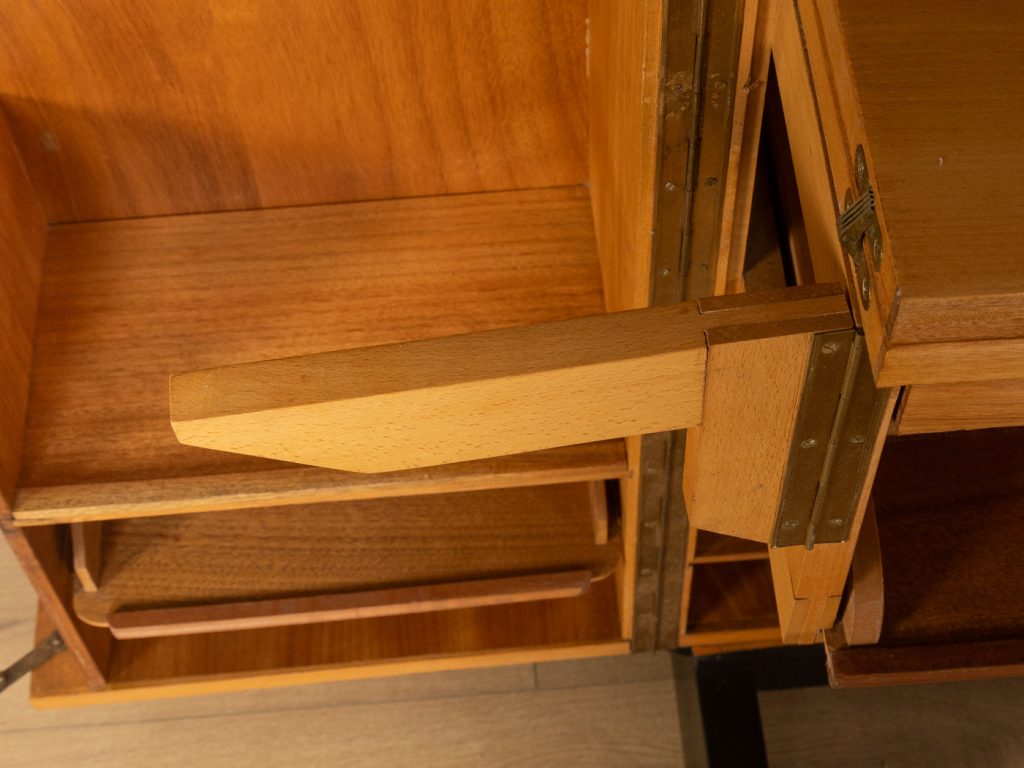
No material here was chosen to impress. Each thing sits where it belongs, and the beauty comes afterwards, as a matter of course.
The makers, and who they made for
History has kept very little of Schreibmayr. The name survives only on labels inside the carcass, in dealers’ listings and in auction catalogues, spelt differently each time: Schreibmayr, Schreibmayer, Schreibmeyr. The Dorotheum auction house in Vienna gives the maker as ‘Schreibmayr – Hausbüro’, as though the product’s name had become fused with the workshop’s. One example even records its year of manufacture: 1956.
Such anonymity was not unusual. Most furniture of the 1950s was made by small and medium-sized workshops, with no well-known designer attached. They made things to be used, not to be shown in museums. The object remains; the maker’s name slowly falls away.
Around Schreibmayr was a larger movement, all pursuing the same question: how to give ordinary people good furniture in a small home.
In Germany, the Deutsche Werkstätten and the WK-Verband network of shops sold modern wooden furniture at reasonable prices, in ranges that could be bought piece by piece. Hans Gugelot, who taught at Ulm, designed the M125 cabinet system for Bofinger, a modular system that could be added to as a family grew. In 1960, Dieter Rams designed the 606 shelving system for Vitsœ, which is still in production today.
In Austria, the Soziale Wohnkultur initiative produced the SW-Möbel range, designed by Oskar Payer and Franz Schuster. The way they chose designs is worth remembering: a design went into production only after visitors to an exhibition had been asked their opinion. The people who would live with the furniture were consulted first.
In Denmark, Poul Cadovius launched the Royal System in 1948, shelving hung on the wall to give the floor back to the people living there. In Switzerland, Fritz Haller created the USM Haller steel-frame system in the 1960s.
America took a different road. In 1964, Robert Propst designed Action Office for Herman Miller, a flexible system of desks and shelving for people working in offices. The Americans moved paperwork out of the home. The Germans, with the Hausbüro, kept it at home, but tucked it away in a cupboard.
The Hausbüro was therefore made for very particular people: the insurance agent who needed to write up his notes each evening, the woman who ran a dressmaking business and kept its accounts, or a family that needed somewhere for the bills, insurance papers and tenancy agreement to rest in one place. They had work to do and papers to keep, but only one sitting room.
The cupboard in our homes today
A workspace at home these days is usually no more than a bare tabletop and a laptop. Papers have moved onto hard drives, files into the cloud, keys into passwords. A flat surface is enough.
Furniture has changed accordingly. The desk no longer knows in advance what it will hold, so none of its compartments is made for any one thing. It arrives in a flat cardboard box, goes together with an Allen key, and is often left behind at the next move. We have traded fit and durability for flexibility, low cost and convenience.
Something else has gone with them. Whoever used a Hausbüro in 1956 closed the cupboard and the working day was over. Our work lives in the phone on the bedside table, and there is no door to close.
Perhaps that is why people are seeking these cupboards out again. A restored Hausbüro is currently offered for around €2,400 to €3,100, and Dorotheum once estimated one at €3,200 to €3,600. A piece made for the modest middle classes has become a collector’s item. That is both heartening and slightly at odds with its original spirit.
I do not think we need to go back to cupboards with locks. But Schreibmayr’s Hausbüro is a reminder of a way of designing that starts from very concrete questions: who will use it, for what, and in a room of what size. Those questions have lost none of their value.
And there is a small comfort in closing a wooden door, hearing the soft click of the catch, and knowing that the working day is done.
Sources

Previous Post
Next Post
- Heatherwick Studio’s 1000 Trees lifts a park onto columns above Suzhou Creek

- Under the vaults of El Born, Delta Arrocería cooks rice in plain sight

- In Ostrava, a Pavilion for Error lets architects talk about their mistakes

- The NM01 Crate Chair lets a dairy crate keep its contents and gain a backrest

- In a former Harlem factory, Infinite Energy Hack lets oil drums and solar panels speak

- Wutopia Lab wraps two old buildings in metal and ceramic to make The Lake House