Now Reading: Aytac Architects designs twisting titanium zinc commercial building for Istanbul industrial district
- 01
Aytac Architects designs twisting titanium zinc commercial building for Istanbul industrial district

Aytac Architects designs twisting titanium zinc commercial building for Istanbul industrial district

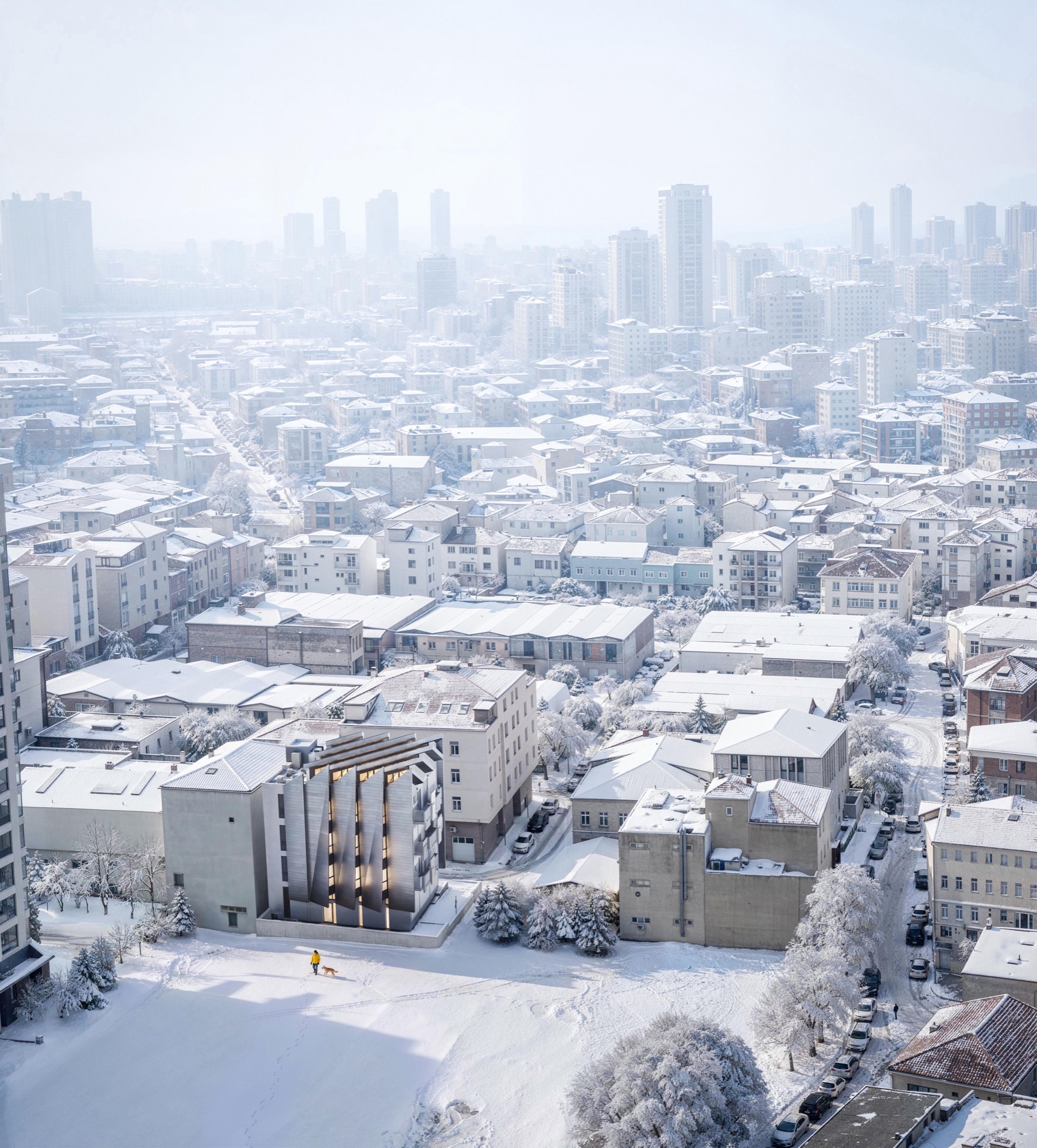
Aytac Architects has developed Sarmaşık 41, a six storey commercial building in Ümraniye, Istanbul, that reinterprets the industrial sawtooth roof as a kinetic titanium zinc envelope.
Located on the western edge of the Dudullu Organized Industrial Zone, the 1,400 square metre building is conceived as a flexible commercial hub for work, production, exhibition and creative exchange. Rather than treating the project as a conventional office or retail block, the Istanbul based studio has used the site’s industrial memory as the starting point for a more expressive architectural language.

Dudullu occupies an important position in the urban and industrial history of Istanbul’s Anatolian side. Until the 1960s, the area remained one of the last rural territories on the periphery of the city. With the expansion of industry, it was rapidly transformed into a zone of production serving the growing metropolis.
Today, this former edge condition has been absorbed into Istanbul’s metropolitan fabric. Sarmaşık 41 responds to this layered condition by drawing together traces of rural geography, industrial infrastructure and contemporary urban life.
The project takes its name from Sarmaşık Street, whose geometry is understood by the architects as part of a larger morphological memory. According to the studio, the street pattern still carries the invisible trace of a former stream bed that once flowed from Dudullu Hill toward the Marmara Sea. Although urbanisation has erased much of this landscape, the project seeks to give architectural form to its remaining spatial logic.

The main formal reference for Sarmaşık 41 is the sawtooth roof, a familiar element of historic industrial architecture. Traditionally used to bring soft, controlled daylight into large production spaces, the typology is here extended beyond the roof and wrapped around the entire building envelope.
Aytac Architects oriented the sawtooth profile toward the north in order to improve daylight comfort. The difference between this orientation and the street aligned mass of the building produces a twisting motion across the shell. As the roof geometry descends onto the facades, it creates a continuous skin of folded and undulating surfaces.
This envelope filters daylight, protects privacy and gives the building a sense of movement. It also transforms the industrial reference into a more sculptural urban presence, positioned between infrastructure, object and inhabited facade.


On the lateral facade, the torsion of the shell is interrupted by a series of operable balcony elements. These L and T shaped surfaces give each floor a distinct spatial extension and introduce an asymmetric rhythm to the exterior.
When closed, the elements read as part of a monolithic sculptural facade. When opened, they become functional loading armatures that support the movement of materials into the building. This dual role connects the project’s artistic ambitions with the practical culture of making and production associated with Dudullu.
The result is a facade that is not only visual, but operational. Sarmaşık 41 treats the building envelope as an active threshold between street, workplace and industrial process.


The exterior of Sarmaşık 41 is clad in titanium zinc, forming a metallic surface that appears to glide over the concrete mass below. The shell is sliced and folded to reveal partial glimpses of the building behind it, balancing concealment with transparency.
Beyond its visual role, the metallic envelope is designed to function as a Faraday cage. By reducing exposure to electromagnetic field radiation, it is intended to protect interior spaces from external interference and support a secure working environment for technology based activities.
The building’s structure is formed by a reinforced concrete mass and a central rigid core. Designed with a building importance factor of 1.5, the structure is intended to support operational continuity after seismic events. The core carries lateral loads while also organising circulation and mechanical systems, allowing the surrounding floor plates to remain open and adaptable.

Inside, Sarmaşık 41 is organised around a free plan strategy. Wide spanning slabs remove the need for internal load bearing columns, allowing each floor to be configured with modular partitions or left as an open workspace.
The interior deliberately contrasts with the mystery of the exterior shell. Structural and mechanical systems are selectively exposed, bringing the language of production into the experience of the building. This rawness is balanced by the central circulation core, where stairs and movement spaces are treated as vivid spatial episodes rather than purely functional zones.

For Aytac Architects, this contrast between exposed construction and chromatic interior experience reflects the project’s central theme: the meeting point between art and craft, industrial memory and contemporary technology.
Project Credit
Project name: Sarmaşık 41
Location: Ümraniye, Istanbul, Türkiye
Architecture: Aytac Architects / @aytacarchitects
More Photos