
Now Reading: Vincent Dubourg reflects on the fragile calm of Blue Weather
- 01
Vincent Dubourg reflects on the fragile calm of Blue Weather

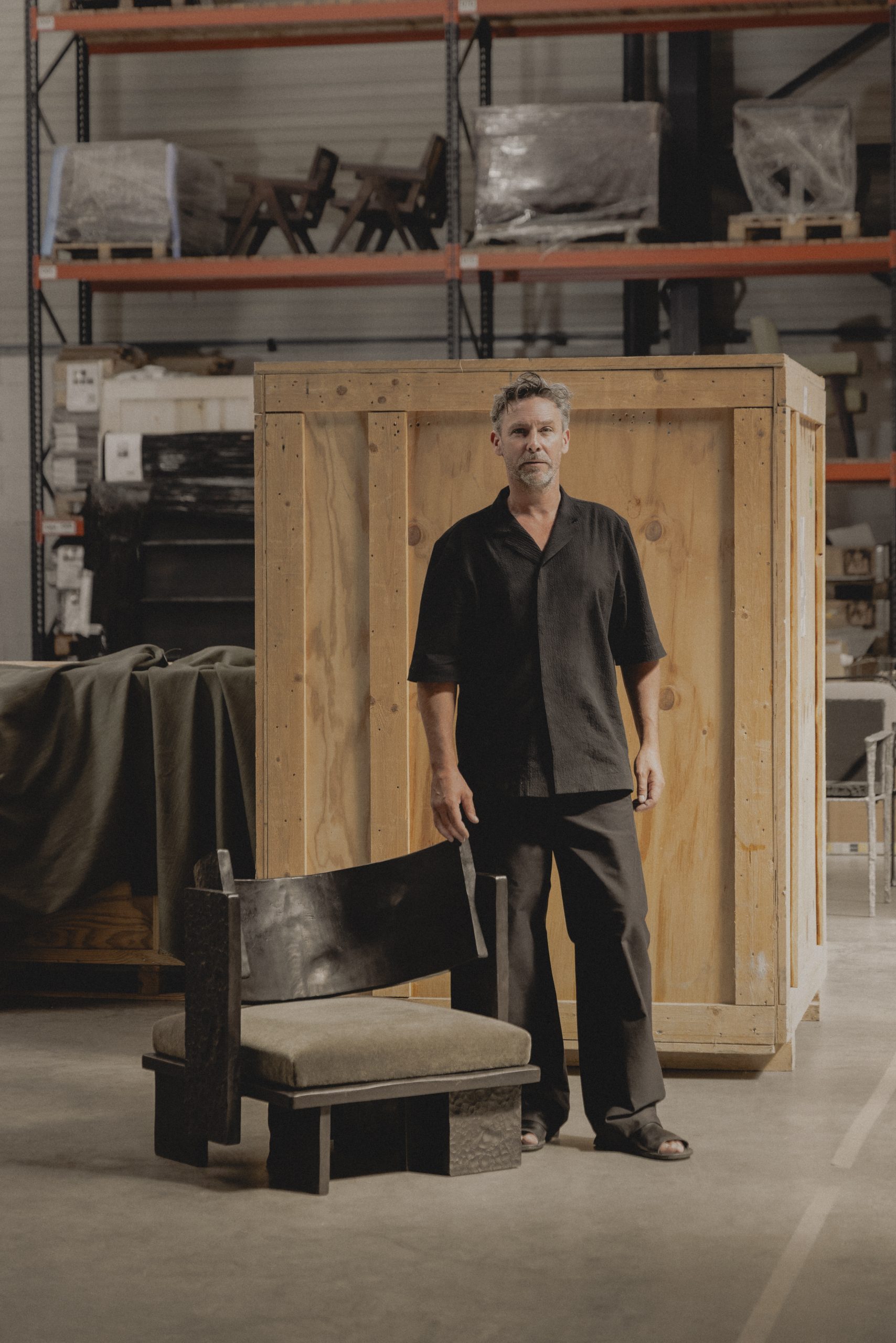

Vincent Dubourg’s Blue Weather considers what remains after a period of upheaval. On view at Carpenters in Ladbroke Hall, London, from 17 September to 19 December 2026, the exhibition brings together sculptural works in bronze, wood and aluminium, drawing on the artist’s interest in architecture, symbolism and the movement held within solid forms.
In this conversation with Designarcus Magazine, Dubourg discusses the social and personal meanings behind the title, the material contrasts that shape his work, and the possibility of turning furniture into an architecture within architecture.
A calm that keeps its memory
Designarcus Magazine: “Blue Weather” suggests a transition from turbulence to calm. What first led you to explore this state of transformation, and how did it become the central theme of the collection?
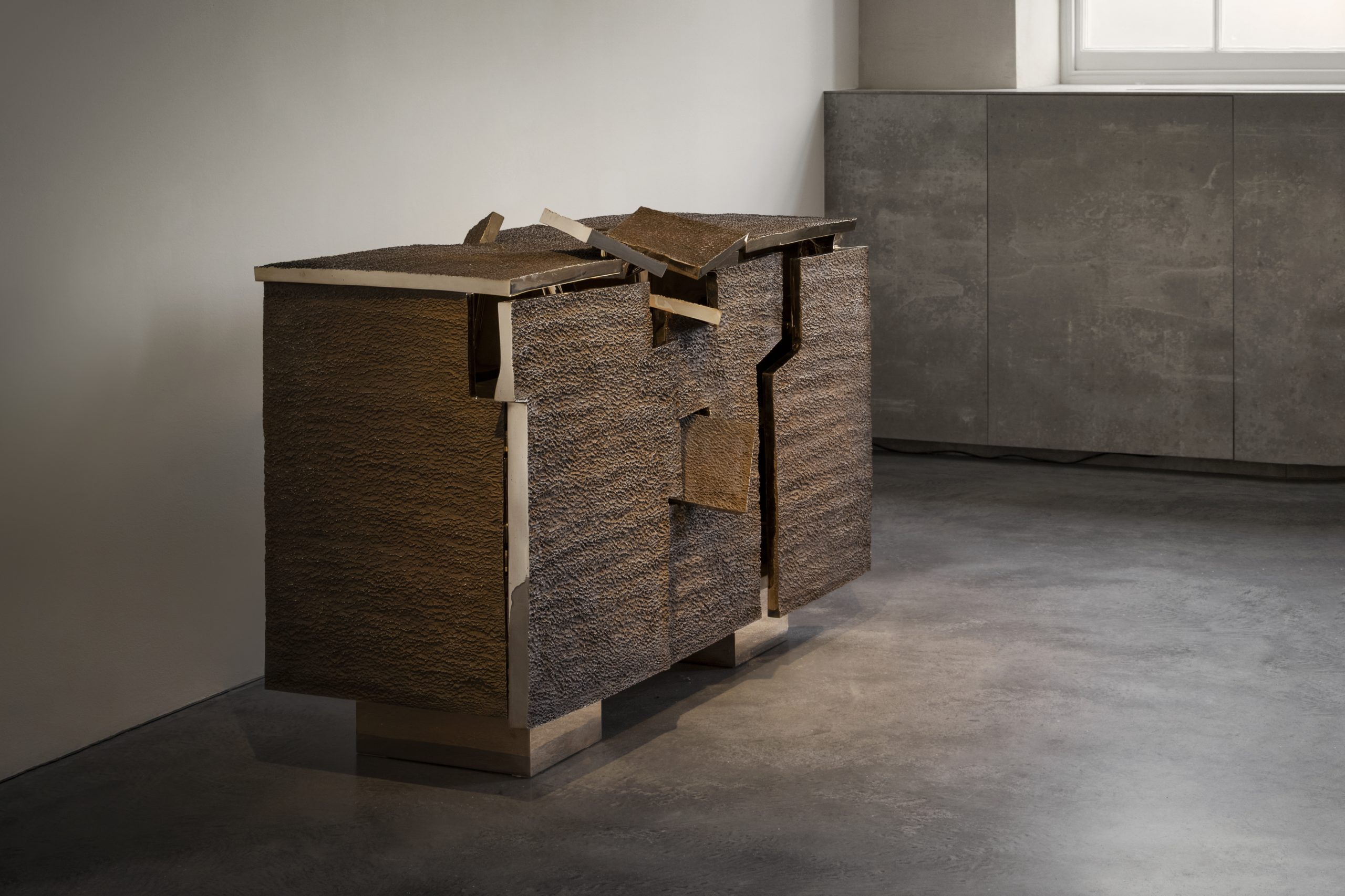
Vincent Dubourg: We all experience, at certain moments in our lives, a transition from turbulence to calm. It is an inevitable pattern that punctuates life, emotions and history. “Blue Weather” evokes the return to calm after a turbulent period. I also see the title as a way of symbolising shifts in mood and events that run through society: a kind of social climate. Wars and crises generate spaces in which peace takes on its full meaning between conflicts.
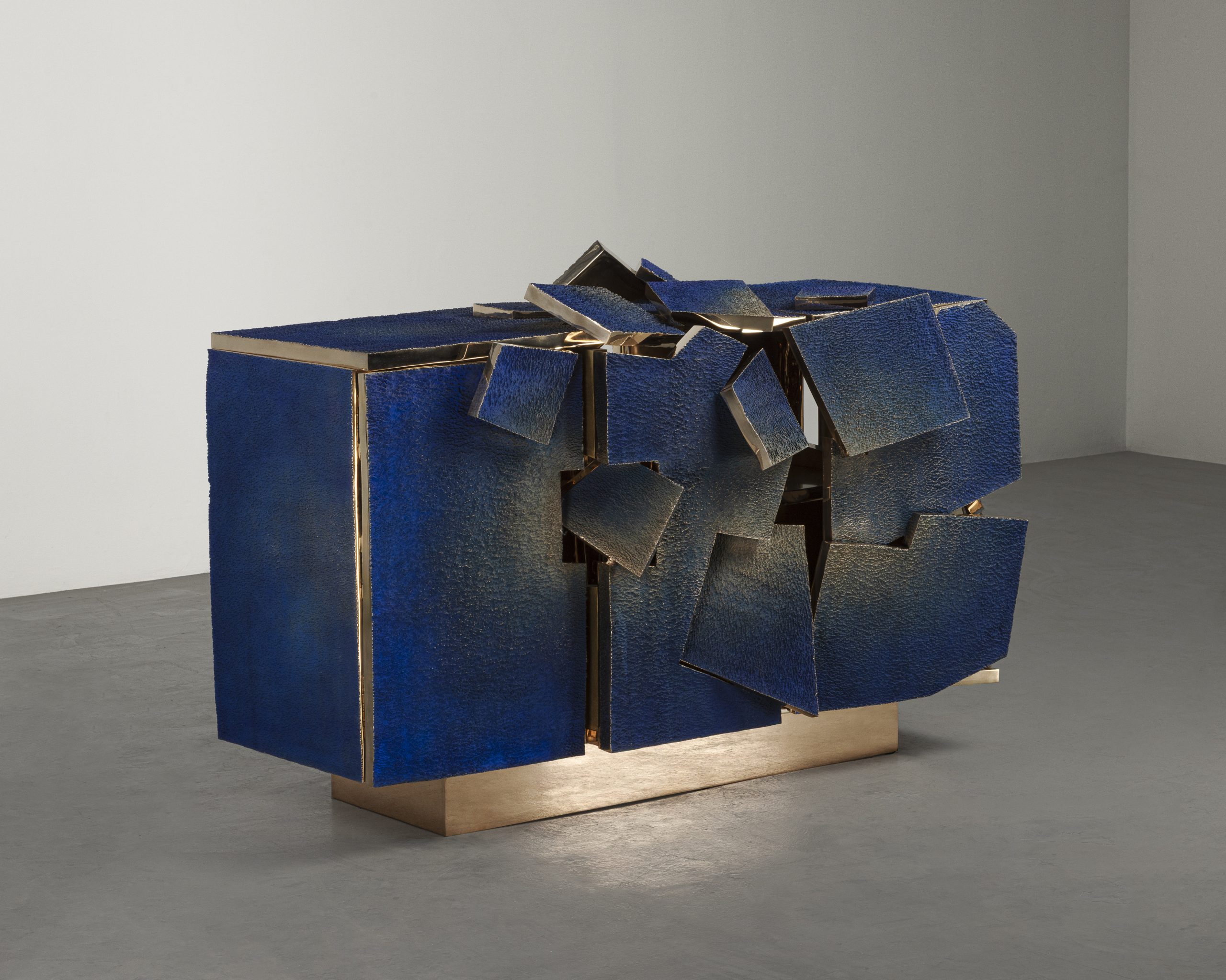
I picture the blue of the sky reappearing after a storm, bringing serenity and hope. I also chose the blue of hope to express a persistent melancholy: calm does not completely erase the wounds caused by turbulence, and that is what I try to convey in the pieces on display.
“Blue Weather” evokes a calm that is still fragile, tinged with sadness, but carrying the possibility of reconstruction.
Designarcus Magazine: You often approach material as a language in its own right. What do bronze and wood communicate that form alone could not express?
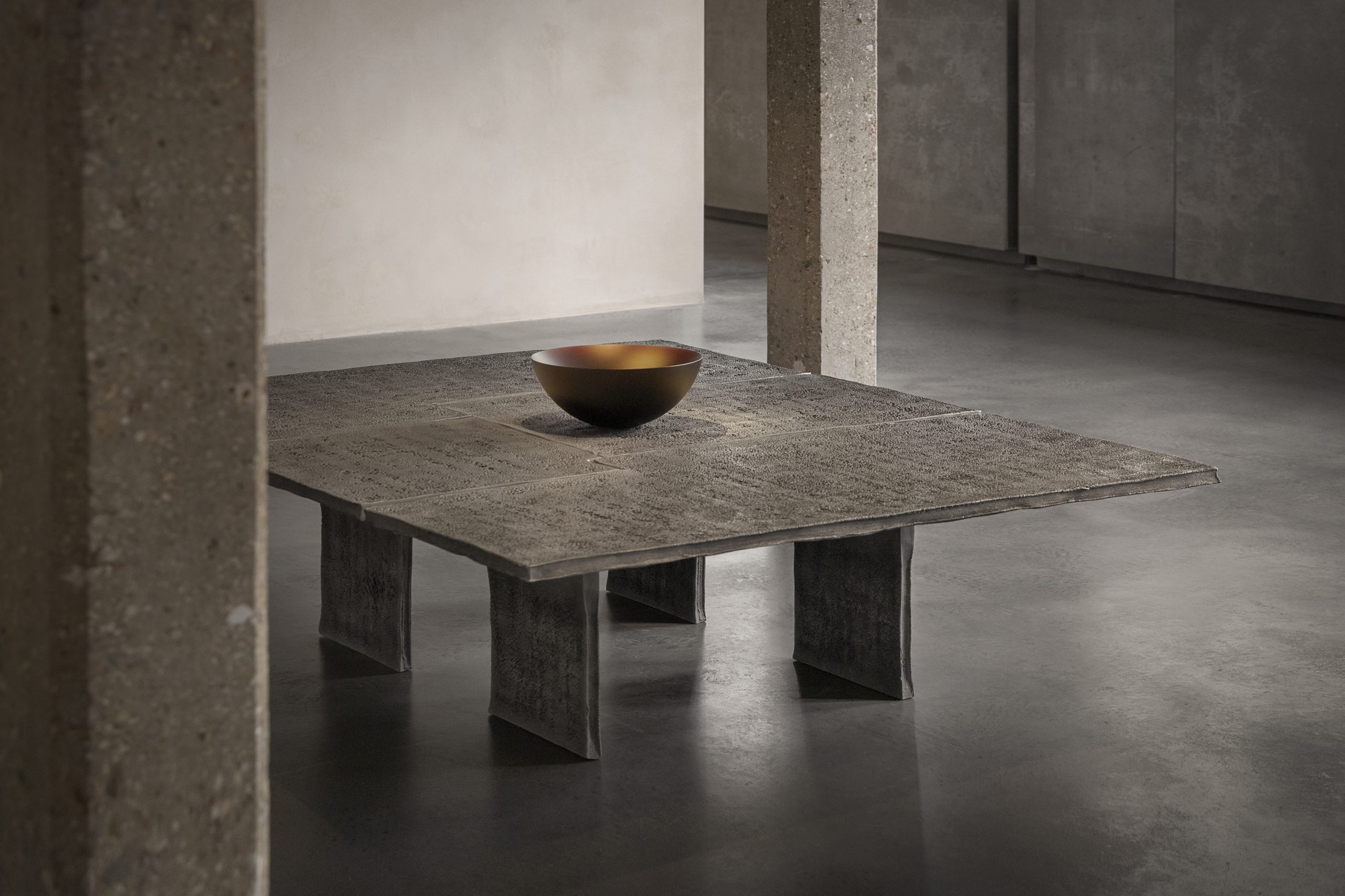
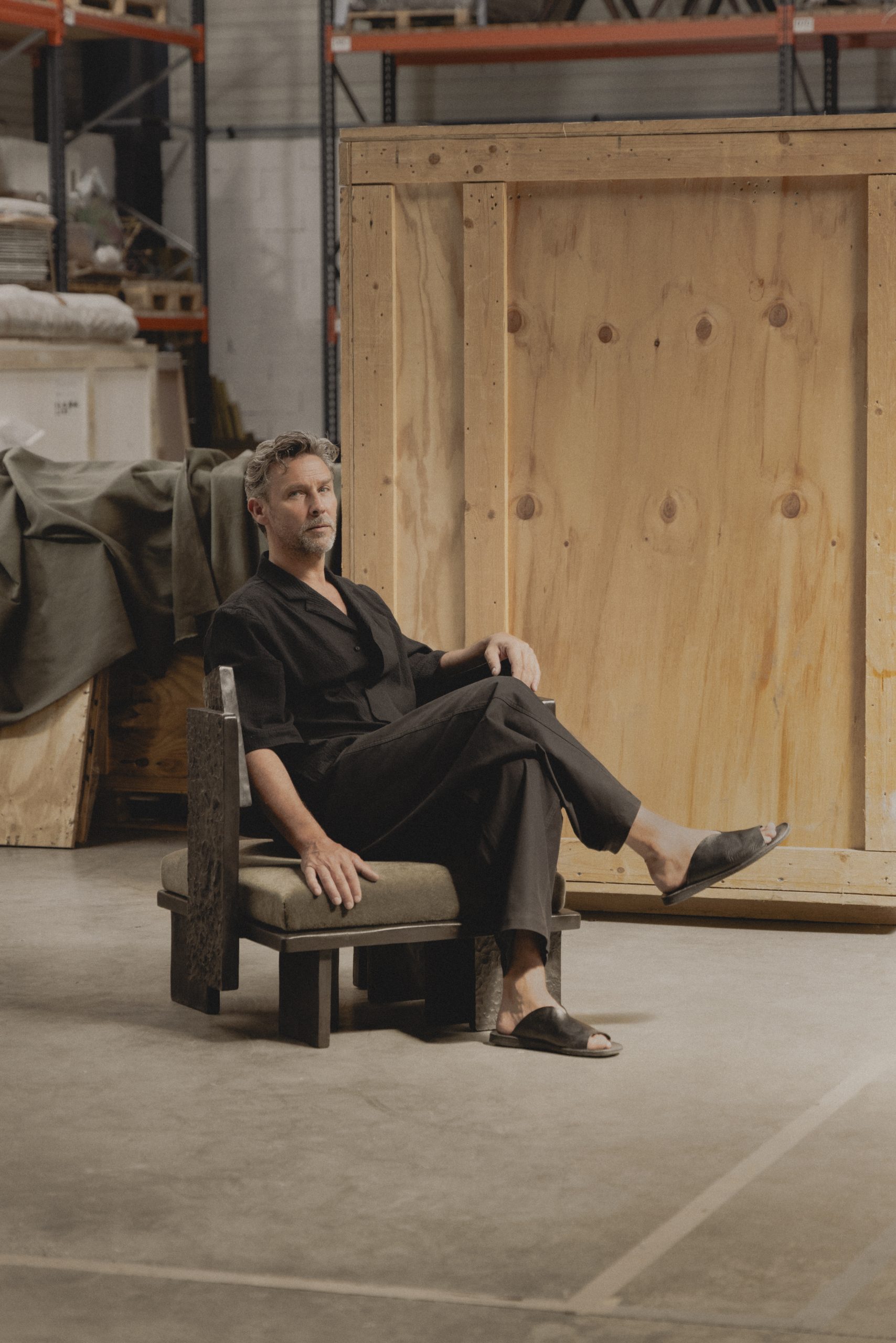
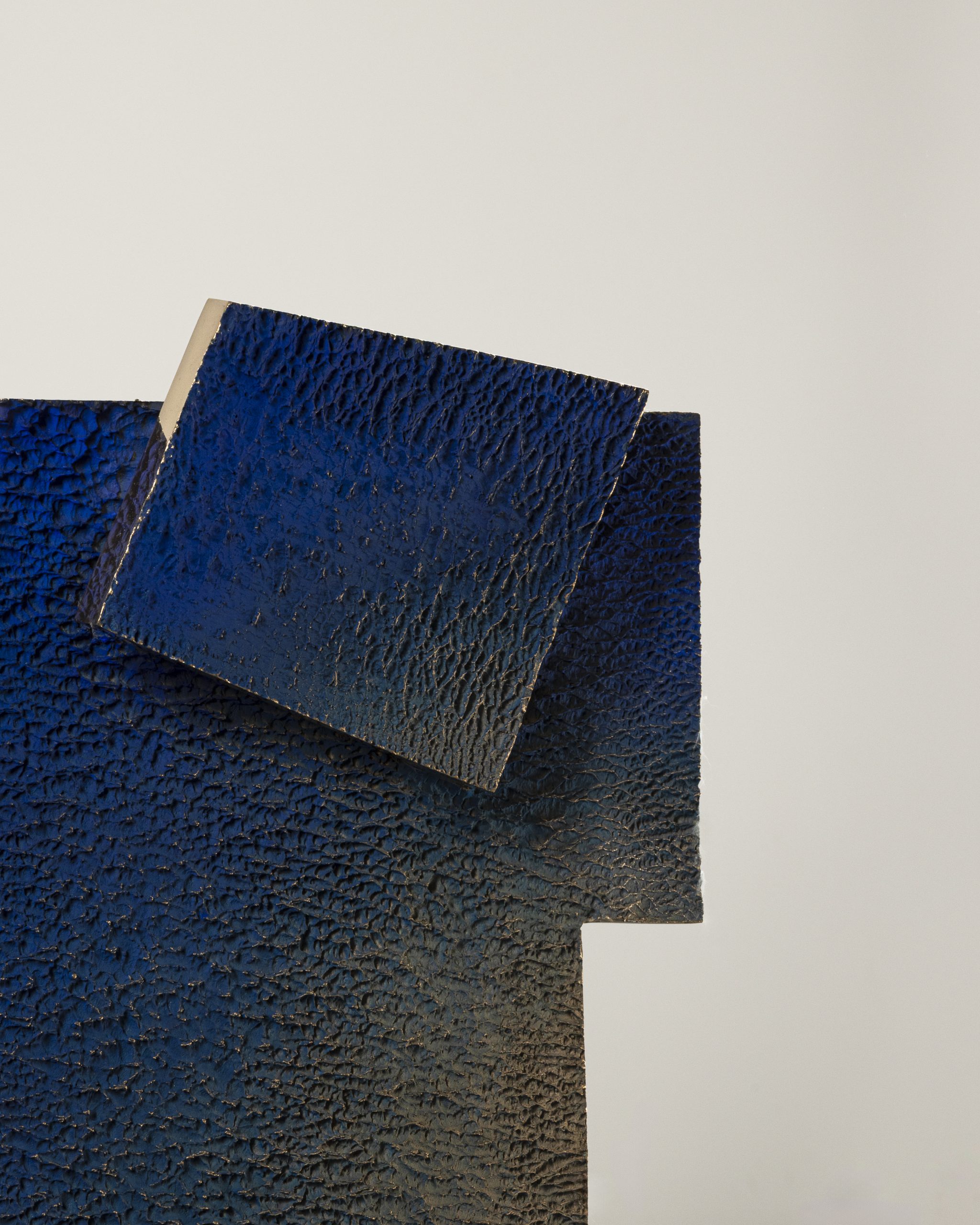
Vincent Dubourg: Above all, I love contrasts. The choice of materials helps make the narrative of these forms clearer; material becomes a language in its own right. Molten metal takes shape under constraint. It pushes back the air to occupy its own space, much like the spirit that inhabits us and seeks to take its place within our bodies. Bronze or aluminium alloy plays that role in my work: it freezes a liquid state into an almost architectural surface, a new surface to inhabit, one that could change again if it became magma once more.
The sculptural form retains the memory of molten metal’s movement, of magma cooling and settling until it draws a contour. The material keeps the trace of this transformation, of the tension between fluidity and solidification, between chaos and construction.
Wood has an entirely different relationship with time. It has lived, grown and developed its own history. It carries traces of its past, like an architecture of memory. Where metal evokes transformation, pressure and metamorphosis, wood brings a presence that is older, organic and silent. It is the supporting arch, the keystone of the magma’s free mass.
Bronze, aluminium and wood are not simply supports for the form; they extend its meaning. They express temporalities and forces that form alone could not communicate.
Keeping movement inside solid form
Designarcus Magazine: The works retain an impression of movement even after their materials have become solid and stable. How do you preserve the memory of force, heat and instability within a finished object?
Vincent Dubourg: An unfinished gesture leaves room to imagine what comes next, keeping movement from being frozen, although that may apply more to painting. I also play with optical effects and contrasts. Imagine a book standing upright on a shelf, with another of the same size leaning at an angle against the shelf and wall. The second book appears to be falling and draws the first into its movement. The contrast between a right angle and another angle creates a sense of motion. You can feel this in the Bhanga sideboard, for example, or more subtly in the Vibration Core sideboard.
The same is true of a smooth surface placed beside a rippled one, like a plain sheet of metal touching a corrugated sheet. We imagine that the smooth surface set the other in motion, causing the rest of it to ripple. That is the power of our imagination: it unconsciously creates stories.
Designarcus Magazine: Constructivism and Brutalism are important references in your practice. What aspects of these movements continue to resonate with you, and how did you reinterpret them in “Blue Weather”?
Vincent Dubourg: We all carry the legacy of an education and of the development of thought. Like these movements, I would like to connect their ideas and carry them forward through a contemporary art practice: working with geometry and massive forms, and with the rigour of functionality, to create art that is useful to society and connected to life.
They opened my mind and led me to transpose the scale of architecture to furniture and objects, through geometric forms, modern materials and dynamic compositions. That said, I do not want to remain locked into a determinism of thought.
Designarcus Magazine: Your work often sits at the crossroads of furniture, sculpture and architecture. When you design a new piece, do you begin with its function, its presence in space or the narrative you want it to carry?
Vincent Dubourg: My approach is variable; I have no fixed rule. I am also an alchemist of materials, revealing through transformation what lies dormant within them. I test and confront materials until they become sculptures of architectural construction. Function is merely a pretext for imposing rigour and constraint on the form.
Furniture as an architecture within architecture
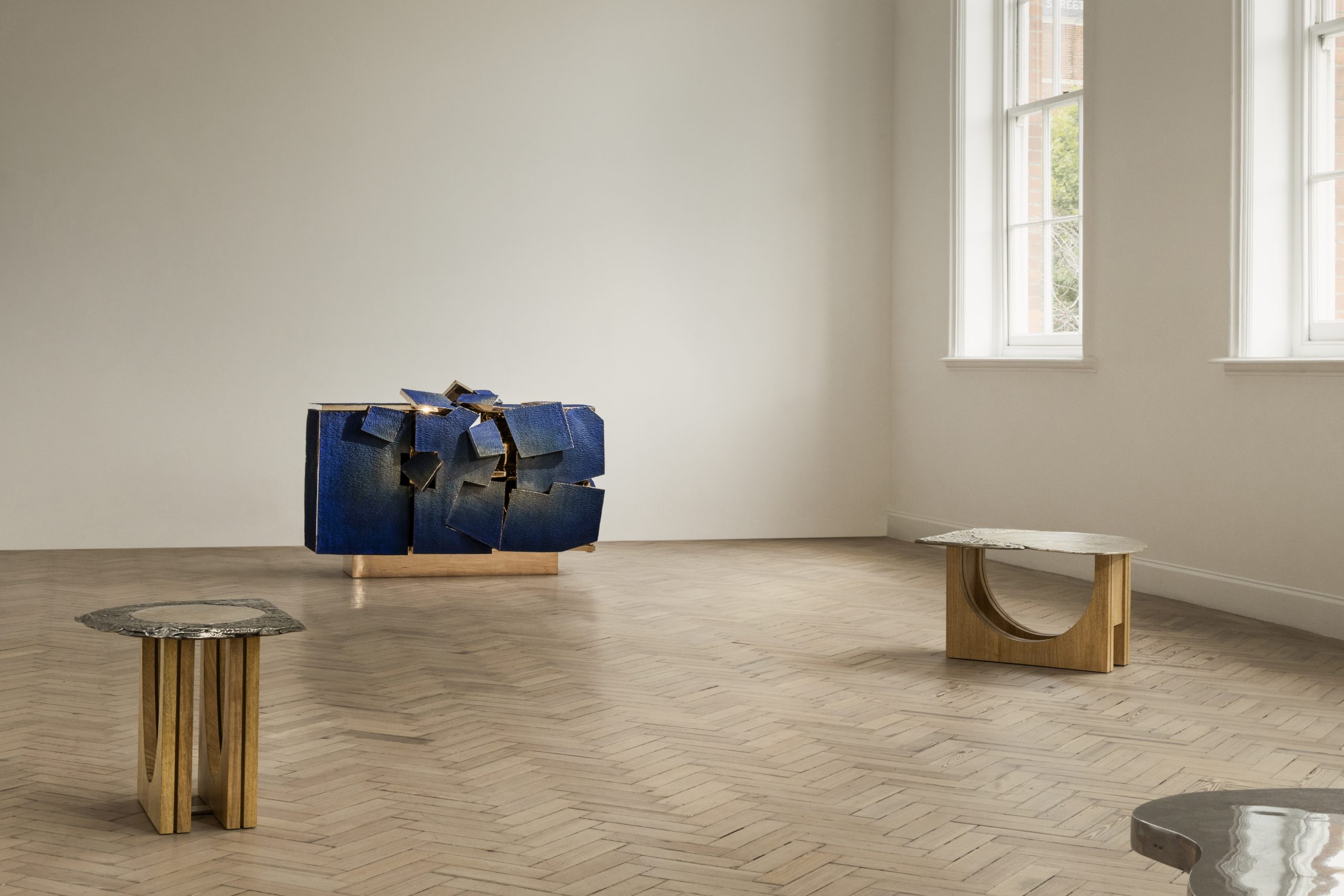
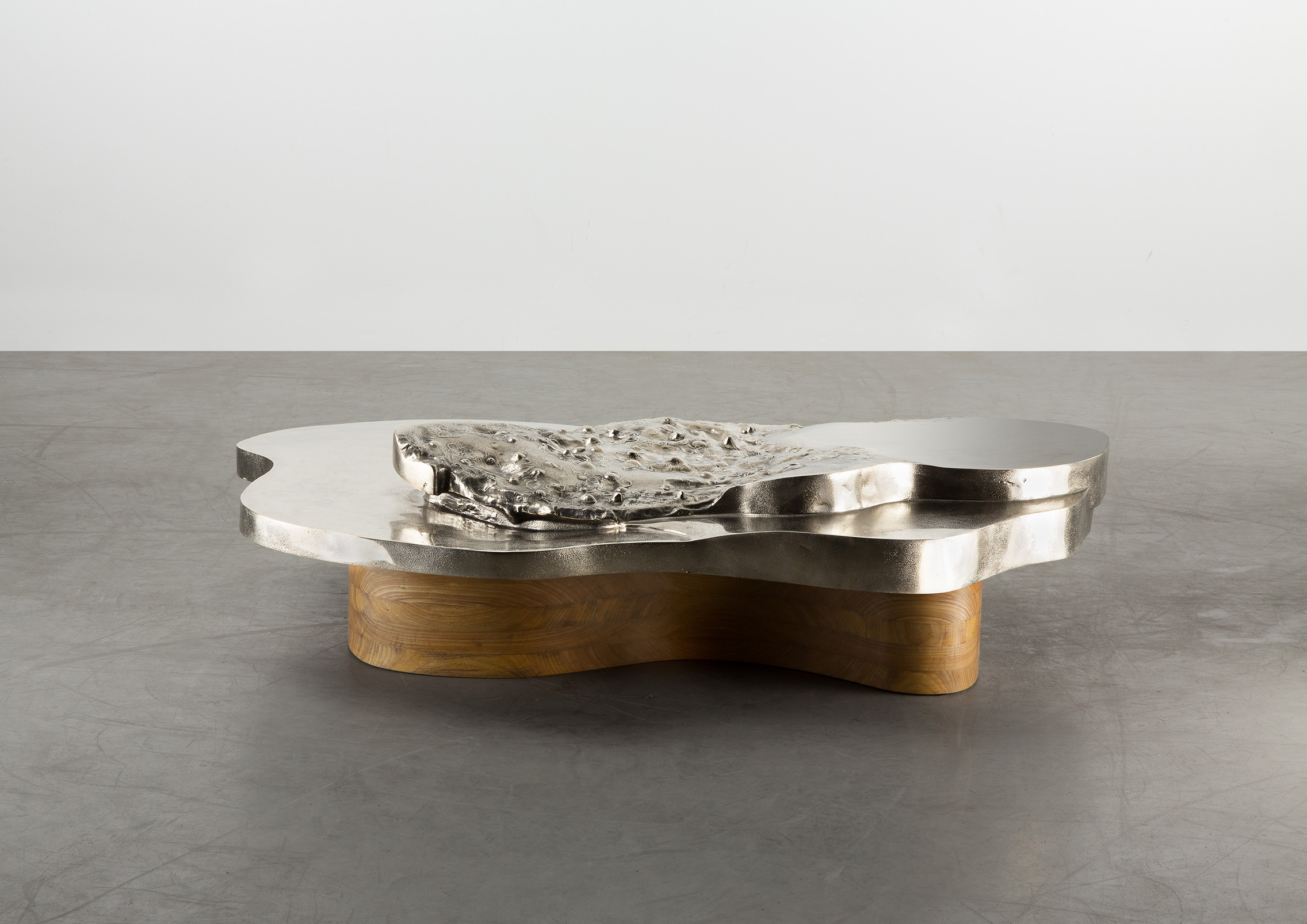
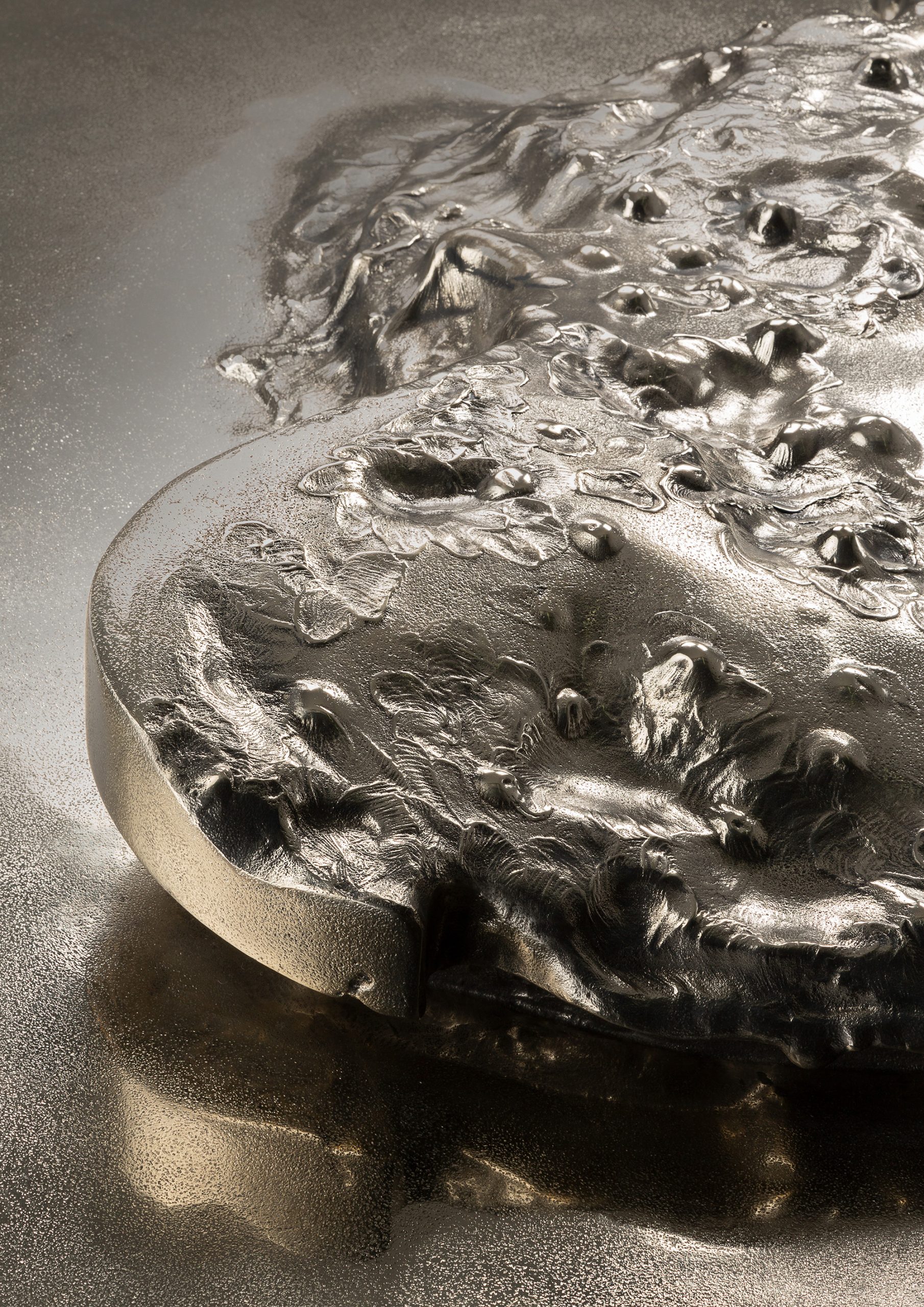
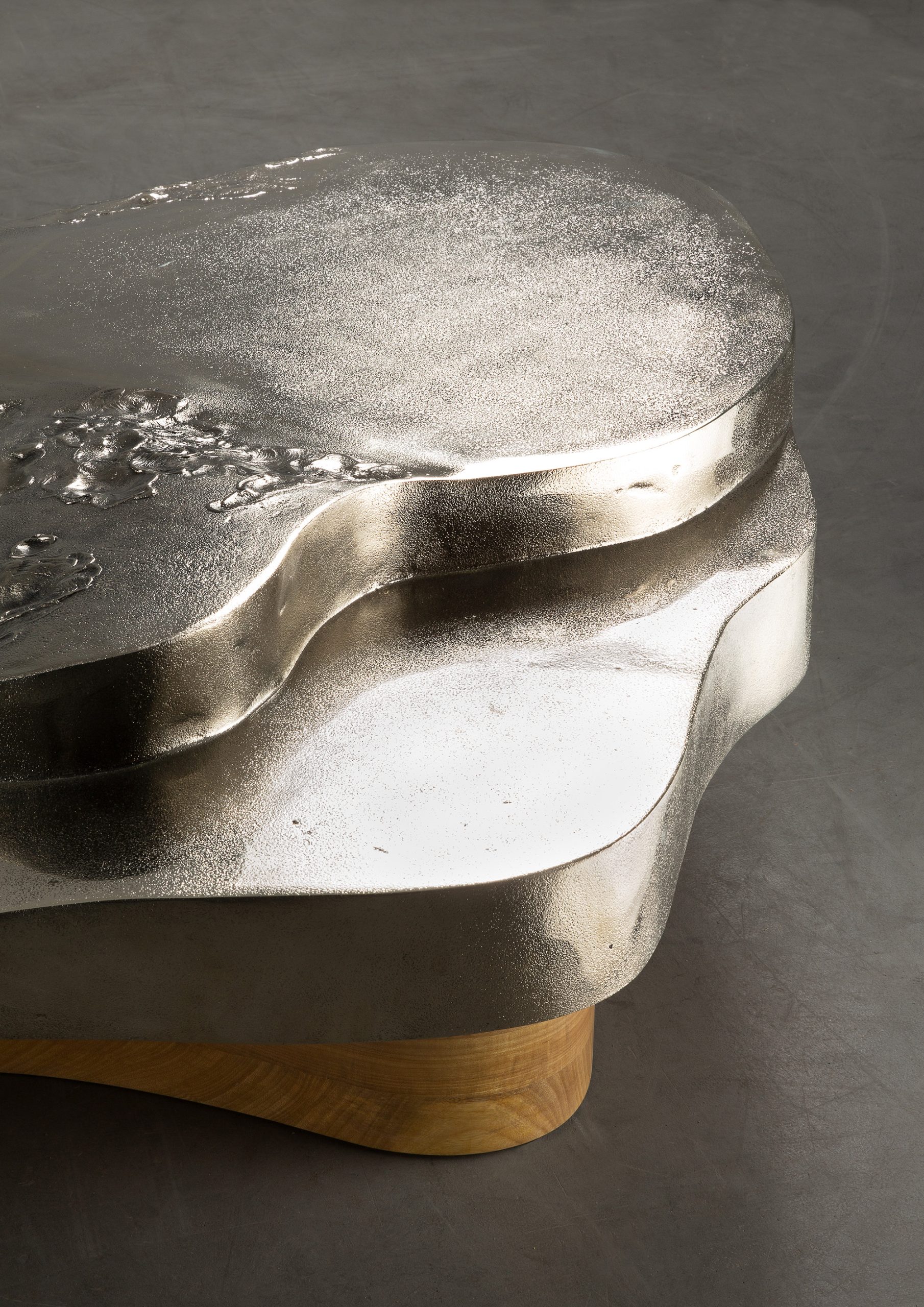
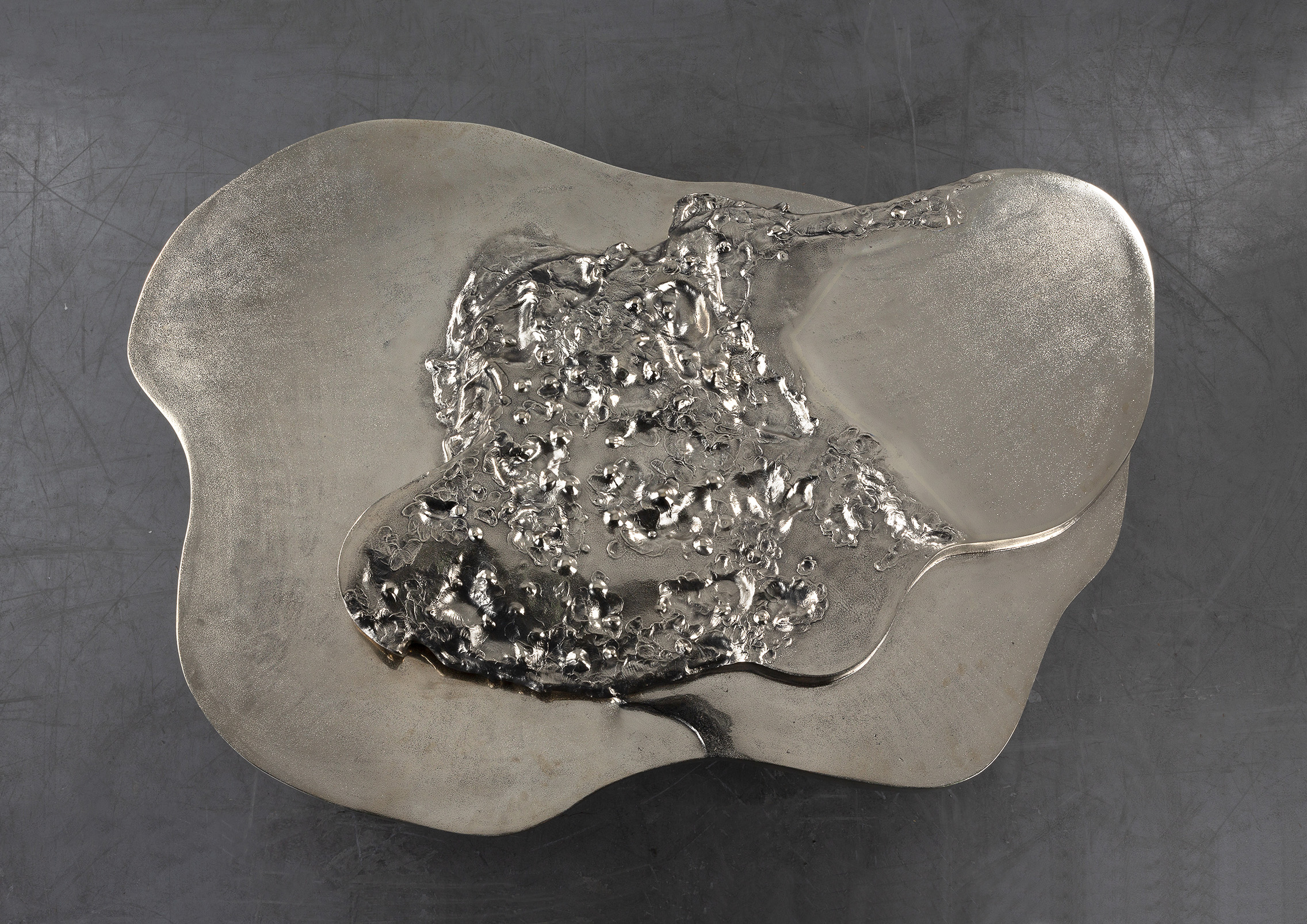
Designarcus Magazine: In “Organic Table”, “Himself 1” and “Himself 4”, polished bronze surfaces evoke still bodies of water, while Movingui wood beneath forms a dense structural labyrinth. How did you develop this relationship between apparent calm and hidden complexity?
Vincent Dubourg: It is first a question of balance, and of giving value to an idea carried by the alliance of two materials. At first, I drew inspiration from the beauty of a stream: the eye is drawn to water as it flows around and embraces an immovable stone breaking its surface, as though the stone were carrying the fluid material on its shoulders and making it dance in a dazzling swirl.
Later, I imagined lava, bringing volcanic eruptions back to life and considering how the molten state might leave traces on the smooth surface of the lake that had covered it. I like this opposition between the magma of molten metal and the apparent stillness of a settled whole that might one day return to its liquid state. Wood brings both calm and movement, simplicity and depth. Colour was also important: the warm light of bronze harmonises with the yellow hue of the chosen wood, creating a unified piece.
Designarcus Magazine: The “Stonehenge” armchair and ottoman transpose the logic of an ancient monument’s posts and lintels into functional objects. What led you to bring this architectural archetype to the scale and intimacy of furniture?
Vincent Dubourg: The way I build furniture never denies the principles of architectural construction. I like to think that I create an architecture within architecture through my furniture. Temples and places of culture such as Stonehenge inspire me enormously, not only through their volumes but above all through the spirit they seek to make resonate. I am intrigued by the way knowledge is passed down through thought, ritual and architecture.
I do not adhere to a defined belief, but I believe in the power of sites and their capacity to bring worlds together. I also believe that thought and the transmission of knowledge are inscribed within an architectural structure. That is why I give some pieces names such as Veda or Uttara. The Kinkaku and Sanjūsangen coffee tables are likewise inspired by the representation of places of worship. They are designed to encourage gathering and create a meeting space around them.
Stonehenge, Kinkaku, Veda and Sanjūsangen share a conception of architecture as a passage between the visible and the invisible, and as a means of transmitting knowledge and connecting individuals. The circle that gathers, the axis around which one sits, the repetition of uses, the light that elevates, the reflection of materials and the orientation of furniture all become ways of representing the order of the world.
I believe that an architecture within architecture, transposed onto furniture, can create an experience that goes beyond function and form. Through its use, a piece of furniture becomes a space for contemplation, transformation and connection with a dimension larger than the individual. It becomes a threshold between matter, landscape, time, thought and the sacred.
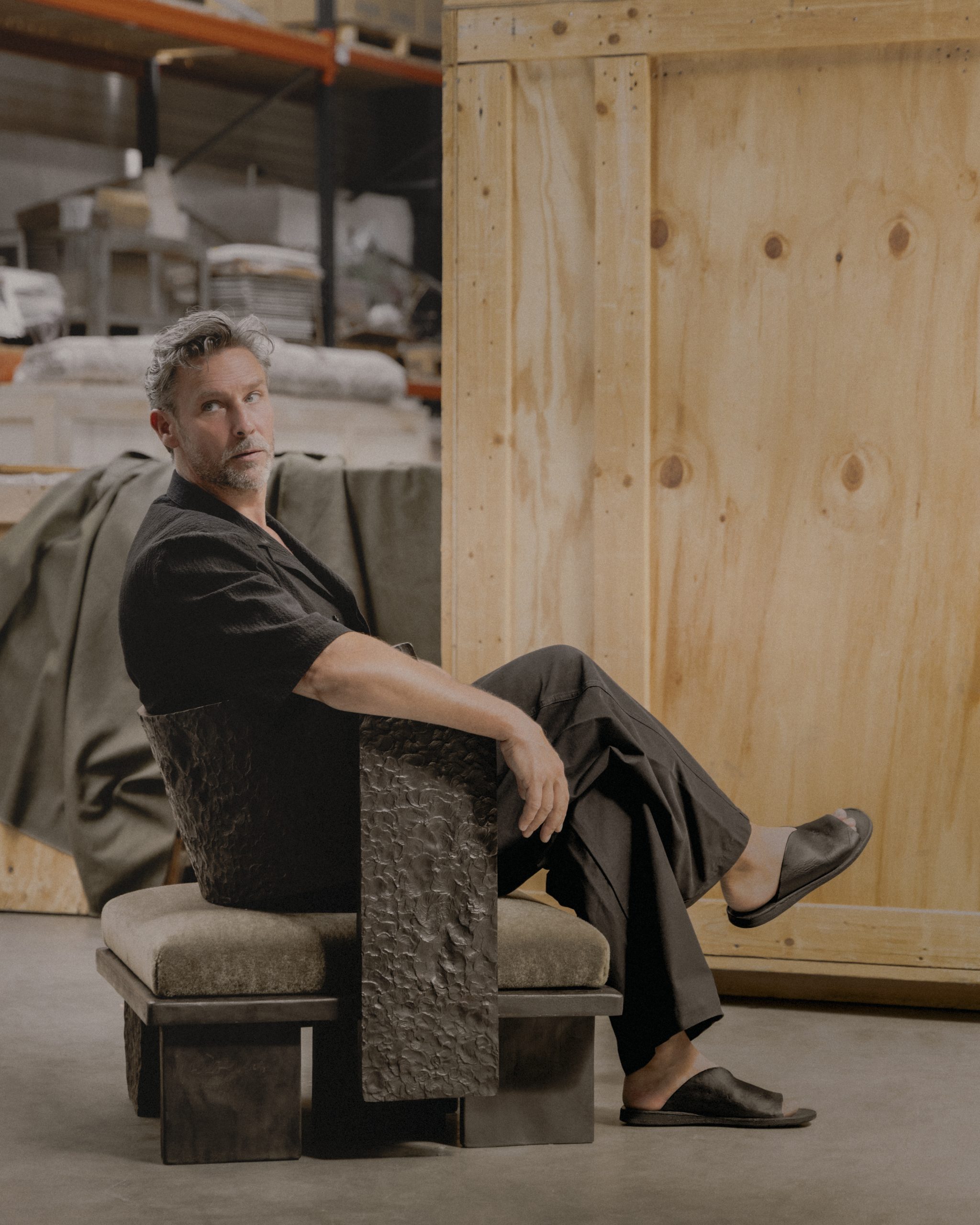
Designarcus Magazine: Power, belief and hierarchy are described as part of the “invisible architectures” that inspire your work. How do these social structures take concrete form in the proportions, weight or construction of the pieces in this exhibition?
Vincent Dubourg: I simply try not to fix things in place. I want to leave everyone the possibility of reworking forms through imagination, and to offer everyone the possibility of reinventing the order of things, dreaming and investing themselves in beauty through their own choices.
Designarcus Magazine: Craftsmanship plays a crucial role in mastering materials that are physically demanding and inherently unpredictable. At what point in the making process do you impose precision, and at what point do you let the material influence the final form?
Vincent Dubourg: I would speak less of precision than of the rigour that a piece’s functions or ergonomics impose. I do not concern myself with a fixed order of steps in the making process. For me, it is not the material that influences the overall form, but the choice of material, intended to serve the concept or narrative of the forms.
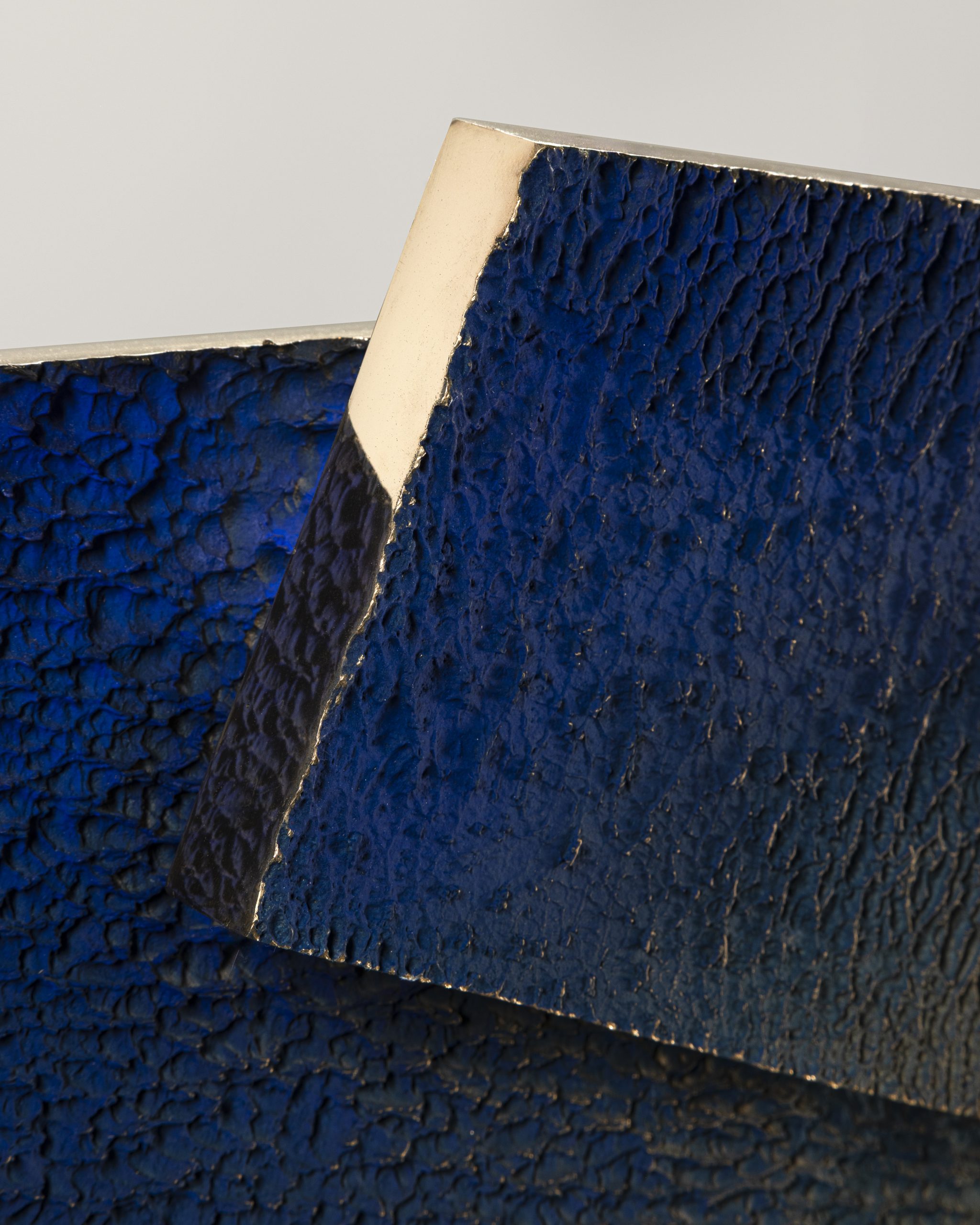
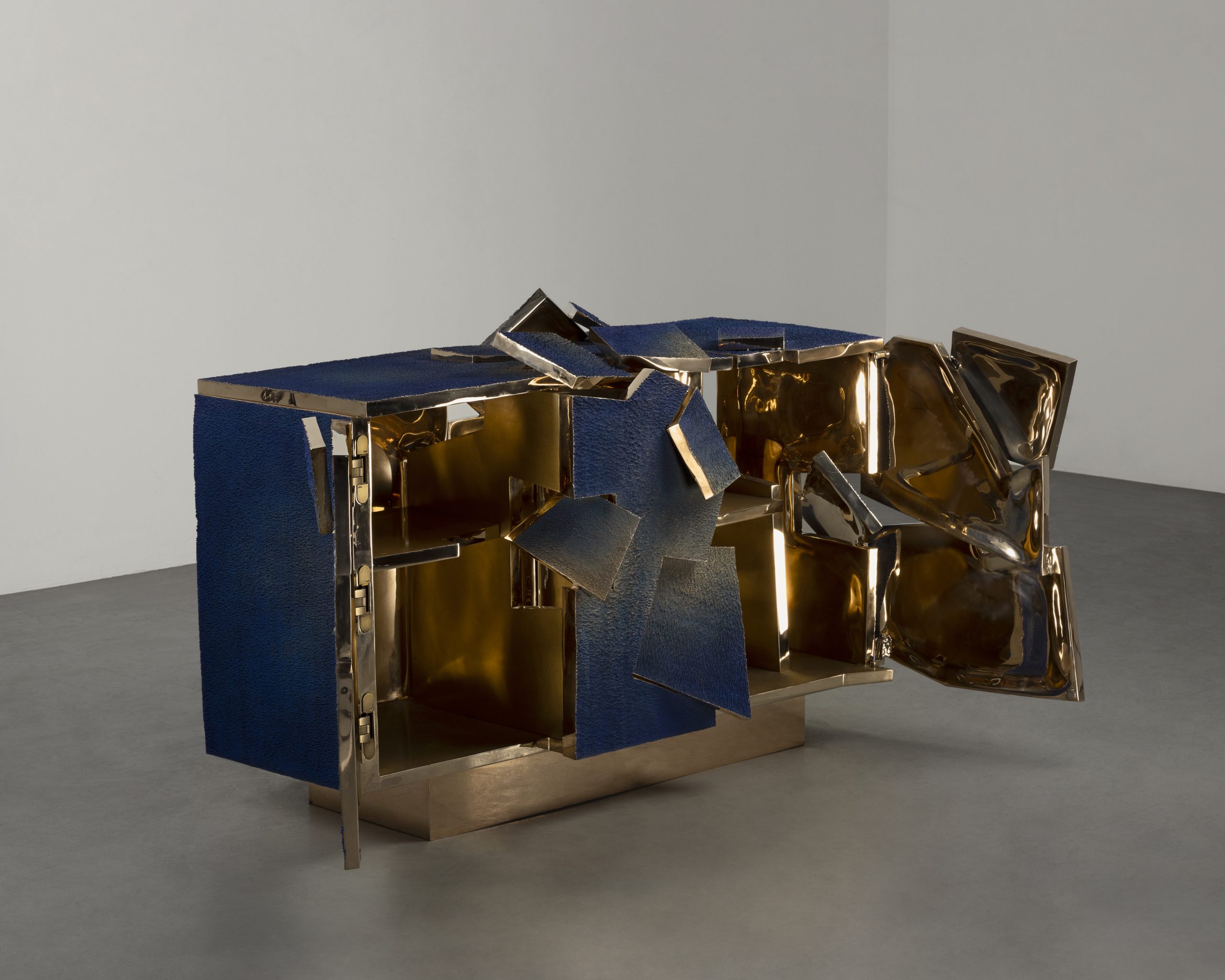
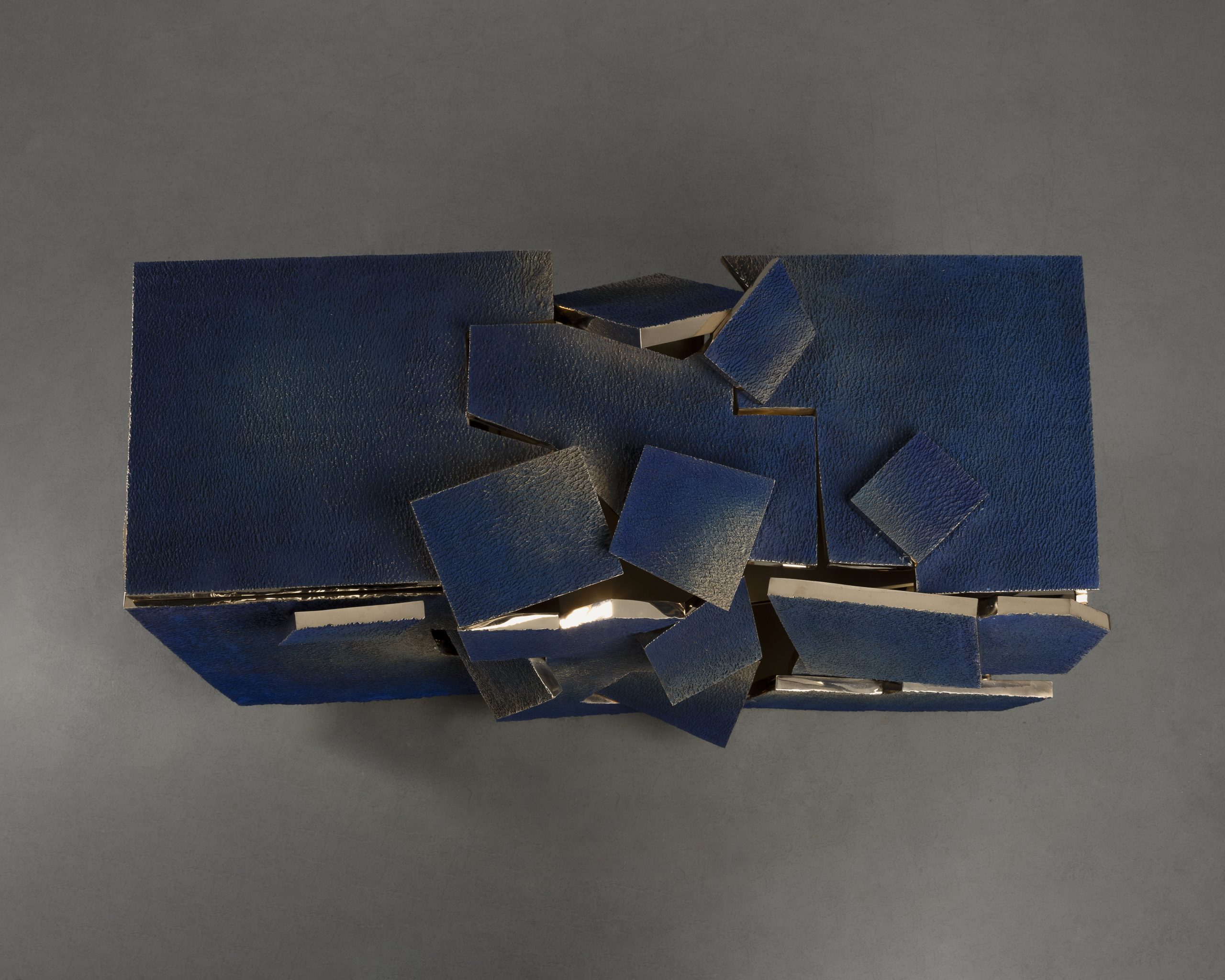
Designarcus Magazine: Considering “Blue Weather” within the broader evolution of your practice, does this collection represent a moment of resolution, a turn towards a new design language or the beginning of another transformation?
Vincent Dubourg: As with every exhibition, I am always happy to bring people together around the works. I love seeing spaces take shape as a journey, like a walk, and hearing murmurs turn into discussions around a theme.
This exhibition, presented by Carpenters, spans a period from 2017, represented for example by the Veda coffee table, to 2019, represented notably by the Between Two Stones sideboard. It allows me to validate this body of work, reflect on it and hand it over to others. I never think of a finished work in terms of resolution; in my mind, it is never entirely finished.
I am constantly taking on new projects through material to nourish my inspiration. There is not really a transformation, but a logical continuation, carried by the inertia of the work, as though I were guided by a thread I must not let go of.
Article Credits
Text: Banchan
Artist: Vincent Dubourg
Exhibition: Blue Weather, Carpenters, London / @carpentersworkshopgallery
Photography: Benjamin Baccarani; Nicky Roding