
Now Reading: WE architecten transforms concrete shell into children’s art museum in Amsterdam
- 01
WE architecten transforms concrete shell into children’s art museum in Amsterdam

WE architecten transforms concrete shell into children’s art museum in Amsterdam

A new children’s art museum has opened in Amsterdam Noord, transforming an empty concrete structure into a spatial environment where children are invited to explore, experiment and follow their own creative process. Designed in collaboration with WE architecten, KiMu Kinderkunstmuseum approaches children not as passive visitors, but as autonomous makers. The museum is grounded in a pedagogical vision that values process over outcome, offering ateliers, materials and spatial conditions that allow children to think, test, fail, begin again and develop work on their own terms.

KiMu opens with Parallel Processes, an exhibition that places the work of nearly seventy children alongside that of Dutch artists Brian Elstak, Willem Harbers and Roos van Haaften. Rather than asking children to respond directly to completed artworks, the museum invited them to work with similar materials, methods and questions as the artists, without seeing their work beforehand.
The result is an exhibition that reveals unexpected echoes between professional and child led creative processes. Sketches, tests, unfinished objects and intermediate steps are shown as part of the exhibition, allowing visitors to understand making as an open and evolving act. In some cases, elements from the artists’ practices, such as Elstak’s robots or Harbers’ cage like structures, reappear in the children’s work without direct imitation.

This parallel structure allows KiMu to shift attention away from finished objects and towards the conditions that make creative thinking possible. The exhibition becomes less a display of outcomes than a study of how ideas take form through material, concentration and imagination.

At the centre of KiMu’s approach is the atelier. These spaces are not conceived as classrooms, but as working environments where children can access tools and materials independently. Rather than following assignments or fixed themes, children are encouraged to decide what they want to make and how they want to work.

The museum’s pedagogical model draws on the experience of founder and director Suzanne Huis, who has worked with children in atelier settings for many years. Her approach is based on a simple but powerful understanding of what children need in order to create freely.
“Children want to know two things: am I welcome here, and can I be who I am?” says Huis. “At KiMu, the answer to both is yes. We create the conditions for them to take charge of their own creativity and to follow their own path, in the way that suits them.”
This philosophy informs the museum’s use of what it calls a prepared environment. Richly arranged tables, floor settings, tools and materials are placed in ways that invite children to begin working without needing to be directed. The emphasis is on concentration, independence and the gradual development of an idea through making.


KiMu is located in Amsterdam Noord, a rapidly changing district across the River IJ, where former industrial areas sit alongside cultural initiatives, galleries, restaurants and new residential developments. The museum occupies a new building that had been constructed with a museum function in mind, but remained an empty concrete shell before KiMu moved in.
Together with WE architecten, the project team developed the space into a museum environment while retaining its raw industrial character. The existing concrete structure remains visible throughout, giving the interior a sense of openness and material clarity.


“We were immediately drawn to the light and the openness of the space,” says Huis. “Even when it was still an empty shell, there was something very inspiring about it. We wanted to keep that feeling intact, while shaping it into a museum environment that supports how children explore and create.”


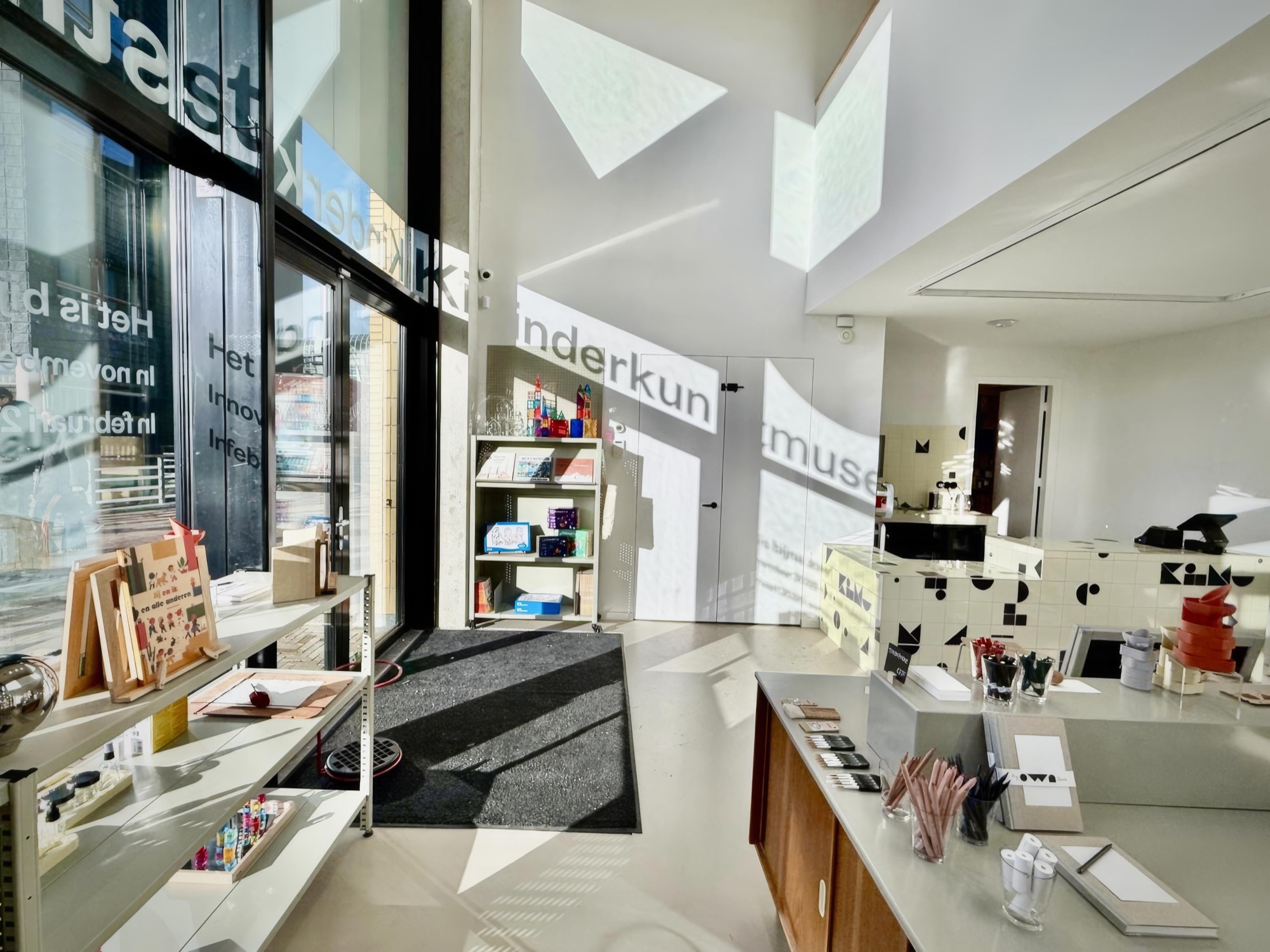
The layout is organised around a large central volume with two storeys of height and generous windows facing the water. Visitors enter through a foyer and shop before moving into this open space, where different routes and perspectives unfold.
Two timber staircases, a triangular balcony and a suspended net animate the central volume. The balcony introduces a raised viewpoint, almost like a crow’s nest, while the net offers children a place to pause, lounge and observe. Above it, a mirror catches light and reflects the water outside back into the interior.
Slender cherry wood frames and internal windows maintain visual connections between the ateliers and the main spaces. These elements give the museum a restrained architectural rhythm, balancing the industrial grey of the concrete with warm timber and moss yellow accents.

The project was developed through close collaboration between Suzanne Huis and WE architecten. Huis defined how the spaces needed to function and developed many of the interior concepts, including the ateliers and furniture. WE architecten translated these ideas into a spatial design, adding architectural interventions such as the stairs, balcony and net.
“It was never about creating a finished image,” says Wouter van Alebeek of WE architecten. “The space needed to invite creative use and leave room for discovery.”
This idea extends into the interior. Materials were sourced during the design process, while furniture was designed, adapted and built in response to practical use. Reused and found materials appear throughout the museum, and children were involved in making parts of the interior. In this way, the building itself carries traces of the same process based approach that defines KiMu’s educational programme.


The combined foyer and shop includes a single counter serving both museum and retail functions, clad in second hand 1930s tiles printed by children with parts of KiMu’s logo. Suspended above, a large light installation by artist Rein uses mirrored glass elements that shift in colour with the changing light.
The cloakroom features a locker system by i29 architects under their new label Elements Amsterdam, combining steel and felt with a row of coat hooks placed at children’s height. In the ateliers, furniture was developed from everyday use and Huis’ experience of working with children, then built by LikaPika, the company of carpenter Lika Kortmann.
The Atelier of Light was developed in collaboration with Stichting TOEVAL GEZOCHT, drawing on its longstanding experience with exhibitions that foreground children’s creative processes, including previous presentations at the Stedelijk Museum Amsterdam.


KiMu proposes a museum model in which children are not simply introduced to art, but are given the space to act as makers within it. Its architecture supports this by remaining open, visible and adaptable, while its programme focuses on the slow formation of ideas rather than immediate results.
By bringing together a raw concrete shell, carefully inserted timber elements, accessible ateliers and a clear pedagogical framework, KiMu offers a new perspective on how museums can engage children in contemporary art and design. It is a place where making is not treated as preparation for something else, but as a serious cultural act in its own right.
The museum was officially opened by Femke Halsema, the mayor of Amsterdam, together with Amsterdam’s official children’s mayor Kiyaro.


Project Credit
Project: KiMu Children’s Art Museum
Location: Amsterdam Noord, Amsterdam, Netherlands
Architect: WE architecten / @wearchitecten
Opening: 2026
Photo: Morad Bouchakour, Cees Hartman, mohamad yekta, Stoika de Vreeze, Suzanne Huis, Stein, Aiste Rakauskaite