
Now Reading: Liwa Farm Village in Abu Dhabi blends rammed earth architecture with oasis agriculture
- 01
Liwa Farm Village in Abu Dhabi blends rammed earth architecture with oasis agriculture

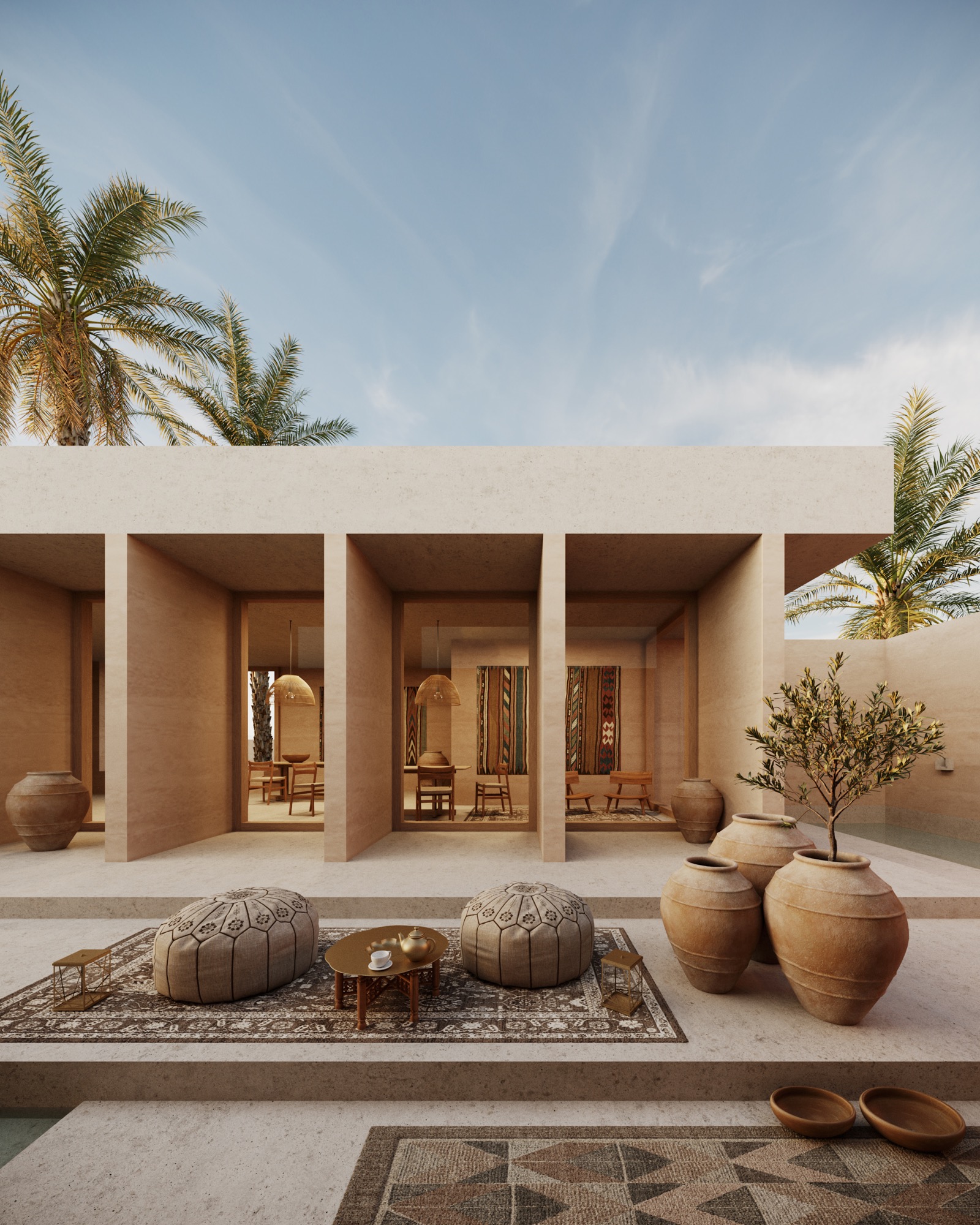
Liwa Farm Village in Abu Dhabi blends rammed earth architecture with oasis agriculture

Set within the historic Liwa Oasis at the edge of the Rub’ al Khali desert, Liwa Farm Village by Inca Hernandez reconsiders the relationship between settlement, agriculture, and climate in one of the UAE’s most culturally charged landscapes. Rather than treating heritage as a static reference, the project operates as an active environment where architecture, farming, and community life are interwoven.

The masterplan is embedded within a working date plantation, allowing buildings to emerge between palm groves rather than occupy cleared ground. This approach positions the oasis not as a backdrop but as a living system that shapes movement, use, and spatial hierarchy. Architecture becomes a framework for inhabiting the landscape rather than an object placed upon it.

The project draws on regional construction knowledge, translating it into a contemporary architectural language without losing its material logic. Rammed earth walls made from desert sand establish a tactile continuity with the site while providing thermal mass suited to extreme heat. Windcatchers reinterpret traditional passive cooling devices, capturing airflow and light while framing the sky as a constant spatial reference.


Clay latticework softens the solidity of the walls, introducing permeability that filters sunlight and supports ventilation. Elevated platforms in pigmented concrete lift the buildings above shifting الرمال, protecting them from wind erosion while reinforcing their presence within the terrain. These elements do not operate as stylistic gestures but as environmental tools, calibrated to the desert’s conditions.

The project is organized as a sequence of interconnected spaces that support both daily agricultural activity and communal exchange. Cultural exhibition areas and date processing facilities sit alongside a veterinary space that also functions as a teaching environment for local farmers. A central atrium opens into a fluid, double curved volume that receives visitors, its geometry shaped by references to water sources within the oasis.


The Majlis forms the social core of the project, constructed with palm based structures that recall traditional roofing systems. Nearby, a farm to table restaurant and a spa extend the experience of the landscape into spaces of gathering and retreat. Reflecting pools and planted courtyards mediate between built form and open land, creating microclimates that temper the desert environment.
The architecture operates through a careful balance between ancestral techniques and contemporary adaptation. Palm trunks and fibers are reused as structural elements, forming lightweight roof systems rooted in local resources. Subterranean irrigation channels inspired by aflaj systems support greenhouse cultivation and aquaculture, ensuring that water remains central to both ecological and spatial organization.


Lime plaster finishes reflect solar radiation and protect earthen surfaces, while stone foundations stabilize the buildings against ground movement and humidity. Across the project, materials are selected not only for performance but for their ability to carry cultural continuity, allowing construction itself to become a form of memory.
Liwa Farm Village proposes an alternative model for development in arid landscapes, one that resists separation between architecture and ecology. By aligning agricultural production, social life, and environmental performance, the project establishes a contemporary interpretation of the oasis as a place of exchange and resilience.

Here, tradition is neither preserved as image nor replaced by innovation, but reactivated as a living process. The result is a settlement that sustains both land and community, offering a future grounded in the intelligence of the past.
Project Credit
Project name: Liwa Farm Village
Location: Bateen Liwa, Abu Dhabi, UAE
Studio: Inca Hernandez Atelier / @incahernandez.atelier
Construction Area: 7,000 sqm | Land Area: 30,000 sqm
Year: 2025
Images: Courtesy of Inca Hernandez Atelier