Now Reading: Place des Montréalaises by Lemay transforms Montreal expressway into memorial plaza
- 01
Place des Montréalaises by Lemay transforms Montreal expressway into memorial plaza

Place des Montréalaises by Lemay transforms Montreal expressway into memorial plaza

In the civic core of Montreal, Place des Montréalaises reimagines a fragmented piece of infrastructure as a generous public landscape. Completed in 2025 and designed by Lemay in collaboration with artist Angela Silver and engineers at AtkinsRéalis, the project covers a sunken expressway with a new urban esplanade that reconnects Old Montreal with the downtown district.

The intervention emerged from an international multidisciplinary landscape architecture competition launched by the City of Montreal in 2017. Rather than treating the site as a purely infrastructural challenge, the proposal adopts a layered architectural strategy that transforms a long-standing urban rupture into a civic destination. The resulting plaza functions simultaneously as a memorial landscape, a universally accessible pedestrian route and a new ecological surface within the dense urban fabric.


At the core of the project lies a commitment to inscribing women’s history within the city’s public space. In many global cities, female figures remain underrepresented in street names and monuments. Place des Montréalaises responds to this imbalance by honouring twenty one women selected by the Conseil des Montréalaises, transforming remembrance into a spatial and collective experience.


The memorial includes the fourteen victims of the 1989 École Polytechnique femicide, alongside seven pioneering women whose contributions shaped the cultural and social history of Montreal. Rather than relying on a conventional monument, the design embeds memory within the landscape itself.

The plaza also establishes a dialogue with two nearby references. One is the stained glass installation La verrière by artist Marcelle Ferron, which animates the façades of the adjacent Champ-de-Mars metro station. The other is Place Marie-Josèphe-Angélique, redesigned in 2025 as part of the broader urban transformation surrounding the site. Through these connections, the project situates remembrance within a wider cultural and spatial network.


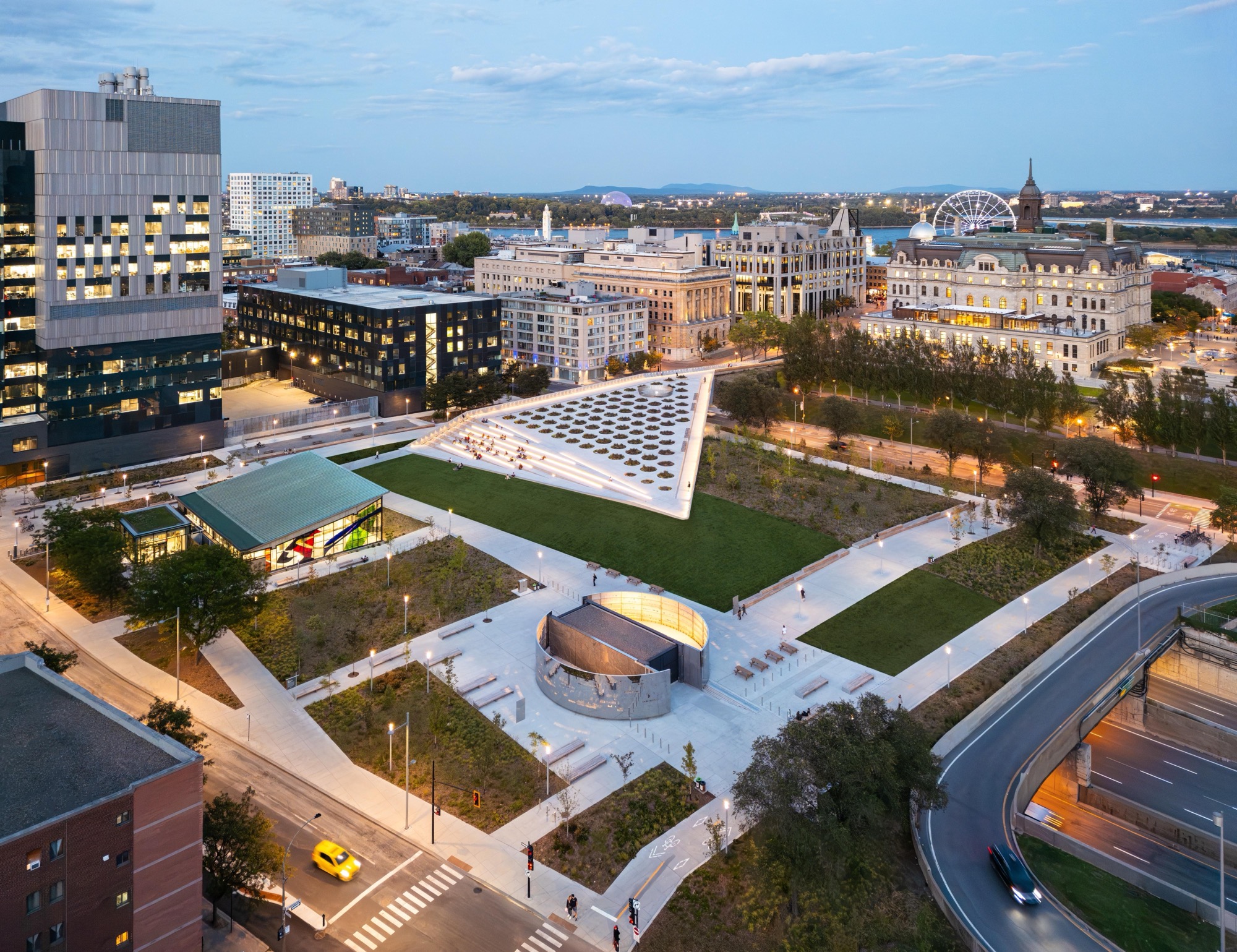
The defining architectural gesture of the project is a floating inclined plane that rises above the expressway deck. This sloped surface hosts a flowering meadow composed of twenty one plant species arranged in eighty six planting clusters that evolve throughout the seasons. The meadow forms both an ecological landscape and a symbolic field that echoes the women commemorated by the plaza.

Near the metro entrance, a cylindrical mirrored installation introduces a more interactive dimension. The names of the honoured women are engraved across its surface, and their letters disperse across the surrounding space toward a staircase. Visitors encounter fragments of these names throughout the plaza, transforming remembrance into an act of movement and rediscovery.

The staircase itself becomes a civic device rather than a simple circulation element. It leads toward the meadow while doubling as seating and an urban balcony overlooking the metro station’s stained glass façade and the activity of the plaza below. Since its opening, the space has hosted public gatherings, artistic performances and spontaneous encounters that extend the life of the site beyond its commemorative function.

Beneath its seemingly effortless landscape lies a complex infrastructural framework. The project required careful coordination between architecture, landscape architecture, art and engineering, allowing technical constraints to generate new spatial opportunities.
At the northern edge of the site, an urban forest marks the entrance to the plaza. Planted above railway tunnels and dense underground infrastructure, this landscape relies on carefully selected tree species adapted to shallow soil conditions. More than half of the site is vegetated, contributing to urban cooling, biodiversity and ecological resilience within the city centre.

One of the project’s most distinctive features is a circular oculus opening within the elevated meadow. This void allows an existing elm tree planted at street level to pass through the structure, turning a structural constraint into a poetic gesture that links the lower city with the elevated landscape above.

Since its inauguration in spring 2025, Place des Montréalaises has quickly become an active civic landmark. Residents and visitors circulate through the plaza, pause within the meadow or gather along the steps overlooking the city.
By combining infrastructure repair, commemorative landscape and ecological design, the project establishes a new urban destination in Montreal’s historic core. More than a plaza, it operates as a living monument that reconnects neighbourhoods while embedding memory within the everyday life of the city.


Project Credit
Design firm: Lemay / @lemayonline
Location: Montreal, Canada
Year 2025
Photo: Vincent Brillant / @vincent.brillant