Now Reading: Lake Resia bell tower marks submerged village in South Tyrol
- 01
Lake Resia bell tower marks submerged village in South Tyrol

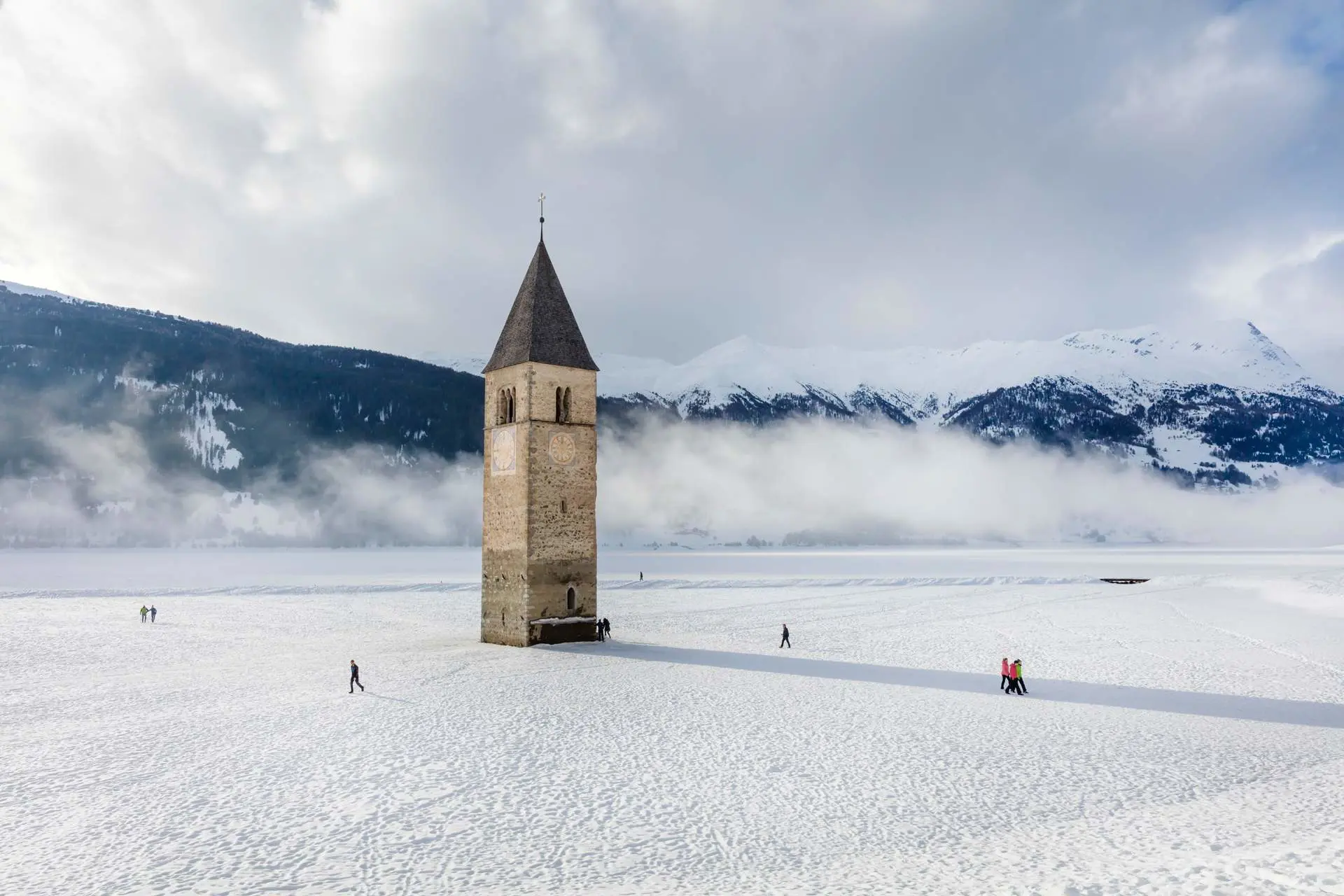

Rising from the dark, glacial waters of Lake Resia in South Tyrol, a solitary stone bell tower cuts a vertical line against the Alpine horizon. There is no church, no square, no ring of houses gathered around it. Only a Romanesque structure from the fourteenth century remains, as if time had withdrawn from everything else and chosen this single form to endure.

This is the Campanile di Curon, the surviving fragment of the old village of Curon Venosta, submerged in 1950 when a hydroelectric project transformed the valley into a reservoir. The tower was spared. The village was not. What stands today is both an image of austere beauty and a material reminder of a community erased from the landscape.

The tower once belonged to the Church of Santa Caterina d’Alessandria, a Romanesque building dating to the fourteenth century, typical of Alpine ecclesiastical architecture. Built in local stone, its compact, square mass and restrained arched openings reflect a vocabulary grounded in durability rather than ornament.
When the waters rose, the church and surrounding houses were demolished. Only the bell tower was preserved, allowed to remain as a marker within the new artificial lake. The bells themselves had been removed before the flooding. Stories that they can still be heard ringing beneath the surface belong to local legend. Yet the persistence of that myth reveals something essential: the need for sound where history has fallen silent.
Depending on water levels, the tower emerges to varying heights. In winter, when the lake freezes solid, visitors can walk across the ice to its base. The experience is unsettling. One moves not simply across a frozen surface, but across a suspended memory.

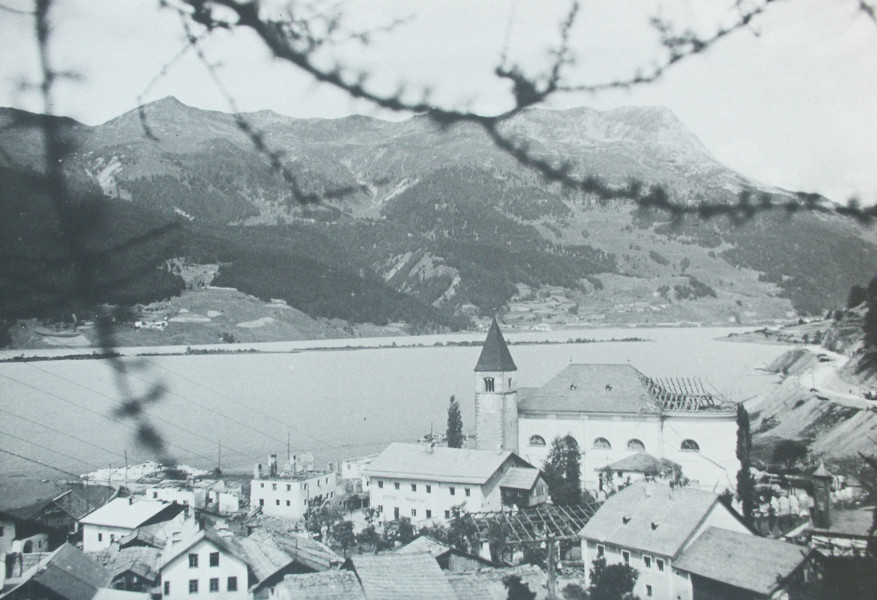
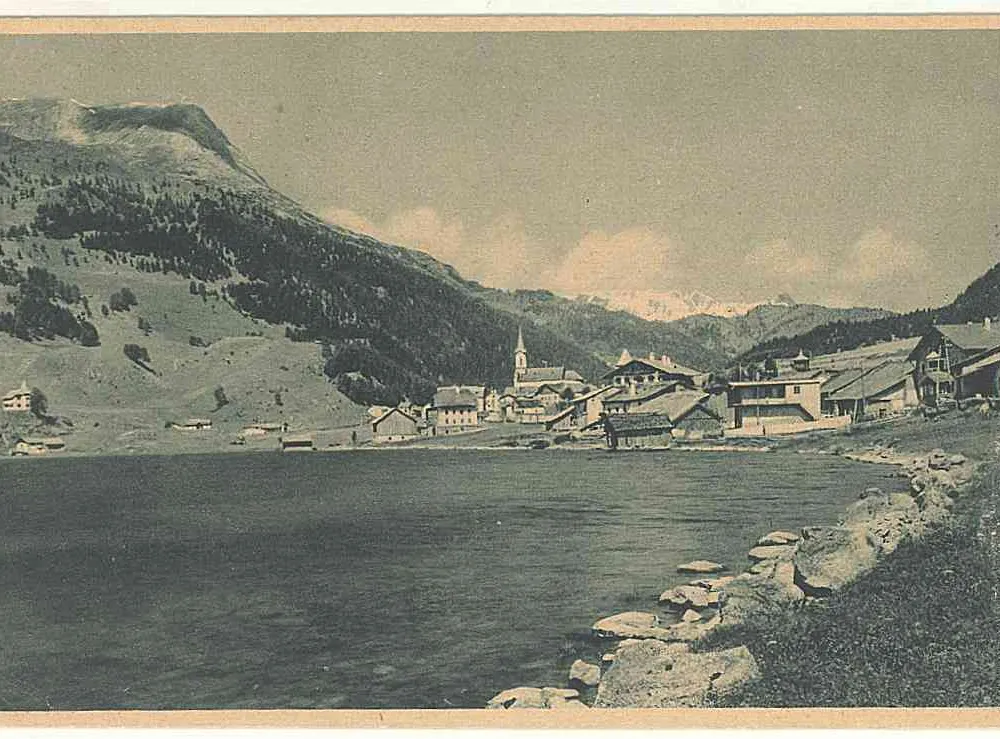
In the aftermath of the Second World War, northern Italy required energy to rebuild and industrialise. The decision to raise the waters of the existing lakes in the valley and create a large reservoir was part of that broader strategy. Completed in 1950, the project submerged more than 160 homes and forced hundreds of residents to leave a settlement that had existed for generations.
South Tyrol occupies a complex cultural and linguistic position. Predominantly German-speaking, the region became part of Italy after the First World War. In this context, a major infrastructure project was never purely technical. It intersected with questions of identity, governance, and the uneven distribution of power between centre and periphery.

The removal of the bells marked the end of a shared acoustic landscape. Soon after, demolition and rising water erased the spatial fabric of the old village. Curon retreated beneath the surface. The tower remained, a lone vertical trace of what had once been a lived environment.
In 2021, maintenance works required a significant lowering of the reservoir. For the first time in seventy years, the foundations of the old village resurfaced. Stone walls, staircases, fragments of basements re-emerged in daylight, briefly reconstructing the plan of a settlement long thought inaccessible.
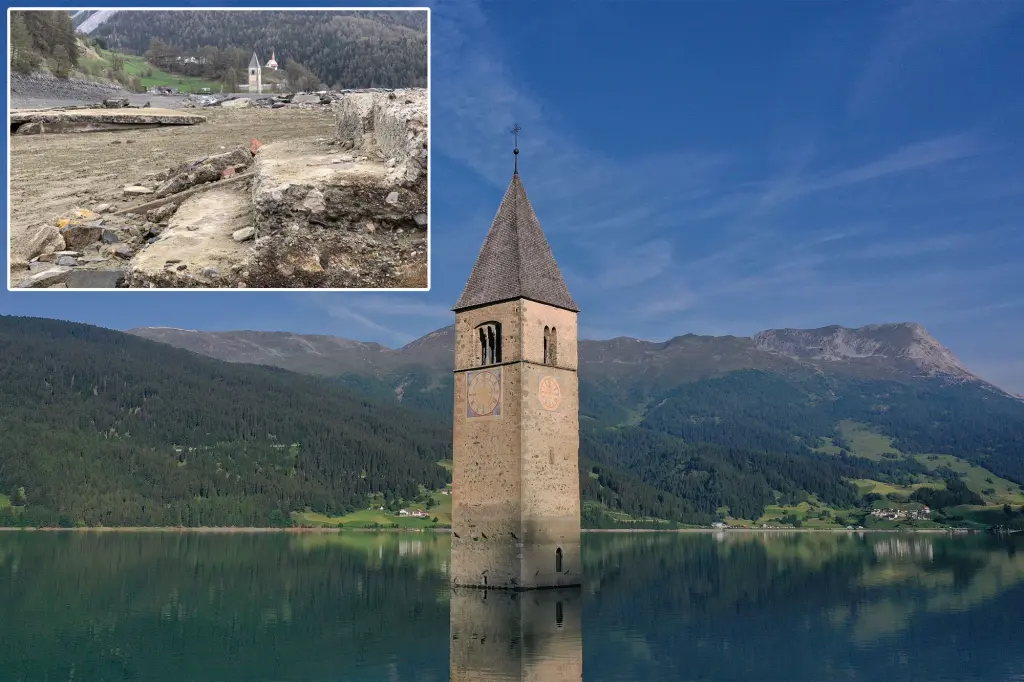
The event drew international attention not merely because it was rare, but because it made memory tangible. What had survived in photographs and oral histories became once again a terrain underfoot. Curon was no longer only a narrative of loss; it became an exposed stratigraphy of habitation.

Today, Lake Resia is a well-known destination in South Tyrol. Visitors circle the lake in summer, photograph the tower rising from reflective waters, and approach it across the white expanse of winter ice. A small museum in the new village recounts the history of displacement and reconstruction.
Yet the tower’s significance exceeds its visual impact. It is a paradoxical monument. A single architectural fragment preserved as heritage, while the social body that once gave it meaning was dissolved. It embodies the tension between development and erasure, between collective necessity and individual loss. The bell tower stands in silence at the centre of the lake. It does not narrate its story through spectacle. Its presence alone is sufficient. In that stillness, the memory of Curon persists, not as a closed chapter, but as an open question about the cost of progress and the ethics of transformation in the landscape.