
Now Reading: Planting Architecture: City in Sky and the idea of watering a building
- 01
Planting Architecture: City in Sky and the idea of watering a building


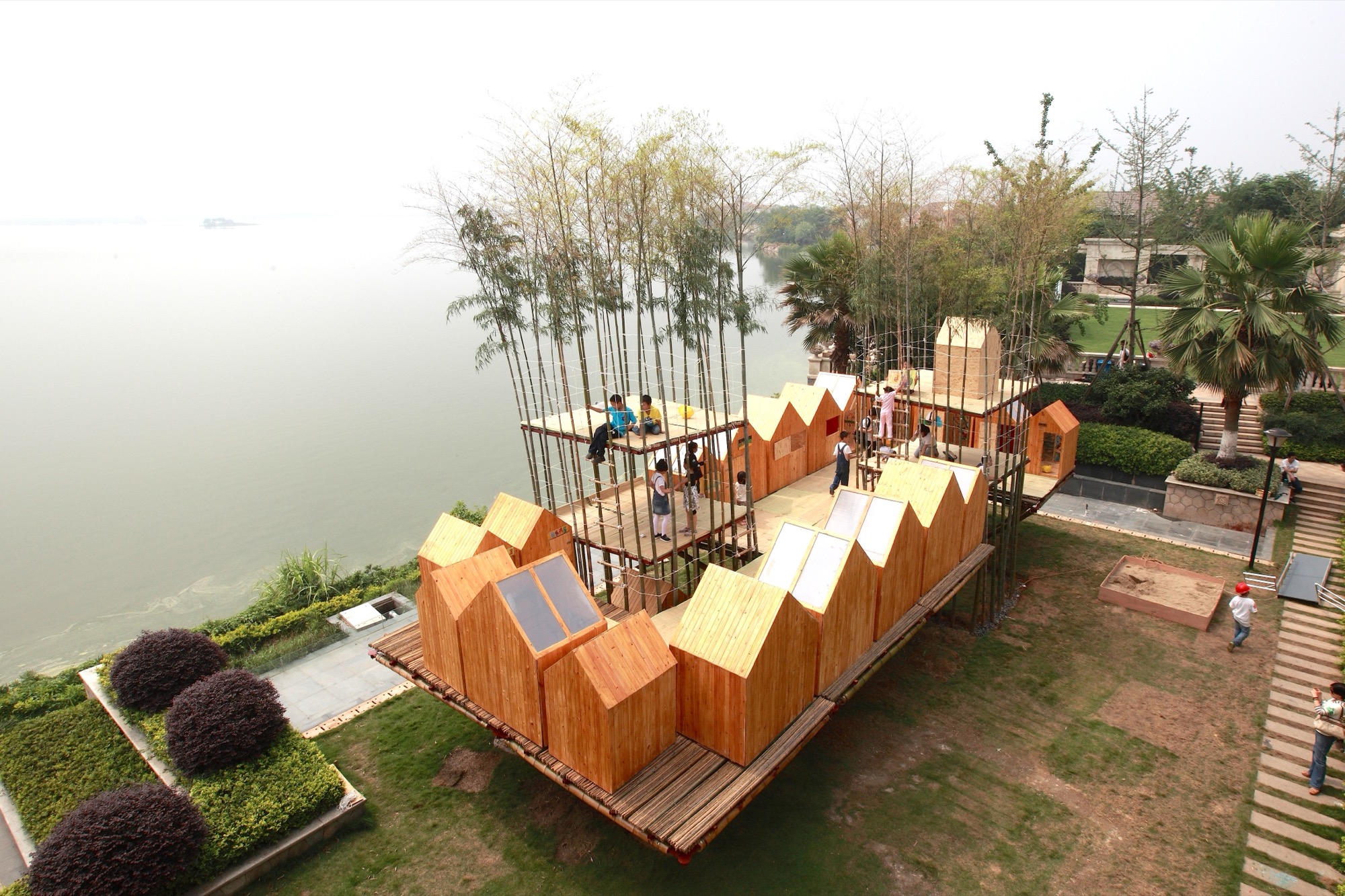
On weekends, over three months, Natur Organic Life turned a children’s workshop into a full scale experiment in architectural authorship. Thirty six children came with their parents, not to “learn architecture” as a subject, but to test what architecture can become when it is treated as a living process: sketched, negotiated, assembled, and ultimately grown.
The project is called City in Sky. It resists the comfort of a single label. House, building, pavilion, playground, prototype, none of these quite hold. What emerged was closer to a small city claimed by children, shaped by their drawings and models, and held together by a structure that refuses to behave like a finished object. Living bamboo is not decoration here, but a participant. Because bamboo is alive, the work is allowed to change over time, to thicken, to sway, to extend, to demand care. The city does not simply stand; it keeps becoming.

City in Sky began with a childhood memory: the first time standing in a bamboo forest, the possibility of an invisible city hovering among the stalks felt not only plausible, but inevitable. That early image returns here as a built question posed in public, with children as the primary designers.


What happens when the “architect” is no longer a single signature, but a chorus of young authors? In this workshop, the children described space with the tools available to them, sketching, modeling, arguing, deciding. Their proposals were not treated as cute approximations, but as real spatial intentions. The role of the adult shifted toward editing constraints, safety, and assembly, while preserving the clarity of the children’s desires: thresholds to climb, corners to hide, platforms to gather, openings to watch the wind move through the grove.

In that sense, City in Sky is less a building than a civic lesson. It introduces the idea of neighborhood not through theory, but through proximity: each child working on a “home,” then seeing how individual spaces become an urban form when they meet.


LIVING BAMBOO AS STRUCTURE
Bamboo has long carried the double identity of vernacular intelligence and contemporary promise. It is fast growing, strong in tension, light enough to handle, and culturally familiar across much of Asia. Here, those qualities are not celebrated as sustainability slogans, but tested structurally and socially.

The workshop began by transplanting living bamboo to form two bamboo “houses” built to a repeated module of 3 by 3 by 8 meters. Transverse elements joint and fix the frame, opening it into outdoor terraces and play rooms. These bamboo houses sit within the wider landscape as both architecture and environment, part structure, part grove.

From there, natural bamboo becomes the primary load bearing system of City in Sky. The larger structure is organized into eight units based on the same 3 by 3 meter logic, a disciplined grid that children can understand and occupy without losing orientation. The project claims a striking efficiency: about 90 square meters of floor area created from a footprint of roughly 3 square meters of foundation. An inverted pyramid profile amplifies the sensation of hovering, making the “houses” read as if they are suspended rather than planted.
Yet the most radical move is not the geometry. It is the proposition that construction can begin with planting. If a building is assembled from living matter, the timeline of architecture shifts. Completion becomes a softer idea, less ribbon cutting, more seasonal maintenance.


City in Sky asks a simple, destabilizing question: can a building be built by planting?
In standard practice, construction means replacement. Soil is cleared, foundations erase the ground, materials arrive as finished commodities. Here, the structure begins with life already in progress. That changes the ethics of making. The work does not dominate nature; it operates with it, accepting that the city will not stay the same size, the same texture, or the same silhouette. Weather and growth become co authors. The project’s “materiality” is not only what you install, but what you cultivate.
This approach also changes who can join the work. Because bamboo elements are relatively light, children can participate on site, lifting, joining, aligning, and learning the stubborn realities of gravity, balance, and connection. The workshop becomes a rare moment where design, labor, and play are not separated into different worlds.


The project is also a critique, delivered without shouting. In China, material culture has been reshaped by speed and scale, with construction dominated by concrete and steel. City in Sky counters that default with a hands on reminder: building is a knowledge, not merely a specification. It can be tactile again, legible again, and shared with non professionals.
At the same time, the workshop speaks to childhood itself. In exam oriented systems, children’s time is often filled with extra training, and imagination is pushed to the edges of the schedule. City in Sky flips the hierarchy. It treats the child’s spatial intuition as valuable, and turns the weekend into a site of making where tools, nature, and real risk are present in a controlled way. In doing so, it offers something that architecture rarely provides directly: a vivid entry point into how the built world is assembled, and how it might be assembled differently.


To describe the feeling of a city that is always under construction, the project echoes Italo Calvino’s image of a place where scaffolding seems endless and the plan is elusive. In Calvino’s scene, when asked where the blueprint is, the builders gesture upward: “There is the blueprint,” they say, pointing to the stars.


City in Sky carries a similar mood. It is an architecture that refuses to present itself as complete, and instead asks viewers to accept uncertainty as part of the work. The “drawing” is not only on paper; it is overhead, in growth, in weather, in the passage of time.
After the workshop, a message to Chenfeng at Natur Organic Life captures the project more precisely than any manifesto: is someone maintaining the house, did you water the house?

That line lands because it dissolves a familiar boundary. We do not usually water buildings. We maintain them, repaint them, repair them, renovate them. Watering suggests care rather than control, patience rather than finish, and a relationship rather than an object.
“Did you water the house?” might be the best description of City in Sky, and also its quiet challenge to contemporary architecture: if a city can be planted, then maybe the future of building is not only about what we construct, but also about what we choose to keep alive.
Project Credit
Architects: Mu Wei, Sam Cho, Yu Hui
Location: Wuhan, China
Architect In Charge: Yu Hui
Structure: natural bamboo
Contractor: 39 kids and families from Natur Organic Life, AaL volunteer students
Area: 100 sqm
Year: 2013
Photographs: Li Xiao, Jiang Jiang
More Photos