Now Reading: Old Trafford: Architecture, Memory, and the Future of the Theatre of Dreams
- 01
Old Trafford: Architecture, Memory, and the Future of the Theatre of Dreams

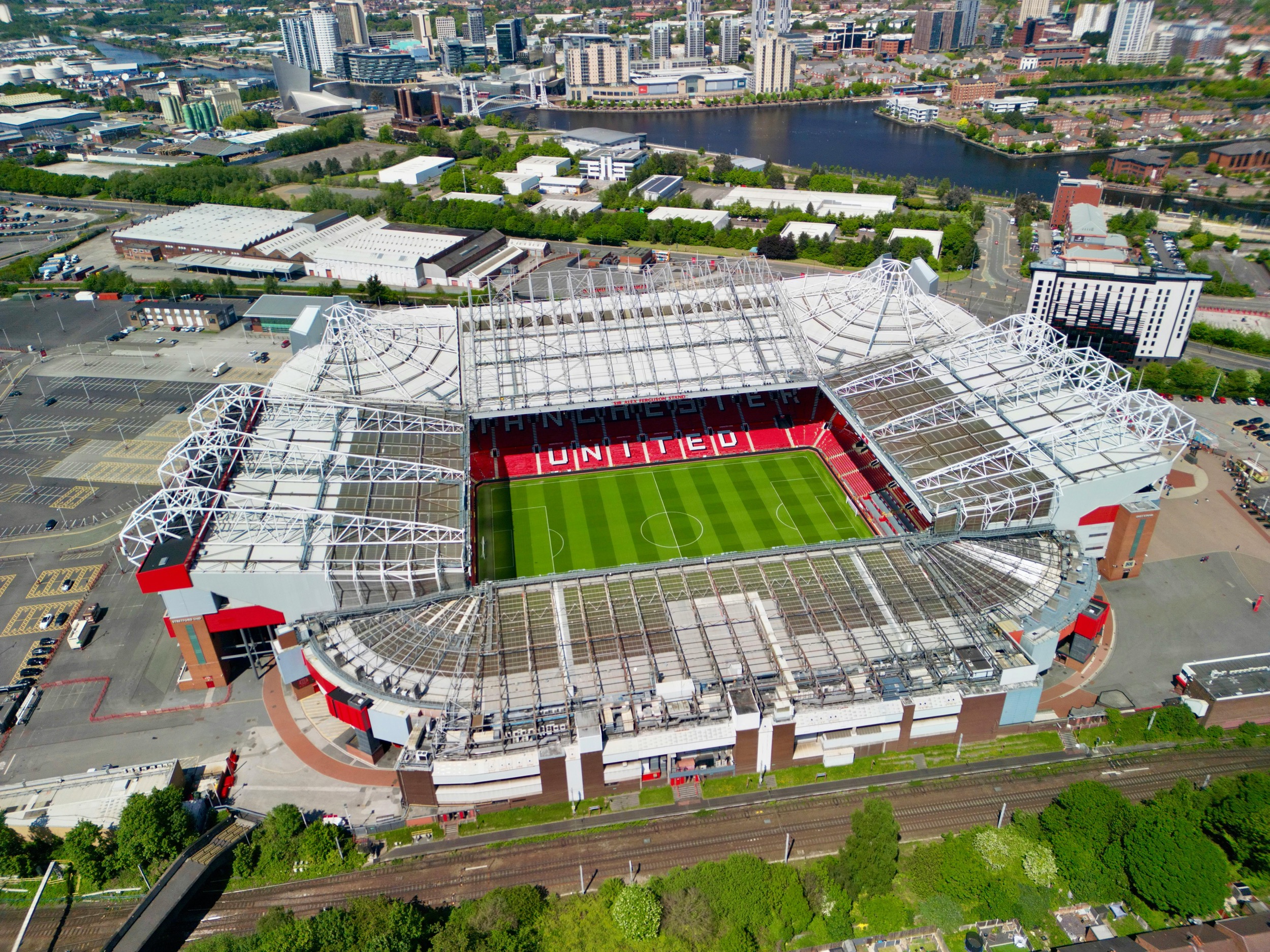

In the fading light of a Manchester evening, when the floodlights ignite and the murmur of the crowd condenses into a single rising sound, Old Trafford reveals itself as more than a football stadium. It is a structure shaped by memory. Steel, brick and concrete form the physical shell, yet what truly animates the ground is a century of accumulated experience: triumphs, disasters, rituals of gathering, and the quiet persistence of civic identity.
Sir Bobby Charlton’s phrase “The Theatre of Dreams” has long defined the emotional aura of the stadium. Yet in 2026 the building occupies an uncertain architectural threshold. Manchester United’s announcement in March 2025 of its ambition to build a new 100,000-seat stadium designed by Foster + Partners signals the possibility of a profound spatial transformation. The project forms part of a much wider regeneration plan for the Trafford Wharfside district, one that seeks to reposition the area as a new urban centre of sport, housing and public life.
The proposal raises an intriguing architectural question. Old Trafford has never been simply a container for football. It is a structure that records the evolution of the twentieth-century stadium itself: from industrial engineering to postwar reconstruction, from safety-driven redesign to the spectacle-oriented architecture of the global Premier League era. To replace such a building is not merely to build a larger arena. It is to translate a deeply embedded cultural object into a new architectural language.
The origins of Old Trafford are inseparable from Manchester’s industrial identity. At the beginning of the twentieth century the city stood among the most dynamic manufacturing centres in the world, its canals and railways feeding a vast network of textile mills and engineering works. Football clubs grew within this environment, drawing their audiences from the industrial workforce that shaped the city’s daily rhythms.

Manchester United, newly stabilised after financial struggles and buoyed by league success in 1908 and FA Cup victory in 1909, sought a stadium capable of reflecting its growing stature. Chairman John Henry Davies secured land near the Manchester Ship Canal, within the expanding industrial zone of Trafford Park. The location embodied the relationship between sport and labour that characterised early English football.

The architect chosen for the project was Archibald Leitch, the Scottish engineer responsible for many of Britain’s earliest purpose-built stadiums. Leitch approached the commission with the sensibility of an industrial designer rather than a monument builder. His architecture prioritised circulation, structural clarity and the management of large crowds.
When Old Trafford opened on 19 February 1910, it immediately stood among the largest football grounds in Britain. Terraced stands curved around the corners of the pitch, allowing spectators to gather in vast numbers while maintaining relatively clear sightlines. A large seated grandstand formed the architectural focus of the stadium, while internal facilities for players and officials introduced a level of organisation rare in football architecture at the time.
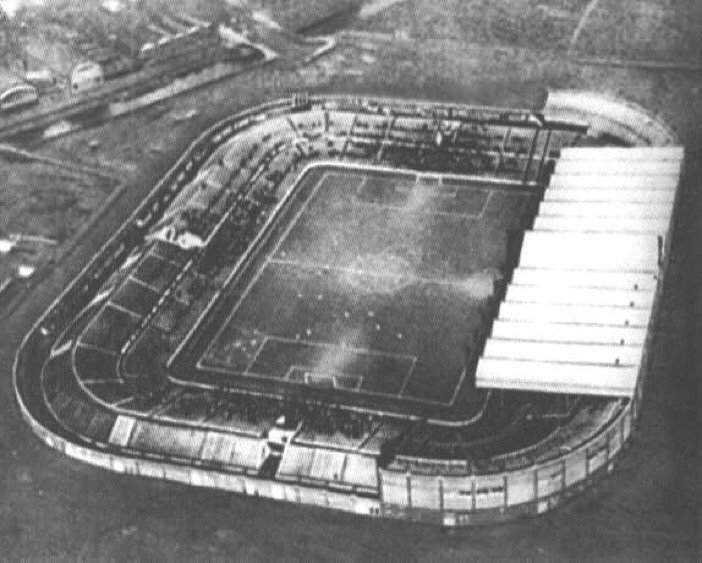
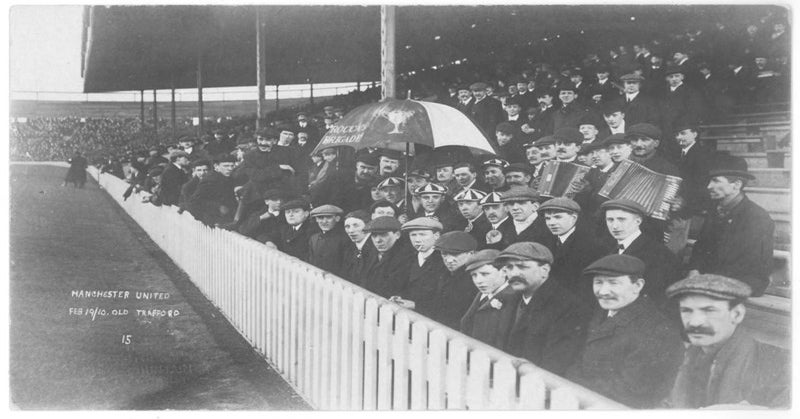

Leitch’s design echoed the industrial language of Manchester itself. Steel trusses, brick walls and simple structural logic defined the building. Rather than attempting decorative grandeur, the stadium expressed the efficiency and scale of the engineered landscape surrounding it.
WAR AND RECONSTRUCTION
Old Trafford’s first decades passed with gradual improvements, but the Second World War dramatically interrupted its architectural continuity. In March 1941 bombing raids inflicted severe damage on the stadium, destroying large sections of the ground. Manchester United were forced to relocate temporarily to Maine Road, the home of their city rivals.
The club returned to Old Trafford in 1949, but the building that emerged from reconstruction was already a hybrid of old and new. Like many British structures of the mid-twentieth century, the stadium became part of the broader narrative of wartime destruction followed by pragmatic rebuilding.
In the years that followed, Old Trafford became inseparable from the mythology of Manchester United under manager Matt Busby. The emergence of the youthful “Busby Babes” gave the stadium an aura of possibility that would be shattered by the Munich air disaster of 1958. The tragedy permanently altered the emotional geography of the ground.


The old players’ tunnel, one of the few surviving fragments of the original 1910 structure, was later renamed the Munich Tunnel in tribute to the players who lost their lives. Through gestures like this, the stadium gradually absorbed remembrance into its architectural identity.
Old Trafford’s status expanded beyond club football as well. It hosted matches during the 1966 FIFA World Cup, games during the 1996 European Championship, and the 2003 UEFA Champions League final. Rugby league finals and large concerts further embedded the stadium within Manchester’s cultural landscape.

ARCHITECTURE IN LAYERS
The Old Trafford visible today is the product of continuous transformation. Successive generations altered the building to respond to evolving expectations about safety, comfort and spectacle.
The introduction of cantilever roof structures during the mid-twentieth century marked a crucial moment in stadium design, removing structural columns that obstructed views and allowing larger uninterrupted seating areas. Floodlighting extended the stadium’s functional life into evening hours, aligning football with the rhythms of broadcast media.


After the Hillsborough disaster in 1989, the Taylor Report required English stadiums to convert to all-seater configurations. Old Trafford underwent a substantial redesign in the early 1990s, trading raw capacity for improved safety and spectator comfort.

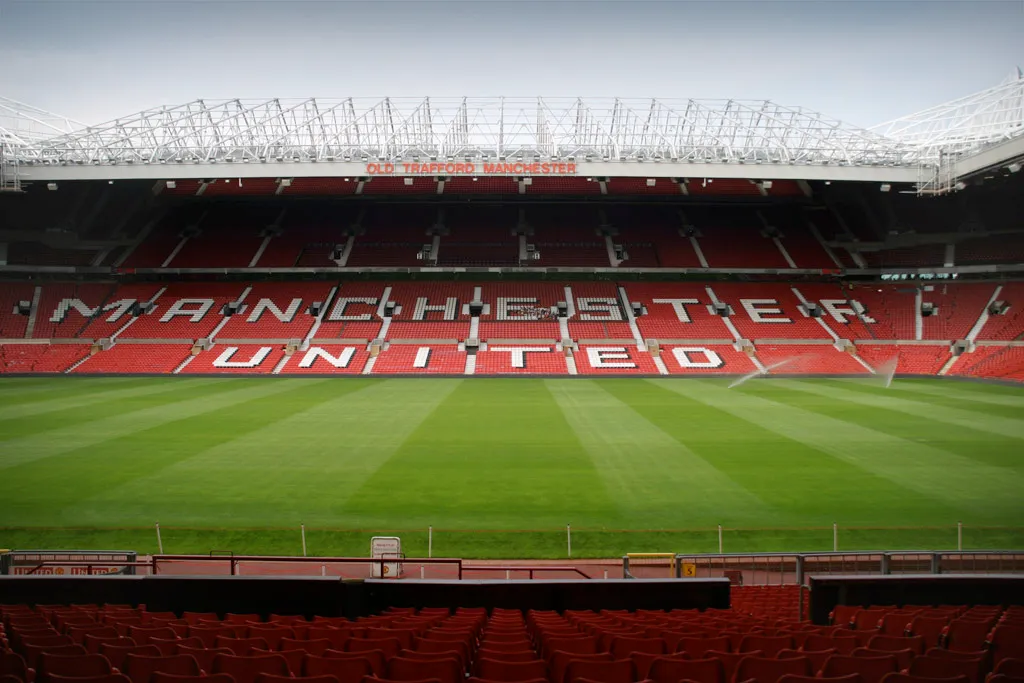
Further redevelopment followed as the Premier League transformed football into a global entertainment industry. The expansion of the North Stand into the imposing Sir Alex Ferguson Stand created a dramatic three-tier structure that dominates the stadium’s skyline. Additional quadrant infills gradually pushed capacity above seventy thousand spectators.

Yet Old Trafford never achieved the seamless symmetry typical of many contemporary arenas. A railway line running behind the southern side of the ground limited expansion, producing an asymmetrical profile that reveals the building’s incremental evolution. Rather than hiding its past, the stadium displays it.
The effect is architectural rather than purely nostalgic. Old Trafford feels like a structure assembled across time, its layers visible to anyone attentive to the logic of the stands.
THE STADIUM OF THE FUTURE
Despite its aura, the building now faces structural and infrastructural limitations. Narrow concourses, ageing service systems and spatial constraints make further expansion increasingly difficult.
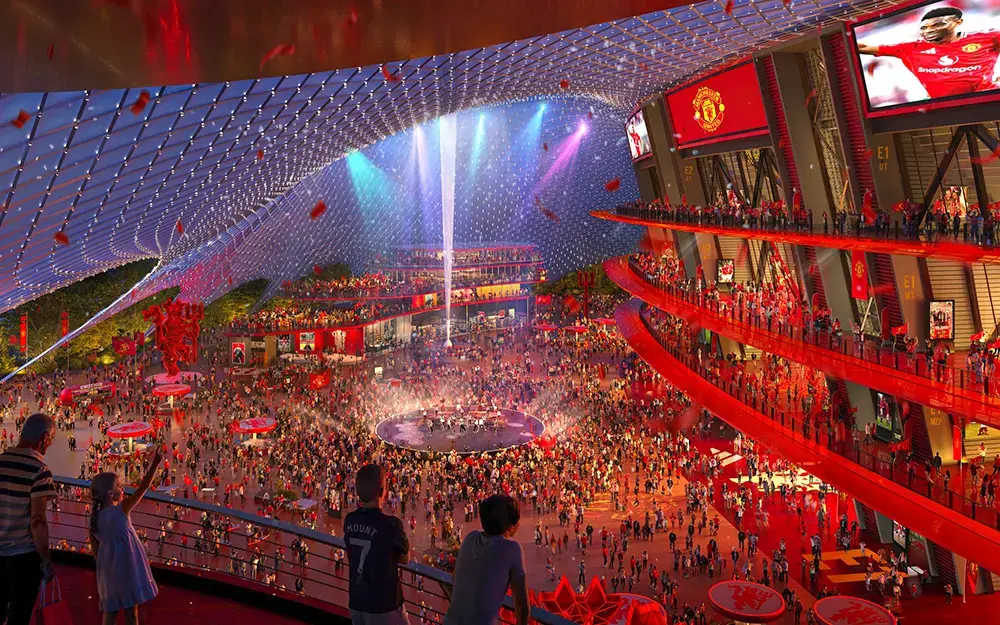
Manchester United’s exploration of a new stadium therefore reflects broader trends in global sports architecture. The Foster + Partners proposal imagines a 100,000-seat arena integrated into a larger urban district that includes housing, public spaces and improved transport connections.
The design envisions a vast canopy structure supported by three mast-like elements rising above the stadium bowl. The ambition is not only to create a new venue for football but to establish a civic landmark capable of anchoring an entire neighbourhood.

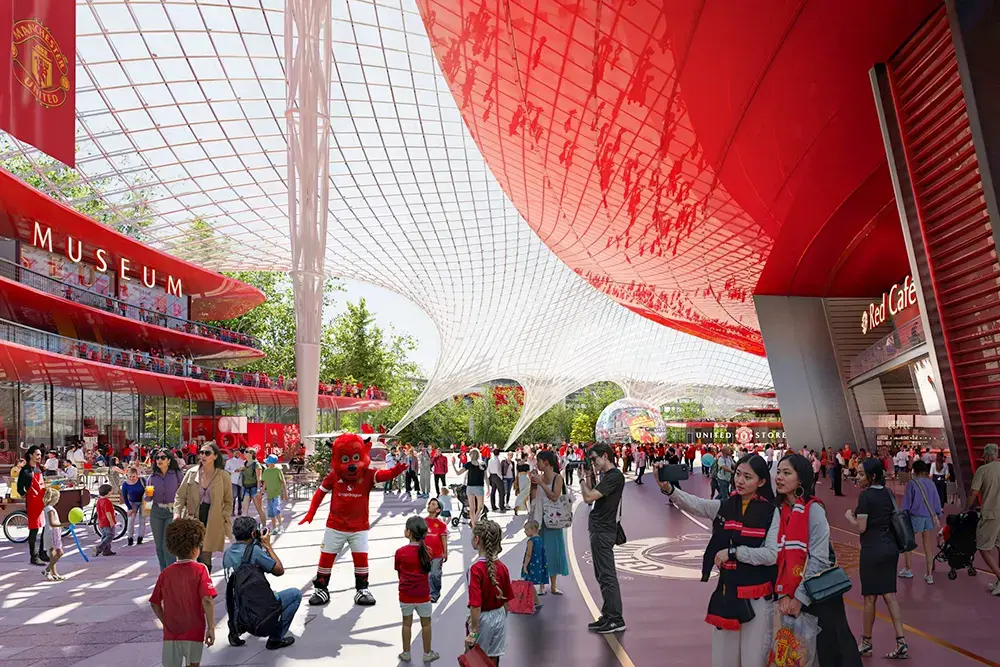
Such thinking reflects the growing role of stadiums as instruments of urban regeneration. Around the world, major sports arenas now function as economic engines as well as cultural symbols.
Yet replacing Old Trafford is not merely a logistical decision. The ground is one of the rare stadiums whose identity has grown inseparable from the emotional history of the club that inhabits it. The challenge facing designers and planners is therefore not only technical but cultural: how to carry forward the intangible atmosphere that generations of supporters have associated with this place.

ARCHITECTURE AND MEMORY
Old Trafford’s century-long history illustrates the unusual architectural condition of stadiums. Few other building types accumulate public meaning with such intensity. They are places where infrastructure meets ritual, where the logic of engineering intersects with the unpredictability of collective emotion.
From Archibald Leitch’s pragmatic design of 1910 to the layered transformations of the modern era, Old Trafford has continually adapted without losing its fundamental identity. Its significance lies not in architectural purity but in visible continuity.

Whether Manchester United ultimately constructs a new stadium beside it or continues to evolve the existing ground, the Theatre of Dreams has already secured its place within the architectural narrative of modern Britain. It remains one of the rare buildings in which the architecture of sport, the memory of a city and the imagination of millions of supporters converge.

Photo Cover
Aerial view of Old Trafford Stadium showcasing its architectural asymmetry and urban integration.
Credit: Pexels / Mylokaye