
Now Reading: From the Gates of Likhobory: The enduring vision of Nikolay Polissky
- 01
From the Gates of Likhobory: The enduring vision of Nikolay Polissky

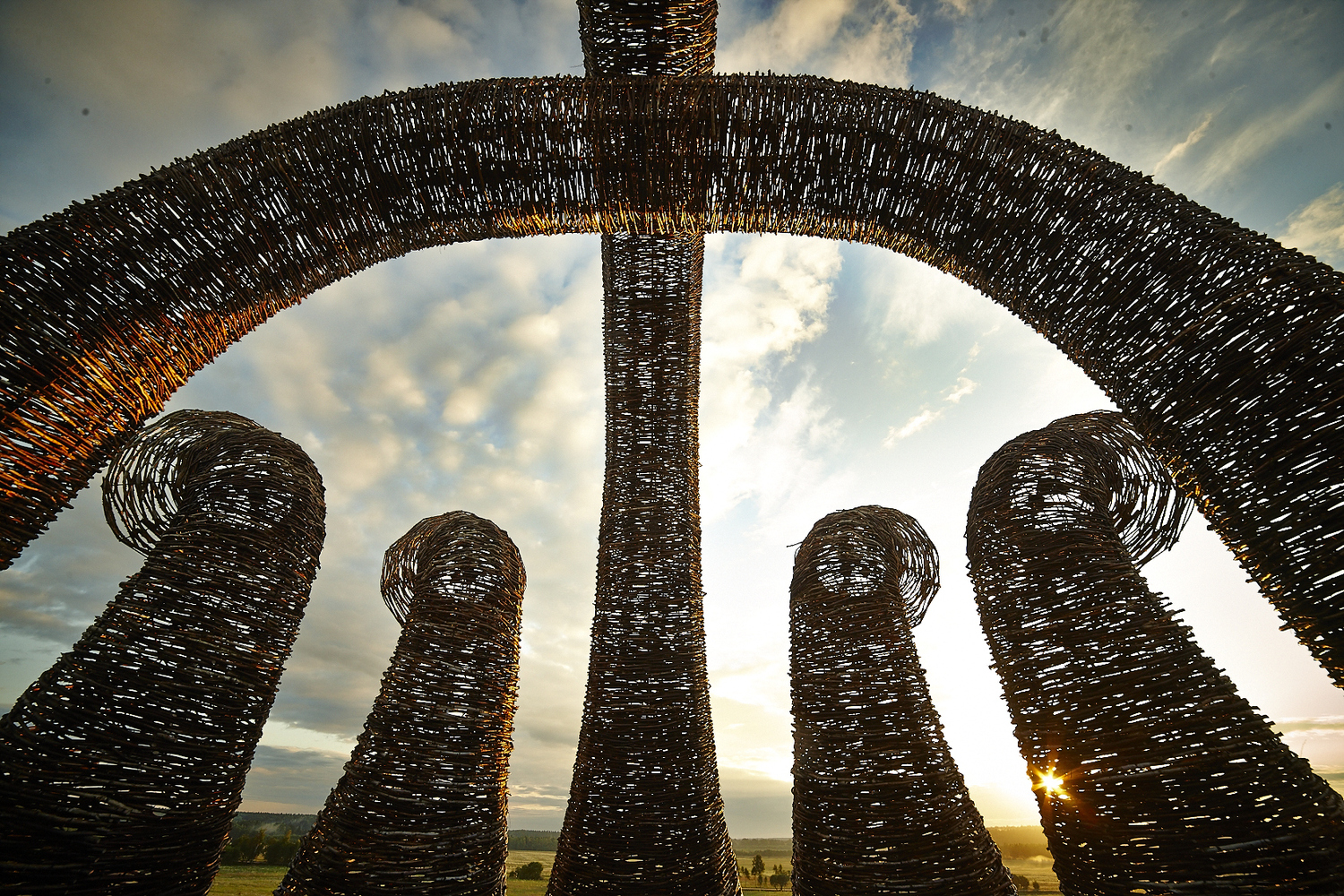

In the northern districts of Moscow, where residential fabric dissolves into infrastructure and parkland, a structure once stood that resisted easy classification. Neither architecture in the conventional sense nor sculpture as a self-contained object, Likhoborskie Gate occupied public space as a provisional threshold. Supported by four concrete pillars and crowned with a dense lattice of wooden rods, the work appeared at once archaic and unresolved, closer to a rural construction than to the symbolic language of the contemporary city.

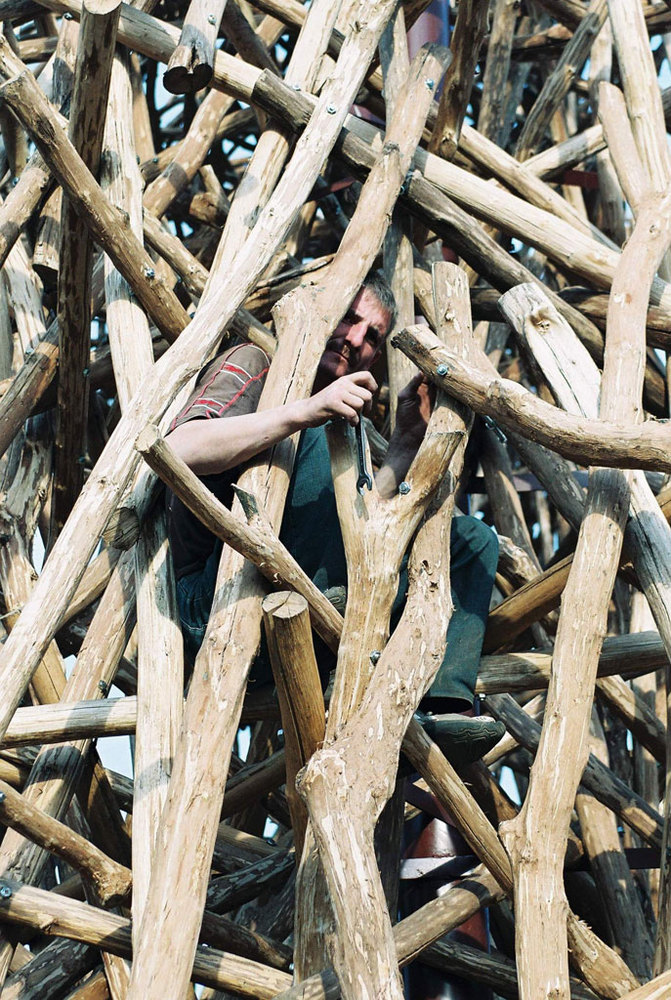
Completed in 2005, the gate emerged from a collaboration between Nikolay Polissky, architect Galina Likhterova, and craftsmen from the village of Nikola Lenivets. Its materials were modest and unmistakably manual. Slender wooden elements were assembled in great numbers, producing a surface that absorbed light and weather rather than reflecting authority. The structure did not dominate its surroundings. Instead, it unsettled them, introducing a form whose logic belonged to a different economy of labor and time.
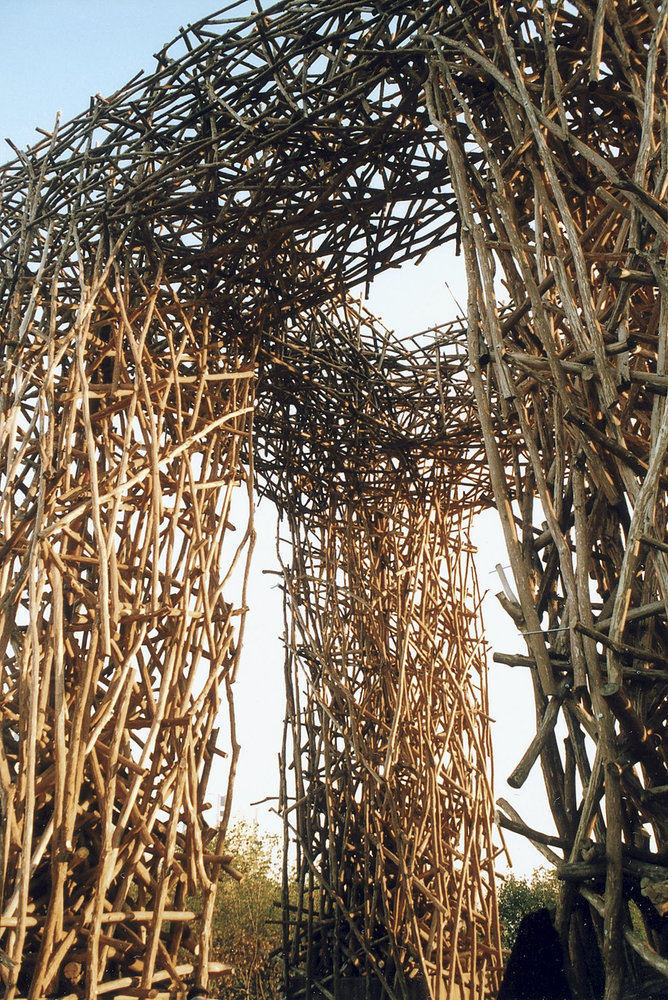
For nearly two decades, Likhoborskie Gate remained in place, weathered and altered by seasons, its presence gradually normalized by everyday use. In late May 2024, it was dismantled during a phase of municipal redevelopment. The removal was quiet and procedural, framed as a matter of urban maintenance rather than cultural loss. Yet the disappearance of the gate sharpened the very questions the work had posed from the beginning. What kind of art is permitted to exist in public space. How long may it remain. And who decides when its time has ended.
Rather than marking a conclusion, the gate’s dismantling clarifies the underlying principles of Polissky’s practice. His works are conceived with an awareness of impermanence, not as a flaw to be overcome but as a condition to be acknowledged. The gate, like many of his projects, was never meant to endure indefinitely. Its significance lay in the processes it activated and the relationships it revealed between people, materials, and place.
THE MAKING OF A VISIONARY
Born in Moscow in 1957, Polissky was trained at the Vera Mukhina Higher School of Art and Design in Leningrad, graduating in 1982 with a focus on ceramics. His early career unfolded within the unofficial art circles of the late Soviet period, including an association with the Mitki group. During the 1980s, he worked primarily as a painter, producing landscapes that already suggested an attentiveness to scale and environment.

A decisive shift occurred at the end of the 1990s, after Polissky relocated to the rural village of Nikola Lenivets in the Kaluga region. Initially seeking distance from the institutional art world, he encountered the limitations of painting as a medium through which to engage the surrounding landscape. Fields, forests, and the remnants of collective farm infrastructure demanded a different response, one that involved physical construction and shared labor rather than solitary authorship.
In 2000, Polissky initiated Snowmen, a project that mobilized local residents to build a field of monumental snow figures. This work marked the beginning of a sustained engagement with land art and collective production. The artist no longer positioned himself as a singular maker but as an initiator of processes in which villagers became collaborators and co authors. The landscape itself functioned not as backdrop but as material and participant.

Over time, Nikola Lenivets evolved into a large scale site of artistic production, hosting permanent installations, temporary structures, and festivals. Despite growing international recognition and invitations to exhibit abroad, Polissky remained anchored to this rural context. It provided not only materials and labor but also a social framework that shaped the ethos of the work.


Likhoborskie Gate represented an extension of this methodology into the urban environment. Built by the same community based workforce, the project transplanted rural modes of making into the city. It challenged assumptions about how public art should be produced and by whom, proposing an alternative model grounded in collective effort and material humility.
ART AS COLLECTIVE MYTH MAKING
At the core of Polissky’s philosophy lies a rejection of art as an exclusive or hermetic practice. His works are designed to accommodate multiple interpretations and to remain legible across social and cultural boundaries. This openness is not rhetorical. It is embedded in the structure of their making.
Collective authorship is fundamental. Polissky’s projects rely on the skills and improvisations of non professional builders whose knowledge of materials derives from everyday use rather than formal training. The resulting forms bear visible traces of this collaboration. Irregularities, repetitions, and adjustments remain present, resisting the polished finality associated with monumental art.


Myth operates in this context as a shared language rather than a fixed narrative. Polissky repeatedly turns to archetypal forms such as towers, gates, and spirals. These structures evoke long histories without prescribing specific meanings. They invite viewers to project their own associations, drawing on cultural memory rather than symbolic instruction.


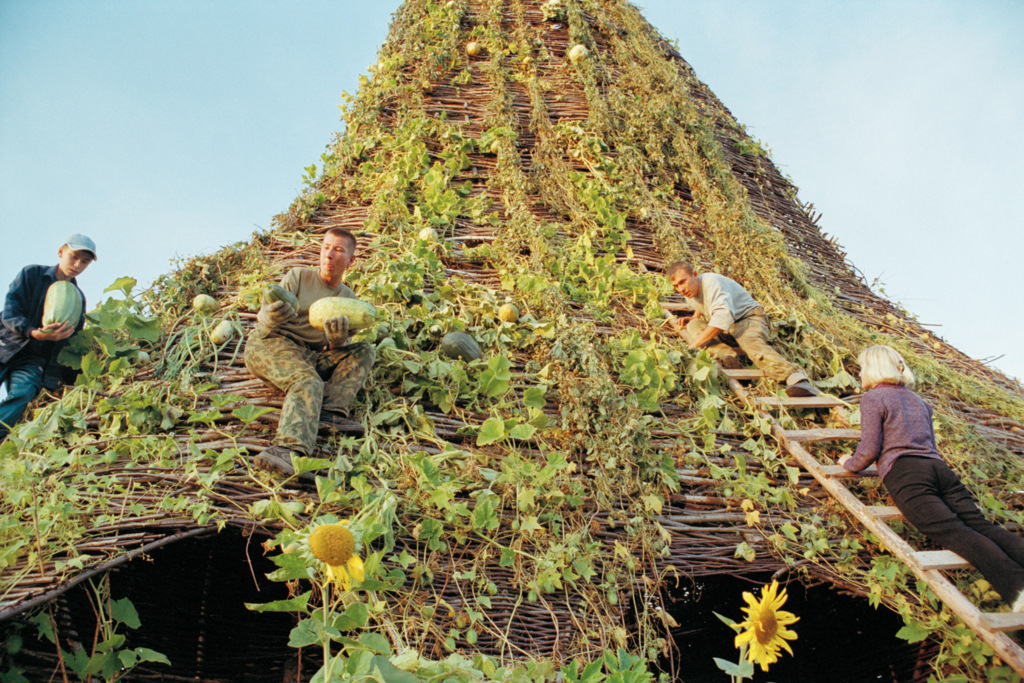
In Likhoborskie Gate, this approach was particularly evident. The form recalled the triumphal arch, yet its fragile materials undermined the rhetoric of permanence and conquest. Positioned within an everyday urban park, the gate functioned less as a monument than as an interruption, prompting reflection on what qualifies as significance in the public realm.
LANGUAGE AND MATERIALS
Polissky’s visual language is defined by scale, repetition, and an insistence on the visibility of labor. His structures often appear excessive in their density or size, but this excess serves a critical function. It counters the abstract efficiency of contemporary development by foregrounding the time and effort embedded in material form.

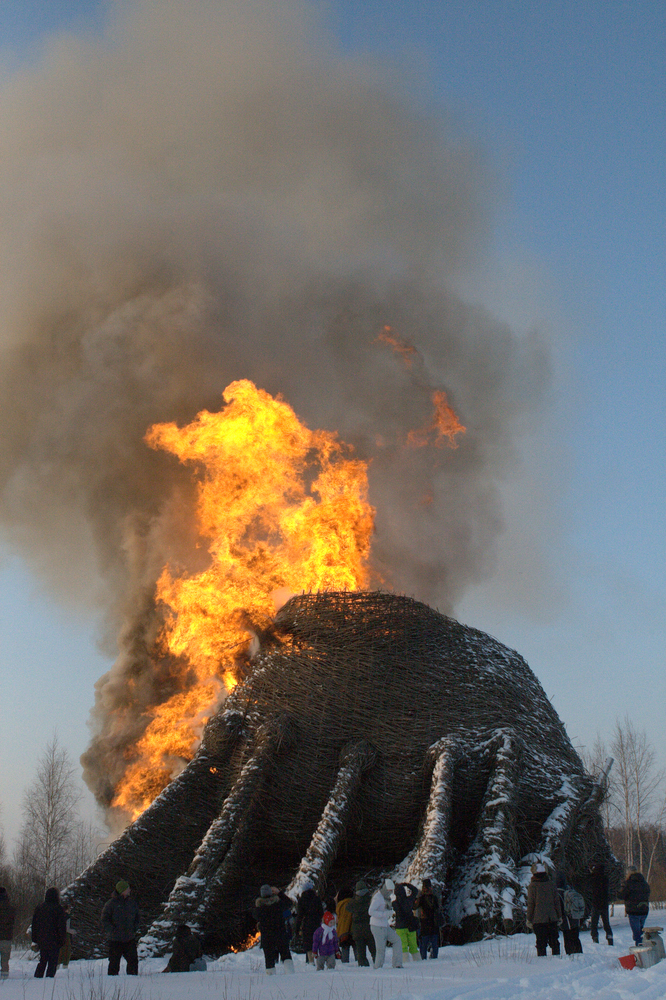
The materials themselves carry temporal qualities. Wood, hay, snow, and other organic resources recur throughout his work, sourced locally and assembled through manual techniques. These materials weather, decay, and eventually disappear. Rather than resisting entropy, Polissky integrates it into the meaning of the work, aligning artistic production with natural cycles.


This approach has ecological implications without resorting to explicit commentary. Polissky does not offer technological solutions or moral prescriptions. Instead, he proposes a different relationship to time, one in which art participates in processes of change rather than standing apart from them. In a cultural landscape dominated by digital reproduction and instantaneous visibility, his emphasis on physical presence and material vulnerability constitutes a quiet form of resistance.

LANDMARK PROJECTS AND CONTINUING INFLUENCE
From early works such as Tower of Babel, constructed from hay in a spiraling ascent, to later projects like Universal Mind, a wooden sphere evoking neural networks, Polissky has consistently explored the relationship between collective form and collective thought. Each project responds to its specific site while maintaining a recognizable logic of construction and participation.

Urban interventions further demonstrate his ability to translate architectural archetypes into vernacular terms. Rather than parodying modernist references, these works absorb and transform them through rural materials and communal labor. The resulting structures operate simultaneously as critique and homage.
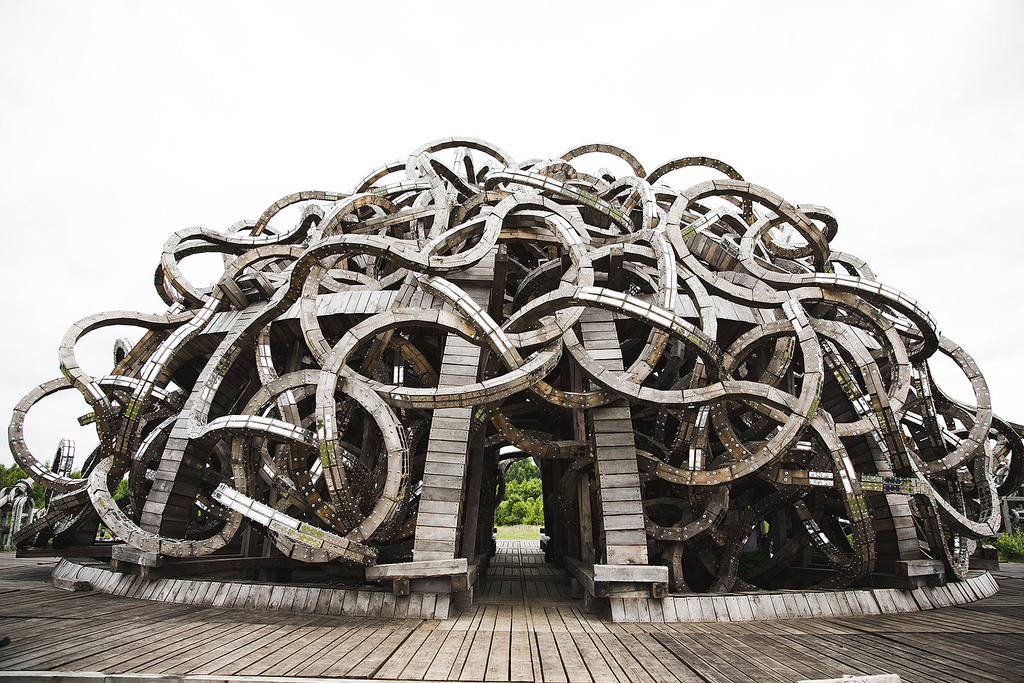
The dismantling of Likhoborskie Gate underscores the vulnerability of such practices within contemporary cities. Yet it also confirms one of Polissky’s central insights. Impermanence does not negate impact. On the contrary, disappearance can intensify meaning, transforming objects into memories and questions that persist beyond their physical presence.
BEYOND THE GATE
As the materials of Likhoborskie Gate return to circulation, decay, or reuse, the principles that shaped the work remain active. Polissky’s practice suggests that the endurance of art lies not in physical survival but in its capacity to reshape relationships between people, place, labor, and time.
In an era marked by accelerated urban transformation and ecological uncertainty, his work offers an alternative model. It privileges collective making over authorship, process over permanence, and material intelligence over spectacle. The gate is gone, but the passage it opened remains, pointing toward a more grounded and participatory vision of what art in the public realm can be.
Photo Cover
Beaubourg (2013). Image © Alexey Lukin