Now Reading: Local Local brightens a listed neoclassical townhouse beneath the Acropolis
- 01
Local Local brightens a listed neoclassical townhouse beneath the Acropolis

Local Local brightens a listed neoclassical townhouse beneath the Acropolis
On a narrow stone-paved alley in Plaka, Local Local has completed the six month renovation of a listed neoclassical townhouse dating to the 1800s. With the Acropolis close enough to feel like a daily presence, the project sits inside a tight weave of nineteenth century façades, Ottoman era balconies, and Byzantine and Roman traces. The studio’s approach is deliberately low key: not a new style imposed on old stone, but a set of edits that let the building’s proportions, openings, and materials lead.


For Plaka House, the constraints were clear. The structure was sound, but a 1990s refurbishment had left interiors glossy and heavy, with polished marbles and dark timber finishes that felt out of sync with the townhouse’s historic character. Listed status ruled out major structural change. That limitation became the project’s framework.

Sofia Xanthakou, Director at Local Local, describes the starting point as listening rather than authoring.
“As a listed townhouse in one of Athens’ most historic neighbourhoods, Plaka House was deeply informed by its surroundings. With a layered heritage and proximity to the Acropolis, we worked to reconnect the home to its context through a lighter, more open interior expression, respecting its historic character while introducing contemporary and playful gestures that invite light, warmth and everyday family life back into the home.”
In practice, that meant working with what already existed: thick stone walls, limited window openings, inherited circulation, and the courtyard as a primary source of atmosphere and borrowed light.

The house unfolds across two levels. Communal rooms occupy the ground floor, including kitchen, living room, family room, office, and courtyard. Bedrooms, a guest room, and staff quarters sit above. A rooftop terrace extends the domestic sequence outward, framing views of the Acropolis and Athens’ layered rooftops.
The first decision was not a new layout, but a new register. “The building was structurally sound,” Xanthakou says, “so our work focused on clarity. We wanted the home to feel bright and open again, without erasing what made it a townhouse of its time and place.”


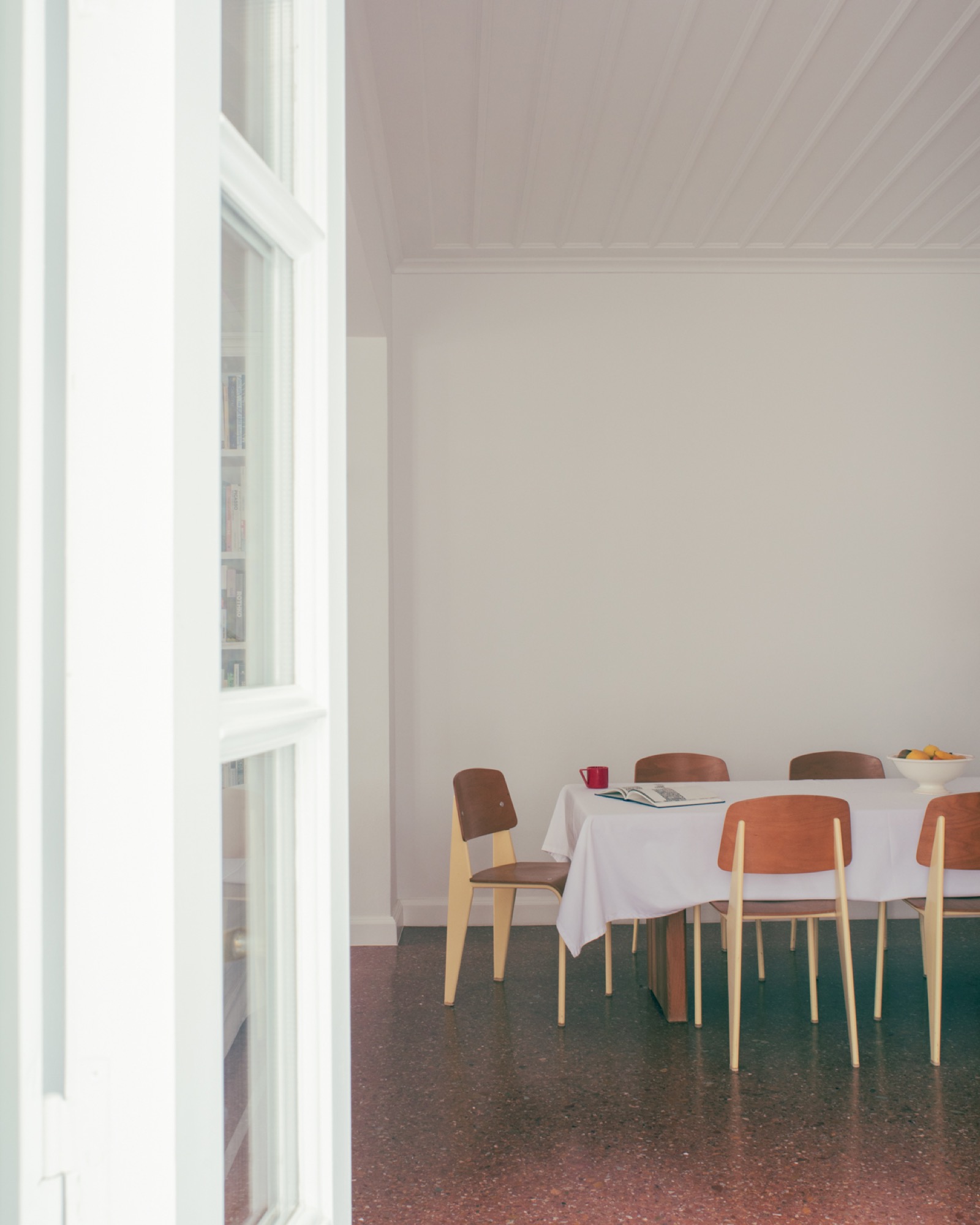
With limited window openings typical of the era, daylight became the project’s central constraint. Local Local responded with an almost entirely white, monochromatic palette across walls, ceilings, and built in joinery.
“We treated white as a tool,” says Xanthakou. “It lifts the light, it reduces visual noise, and it makes the rooms feel continuous.”

The courtyard was recalibrated in the same spirit. Overgrown trees were pruned and courtyard walls repainted, turning the garden into a lighter extension of the living space.
“In a house like this, the courtyard is not a backdrop,” she adds. “It’s part of the interior, especially when openings are small.”


Material choices keep the project anchored to the city. The ground floor was resurfaced entirely in terrazzo, a familiar Athenian interior material and a practical surface for everyday life. In the living room, a bold red terrazzo gives the home its most direct note of colour. In the kitchen and bathrooms, a lighter terrazzo with a soft grey tone reflects light in tighter spaces. Upstairs, flooring shifts to light grey solid oak, unifying private rooms with a contemporary grain.
“Terrazzo is Athens,” Xanthakou says. “It carries memory without feeling nostalgic. And it’s a surface that can take daily wear.”


Local Local worked closely with local makers, using bespoke joinery to connect classical proportions to modern needs. A local carpenter produced bookshelves, radiator covers, skirting, and built in details across the house. The existing staircase, previously dark timber, was repainted a soft grey to refresh vertical circulation, with new under stair storage integrated to reclaim space discreetly.
“We wanted the details to feel inevitable,” Xanthakou says. “Not decorative, not loud, but precise enough that you notice the care.”

The living room fireplace was rebuilt in green marble sourced from the island of Tinos, reintroducing a hearth as an anchor within the pale envelope. “Tinos marble has a particular depth,” she notes. “It grounds the room without dragging it back into heaviness.”

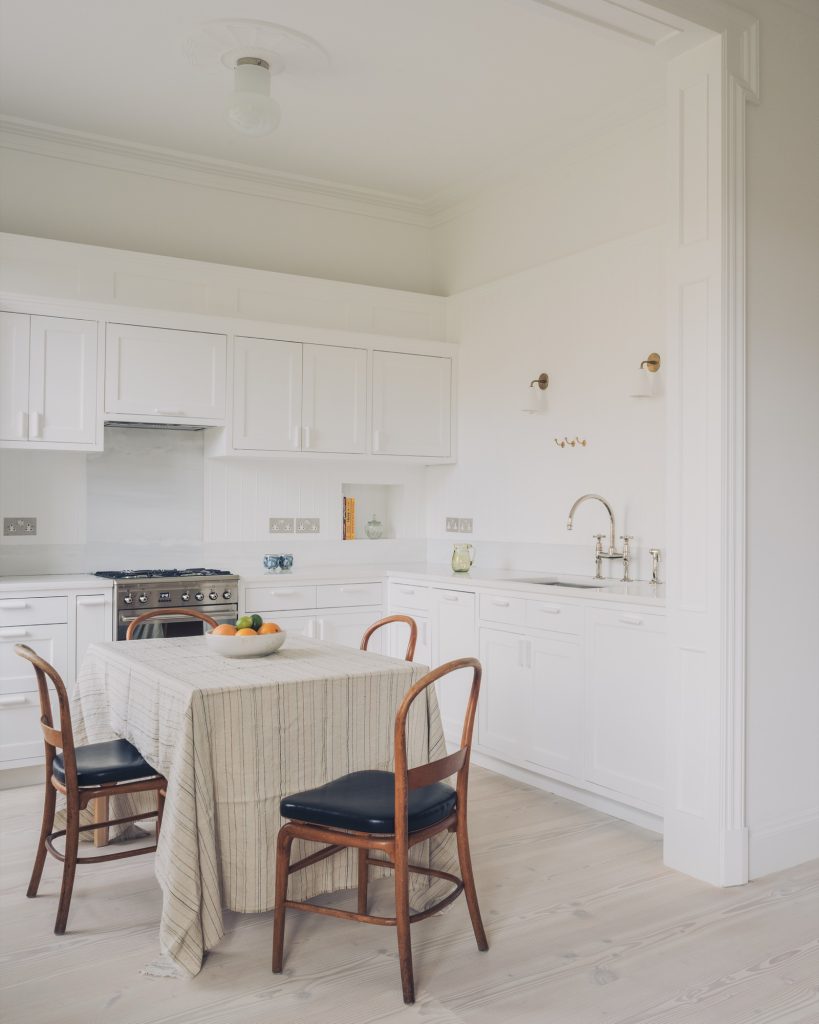
Rather than redraw the kitchen, the studio retained much of its layout and shifted its character through craft and colour. Cornices and cupboard curtains introduce softness, while furniture adds a more playful note, including a custom green hued table and bold red chairs designed by the studio. “The kitchen is where the house performs everyday life,” says Xanthakou. “We kept it practical, but we wanted it to carry personality.”
Original features were preserved where possible, from wrought iron exterior details to wooden panelled doors with marble jambs, repainted in neutral tones to align exterior and interior.


Plaka House demonstrates a particular kind of ambition: one that works within preservation rules but still shifts how a building feels to live in. Without theatrical structural moves, the renovation concentrates on the things that matter most day to day: light, surfaces, storage, and the calibrated presence of materials.
“It’s not about making the old look new,” Xanthakou shared. “It’s about making it liveable, with respect, and with joy.”
Project Credit
Location: Plaka, Athens, Greece
Completed: 2023
Architect: Local Local / @localocal_localocal
Photographer: Lorenzo Zandri
More Photos


Previous Post
Next Post
- The timeless elegance of domestic appliances: From the Iconic Braun KF 20 aromaster to the German design ethos

- Emilio Ferro on the light, sound and memory of a place
- At Maniwa, an architect’s family home opens to the neighbourhood
- What bronze remembers of the hand

- Caught in light: Moradavaga’s suspended shoal

- The making of Alex Chinneck’s impossible Dior windows