Now Reading: TAELON7 transforms unfinished structure in Accra into Limbo Engawa installation
- 01
TAELON7 transforms unfinished structure in Accra into Limbo Engawa installation

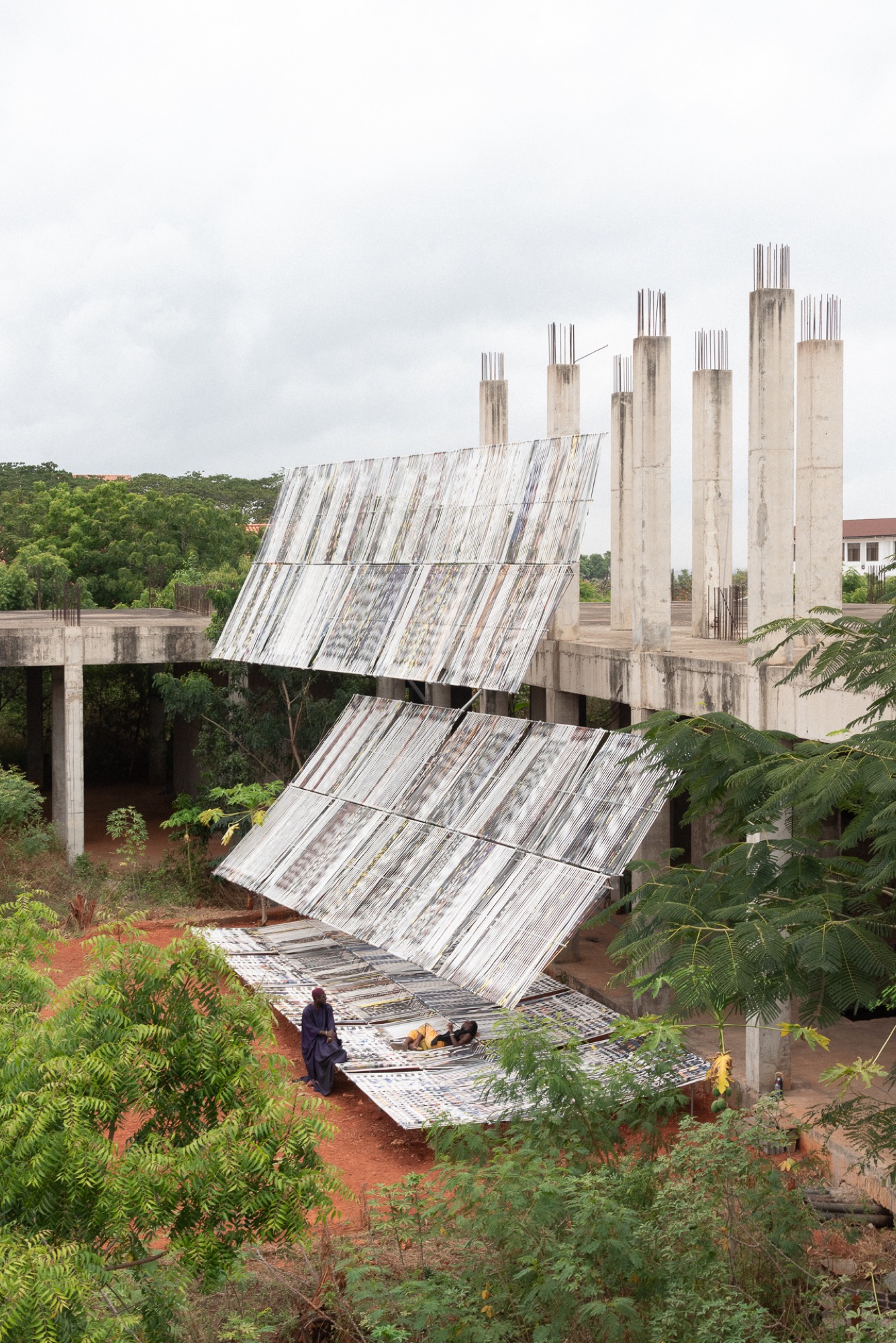

In Accra, within the skeletal frame of an unfinished concrete structure, architecture is neither complete nor abandoned. It exists in a state of suspension. Limbo Engawa, a site specific installation by TAELON7 led by architect Juergen Benson Strohmayer, engages precisely this condition, transforming a space of perceived absence into one of presence, care, and collective use. Presented by Limbo Museum in partnership with Art Omi, the project unfolds as both spatial intervention and cultural proposition, questioning how architecture might operate within the realities of rapid urbanization and informal development.

Limbo Engawa begins with a simple yet critical observation. In many cities undergoing accelerated growth, unfinished buildings and surrounding land are often dismissed as residual or unusable. Here, that assumption is overturned. The installation activates both the raw concrete frame of the museum and its adjacent terrain, constructing a continuous field where architecture, labor, and daily life intersect.


The project draws from the Japanese notion of engawa, a spatial threshold mediating interior and exterior, private and communal. In Accra, this concept is neither replicated nor translated literally. Instead, it is reinterpreted through a series of human scaled interventions that negotiate between monumental unfinished structures and the cultivated ground that surrounds them.


Rather than imposing a fixed form, the installation operates as a flexible system. Lightweight modular elements are assembled on site, allowing for adaptability and participation. Oversized daybeds, inspired by vernacular woven beds commonly found in unfinished buildings, become central devices within the project. They provide shade, frame views, and invite occupation, whether for rest, conversation, or observation.


Material choices reinforce this logic of reuse and openness. Steel profiles are combined with salvaged billboard strips, woven into structural frames that blur distinctions between construction and craft. The result is an architecture that is provisional yet precise, modest in means yet expansive in its social potential.
Limbo Engawa resists the idea of architecture as a static object. Instead, it positions itself as an infrastructural gesture, temporary, mobile, and inherently incomplete. In doing so, it foregrounds forms of labor and stewardship that often remain invisible within both urban and institutional contexts. Farmers, caretakers, and visitors become active participants, their presence shaping the space as much as its physical components.


This approach aligns with the broader ethos of Limbo Museum, an institution that embraces incompletion as a generative condition. The project does not resolve the unfinished. It inhabits it, demonstrating how overlooked spaces can become sites of civic possibility and cultural exchange.
The project extends beyond Accra through a second installation at Art Omi in upstate New York. Detached from its original host structure, Limbo Engawa is reconfigured as a freestanding pavilion within an open landscape. Here, the emphasis shifts. Instead of mediating between building and ground, the structure frames horizon, weather, and seasonal change, offering a shaded space for gathering within a rural context.


This dual manifestation does not produce a single traveling work but rather a dialogue between two sites. Each iteration responds to its environment while maintaining a shared architectural language. Together, they test how modular systems can adapt across climates, scales, and cultural conditions, revealing architecture as a practice of translation rather than replication.
At its core, Limbo Engawa proposes a shift in how architecture is understood and practiced. It suggests that the discipline can move beyond permanence and authorship toward processes of care, engagement, and reuse. By working within spaces that exist between completion and abandonment, the project opens a field of possibilities where architecture becomes a mediator of relationships rather than a finished product.
In this sense, Limbo Engawa is less about form than about condition. It is an architecture of thresholds, of moments in between, where new forms of collective life can emerge.


Project Credit
Project: Limbo Engawa
Architect: TAELON7 / @taelon7_, led by Juergen Benson Strohmayer
Commissioned by: Limbo Museum in partnership with Art Omi
Locations: Accra, Ghana and Ghent, New York, United States
Exhibition dates: March 12 to April 12 2026 in Accra, Fall 2026 in New York
Support: Austrian Cultural Forum in Accra
Photo: Edem Tamakloe / @edem_jpg, Juergen Benson-Strohmayer
More Photos